
Enterprise websites were built around a familiar assumption: users would know what to search, recognize the right page, read enough content, and eventually find the next step. That assumption is weakening.
Today's digital customer journey is increasingly non-linear, intent-driven, and shaped by expectations for immediate access to relevant information. Users evaluating products, services, programs, or technical solutions are often seeking answers that are accurate, contextual, verifiable, and directly aligned to their needs rather than a list of search results.
Most enterprises already possess extensive content assets, including product pages, resource centers, support content, policy documents, videos, webinars, knowledge bases, and technical documentation. The challenge is not content availability but content accessibility. These assets frequently reside across disconnected systems, making it difficult for traditional search experiences to connect user intent with the most relevant answer, supporting evidence, and next action.
Accenture's June 2025 consumer research found that 72% of consumers now interact with generative AI, while approximately half have made a purchase decision with generative AI support. Among active generative AI users, 83% rely on generative AI when choosing a product or service. [1]
Customers are learning to ask natural-language questions and expect synthesized guidance. If an enterprise website still behaves like a keyword index, it risks becoming a slower layer in the journey. Worse, customers may outsource their discovery to third-party AI tools that do not necessarily use the latest, approved, or brand-controlled information.
Deloitte's September 2025 Connected Consumer research reinforces the same pattern from a trust angle. Its study of about 3,500 US consumers found that consumers are embracing generative AI and digital tools, but they also want transparency, control, and data security as technology advances. [2]
For enterprise leaders, this creates a dual mandate: make discovery faster, but do not make it opaque. Customers want intelligent experiences, but they also want to understand where answers come from, how their data is used, and whether the experience is trustworthy.
That is where the Progress Software Corp asset becomes directly relevant. Progress's Websites Supercharged: Content Storage Transformed into an Answer Engine frames the shift clearly: generative search, powered by agentic retrieval-augmented generation, can turn website and content management system content into a trusted, contextual answer engine that accelerates customer journeys and unlocks the value of unstructured content. [7]
Generative Discovery is Becoming the New Journey Layer
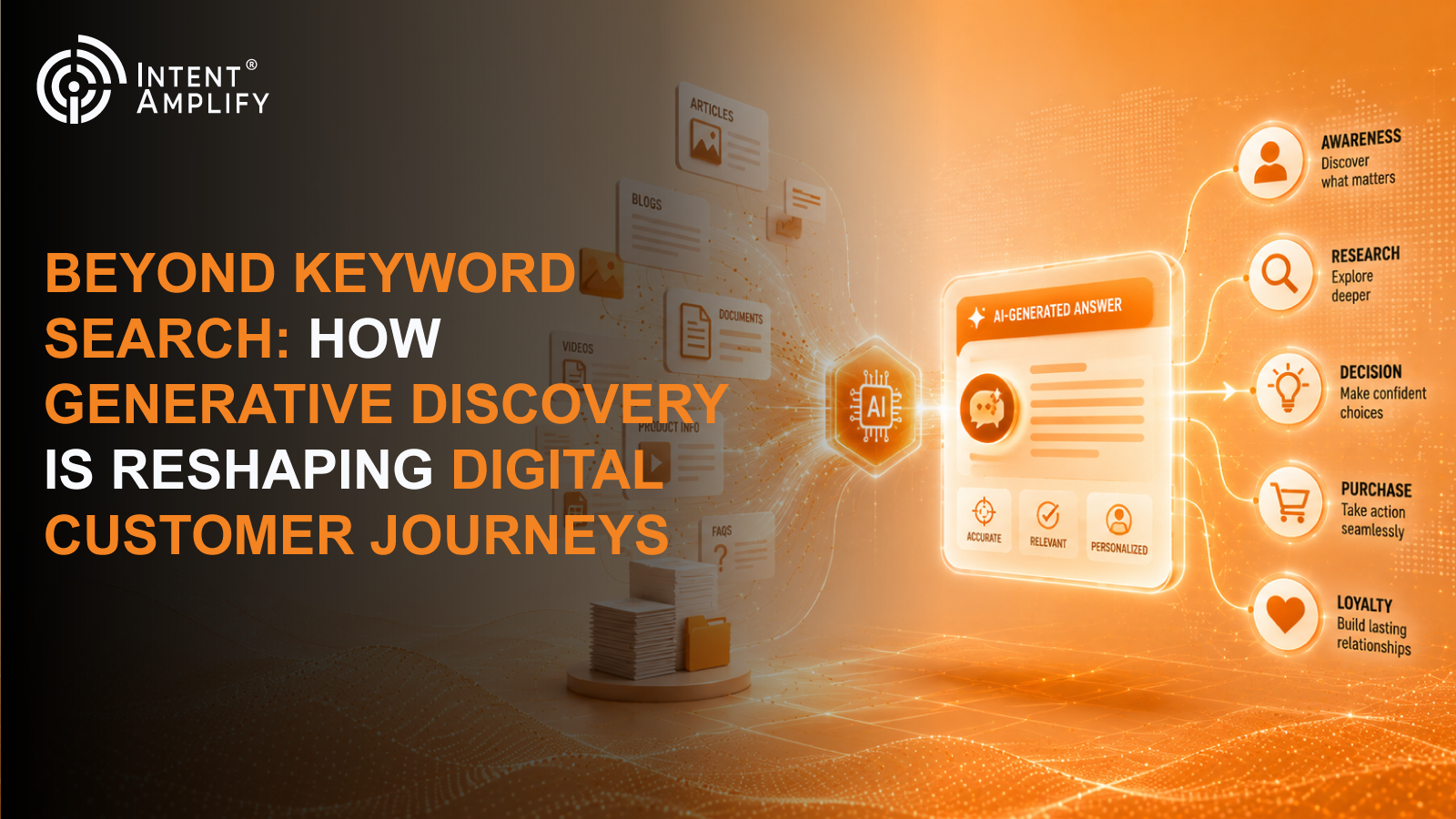
Generative discovery is not simply a smarter search bar. It is an experience layer that interprets intent, retrieves approved content, generates grounded answers, and guides the customer toward the next relevant step.
The distinction matters. Keyword search is reactive. It waits for users to type the right term. Generative discovery is contextual. It understands that a user asking, "Which plan is right for a mid-sized business with seasonal demand" may need product guidance, pricing context, implementation considerations, support information, and a call to action, not just a ranked list of pages.
Gartner's June 2025 research on customer service points to the same evolution. Gartner identified automation, AI assistants, and customer value creation as three trends that will transform customer service and support by 2028. It also reported that 51% of customers would be willing to use a generative AI assistant for customer service interactions on their behalf. [3]
That finding has major implications beyond service teams. As AI assistants become part of the journey, enterprises will increasingly need to serve both human visitors and AI-mediated visitors. Content must be structured, current, findable, and verifiable. Brand experience will not only be judged by page design; it will be judged by whether the organization can produce a trustworthy answer at the moment of intent.
McKinsey's October 2025 research on AI-powered next-best-experience capabilities highlights the commercial potential of more intelligent customer interactions. McKinsey reports that AI-powered next-best-experience programs can improve customer satisfaction by 15% to 20%, increase revenue by 5% to 8%, and reduce cost to serve by 20% to 30%. [4]
Generative discovery should be evaluated as a customer journey capability rather than a content feature. Organizations that connect content, context, and decision-making can transform websites from information repositories into guided engagement environments.
Many enterprises continue to manage search, content management, personalization, and customer support as separate operational functions. Customers, however, experience these capabilities as a single journey. Weak discovery experiences often create downstream consequences, including higher support demand, abandoned evaluations, lower content engagement, and reduced confidence in the provider's ability to address customer needs.
McKinsey's 2025 Global Survey on AI adds the enterprise adoption context. It found that 88% of respondents report regular AI use in at least one business function, yet most organizations remain in experimentation or pilot phases; only about one-third have begun scaling AI across the enterprise. McKinsey also found that 23% are scaling agentic AI somewhere in the enterprise, while another 39% are experimenting with AI agents. [5]
The message for CIOs, CMOs, and digital experience leaders is practical: AI adoption is broad, but scaled customer journey transformation is still early. That makes website discovery a high-value starting point. It is visible, measurable, content-rich, and directly tied to conversion, satisfaction, and operational efficiency.
Gartner's August 2025 forecast strengthens the urgency. Gartner predicts that 40% of enterprise applications will include task-specific AI agents by the end of 2026, up from less than 5% in 2025. [6]
If applications are becoming agent-enabled, websites and digital experience platforms cannot remain static. Discovery must evolve from keyword matching to intent recognition, source-aware retrieval, and answer generation.
Move from Search Results to Governed Answer Experiences
Enterprises should not respond to this shift by adding a generic chatbot to the homepage. That approach may create a novelty layer, but it does not solve the underlying discovery problem. The better path is to build a governed answer experience on top of trusted enterprise content.
The first requirement is content readiness. Organizations need to identify which sources are authoritative, current, audience-appropriate, and approved for customer-facing use. A generative discovery layer is only as reliable as the content it retrieves. This includes web pages, PDFs, technical documentation, product explainers, videos, support content, and knowledge articles.
Progress's eBook is useful here because it addresses the limitations of traditional content management systems and keyword search, including how they can bury valuable content and slow buying decisions. It also outlines how agentic RAG can ingest web pages, PDFs, videos, and more to surface citation-backed insights tailored to user intent. [7]
The second requirement is retrieval quality. Search must move beyond exact-match keywords. Progress describes its Agentic RAG solution as replacing link-based search results with precise, context-rich answers, allowing users to ask natural-language questions and receive the exact passage, timestamp, or snippet they need from across the content ecosystem. [8]
The third requirement is trust and transparency. Generative discovery should not produce unsupported claims. It should provide citations, logs, and source traceability so users and internal teams can verify the answer. Progress states that its Agentic RAG solution provides source citations, retrieval logs, and governance-ready audit trails, with outputs linked back to the exact sentence, paragraph, or timestamp used. [8]
Deloitte's 2025 data shows why this matters. Only 20% of surveyed consumers said tech providers are "very clear" about what data they collect or how it is used, and only 27% said they have high or very high trust that providers are keeping their data secure. At the same time, nine in 10 consumers believe tech companies should do more to protect data privacy and security. [2]
For digital leaders, that means answer engines must be designed around trust. The experience should feel intelligent but also explainable. It should reduce friction but not remove accountability.
The fourth requirement is journey orchestration. The most valuable generative discovery systems will not stop at answering a question. They will guide users toward the next useful action: compare options, book a demo, read a related guide, access documentation, contact support, or explore a tailored product path.
McKinsey's next-best-experience research offers a commercial proof point. In one telecommunications example, AI-driven personalization supported a 5% increase in incremental revenue, a 30% margin impact one year from launch, and click rates two to three times higher than traditional campaigns. [4]
This is where Progress's positioning should land for enterprise buyers: the value is not only better search. The value is better movement through the journey.
For CIOs, CMOs, digital experience leaders, and content strategy teams rethinking how customers find and act on information, Progress Software Corp's Websites Supercharged: Content Storage Transformed into an Answer Engine offers a practical starting point. The eBook shows how generative search and agentic RAG can transform existing website and CMS content into a trusted answer engine for faster, more relevant customer journeys. [7]
Turning Generative Discovery Interest into Qualified Engagement
At Intent Amplify, we connect enterprise technology narratives to buying-group behavior and market intent. The shift from keyword search to generative discovery sits at the intersection of customer experience, enterprise AI, content operations, digital commerce, service transformation, and revenue growth. For Progress Software Corp, this creates an opportunity to engage a diverse buying committee that includes CIOs, CMOs, digital leaders, content owners, and IT architects. Each stakeholder approaches the challenge from a different perspective, including search friction, content utilization, customer experience, governance, and digital transformation.
References
[1] Accenture (2025), Me, My Brand and AI: The New World of Consumer Engagement, published June 3, 2025.
[2] Deloitte (2025), 2025 Connected Consumer: Innovation with Trust, published September 25, 2025.
[3] Gartner (2025), Gartner Identifies Three Trends That Will Shape the Future of Customer Service, published June 25, 2025.
[4] McKinsey & Company (2025), Next Best Experience: How AI Can Power Every Customer Interaction, published October 9, 2025.
[5] McKinsey & Company (2025), The State of AI in 2025: Agents, Innovation, and Transformation, published November 5, 2025.
[6] Gartner (2025), Gartner Predicts 40% of Enterprise Apps Will Feature Task-Specific AI Agents by 2026, published August 26, 2025.
[7] Progress Software Corp (2026), Websites Supercharged: Content Storage Transformed into an Answer Engine.
[8] Progress Software Corp, Progress Agentic RAG: Generative Search and AI Quality & Trust.