
logo
logo
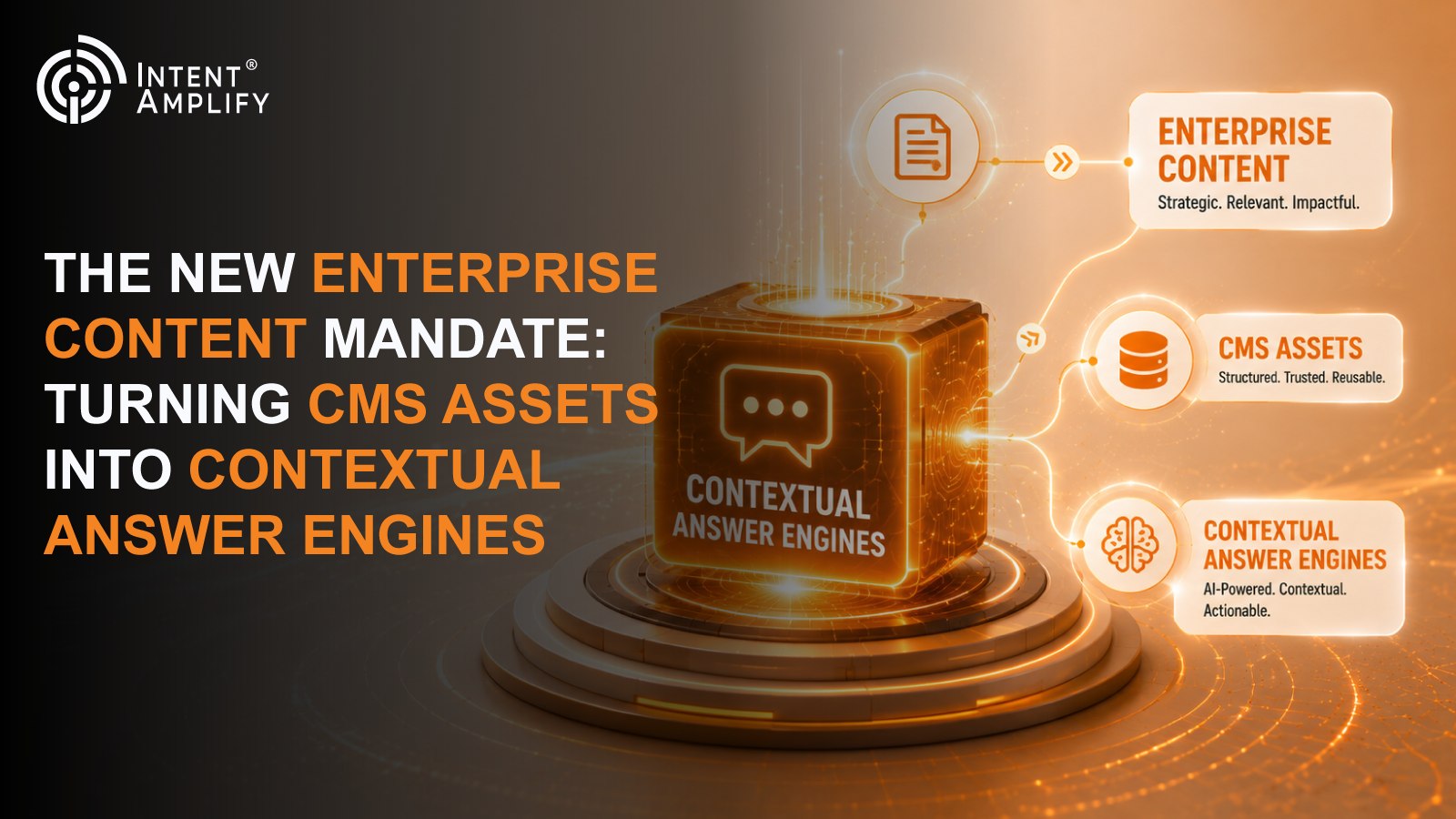
The New Enterprise Content Mandate: Turning CMS Assets into Contextual Answer Engines

NEWSLETTER

The New Enterprise Content Mandate: Turning CMS Assets into Contextual Answer Engines

Learn how enterprises can transform CMS assets, PDFs, videos, and knowledge repositories into trusted contextual answer engines powered by AI and Agentic RAG.

A member looking for certification requirements should not have to open six PDFs, three archived webinar pages, a policy update, and a half-forgotten portal thread to find out which answer still applies. A prospective member comparing benefits should not need to guess whether a website page, annual report, event recording, or three-year-old resource guide contains the clearest explanation. A member trying to solve a common issue should not be sent into a content maze just because the association technically "has the information."

Yet that is often how enterprise websites behave.

The content exists, usually in alarming quantities. Membership guides, certification resources, event pages, webinar recordings, policy updates, research reports, advocacy content, newsletters, FAQs, community discussions, learning materials, committee documents, and PDFs continue to accumulate across the CMS, member portal, LMS, archive, and surrounding systems. The problem is not that enterprises have nothing to say. It is that users cannot reliably get the right approved answer without digging through the entire content estate.

Coveo's 2025 CX research puts numbers behind that frustration: 84% of customers said they struggle to get relevant help, and 53% cited website search difficulties as their biggest self-service frustration. The painful part is that users often know the answer probably exists somewhere. The information often exists, but users struggle to locate it efficiently. For digital experience, CX, product, content, and IT leaders, that friction shows up as more than poor search performance. It appears as abandoned sessions, repeated support questions, low content engagement, frustrated users, duplicated content requests, and teams manually guiding people to answers that should have been self-service. For AI, data, and engineering leaders, the same problem becomes an architecture challenge: how to turn approved enterprise content into trusted, contextual answers without creating another brittle custom system. 1

The CMS did its job. Digital expectations changed.

The traditional CMS was built for a different digital era. It helped organizations create, approve, organize, localize, and publish content at scale. That remains valuable. Publishing at enterprise scale requires coordination across brand, legal, product, and regional stakeholders.

But publishing is only one part of the experience now.

Users increasingly arrive with specific questions. They want to compare, validate, troubleshoot, configure, integrate, evaluate, or understand what applies to their situation. They are not always looking for "content" in the broad sense. They are looking for a trusted answer that fits their context, role, product, stage, region, permissions, and intent.

That changes the role of CMS assets. A page, document, or article is no longer only an endpoint in a browsing journey. It can become source material for AI-powered discovery, website search, support assistance, buyer education, and internal enablement. The CMS remains the place where approved content lives, but the value of that content depends on whether it can be retrieved, understood, and applied.

Gartner's 2025 forecast shows how aggressively enterprises are moving toward AI-enabled systems: worldwide generative AI spending is projected to reach $643.9 billion in 2025, up 76.4% from 2024. Gartner also noted that CIOs are expected to lean more toward commercial off-the-shelf GenAI solutions instead of building everything themselves when predictable value matters.2

Before the answer engine, clean up the knowledge sources

Generative AI does not rescue a messy content estate. It exposes it.

If the CMS, portal, documentation hub, support knowledge base, DAM, CRM, or archive contains duplicate pages, outdated PDFs, inconsistent metadata, unclear ownership, conflicting claims, stale webinars, or regionally vague guidance, an answer engine will inherit those problems. Worse, it may repackage them in confident language. That is not a transformation. Generative systems can amplify existing content-quality issues when governance and source management are weak.

The practical work starts with making CMS assets easier for both people and AI systems to interpret. That means content needs clear metadata, canonical source pages, structured fields, lifecycle status, topic and product tags, language and regional markers, and defined ownership. Teams also need to retire or deprecate outdated material instead of letting it remain searchable forever allowing outdated material to remain discoverable can introduce compliance and trust risks.

This is not glamorous work. It is also where most of the answer quality is decided.

McKinsey's 2025 State of AI research shows the gap between AI usage and AI maturity. 88% of organizations now use AI regularly in at least one business function, but only about one-third have begun scaling AI across the enterprise, and 23% are scaling agentic AI systems somewhere in the organization. The takeaway is simple enough: adoption is common; disciplined execution is not.For AI, data, and IT leaders, disciplined execution means more than connecting a model to a content index. It means defining source authority, metadata rules, permissions, evaluation methods, refresh cycles, cost controls, and accountability for answer quality before the system becomes part of the customer or employee experience. .3

Where RAG earns its keep

Retrieval-Augmented Generation, or RAG, gives generative AI a way to answer from approved enterprise sources instead of relying only on the model's general knowledge. In a CMS-led environment, this means a system can retrieve relevant product pages, documentation, support content, policy material, whitepapers, FAQs, and knowledge base articles before producing an answer.

Enterprise users require responses that are accurate, traceable, and grounded in approved sources.

For example, if a healthcare technology buyer asks which deployment model supports regulated workflows, the answer should not be stitched together from a random mix of old marketing pages and generic AI assumptions. It should pull from approved product documentation, compliance-related content, regional rules where relevant, and the most current implementation guidance. Ideally, it should also show where the answer came from.

Forrester's 2025 AI predictions add a useful caution: three out of four firms attempting aspirational agentic architectures on their own are expected to fail. That does not mean enterprises should avoid custom development. It means they should be careful about rebuilding complex infrastructure unless that work creates a real strategic advantage.4

Explore how agentic RAG can transform website and CMS content into a trusted answer engine, helping organizations turn scattered pages, PDFs, videos, and digital assets into contextual, citation-backed answers that improve search, speed up content discovery, and create smarter website experiences.

Search is no longer just "site functionality."

Website search used to be easy to ignore until it broke. Now it affects buyer education, customer support, partner experience, developer enablement, and internal knowledge reuse.

A weak discovery experience does not always announce itself loudly. It appears as abandoned sessions, repeated support questions, low content engagement, duplicated content requests, poor self-service, and sales teams sending prospects the same explanation manually because the website somehow cannot.

Michelle Adams, President of Field Operations, Algolia, remarked: "Amid economic uncertainties, the B2B ecommerce sector is harnessing the power of AI search and discovery to elevate customer experience and drive business growth. Our findings show that 67% of respondents are not only excited about AI technology, but also believe we've passed the hype stage. AI search has now become a foundational requirement for any B2B ecommerce strategy.".5

The bigger value case cuts across functions. McKinsey has estimated that around 75% of generative AI's total annual value may come from customer operations, marketing and sales, software engineering, and R&D. Those areas all depend on accurate, reusable, findable enterprise knowledge.The same content foundation can improve customer journeys, product education, campaign performance, support self-service, partner enablement, and internal productivity. The opportunity is not simply to publish more assets. It is to make existing knowledge easier to find, trust, reuse, and apply across digital experiences. In other words, the same content foundation can support customer answers, sales conversations, product education, developer guidance, and internal workflows if it is structured and governed properly.6

The trust problem arrives early

Some teams treat governance as a later phase. Delaying governance introduces unnecessary operational and compliance risks.

A contextual answer engine has to figure out what's legit, check if the info is up to date, spot its location, see who can view it, and decide when not to answer. This isn't about fancy features; these parts ensure the responses help instead of hurt.

In tightly controlled areas like finance or healthcare, handing out incorrect info can create major problems - it could break rules, confuse customers, or damage your reputation. So from the start, it's critical to have things like checked sources, permission checks, update logs, activity tracking, proper workflow processes, and thorough reviews for tricky topics.

Forrester reports that by 2026, 75% of tech decision-makers believe AI will make things more complex and increase technical debt. Even though teams might ace small projects, the whole company ends up dealing with a bunch of different tools and systems. While initial results look good, the result is frequently increased complexity, fragmented tooling, and higher technical debt. 7

The operating model is not optional

This work cannot sit with one team.

Content teams know source quality, ownership, and lifecycle. Search teams understand relevance. AI teams handle retrieval, prompts, orchestration, and evaluation. Architects deal with integration and scale. Security and compliance define access and risk boundaries. Digital experience teams know how users move through the site. Analytics teams show whether any of this is improving outcomes.

When those groups do not coordinate, the answer engine may still launch. It just may retrieve stale content, ignore permissions, overuse weak sources, or answer questions nobody important is asking. Enterprise software could never ship something questionable with confidence.

O'Reilly's 2025 technology trends report shows how quickly the skills market is moving: prompt engineering grew 456%, AI principles grew 386%, and generative AI grew 289% as learning topics, with rising attention around LangChain and RAG-related skills. The talent side is shifting toward retrieval-oriented AI. The operating model now has to catch up.8

For enterprise leaders, that means defining practical rules: which content can be indexed, how often it refreshes, what metadata is mandatory, how answers are evaluated, when human review is required, how permissions are enforced, and which business metrics matter.

Build where the business is different. Buy where the plumbing is not.

There is no clean universal answer to build versus buy. Enterprises usually need both.

It makes sense to build where the organization has real differentiation: industry-specific workflows, content models, retrieval policies, user experience, compliance logic, and integrations tied closely to the business. It makes less sense to custom-build every connector, parser, index, monitoring layer, permission system, and evaluation workflow unless the company is prepared to maintain that stack over time. Long-term maintenance requires budget, ownership, documentation, and dedicated operational resources.

This is where Progress Software can sit naturally in the discussion. Sitefinity supports the CMS and digital experience layer. MarkLogic brings capabilities around complex enterprise data, semantics, and governance. Progress Agentic RAG connects to the production answer layer. For content produced by Intent Amplify on behalf of Progress, the stronger message is not "buy a tool because of AI." It is that enterprises need a practical way to connect approved content, retrieval, governance, and answer delivery without rebuilding every technical layer from scratch.

The new enterprise content mandate is not dramatic for the sake of drama. It is practical: help users get the right approved answer without forcing them to search through the entire content estate.

Enterprise websites do not need to become AI showcases. They need to become better at using what the organization already knows. That is less flashy than most AI promises, which is probably why it is more useful.

Looking to bring research-led content to the right enterprise technology buyers? Intent Amplify helps B2B technology brands support demand generation, lead generation, and campaign execution for targeted professional audiences. Visit Intent Amplify's Contact Us page to start a conversation.

https://intentamplify.com/contact-us/

References

  1. Coveo -- Coveo CX Relevance Report Reveals 84% of Customers Struggle to Find Relevant Information Online -- 2024
  2. Gartner -- Gartner Forecasts Worldwide GenAI Spending to Reach $644 Billion in 2025 -- 31 March 2025
  3. McKinsey & Company -- The State of AI -- 2025
  4. Forrester -- Predictions 2025: Artificial Intelligence -- 2025
  5. Algolia -- AI Search Is Critical in B2B Ecommerce Strategy, but Adoption Varies -- 2025
  6. McKinsey & Company -- The Economic Potential of Generative AI: The Next Productivity Frontier -- 14 June 2023
  7. Forrester -- Forrester Predictions 2025: Tech & Security -- 2025
  8. O'Reilly Media -- O'Reilly Technology Trends for 2025 -- 2025
Prabhanshi   Singh

Prabhanshi Singh

Research Analyst

Contact Us