
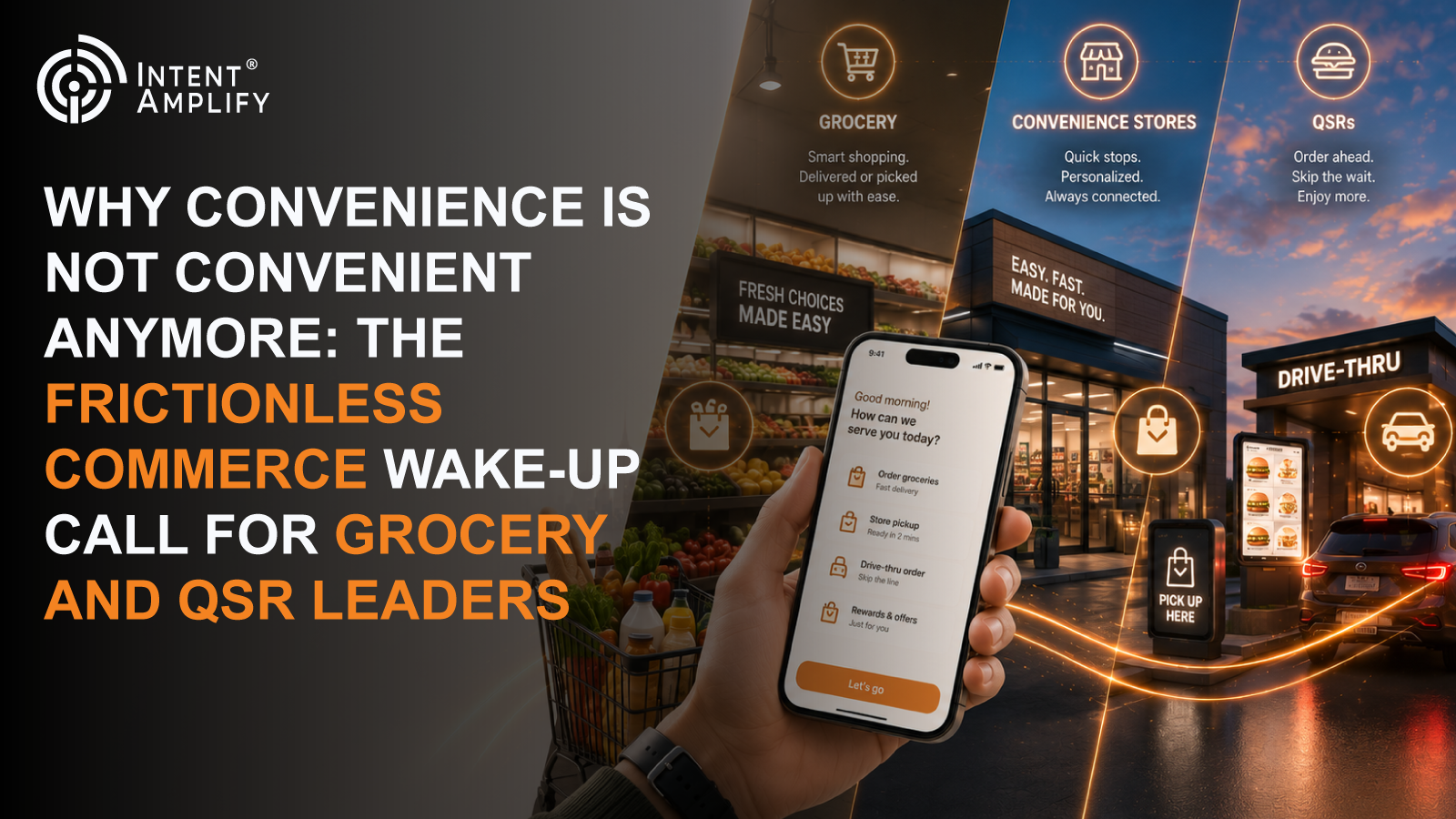
RETHINK Retail brings this intelligence to grocery, convenience, and quick service restaurant leaders through Retail Technology Intelligence, where operators, CIOs, CTOs, store technology executives, and customer experience leaders can evaluate the market signals, technology shifts, and operating pressures now shaping the future of retail.
Convenience once meant proximity, product availability, and a fast checkout experience, although today’s shopper measures convenience against the best digital interaction they had earlier in the day. A grocery customer who can reorder household essentials in seconds will not understand why checkout friction still slows a basic basket, while a QSR guest who can customize a mobile order will question why an in-store self-service kiosk cannot handle a common modifier without staff assistance.
RETHINK Retail’s The Frictionless Frontier: Why Grocery, Convenience, and QSR Need a Reset argues that friction has become a commercial performance issue because every delayed transaction, manual override, abandoned basket, and disconnected journey now affects revenue, labor efficiency, and loyalty. The report’s value is its practical focus: it does not treat frictionless retail as a futuristic concept, but as a near-term operating requirement for leaders managing store operations, transaction speed, customer experience, and digital retail strategy.
The Convenience Promise Is Under Pressure
Consumers still value physical retail, but they increasingly expect stores to behave with the speed and intelligence of digital commerce. IBM and the National Retail Federation’s Own the Agentic Commerce Experience found that 72% of consumers still shop in stores, confirming that the physical channel remains commercially vital even as artificial intelligence begins shaping product discovery before customers reach the aisle, counter, or kiosk.²
The same research found that 41% of consumers use AI assistants to research products, 33% use them to look for reviews, and 31% use them to search for deals.²
For grocery, convenience, and QSR leaders, those numbers signal a deeper shift: customers are arriving more informed, less patient, and more likely to judge retail technology platforms by whether they remove effort from the journey.
Unified commerce has become an operational requirement across search, loyalty, ordering, checkout, pickup, and post-purchase engagement. The customer journey now moves across search, loyalty, mobile ordering, in-store browsing, payments, pickup, returns, and post-purchase engagement, which means platform unification, POS integration, and checkout automation must work together if retailers want to reduce friction across the full experience.
KEY FIGURES AT A GLANCE
Consumer behavior is already pointing toward a more automated front end, with 84% of consumers preferring self-service kiosks, kiosk deployments driving 30% higher ticket sizes, and AI age estimation reducing human intervention by 75% in regulated product journeys.¹
Physical stores remain central, with 72% of consumers still shopping in stores, yet AI is changing how those visits begin because 41% of consumers use AI assistants to research products, 33% use them to look for reviews, and 31% use them to search for deals. Trust remains a constraint on personalization, as 52% of consumers are comfortable sharing data, while 83% still express concerns about privacy, misuse, or unwanted marketing.²
Retail executives are preparing for growth while demanding clearer technology returns, with 96% of global retail executives surveyed by Deloitte expecting industry revenues to grow in 2026 and 81% expecting margin expansion. The same outlook found that 88% of retail executives believe retail media networks will be crucial for revenue and profitability, while 30% of retailers currently use AI for supply chain visibility, and that share is expected to rise to 41% within the next year.³
Store operations remain under strain, with 87% of retail leaders in Zebra Technologies’ 18th Annual Global Shopper Study citing generative AI as important to loss prevention, in-store shopper satisfaction declining to 79%, online shopper satisfaction declining to 73%, and 88% of retail associates reporting difficulty obtaining timely assistance or information, up from 82% the previous year.⁴
Security must be central to the frictionless commerce conversation, particularly as AI, since 99% of organizations have encountered an attack on an AI system in the past year.⁵
Why Checkout Friction Has Become a Growth Risk
Checkout friction is often treated as a store operations nuisance, but it increasingly behaves like revenue leakage. When a customer waits for an associate intervention, repeats an order, abandons a kiosk flow, or moves between disconnected systems, the brand is asking that customer to absorb the cost of outdated architecture.
The most important insight from RETHINK Retail’s report is that convenience cannot be fixed through one isolated upgrade. Grocery, convenience, and QSR journeys depend on the coordination of point of sale integration, checkout automation, workforce efficiency, age verification software, loyalty data, and store operations. A manual age check may seem minor in one transaction, yet across a high-volume convenience environment, it can become a recurring labor drain that slows customer flow and weakens retail throughput.
Friction rarely originates in a single device. It typically emerges between disconnected systems, workflows, and customer touchpoints. It usually hides between systems, which is why unified retail architecture should be treated as a strategic growth priority rather than a technology cleanup project.
Self-Service Is Becoming a Revenue Engine
The commercial case for self-service kiosks has strengthened because the technology can now do more than reduce queues. When designed around real customer behavior, self-ordering kiosks can guide decisions, improve order accuracy, present add-ons, support loyalty engagement, and create structured upsell moments that are difficult to deliver consistently during rushed counter interactions.
RETHINK Retail’s finding that kiosk deployments can drive 30% higher ticket sizes gives operators a stronger reason to evaluate kiosk technology as a revenue lever rather than only a labor-saving tool.¹
For QSR and convenience leaders, digital ordering creates more room for personalization without increasing pressure on associates. A self-service interface can suggest a combo, surface a promotion, or prompt a loyalty redemption while the associate remains focused on food quality, fulfillment, and service recovery.
Deloitte’s finding that 88% of retail executives view retail media networks as crucial to revenue and profitability also changes the front-end conversation.³
When ordering systems, loyalty data, promotions, and media opportunities connect, the store becomes more than a transaction point. It becomes a measurable commercial platform.
Labor Pressure Makes Automation a Leadership Issue
Retail labor shortage concerns continue to shape grocery, convenience, and QSR strategy, although the strongest automation strategy is not about removing people from the store. It is about removing avoidable interventions so associates can spend more time on service, replenishment, pickup coordination, food quality, and exception handling.
If AI age estimation can reduce human intervention by 75%, the benefit extends beyond faster checkout because it allows employees to stay focused on higher-value work.¹
Zebra’s finding that 88% of retail associates struggle to obtain timely assistance or information suggests that frontline teams are often expected to move faster without enough technology support.⁴
Zebra Technologies specializes in smart data capture and automation solutions, including barcode and RFID systems, rugged mobile computing, scanning, location-tracking technologies, machine vision, and enterprise software.
A better automation strategy combines customer flow management, workforce efficiency, labor automation, and store process optimization in ways that make associates more capable rather than more exposed.
Security, Trust, and Loss Prevention Cannot Be Added Later.
Frictionless commerce cannot succeed if customers, operators, and regulators lose confidence in the systems that enable it. As stores become more connected, every self-checkout lane, kiosk, mobile order, loyalty prompt, and AI-enabled workflow creates data movement that must be governed carefully.
IBM and NRF’s finding that 52% of consumers are comfortable sharing data, while 83% still worry about privacy and misuse, should remind retailers that personalization needs a clear value exchange.²
Zebra’s finding that 87% of retail leaders view generative AI as important to loss prevention reinforces the same point from an operational angle.⁴
Palo Alto Networks’ finding that 99% of organizations have encountered an attack on an AI system adds a cybersecurity warning that AI checkout, computer vision retail systems, cloud-connected POS platforms, and automated checkout technologies must be secured as part of the operating model.⁵
What RETHINK Retail Brings to the Conversation
RETHINK Retail is positioned for this moment because it helps retail leaders interpret how customer expectations, retail innovation, store modernization, frictionless checkout, and commerce platform strategy are converging. The Frictionless Frontier provides grocery, convenience, and QSR executives with a framework for identifying operational friction, evaluating self-service opportunities, and improving front-end performance.
For operators navigating the future of retail, the report encourages a disciplined friction audit across the full customer journey, including transaction speed, POS integration, labor automation, self-checkout security, retail shrinkage reduction, and platform unification.
Download The Frictionless Frontier: Why Grocery, Convenience, and QSR Need a Reset
RETHINK Retail’s report gives grocery, convenience, and QSR leaders a practical framework for evaluating where friction is reducing revenue, slowing associates, and weakening customer experience across the front end.
About Intent Amplify
Intent Amplify helps organizations move from market insight to measurable growth through GTM strategy, demand intelligence, pipeline activation, executive roundtables, sponsored research, targeted content, webinars and panels, vendor intelligence, and strategic consulting. For teams that need sharper positioning, stronger executive engagement, and more effective activation, Intent Amplify connects strategy, content, and market intelligence into a practical growth engine.
Executive Takeaway
Convenience is increasingly measured by the effort required to complete a transaction across ordering, payment, pickup, loyalty, compliance, and service recovery. The operators that win this phase will not simply add more technology to the store environment. They will remove unnecessary effort while making every customer interaction easier to complete, easier to secure, and easier to monetize.
References
- RETHINK Retail and IntentTechPub (2026) The Frictionless Frontier: Why Grocery, Convenience, and QSR Need a Reset. Available at: https://intenttechpub.com/report/the-frictionless-frontier-why-grocery-convenience-and-qsr-need-a-reset/
- IBM and National Retail Federation (2026). Own the Agentic Commerce Experience. Available at: https://nrf.com/research/own-the-agentic-commerce-experience
- Deloitte (2026) 2026 Retail Industry Global Outlook. Available at: https://www.deloitte.com/us/en/insights/industry/retail-distribution/retail-distribution-industry-outlook.html
- Zebra Technologies (2025) 18th Annual Global Shopper Study. Available at: https://investors.zebra.com/news-and-events/news/news-details/2025/Zebra-Study-87-of-Retailers-Believe-Gen-AI-to-Have-Significant-Impact-on-Loss-Prevention/default.aspx
- Palo Alto Networks (2025) State of Cloud Security Report 2025. Available at: https://www.paloaltonetworks.com/state-of-cloud-native-security