
logo
logo
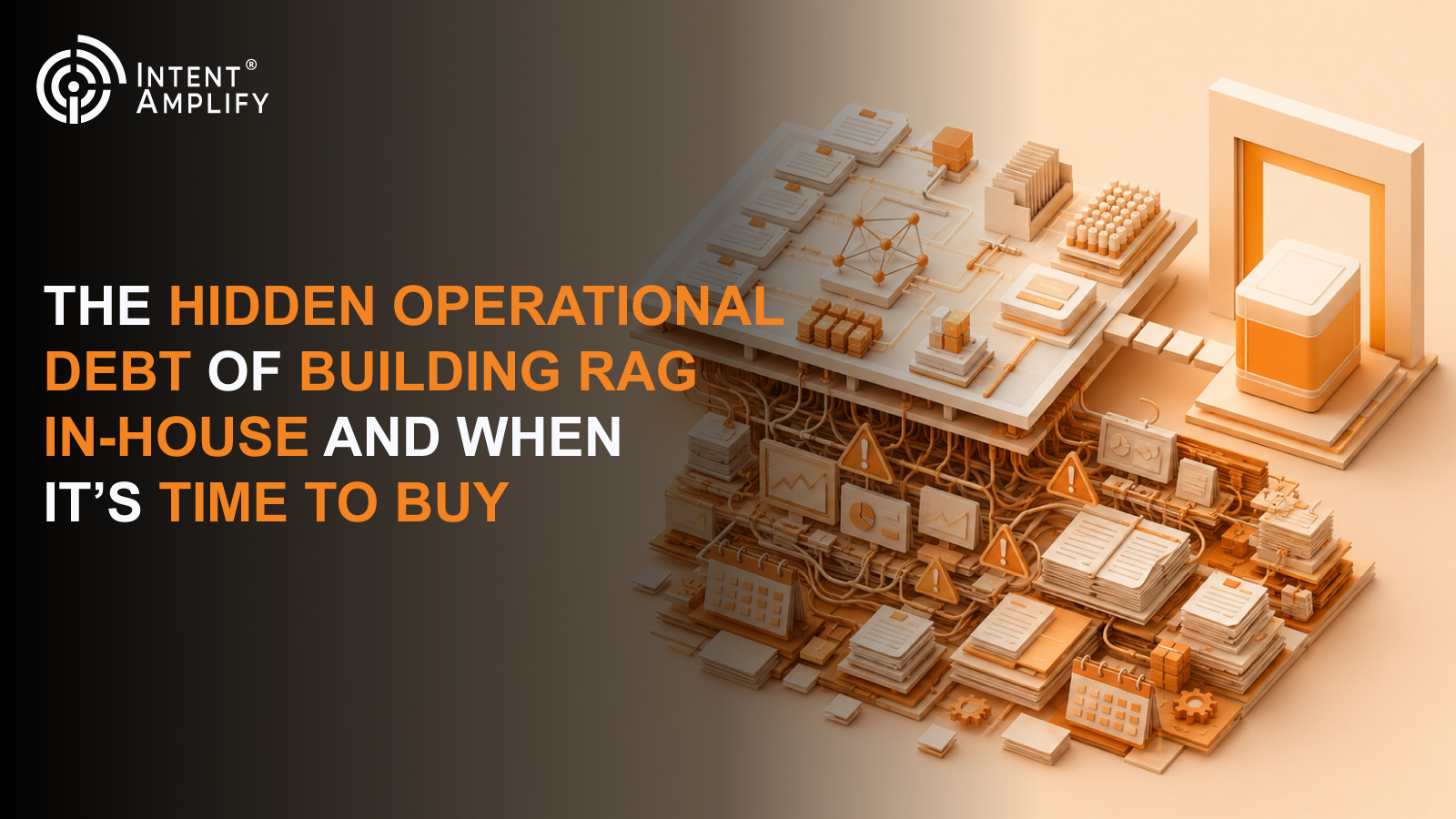
The Hidden Operational Debt of Building RAG In-House and When It’s Time to Buy

NEWSLETTER

The Hidden Operational Debt of Building RAG In-House and When It’s Time to Buy

Discover why DIY RAG projects become expensive at enterprise scale, how operational debt accumulates, and when a governed RAG-as-a-Service platform becomes the smarter long-term choice.

The first RAG prototype usually feels lighter than it should.

A team picks a narrow use case, maybe internal policy search. Maybe support knowledge. Maybe product documentation. They connect a language model to a controlled set of documents, add retrieval, test a few questions, and the system responds with answers that sound useful and cite sources that look reassuring.

The content is clean. The users are limited. The permissions are simple. The questions are mostly predictable because the pilot team already knows what to test. Nobody has asked it to deal with a half-retired SharePoint library, a duplicated HR policy, or the "temporary" folder from a migration that somehow became permanent, because enterprise systems have a deep spiritual commitment to clutter.

Then the pilot works.

That is when the trouble starts.

Not because the team failed, but because success changes the job. A working prototype invites expansion. Expansion invites more repositories, more users, more permissions, more review requirements, more exceptions, and more people asking why the answer changed since last Tuesday.That is the moment an AI experiment starts behaving like a platform responsibility. What began as a useful assistant now needs source governance, access control, monitoring, evaluation, cost visibility, and a clear operating model.

McKinsey's The state of AI in 2025: Agents, innovation, and transformation found that 88% of organizations report regular AI use in at least one business function, but only about one-third have begun scaling AI across the enterprise.1

That gap is where in-house RAG starts to get expensive. The prototype proves that the idea can work. It does not prove that the organization is ready to operate it.

A Small Example, Because This Is Where the Mess Lives

Imagine a compliance team building an internal assistant for policy questions.

During the pilot, the assistant searches one approved folder. The documents are current. Someone has checked them. The access rules are boring, which is a compliment in governance work.

Three months later, the assistant is connected to more sources. SharePoint. OneDrive. Regional team folders. A training repository. An archive created during a system migration.

Now, a user asks about an anti-money laundering procedure. The assistant finds a strong match in the archive, not the official library. The answer is cited. It looks defensible. It is also based on an outdated document.

Another user asks a similar question but gets a different answer because their department has access to a copied regional version. That version was created for training, edited slightly, and never marked as non-authoritative.

The pipeline simply did what it was allowed to do: retrieve from messy enterprise content. This is especially familiar to data and platform teams working across websites, document stores, collaboration tools, CRM systems, ticketing platforms, databases, and internal applications. Enterprise knowledge rarely lives in one clean repository. It is distributed, duplicated, permissioned differently, and updated at uneven speeds. A RAG architecture has to work inside that reality, not inside the tidy diagram from the pilot deck.

That is operational debt. Not a bug you fix once, but the steady accumulation of small obligations the prototype made easy to ignore.

The Things You End Up Owning

An in-house RAG system is not just a model connected to documents. It is a chain of decisions that needs to keep being correct. For AI engineering, data engineering, MLOps, and architecture teams, every one of those decisions becomes an ownership question: should this be custom-built, governed internally, automated through platform capabilities, or handled by a vendor because it adds more maintenance than differentiation?

Which sources are included? How often do they refresh? What happens when permissions change? Who reviews stale content? Which metadata fields actually matter? How do you know a retrieved passage is enough to answer the question? Where are logs stored? Who gets to audit them? What happens when two sources disagree?

The engineering team may start with ingestion and retrieval, but the ownership expands quickly. Connectors need maintenance. Indexes need rebuilding. Chunking strategies need adjustment because contracts, support articles, product manuals, engineering runbooks, and policy documents do not behave in the same way. Access controls have to travel from source systems to the retrieval. Evaluation has to become repeatable, observable, and version-aware. This is where technical leaders feel the real tradeoff. Business teams want faster answers from enterprise knowledge, but engineering leaders have to balance answer quality, governance, system integration, latency, and cost. A RAG system that works beautifully for one curated repository may become fragile when it has to support multiple departments, role-based access, changing content, and production-level expectations.

And then there is metadata, the small swamp at the center of many enterprise AI projects.

A document can be current but poorly tagged. A source can be trusted but incomplete. A file can be accessible but not appropriate for the question. A page can be outdated but still rank highly because the wording is perfect.

Microsoft's Copilot and SharePoint governance guidance emphasize identifying overshared, inactive, ownerless, or poorly governed content before AI retrieval expands across collaboration environments.

That point matters beyond Microsoft environments. AI does not fix weak information governance. It reveals it at speed.

Retrieval Can Be Wrong Without Looking Wrong

One reason RAG debt is hard to spot early is that the system often fails politely.

It does not always hallucinate wildly. Sometimes it gives a sensible answer from the wrong source. Sometimes it retrieves content that is related but incomplete. Sometimes it answers a question it should have refused. These failures look professional enough to be trusted, which is precisely the problem.

The paper Sufficient Context: A New Lens on Retrieval Augmented Generation Systems found that RAG systems often fail because retrieved context is insufficient, not merely irrelevant. The study found that guided abstention improved correctly answered responses by 2% to 10%.2

That is a useful reminder for enterprise teams. More retrieval is not automatically better retrieval. A larger index does not guarantee better judgment. A better model does not know that the "approved" policy sits in one library while a more textually similar but outdated version sits somewhere else. At scale, quality control becomes its own workload. You need test sets. You need source comparisons. You need regression checks when documents change.

The Budget Starts Leaking Through People

Infrastructure costs are visible. Engineering distraction is harder to measure, but often more damaging. For a VP of Engineering or Director of Data Engineering, the concern is not only token spend or vector database cost. It is whether scarce senior engineers are spending their time building differentiated AI capabilities or repeatedly solving connectors, permissions, indexing failures, stale content, and evaluation workflows that every production RAG system eventually needs.

When teams talk about DIY RAG cost, they often start with infrastructure: vector databases, storage, tokens, compute, and orchestration. Fine. Those matters.

But the higher cost often shows up in calendars.

A platform engineer spends two days figuring out why a connector skipped a batch of files. A data steward has to clean ownership fields that were never maintained. A security architect joins another review because permission synchronization is "nearly real-time," a phrase that does not soothe anyone. A business owner is asked to define the trusted source of truth for a workflow that they assumed IT already understood.

Multiply that across departments, and the build starts looking less like a one-time investment and more like a subscription paid in senior attention.

Gartner predicted that at least 30% of generative AI projects would be abandoned after proof of concept by the end of 2025 because of poor data quality, inadequate risk controls, escalating costs, or unclear business value.3

For teams reaching that stage, the next decision is rarely a simple build-or-buy vote. It is a closer look at which parts of RAG create real advantage and which parts quietly drain engineering capacity. Progress Software explores that tradeoff in its whitepaper, Build vs. Buy: The Reality of Production-Grade RAG, which is especially relevant for teams trying to move from isolated AI prototypes to reusable, governed, production-ready architectures. Build vs. Buy: The Reality of Production-Grade RAG.

The Moment Buying Starts to Look Sensible

The buy signal is rarely a grand technical collapse.

Another connector. Another permission-mapping problem. Another source refresh issue. Another dashboard. Another audit question. Another team is building the same ingestion flow because the first one was too specific to reuse.

At some point, the organization has to ask which parts of the RAG stack are actually worth owning. Not in theory. In calendar time, support tickets, review meetings, and delayed launches.

A governed RAG-as-a-Service model can reduce repeated platform work: managed connectors, indexing, retrieval infrastructure, permission-aware access, monitoring, evaluation workflows, and auditability. These are not minor features. They are the plumbing that decides whether a RAG system can be operated without turning every new use case into a custom engineering project.

A platform will not decide which policy is authoritative. It will not repair a decade of casual folder sharing. It will not remove stale content unless someone defines what stale means. It will not create domain-specific evaluation criteria out of thin air, though vendors will continue implying this sort of thing in tasteful gradients.

Gartner has warned that through 2026, organizations will abandon 60% of AI projects unsupported by AI-ready data, and reported that 63% of organizations either do not have, or are unsure they have, the right data management practices for AI.4

So buying should not be framed as escape. It is more like narrowing the problem. Let the platform handle repeatable infrastructure where possible. Keep internal ownership over content quality, trusted sources, evaluation standards, and the business rules that decide what the assistant should do when confidence is low.

The Less Elegant, More Useful Answer

There is no heroic build-versus-buy conclusion here. Most enterprises will not land cleanly on one side.

Some pieces may deserve custom development. Proprietary ranking logic, domain-specific workflows, deployment constraints, and specialized retrieval methods can justify internal ownership.

Other pieces are just heavy. Connectors. Re-indexing. permission synchronization. monitoring. audit trails. evaluation scaffolding. Necessary, yes. Distinctive, often not.

The practical answer is usually hybrid, though "hybrid" is one of those words that can mean anything if left unsupervised. In this case, it should mean something specific: keep the parts that express your business logic, and stop hand-building the parts that every serious RAG deployment needs anyway.

The hidden operational debt of in-house RAG is not the prototype. It is what happens after people trust it enough to depend on it.

That is when stale content matters. That is when permissions matter. That is when evaluation stops being optional. That is when the organization discovers whether it built a product, a platform, or a very convincing demo with a growing maintenance tail.

The first version answers the question, "Can this work"

The latter version has to answer a harder one: "Who owns keeping it true"

For organizations planning demand generation around AI infrastructure, data platforms, or enterprise software, explore Intent Amplify's targeted B2B lead generation programs:
Contact us.

References

  1. McKinsey & Company -- The State of AI -- 2025
  2. ArXiv -- Legal Hallucinations: Large Language Models in Legal Research and Reasoning -- November 2024
  3. Gartner -- Gartner Predicts 30% of Generative AI Projects Will Be Abandoned After Proof of Concept by End of 2025 -- 29 July 2024
  4. Gartner -- Lack of AI-Ready Data Puts AI Projects at Risk -- 26 February 2025
Prabhanshi   Singh

Prabhanshi Singh

Research Analyst

Contact Us

The Hidden Operational Debt of Building RAG In-House