
Published by Intent Amplify, delivering research-driven insights for legal knowledge leaders, AI leaders, risk leaders, architecture teams, legal operations leaders, innovation teams, and professional services decision-makers navigating trusted AI adoption, governed knowledge discovery, traceability, client trust, regulatory expectations, and digital transformation.
There is a quiet knowledge-access problem inside most law firms. It rarely appears in a board update, and it does not always show up in a matter budget. But legal knowledge teams, lawyers, and risk leaders know it well.
It is the time spent searching.
Legal professionals routinely search across legislation, client history, guidance notes, tax interpretations, employment law updates, public-sector material, and internal knowledge repositories.
Manual research has always been part of legal work. The problem is that legal knowledge has outgrown the workflow, the search architecture, and the governance model. As firms absorb more regulation, more documentation, more client demand, and more pressure to respond quickly, traditional search is starting to feel like a bottleneck.
The market is already moving. Thomson Reuters' professional services research gathered responses from 1,514 professionals across legal, tax, accounting, risk, fraud, and government sectors, and found that 40% of organizations now use GenAI, up from 22% the prior year. Among professionals using GenAI, more than 80% use it at least weekly, and 87% expect it to become central to workflow within five years.¹
For law firms, the question is no longer whether AI can assist research. It is whether AI can retrieve the right source, respect permissions, provide traceability, support lawyer review, and be governed, verified, and trusted.
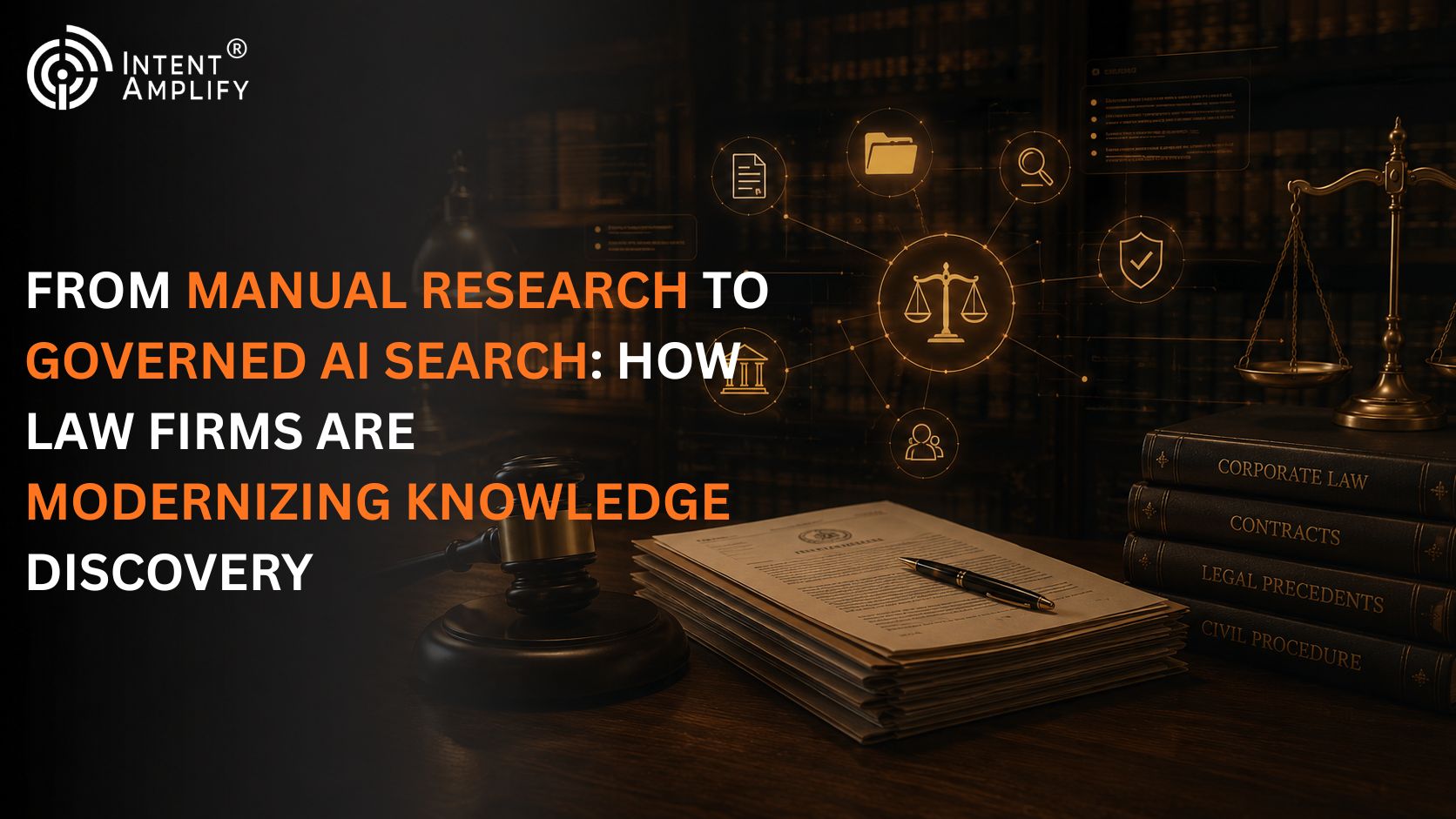
That is the story behind Progress Agentic RAG and its case study with a leading European law firm. The firm moved from time-intensive legal and accounting research toward AI-powered search experiences that deliver traceable answers grounded in internal knowledge and selected authoritative sources.
View the Progress Agentic RAG case study
Key Figures for Legal Knowledge, AI, Risk, and Architecture Leaders
Progress reports that traditional enterprise search can force employees to open 8-12 documents to answer a single question.²
Progress Agentic RAG reports up to 95% faster AI-readiness and 80% cost savings compared with building similar RAG capabilities internally.³
The Progress case study shows the firm transformed workflows for approximately 300 legal and accounting professionals. The same firm now handles thousands of legal and accounting questions per month through its AI assistant. The firm provides legal information, consulting, and decision-support services to more than 20,000 private and public clients.⁴
Only 18% of professional services respondents say their organizations collect AI ROI metrics, while 40% do not know whether AI ROI is measured.¹
Legal professionals expect AI to free up nearly 240 hours per year, up from 200 hours in the prior year, creating about $19,000 in annual value per professional. Thomson Reuters estimates AI-related time savings could create $32 billion in combined annual impact across the U.S. legal and tax/accounting sectors.⁵
Agentic AI adoption is still early, with 15% of professional services organizations using agentic AI, 53% planning or considering it, and 77% expecting it to become central to workflow by 2030.¹
Microsoft analyzed 31,000 workers across 31 countries and found 81% of leaders expect agents to be moderately or extensively integrated into the company's AI strategy within 12-18 months.⁶
IBM reports AI-enabled workflows are expected to expand from 3% in 2024 to 25% by 2026, an 8x increase.⁷
Google Cloud's grounding documentation supports an overall support score from 0 to 1, up to 200 facts, and 10,000 characters per fact for grounding checks.⁸
McKinsey estimates agent-enabled process reinvention can reduce time to resolution by 60-90% in selected service workflows.⁹
PwC analyzed close to one billion job ads across six continents and found industries more exposed to AI had 3x higher growth in revenue per worker.¹⁰
Why Manual Legal Research Is Becoming a Knowledge Architecture Problem
Legal research is not broken because lawyers are inefficient. It is strained because the legal knowledge environment has become too fragmented, permissioned, fast-changing, and difficult to govern.
A single client question can require legislation, prior internal analysis, practice-area interpretation, jurisdictional context, and the latest regulatory update. Traditional search gives links. Lawyers still have to open documents, compare passages, judge relevance, validate source authority, check currency, and assemble a defensible answer.
That model works when volume is manageable. It starts to fail when every practice area becomes more data-heavy, and every client expects faster guidance.
Governed AI search changes the starting point. Instead of asking lawyers to begin with scattered documents, it gives them an answer draft grounded in firm-approved knowledge, permission-aware retrieval, and citations back to authoritative sources. The professional still decides. The system removes the unnecessary friction.
This division of responsibilities preserves professional judgment while reducing research friction.
Progress Agentic RAG: Built for Legal-Grade Governed Knowledge Discovery
The Progress case study matters because the firm did not need another chatbot. It needed a legal-grade knowledge architecture with governed retrieval, traceability, evaluation, and source control.
The firm had evaluated internal development, hyperscalers, and other retrieval-augmented generation options. The challenge was not generating text. The challenge was controlling how documents were ingested, permissioned, retrieved, cited, monitored, evaluated, audited, and improved over time.
Progress Agentic RAG helped the firm build an AI-powered assistant that reflects how legal professionals actually work. The solution uses internal legal and accounting knowledge, selected external sources, multiple knowledge boxes, tuned retrieval strategies, evaluation metrics, and clear citations to source documents.
For lawyers, this means less time moving between repositories and more time applying judgment. For clients, it means faster responses that still carry the firm's authority.
The Client Benefit: Faster Answers That Remain Traceable and Defensible
Clients do not care whether a firm has AI in the stack. They care whether the firm responds faster, explains clearly, cites trusted sources, and gives guidance they can rely on.
Governed AI search supports that experience.
When a lawyer receives a grounded draft answer, the work does not become automatic. It becomes better prepared. The lawyer can validate the source, refine the interpretation, and move more quickly toward advice that is useful for the client. This human-in-the-loop approach reflects a broader shift across professional services. Thomson Reuters' Future of Professionals Report 2025 found that organizations increasingly view AI as a tool for augmenting expertise rather than replacing it, while Microsoft's 2025 Work Trend Index highlights how AI is helping knowledge workers reduce time spent searching for information and focus more on higher-value judgment and decision-making.
That matters for routine questions. It matters even more for urgent ones. A client waiting on a policy decision, workforce issue, tax position, or compliance response does not benefit from a slow knowledge hunt. They benefit from a lawyer who can access the right material faster and spend more time thinking. Progress's Agentic RAG approach is designed around this principle, moving users from traditional document search to grounded answers that are linked to authoritative sources and firm-approved knowledge. By reducing the effort required to locate relevant information, professionals can dedicate more attention to analysis, context, and client-specific recommendations.
The client benefit is speed without sacrificing confidence. Google Cloud identifies grounding as a critical requirement for trustworthy AI because it enables answers to be tied back to verifiable sources rather than generated in isolation. For legal and advisory services, that distinction is essential. Clients expect responsiveness, but they also expect accountability. When lawyers can review AI-generated drafts, inspect supporting evidence, and provide final judgment before advice is delivered, firms create a service experience that is both faster and more reliable.
This combination of speed, transparency, and professional oversight is becoming a competitive differentiator. McKinsey's Seizing the Agentic AI Advantage and IBM's From AI Projects to Profits both highlight that the greatest value from AI emerges when organizations redesign workflows around human expertise rather than treating AI as a standalone technology. For clients, that translates into quicker access to trusted guidance. For firms, it means delivering a more responsive service model while preserving the professional accountability that remains at the heart of legal practice.
The Strategic Advantage: Governed Knowledge as a Client Experience
The most strategic part of the Progress case study is not only internal efficiency. It is the customer-facing AI legal assistant that the firm built on the same platform.
That changes the brand message.
The firm is not simply saying, "We use AI." It is saying, "We have modernized how clients access our expertise while keeping lawyers in control, sources traceable, and governance intact."
The approach combines innovation with accountability while preserving professional oversight. It makes the firm more responsive without making its advice feel less human. It also creates a differentiated service model where selected clients can ask routine legal questions through a secure portal and receive well-grounded answers backed by the firm's expertise.
In professional services, that is where AI becomes commercially meaningful. It does not replace trust. It makes trust easier to experience.
Why Progress Is Positioned for Legal-Grade AI Search
Progress Agentic RAG is positioned for firms that cannot treat AI as an experiment sitting outside the business. Legal and professional services organizations need source control, permission-aware retrieval, governance, model flexibility, quality monitoring, secure deployment, auditability, and visible citations.
That is the difference between AI search and governed AI search.
Governed AI search extends beyond information retrieval by supporting validation, traceability, and professional review.
For law firms, this distinction will become central to client service, brand trust, and AI strategy. The firms that modernize knowledge discovery now will not simply move faster. They will create a more transparent, traceable, scalable, and legally defensible way to deliver expertise.
Download the full Progress case study PDF to explore how a leading law firm used Progress Agentic RAG to modernize legal knowledge discovery with governed retrieval, source traceability, secure AI search, and a client-facing AI assistant model.
Want to explore more research like this?
Intent Amplify delivers research-driven insights, market intelligence, and industry analysis to help technology leaders make informed business decisions. Learn More
References
Thomson Reuters (2026) AI in Professional Services Report 2026. Thomson Reuters, 2026.
Progress (n.d.) From Search to Answers with Agentic RAG. Progress Software Corporation.
Progress (n.d.) Agentic RAG Platform Overview. Progress Software Corporation.
Progress (n.d.) Leading Law Firm Agentic RAG Success Story. Progress Software Corporation.
Thomson Reuters (2025) Future of Professionals Report 2025. Thomson Reuters, 2025.
Microsoft (2025) 2025 Work Trend Index Annual Report. Microsoft Corporation, 2025.
IBM (2025). From AI Projects to Profits. IBM Corporation, 2025.
Google Cloud (n.d.) Check Grounding with RAG. Google Cloud.
McKinsey & Company (2025) Seizing the Agentic AI Advantage. McKinsey & Company, 2025.
PwC (2025) 2025 Global AI Jobs Barometer. PricewaterhouseCoopers (PwC), 2025.