
logo
logo
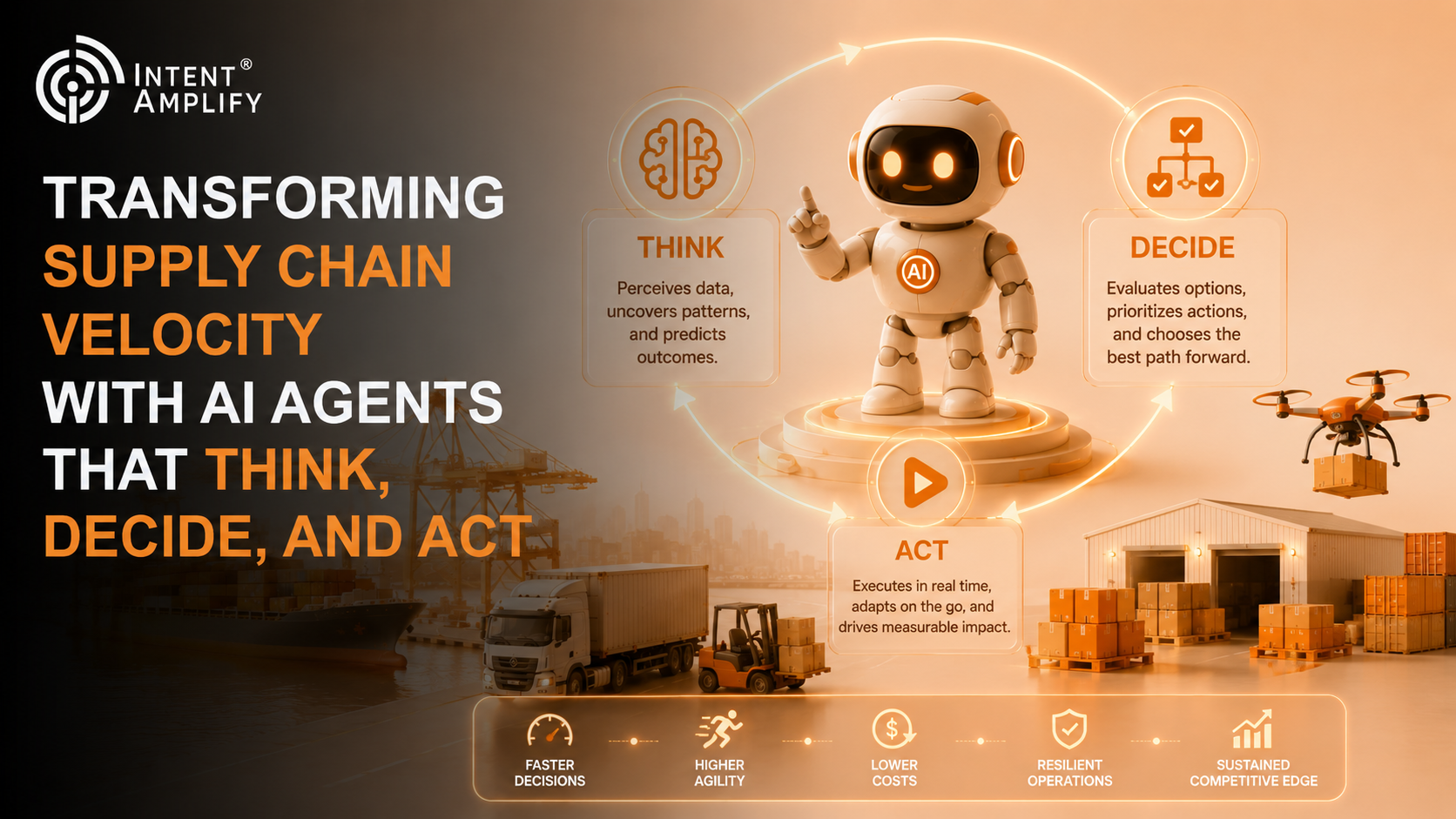
Transforming Supply Chain Velocity with AI Agents That Think, Decide, and Act

NEWSLETTER

Transforming Supply Chain Velocity with AI Agents That Think, Decide, and Act

Discover how AI agents help supply chains reduce decision latency, improve planning agility, accelerate response times, and drive operational resilience through agentic workflows.

Published by Intent Amplify, delivering research-driven insight for supply chain leaders, CIOs, COOs, planning executives, digital transformation teams, and enterprise decision-makers navigating AI, latency reduction, adaptive planning, operational resilience, and decision velocity.

Supply chain velocity used to mean moving goods faster.

Now it means making decisions faster.

What does this mean? The problem with supply chains today is that they don't slow down because there are trucks, ports, warehouses, or even factories. What slows down supply chains is that there's a delay in recognizing, understanding, comparing, and reacting to signals.

That delay is where margin, service, and resilience quietly leak.

A demand shift waits for the next forecast cycle. A supply constraint waits for escalation. Inventory imbalance waits for review. Financial impact waits for reconciliation. By the time the decision reaches the right people, the business may already be reacting instead of leading.

This is why AI agents are becoming central to supply chain velocity.

Unlike static dashboards or traditional automation, AI agents can monitor signals, interpret patterns, recommend next steps, and route decisions into action. They do not simply report what happened. They help supply chain teams decide what should happen next.

Supply Chain Now's webinar, "AI That Moves at Velocity: Cut Through Latency with Agentic Workflows," frames the problem clearly: many planning processes still operate in weekly or monthly cycles even though demand, supply, and financial conditions can shift hourly. 1

The session brings together Zero100 and OMP to explore two practical workflows where agentic AI can create measurable value: Signal-to-Plan and Inventory-to-Service. 1

That is the new supply chain velocity mandate: AI agents that think, decide, and act with human oversight.

View the Supply Chain Now webinar

Key Figures at a Glance

PwC's 2026 Digital Trends in Operations Survey of 767 operations and supply chain leaders found 85% say they are ahead of competitors in digital transformation, yet 89% say technology investments have not fully delivered expected results.2

PwC also found 83% of leaders believe AI agents and automation will accelerate the breakdown of traditional functional silos.2

Accenture's Pulse of Change reports 82% of C-suite leaders expect higher change levels in 2026, while 86% plan to increase AI investment. 3

Microsoft describes agentic supply chain architecture as a model that connects data, decisions, and actions across supply chain operations. 4

Microsoft's Supply Chain 2.0 research describes a global pharmaceutical company using agentic architecture to identify temperature-critical returns in real time and unlock multi-million euro annual productivity gains. 5

Google Cloud's 2026 update highlights 1,302 real-world generative AI use cases from leading organizations. 6

Google Cloud reports that Domina manages 20 million+ annual shipments and uses Vertex AI and Gemini to predict package returns and automate delivery validation. 7

OMP's UnisonIQ brings always-on agents, optimization, machine learning, and explainable AI into supply chain planning workflows.

Figure: What AI Agents Change in Supply Chain Velocity

Traditional Planning Pattern

Agentic AI Pattern

Business Impact

Wait for reports

Monitor live signals continuously

Faster awareness

Escalate manually

Prioritize exceptions automatically

Less decision drag

Build scenarios after the disruption

Refresh scenarios as conditions change

Better readiness

Debate across functions

Share one decision path

Stronger alignment

Act after service pressure

Recommend earlier interventions

Better customer outcomes

Why Velocity Is Now a Decision Problem

Supply chains already move. The harder question is whether decisions move fast enough to matter.

A planner may see demand volatility. Logistics may see capacity pressure. Finance may see a margin impact. Commercial teams may see customer risk. But if those signals stay separated, velocity does not improve. The organization still waits for coordination.

AI agents help close that gap.

They can observe changes, connect signals, rank urgency, and help teams understand which decision needs attention first. That does not remove human judgment. It gives human judgment a better context earlier.

This is the point many AI conversations miss. Supply chain leaders do not need another tool that only summarizes information. They need workflows that shorten the distance between signal and action.

Agentic AI does that by changing the operating rhythm.

Why Supply Chain Now Belongs in This Conversation

Supply Chain Now gives the topic the right industry stage because agentic AI is not just a technology story. It is a leadership and operating model story.

The webinar focuses on where value can begin: Signal-to-Plan and Inventory-to-Service. 1

Why is Signal-to-Plan Important? It brings market signals, demand signals, supply signals, cost signals, and financial signals into the process of planning. Why is Inventory-to-Service Important? It ties inventory management to service delivery.

This is practical. They sit close to the business pain. They also show why AI agents need more than data access. They need governance, decision ownership, fusion teams, and process redesign.

Supply Chain Now makes that clear for executives who are tired of generic AI promises. The question is not whether AI can produce insight. The question is whether AI can help the organization act before latency becomes loss.

Zero100 and OMP: From AI Insight to AI Action

Zero100's Power Threads concept is useful because it frames AI value around end-to-end workflows rather than isolated pilots. Instead of deploying AI across scattered use cases, Power Threads concentrates attention on operating flows where signals, plans, decisions, and execution connect.

Inventory-to-Service is a strong example. Inventory does not mean product availability. Rather, product availability results from demand indicators, inventory strategies, supply limitations, logistics timing, delivery capabilities, and business objectives.

If all these considerations depend on other schedules, the customer bears the cost of waiting.

OMP brings the planning backbone into that conversation. Its UnisonIQ approach positions AI agents as part of a decision-support environment that combines optimization, machine learning, explainability, and always-on planning intelligence.

That combination matters for clients. Zero100 helps define where AI value concentrates. OMP helps operationalize how agents work inside planning decisions.

Together, the message is strong: supply chain velocity improves when agents are embedded into the workflow, not bolted onto the side.

Agentic Workflow Map

Workflow

What the Agent Thinks About

What It Helps Decide

What It Helps Act On

Signal-to-Plan

Demand, supply, cost, finance, market change

Which plan should be refreshed

Scenario update and escalation

Inventory-to-Service

Stock, constraints, fulfillment, availability

Where inventory should move

Replenishment and deployment

Exception-to-Action

Risk, urgency, service impact, margin exposure

Which issue comes first

Routing to the right owner

Scenario-to-Decision

Trade-offs across cost, service, cash, and resilience

Which option fits now

Decision recommendation

Plan-to-Execution

Timing, responsibility, and downstream effect

How action should flow

Execution handoff

Client Benefit: Speed That Still Feels Governed

Clients do not need reckless speed. They need controlled velocity.

A fast decision that weakens service, increases cost, or creates operational confusion is not progress. The value of AI agents is that they can compress the time to decision while keeping humans connected to the reasoning, evidence, and trade-offs.

For supply chain leaders, this creates several client benefits.

First, faster response to changing conditions. Agents can watch signals continuously and prompt teams before the next planning cycle.

Second, better product availability. Inventory-to-Service workflows help connect stock decisions directly to customer outcomes.

Third, stronger decision prioritization. Not every exception deserves the same attention. Agents help rank issues based on risk, cost, and service impact.

Fourth, more scalable planning. Teams can standardize repeatable decision paths instead of rebuilding the same analysis during every disruption.

Fifth, stronger executive confidence. Leaders see not only the recommendation, but the scenario logic behind it.

Figure: Client Value from AI Agents

Client Need

AI Agent Capability

Business Benefit

Faster response

Always-on signal monitoring

Less delay between the event and the action

Better availability

Inventory-to-Service coordination

Stronger customer reliability

Reduced manual drag

Automated exception prioritization

More planner capacity

Stronger alignment

Shared workflow logic

Faster cross-functional decisions

Governed speed

Human-in-the-loop recommendations

Confidence before action

What Leaders Should Prioritize First

The priority is not deploying AI agents everywhere. It is choosing the decision where delay is already expensive.

Signal-to-Plan is a strong starting point when volatility forces teams to refresh assumptions faster. Inventory-to-Service is a strong starting point when product availability, replenishment, and fulfillment decisions directly affect customer trust.

Next, leaders should define the decision owner. AI agents can recommend, route, and monitor, but accountability must remain human.

Then they should measure latency. How long does it take today to move from signal to scenario, scenario to decision, and decision to execution? That baseline creates the business case.

Finally, leaders should build fusion teams. Agentic workflows require supply chain, IT, data, planning, finance, and process experts working together. Without that operating model, AI agents become another disconnected layer.

The Boardroom Takeaway

The boardroom does not need AI that waits for instructions.

It needs supply chain systems that sense change, surface decisions, and help teams act with discipline.

Agentic AI matters because it reduces the gap between what the business knows and what the business does. Supply Chain Now, Zero100, and OMP are putting attention on the right issue: not AI as a novelty, but AI as workflow velocity.

When agents think, decide, and act within governed planning workflows, supply chains become more responsive. When supply chains become more responsive, businesses protect service, margin, resilience, and growth with greater confidence.

Bottom Line

Transforming supply chain velocity is not about replacing planners. It's about giving planners and leaders a real-time system of thinking for keeping up with the pace of change.

AI-driven agents will have the ability to reason about signals, determine which actions are important, and then act through controlled workflows from planning to action.

But it won't be about having the most amount of data or even having dashboards. They will be the companies that use AI agents to cut decision latency before volatility becomes a business loss.

Reserve your seat to explore Signal-to-Plan and Inventory-to-Service workflows

Be Ready for What's Next

Subscribe to Intent Amplify for insightful analysis of the adoption of artificial intelligence and digital transformation powered by data.

References

  1. Supply Chain Now and IntentTechPub (2025) AI That Moves at Velocity. Supply Chain Now and IntentTechPub, 2025.

  2. PwC (2026) 2026 Digital Trends in Operations Survey. PricewaterhouseCoopers (PwC), 2026.

  3. Accenture (2025) Pulse of Change. Accenture, 2025.

  4. Microsoft (2025). From Intelligence to Impact. Microsoft Corporation, 2025.

  5. Microsoft (2024) Supply Chain 2.0. Microsoft Corporation, 2024.

  6. Google Cloud (2026) Google Cloud Next 2026. Google Cloud, 2026.

  7. Google Cloud (2024) Real-World Gen AI Use Cases. Google Cloud, 2024.

Yash Lad

Yash Lad

Research Analyst

Contact Us

Transforming Supply Chain Velocity with AI Agents That Think, Decide, and Act