
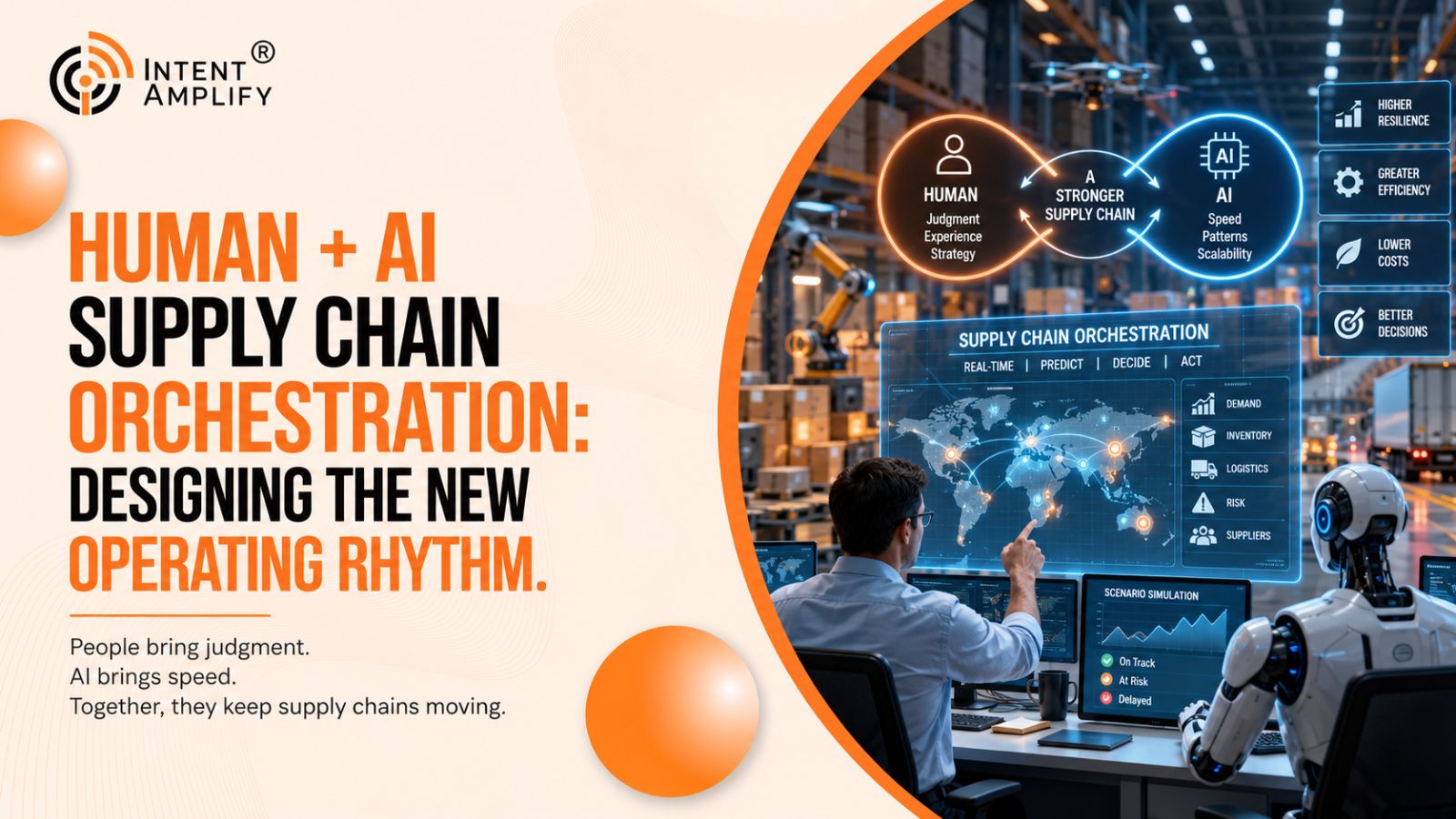
The future supply chain is unlikely to be run entirely by people or entirely by AI agents. The more practical model is orchestration: people and agents working from shared operational context, with clear authority and deliberate handoffs.
WHY SUPPLY CHAIN ORCHESTRATION MATTERS
Supply-chain work is distributed across planning, procurement, logistics, manufacturing, inventory, fulfillment, finance, and technology. An exception that begins in one function can quickly become a cross-functional decision.
AI can help monitor events, assemble context, identify patterns, prioritize issues, and recommend responses. Humans remain essential for commercial judgment, negotiation, accountability, novel exceptions, and high-impact decisions.
The operating challenge is deciding how those capabilities fit together.
DESIGN THE ROLE BEFORE DEPLOYING THE AGENT
For each workflow, define whether AI may observe, recommend, execute, or escalate.
Observe gives the agent permission to monitor and interpret.
Recommend lets it propose a response while a person retains approval.
Execute permits bounded action under explicit conditions.
Escalate transfers responsibility when uncertainty or impact requires judgment.
This prevents technical capability from silently becoming business authority.
MAKE CONTEXT THE SHARED LANGUAGE
Humans and agents should reason from the same operational picture. That means connecting the event to the process history, dependencies, constraints, policies, and prior actions that give it meaning.
A planner should be able to understand why an agent recommended an action. An agent should have enough context to recognize when the decision exceeds its authority.
Shared context makes collaboration inspectable.
DESIGN THE HANDOFF
When an agent escalates, the human should receive the event summary, relevant process history, material constraints, actions already taken, options considered, and reason for escalation.
When a human overrides an agent, that decision should become a learning signal where appropriate. Repeated overrides can reveal a missing rule, weak data, incomplete context, or an authority boundary that needs adjustment.
CREATE AN OPERATING RHYTHM
A practical orchestration rhythm can include:
Continuous monitoring by AI.
Context assembly when an exception appears.
Agent recommendation or bounded action.
Human review when thresholds are crossed.
Outcome capture after resolution.
Recurring review of exceptions, overrides, and process behavior.
This creates a loop rather than a one-time deployment.
WHAT LEADERS SHOULD MEASURE
Do not measure orchestration by the number of agents deployed. Measure whether the workflow becomes more effective.
Use process evidence such as cycle time, backlog, delay, rework, throughput, or service exposure. Use decision evidence such as recommendation acceptance, override patterns, and exception outcomes. Use control evidence to confirm that the agent stayed within its authority and escalated appropriately.
A successful operating rhythm improves outcomes while keeping accountability visible.
THE EXECUTIVE QUESTION
The right question is not “Where can we remove humans?” It is “Where can AI increase the speed and quality of operational understanding, and where must human judgment remain decisive?”
That framing creates a more durable path to agentic operations.
ORCHESTRATION STARTS WITH A WORKFLOW, NOT AN ORG CHART
Human + AI orchestration should be designed around the flow of a decision. Organizational boundaries matter, but the exception does not stop when responsibility moves from planning to procurement, logistics, operations, or finance.
Begin with the operational trigger. Identify what AI can monitor, which context it can assemble, what decision is required, which actions are available, and who owns the decision at each stage. Then map how responsibility transfers when the situation changes.
This workflow-first view exposes handoff problems that functional automation can miss. A planning system can produce a strong signal while procurement lacks the supplier context required to act. A logistics agent can identify a recovery option while finance approval becomes the bottleneck. An inventory recommendation can be operationally sound while customer priorities remain invisible.
Orchestration means designing those transitions as one operating system.
THE FIVE ROLES IN A HUMAN + AI OPERATING MODEL
AI does not need one role across the entire workflow. It can perform several distinct functions.
Monitor: continuously watch events and process conditions. Assemble: gather the relevant process history, relationships, constraints, and evidence. Recommend: evaluate permitted options and propose a response. Execute: perform a bounded action when explicit conditions are satisfied. Escalate: transfer responsibility when the situation exceeds the permission boundary or requires judgment.
Humans also play several roles. They define objectives and policy, approve material actions, handle novel exceptions, negotiate with external parties, review recurring patterns, and decide when AI authority should change.
The operating model becomes clearer when these roles are explicit. The question is not whether humans or AI “own” the process in general. It is who owns each decision and action.
SHARED CONTEXT IS THE COORDINATION LAYER
Orchestration breaks down when each participant sees a different version of the operating situation. A planner may understand production exposure, procurement may understand supplier constraints, logistics may understand transport options, and finance may understand cost thresholds. AI can help connect these views, but only if the relevant context is represented and trusted.
Shared context should include the triggering event, process history, affected objects, material dependencies, constraints, prior actions, and current ownership. The exact content will differ by workflow.
For AI, shared context improves reasoning and helps the system recognize when it should stop. For humans, it makes recommendations and escalations inspectable. For cross-functional teams, it reduces repeated investigation as the decision moves through the organization.
Context therefore acts as the coordination layer between people, agents, systems, and functions.
DESIGNING THE HUMAN HANDOFF FOR SPEED
A human handoff should be decision-ready. When an agent escalates, the receiving person should know what happened, why it matters, what the agent already evaluated, what options remain, and why human judgment is required.
The handoff can include the event summary, relevant process path, material constraints, affected orders or commitments, actions already taken, options considered, and the escalation trigger. The person should not need to reconstruct the same case from multiple applications.
Ownership should also be explicit. A commercial supplier issue may route differently from a data conflict, production consequence, logistics commitment, or customer-impacting exception. A generic queue can preserve oversight while still creating delay.
The strongest handoff keeps context and responsibility together.
THE REVERSE HANDOFF: HUMAN DECISIONS BACK INTO THE WORKFLOW
Orchestration is incomplete if information flows only from AI to humans. Human decisions should return to the operating record where appropriate.
An approval tells the workflow that a recommended action was accepted. An override can reveal missing context, a policy constraint, a commercial consideration, or a recommendation problem. An exception resolution can identify a new process variant. A repeated escalation can reveal an authority boundary that is too narrow or a data source that needs improvement.
Capturing these signals creates a learning loop. The purpose is not to make the AI imitate every human decision. It is to improve the process, context, and authority design based on observed operating behavior.
THE DAILY OPERATING RHYTHM
A human + AI operating rhythm can be continuous at the system level and event-driven for people.
AI monitors the workflow and assembles context as conditions change. Routine events remain in the normal flow. Material exceptions are prioritized. Recommendations are routed to the appropriate owner. Bounded actions are executed only where permission is explicit. Human decisions and overrides are captured. Outcomes return to the process record.
This reduces the need for people to continuously scan every signal. Human attention can be directed toward decisions that require judgment, accountability, or intervention.
The rhythm should be designed to reduce noise, not create another layer of alerts.
THE WEEKLY OR PERIODIC REVIEW RHYTHM
In addition to event-level operation, leaders need a recurring review of how the human + AI system is behaving.
Review exception volume and type, recommendation acceptance, override reasons, escalation patterns, process delays, context gaps, and any actions that approached or crossed control boundaries. Examine whether humans are repeatedly searching for information the agent should provide. Look for process variants that produce different outcomes.
The purpose is to identify improvement opportunities. A recurring override may indicate missing context. A repeated escalation may justify a new rule or a different owner. A drop in escalation may be positive, or it may require checking whether the agent is proceeding too aggressively.
The review rhythm keeps orchestration adaptive as operating conditions change.
ORCHESTRATION ACROSS PLANNING AND PROCUREMENT
Planning and procurement often share decisions but operate from different contexts. A material shortage may begin as a planning exception and become a supplier action.
AI can connect the production requirement, current inventory, inbound supply, supplier commitment, and alternative options. Planning can retain ownership of production priorities while procurement retains ownership of supplier and commercial decisions.
The handoff becomes more efficient when both functions see the same decision case. The agent can prepare the context, identify where the decision crosses functional ownership, and route the next step without erasing accountability.
ORCHESTRATION ACROSS LOGISTICS AND OPERATIONS
A transport disruption can require both logistics recovery and operational judgment. AI can connect shipment status to inventory coverage, production dependency, service commitments, route alternatives, and cost thresholds.
Logistics can own carrier and route decisions within approved boundaries. Operations can own production consequences. High-impact financial or customer decisions can escalate further when necessary.
The operating model should make these ownership transitions visible rather than relying on informal communication after the disruption occurs.
ORCHESTRATION ACROSS INVENTORY AND CUSTOMER COMMITMENTS
Inventory decisions can appear operationally simple while affecting commercial priorities. An agent may identify a technically efficient reallocation, but the preferred action can depend on customer commitments, production needs, service policies, and the reversibility of physical movement.
Shared context allows AI to recommend with those dependencies visible. Human owners can retain authority over actions that change commitments or materially affect customers.
This is another example of why orchestration is more than automation. The workflow must coordinate multiple objectives and owners around the same decision.
MULTI-AGENT ORCHESTRATION
As organizations introduce specialized agents, orchestration becomes a design problem inside the AI layer as well. One agent may monitor supplier events, another may analyze inventory exposure, and another may evaluate logistics options.
The organization should define what context is shared, which agent can initiate an action, how conflicting recommendations are handled, and where human authority sits. One agent should not implicitly authorize another unless that interaction is explicitly permitted.
A multi-agent workflow should still produce one reconstructable operating trail. An authorized reviewer should be able to understand which components contributed, what evidence they used, and how the final decision was reached.
Distributed intelligence should not create distributed accountability.
THE AUTHORITY RHYTHM: EXPAND, HOLD, OR REDUCE
Authority should be reviewed as part of the operating rhythm. The next step is not always more autonomy.
If evidence shows that a bounded action is dependable, leaders can consider expanding that specific permission. If recommendation quality is strong but the consequence remains high, the workflow can remain human-approved. If data quality deteriorates or new exceptions appear, an executable action can return to recommendation until the issue is resolved.
This makes authority dynamic but controlled. The organization is not committing to a one-way maturity path. It is matching responsibility to current operating evidence.
THE SUPPLY CHAIN ORCHESTRATION SCORECARD
Leaders can evaluate the operating rhythm through a small set of questions. Are the right events being prioritized? Is the required context available? Are recommendations decision-useful? Are human owners clear? Are handoffs complete? Are overrides and escalations understandable? Does the agent stay inside its authority? Can outcomes be observed? Is the workflow becoming easier to operate?
These questions should be answered with workflow-specific evidence rather than universal benchmarks.
A 30-60-90 ORCHESTRATION PLAN
In the first phase, select a bounded cross-functional decision, map the workflow, define context, identify human owners, and assign the initial AI role. Establish the escalation design before the pilot begins.
In the second phase, use AI for monitoring, context assembly, prioritization, and recommendation. Test the handoffs. Capture where humans need additional information and where ownership is unclear.
In the third phase, review process outcomes, overrides, escalation patterns, and context quality. Improve the workflow and consider bounded execution only for actions supported by evidence.
The sequence is a planning model rather than a universal timetable. The appropriate pace depends on process complexity, integration, data, controls, and organizational capacity.
THE NEW OPERATING RHYTHM
The new rhythm is not “AI works until a human takes over.” It is a continuous collaboration model in which people and agents contribute different capabilities to the same process.
AI provides persistence, speed, monitoring, synthesis, and coordination. Humans provide objectives, accountability, commercial judgment, negotiation, and interpretation of novel situations. Shared context connects them. Authority defines responsibility. Evidence allows the model to improve.
That is how human + AI orchestration becomes an operating capability rather than a technology concept.
CONCLUSION
Human + AI orchestration works when context, authority, handoffs, and evidence are designed as one operating system.
Start with a bounded workflow. Give the agent a clear role. Preserve accountable human judgment. Make context transferable. Learn from every exception. Expand only when the evidence supports the next level of responsibility.
Join the September 17 webinar, “Operational AI in the Supply Chain: How Context Empowers Agents and Humans to Operate Side by Side,” to explore the operating model for coordinated human-and-agent execution.
REFERENCES
1. Celonis — Context Model: https://www.celonis.com/platform/context-model
2. Celonis — Enterprise AI: https://www.celonis.com/solutions/ai
3. Celonis — Supply Chain Transformation: https://www.celonis.com/solutions/supply-chain-transformation/
4. NIST — Artificial Intelligence Risk Management Framework (AI RMF 1.0): https://www.nist.gov/publications/artificial-intelligence-risk-management-framework-ai-rmf-10
5. NIST — Generative AI Profile (NIST AI 600-1): https://www.nist.gov/publications/artificial-intelligence-risk-management-framework-generative-artificial-intelligence