
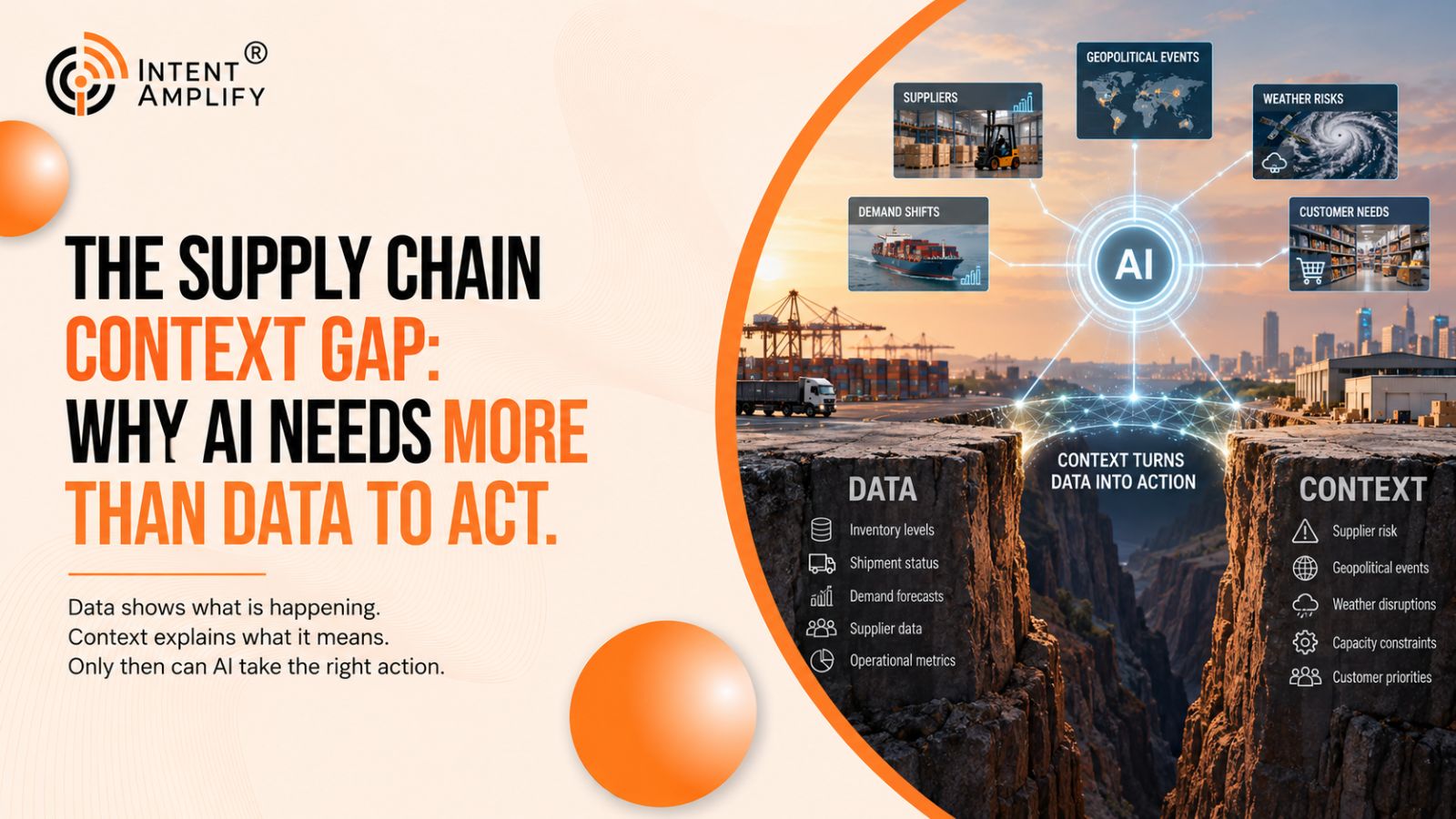
Supply chains do not suffer from a lack of data. They suffer from a lack of connected operational meaning.
An AI system can see an inventory level, a delayed shipment, a supplier update, or a production exception. But the decision depends on relationships the individual record may not contain: which orders are exposed, which constraints matter, what alternatives exist, who owns the response, and what action is permitted.
That is the context gap.
WHY CONTEXT IS THE NEW OPERATING REQUIREMENT
As AI moves from summarizing information toward recommending and executing actions, context becomes more important. A plausible answer is not enough. The system must understand the operational situation well enough to avoid optimizing one variable while creating a problem somewhere else.
For a shortage, that context may include inbound supply, production demand, inventory coverage, supplier commitments, substitutes, customer priorities, and logistics options. For a transport delay, it may include service commitments, production dependency, alternative routes, and cost thresholds.
The objective is not to connect every possible data source. It is to define the minimum trusted context required for the decision.
FROM DATA ACCESS TO PROCESS UNDERSTANDING
Process intelligence helps connect events across systems into the workflow that produced the current state. That matters because supply-chain decisions are often path-dependent. What happened earlier in the process can change what the organization should do now.
For AI agents, process context provides a stronger basis for reasoning. For people, it reduces the effort required to reconstruct the situation. Both can operate from a more consistent picture of reality.
CONTEXT DOES NOT REMOVE THE NEED FOR AUTHORITY
Better context can improve a recommendation, but it does not automatically grant permission to act.
Leaders should explicitly define whether AI may observe, recommend, execute, or escalate at each major workflow step. A low-risk, reversible action can support a different level of autonomy from a decision involving strategic suppliers, production commitments, premium freight, or customer impact.
Technical capability is not business authority.
THE HUMAN HANDOFF IS PART OF THE DESIGN
When an AI agent cannot proceed, escalation should transfer the work already completed. The human should receive the event summary, relevant process history, constraints, actions already taken, options considered, and reason for escalation.
This is how human judgment and AI speed become complementary rather than duplicative.
SUPPLY CHAIN AI CONTEXT CHECKLIST
Which operational decisions are slowed by fragmented context?
Which data sources are authoritative?
Which relationships materially change the decision?
What may the AI do without approval?
What conditions force escalation?
What evidence will show whether the workflow improved?
These questions move the AI conversation from technology capability to operating design.
HOW TO CLOSE THE SUPPLY CHAIN CONTEXT GAP
Select one bounded workflow. Map the decision. Identify the minimum trusted context. Define AI authority. Design the human handoff. Instrument the outcome. Then pilot at the lowest level of autonomy that can create useful evidence.
If the workflow performs well, expand deliberately. If it does not, use the exceptions to determine whether the problem is data, context, authority, process design, or handoff quality.
THE SIX TYPES OF CONTEXT AI NEEDS
The context gap becomes easier to diagnose when leaders separate context into practical categories.
Event context describes what changed: an inventory position, shipment status, supplier commitment, order exception, production constraint, or another operational signal. Process context explains how the workflow reached the current state. Relationship context identifies the orders, materials, suppliers, customers, assets, and downstream processes connected to the event.
Constraint context defines what limits the response: capacity, qualification, policy, cost thresholds, service commitments, contractual terms, or approved alternatives. Ownership context identifies who has authority to decide and who receives an escalation. Outcome context captures what happened after prior decisions and whether the process produced the intended result.
An AI workflow does not need every possible enterprise data source. It needs the categories of context that materially change the decision. The executive task is to identify those categories before expecting AI to act.
WHY MORE DATA CAN STILL PRODUCE A WEAK DECISION
Organizations can give an AI system access to many records and still leave it without decision-grade understanding. The problem is not only completeness. It is meaning.
A supplier date may be available, but the system may not know whether it is a requested date, confirmed date, revised date, or operationally trusted commitment. Inventory may be visible without distinguishing what is available, reserved, in transit, blocked, or dependent on another process. A shipment status may be current while the customer or production consequence remains unknown.
This is why the move from data access to operational context is important. Leaders should ask which information changes the decision, which source should be trusted, how fresh the information must be, and what the workflow should do when evidence conflicts.
The goal is not a larger data footprint. It is a more reliable decision picture.
THE CONTEXT GAP IN SHORTAGE MANAGEMENT
A shortage alert is useful, but it does not tell the organization what response is appropriate. The decision can depend on current and inbound inventory, production requirements, supplier commitments, alternate materials, order priorities, transport options, and the time available to respond.
Without this context, AI may simply restate the shortage. With context, it can help distinguish which shortages require intervention, assemble the affected process, and evaluate permitted response options.
The authority boundary still matters. AI can monitor and recommend while supplier, production, or customer-impacting actions remain human-owned. As the workflow produces dependable evidence, selected reversible actions can be considered separately for bounded execution.
THE CONTEXT GAP IN LOGISTICS
A delayed shipment is another example of an event that needs operational meaning. The same delay can be low consequence when inventory coverage is sufficient and high consequence when a production order or customer commitment is exposed.
Context-aware AI can connect transport status to inventory, production dependency, service priority, route alternatives, and cost thresholds. The system can then prioritize the disruption and recommend a recovery path rather than simply creating another alert.
This reduces the gap between visibility and action. It also gives the human reviewer a clearer explanation of why one disruption deserves attention before another.
THE CONTEXT GAP IN SUPPLIER EXCEPTIONS
Supplier exceptions often appear as individual variances: a late confirmation, changed quantity, missed milestone, or delivery deviation. The operational significance depends on what the supplier event affects.
AI can become more useful when it connects the exception to open orders, production dependencies, inventory coverage, alternate supply, qualification rules, and prior supplier behavior. The workflow can distinguish routine variance from an exception that threatens a material commitment.
Procurement leaders can then focus judgment on the cases that require commercial or relationship decisions while AI handles monitoring, context assembly, and prioritization.
CONTEXT SHOULD TRAVEL WITH THE WORK
One of the most important design principles is that context should move with the decision. If an AI agent assembles a strong operational picture and then escalates only a short alert, the human must repeat the analysis.
A useful handoff should include the trigger, relevant process history, affected objects, material constraints, actions already taken, options considered, and reason for escalation. The receiving owner should understand what decision remains open.
The same principle applies when work moves between human teams. Shared context can reduce repeated investigation across planning, procurement, logistics, operations, and customer-facing functions.
AI creates more value when it improves the continuity of the workflow rather than becoming another disconnected interface.
CONTEXT AND AUTHORITY: A TWO-PART DESIGN
Context answers, “What is happening and what does it mean?” Authority answers, “What is the system allowed to do about it?” These questions should be designed together but never confused.
A workflow with limited context should usually have limited authority because the system cannot reliably interpret the situation. A workflow with rich context can support better recommendations, but high-impact or difficult-to-reverse actions may remain human-owned.
Leaders should define the AI role at each step: observe, recommend, execute, or escalate. They should also define explicit prohibitions. A technically capable agent should not be able to turn capability into permission simply because the action is available through an integrated system.
THE CONTEXT-QUALITY REVIEW
Context quality should be reviewed as part of operating performance. Useful questions include: Are the required sources available when the decision occurs? Are values current enough? Are relationships complete? Do teams repeatedly correct the same field? Are human reviewers searching for information the agent should already provide? Do overrides cluster around missing context?
These questions turn frontline behavior into evidence. If humans repeatedly add the same information before approving a recommendation, the workflow has identified a context gap. If the agent escalates because two systems disagree, the organization has identified a source-ownership problem.
The objective is continuous improvement of the decision environment.
FROM ALERT MANAGEMENT TO DECISION ORCHESTRATION
Many supply-chain teams already have alerts. The next step is not necessarily more sophisticated alerting. It is decision orchestration.
A decision-orchestration workflow can detect an event, assemble the relevant process context, determine the AI role, route the case to the correct owner, retain the evidence, and observe the outcome. Some cases can remain informational. Others can become recommendations. Selected low-impact actions can be executed when permissions are explicit.
This model focuses attention on the decision rather than the notification. It also creates a common operating pattern across different supply-chain domains.
WHAT A CONTEXT-AWARE PILOT SHOULD PROVE
A pilot should not be judged only by whether the AI produces convincing output. It should test whether the workflow can consistently assemble the required context and support a real operating decision.
Leaders should review whether the correct events were prioritized, whether the context was complete enough for the decision, whether recommendations reflected material constraints, whether humans received usable handoffs, and whether the agent stayed within its authority.
The pilot should also reveal where context is missing. Those gaps are useful evidence. They tell the organization what must improve before the workflow receives more scope or responsibility.
THE EXECUTIVE CONTEXT BLUEPRINT
For one priority workflow, document the business objective, trigger, current process, decision owner, required context, authoritative sources, key relationships, constraints, AI role, permitted actions, prohibited actions, escalation triggers, evidence retained, outcome measures, and expansion criteria.
This blueprint creates a shared view across operations, business, data, technology, security, and governance teams. It makes the context requirement explicit enough to build and the authority boundary explicit enough to review.
It also keeps the project tied to a decision rather than an abstract AI capability.
THE OPERATING RHYTHM FOR CONTEXT-AWARE AI
Context-aware AI should be managed as a loop. Monitor the process. Detect the event. Assemble context. Recommend or act according to authority. Escalate when the boundary is crossed. Capture the outcome. Review exceptions and overrides. Improve the context, process, or authority model.
This rhythm matters because supply chains change. New suppliers, policies, systems, priorities, and exceptions can alter what information is relevant. A context model that was sufficient during a pilot may require adjustment later.
Recurring review prevents the workflow from assuming that yesterday’s operating conditions still apply.
WHAT LEADERS SHOULD NOT ASSUME
Leaders should not assume that more integrations automatically create better context. They should not assume that a high-quality recommendation grants permission to execute. They should not assume that fewer escalations always indicate improvement. They should not assume that success in one process variant proves readiness in another.
Each of these assumptions collapses a distinct operating question. Data access, decision quality, authority, escalation, and scale should be evaluated separately.
This discipline keeps the AI program grounded in evidence rather than capability claims.
A PRACTICAL 30-60-90 CONTEXT PLAN
In the first phase, select the decision, map the process, identify the minimum trusted context, name authoritative sources, and document the initial AI authority. The purpose is to make the operating problem and context gap visible.
In the second phase, pilot monitoring, context assembly, prioritization, and recommendation. Review human handoffs and record where people still need to search for missing information. Treat those gaps as improvement requirements.
In the third phase, evaluate outcomes, override patterns, escalation reasons, and context quality. Expand volume, scope, or authority only where the evidence supports the specific change.
The sequence is a planning framework, not a universal deployment timetable. The appropriate pace depends on the workflow and operating environment.
THE NEWSLETTER TAKEAWAY
The context gap is the distance between seeing an operational event and understanding enough of the process to make the right decision. Closing that gap is foundational for AI that participates in supply-chain operations.
The strongest near-term opportunity is not to ask AI to act everywhere. It is to give humans and agents the same decision-ready picture, define who owns each action, and use operating evidence to determine where responsibility should evolve.
CONCLUSION
The next competitive advantage in supply-chain AI will not come from having the most data or the most agents. It will come from giving humans and AI a better understanding of how the business actually operates.
Context connects the event to the process, the process to the decision, the decision to the owner, and the action to the outcome.
Join the September 17 webinar, “Operational AI in the Supply Chain: How Context Empowers Agents and Humans to Operate Side by Side,” to explore how operational context can help AI move from information access to dependable action.
REFERENCES
1. Celonis — Context Model: https://www.celonis.com/platform/context-model
2. Celonis — Supply Chain Transformation: https://www.celonis.com/solutions/supply-chain-transformation/
3. Celonis — Enterprise AI: https://www.celonis.com/solutions/ai
4. NIST — Artificial Intelligence Risk Management Framework (AI RMF 1.0): https://www.nist.gov/publications/artificial-intelligence-risk-management-framework-ai-rmf-10
5. NIST — Generative AI Profile (NIST AI 600-1): https://www.nist.gov/publications/artificial-intelligence-risk-management-framework-generative-artificial-intelligence