
logo
logo
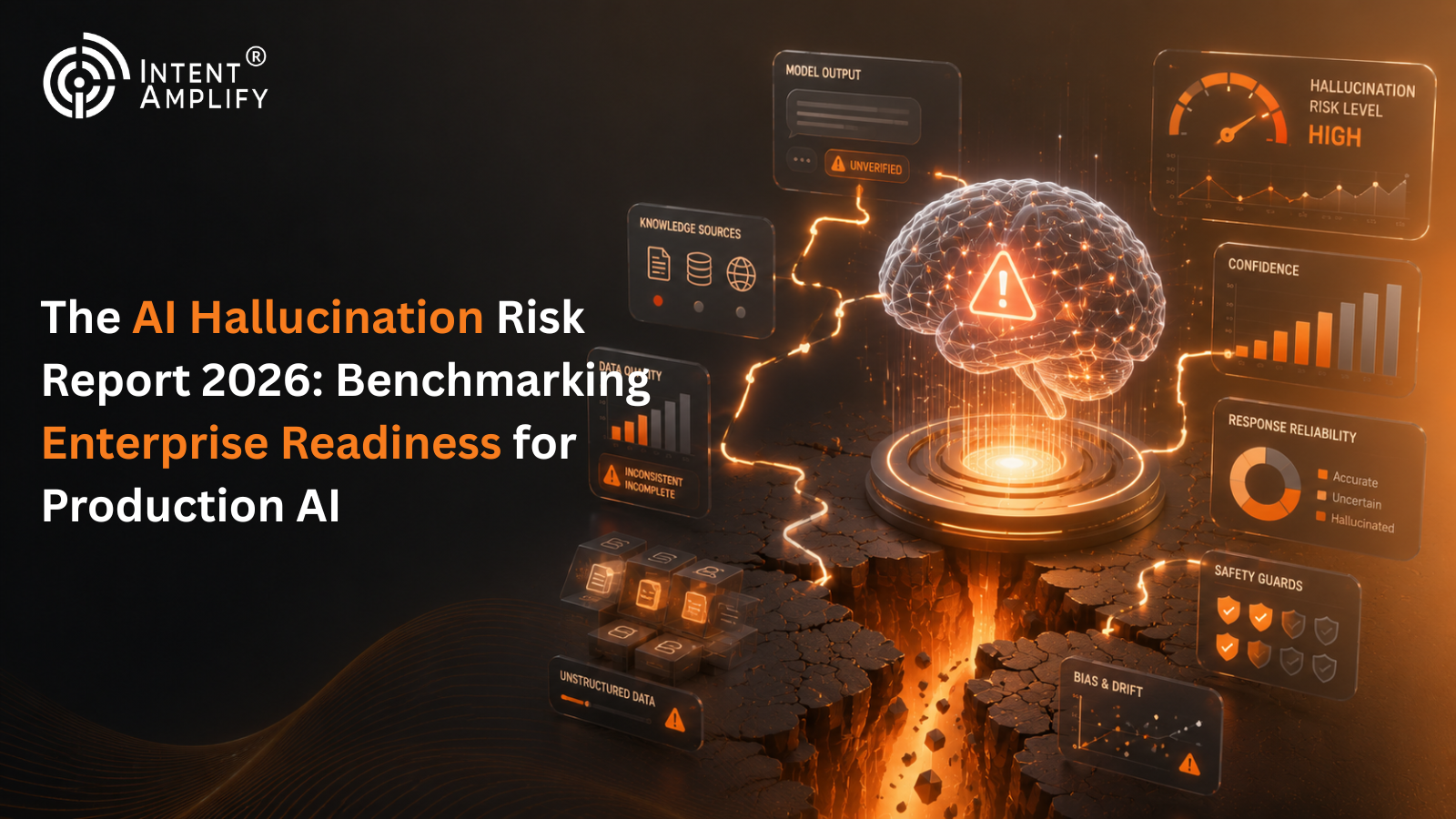
The AI Hallucination Risk Report 2026: Benchmarking Enterprise Readiness for Production AI

REPORT

The AI Hallucination Risk Report 2026: Benchmarking Enterprise Readiness for Production AI

Explore how enterprises can assess AI hallucination risk, benchmark production readiness, and build governance frameworks for reliable AI deployment.

Benchmarking Enterprise Readiness for Production AI

Enterprise AI is entering a phase where operational outcomes matter more than demonstration value.

In the pilot room, everything behaves. The model summarizes the document. The copilot drafts a response. The assistant compares supplier submissions and produces a clean risk table. Someone in the meeting says the word "transformational."

The problem begins after the demo.

Production AI does not live in a controlled showcase. It lives inside business processes, old knowledge bases, inconsistent document repositories, regional policy exceptions, unclear approval paths, impatient users, and systems of record that were not designed for probabilistic outputs. The model may be impressive.

That is where hallucination risk stops being an AI talking point and becomes an operating problem. For AI and machine learning leaders, this is the point where GenAI stops being a model-selection question and becomes a systems-engineering challenge. Heads of AI, VP Engineering teams, ML directors, data science leaders, and enterprise architects are being asked to move pilots into production while proving that answers are accurate, traceable, governed, and safe enough for real business workflows.

The usual definition of an AI hallucination is that a model produces false or unsupported information. That is true, but not sufficient. In enterprise settings, hallucination is more dangerous when the answer is not obviously ridiculous. A fake citation is embarrassing. A completely invented policy may get caught. The harder problem is a mostly right answer, written in a professional tone, and wrong in the one place where the business needed precision.

A summary that misses a carveout.
A compliance answer that applies the wrong regional rule.
A supplier-risk note that ignores a dependency hidden in an appendix.
A customer response that repeats last year's cancellation terms.

Nothing explodes immediately. That is part of the problem.

McKinsey's 2025 State of AI research shows how far AI adoption has already moved. Eighty-eight percent of organizations report regular AI use in at least one business function. That number sounds like maturity until the rest of the picture appears: only about one-third have started scaling AI enterprise-wide, and just 39% report enterprise-level EBIT impact. So the market has adoption. It does not yet have consistent enterprise readiness. For AI leaders, that gap is becoming the real mandate: prove that GenAI can move beyond isolated demos and deliver reliable, measurable value across production workflows. 1

This report is about that gap. Not whether AI is useful. It clearly is. Not whether hallucinations can happen. They can. The real question for 2026 is whether organizations are ready to put AI into production environments where accuracy, traceability, escalation, and responsibility actually matter.

The most dangerous hallucination is the one that fits the workflow

Enterprises already know what bad information feels like. They have lived with duplicate records, outdated spreadsheets, conflicting dashboards, stale policy documents.

AI has amplified existing information-quality challenges by making inaccurate outputs appear more authoritative and actionable.

That is the uncomfortable part. AI-generated output often arrives with confidence, structure, and fluency. It can sound like an analyst, a policy specialist, a legal researcher, a procurement lead, or a helpful customer service representative. It does not look like uncertainty. It looks like progress.

A rough answer slows people down. A polished answer moves.

It gets copied into a brief. It becomes the basis for a recommendation. It is pasted into a customer email. It appears in a dashboard summary. It shapes the next question in a meeting. By the time someone notices the issue, the answer may already have traveled through three systems and two departments.

This is why hallucination risk cannot be managed as a generic model-quality issue or solved only by switching to a stronger model. The same AI mistake can be harmless in one context and expensive in another. For AI engineering and data science teams, the real challenge is designing systems that understand workflow risk, retrieve the right evidence, expose uncertainty, and prevent unsupported answers from moving downstream. If a marketing team asks for campaign headline ideas and gets a few weak suggestions, the business survives. If a compliance team asks whether a process is permitted and receives a confident answer based on the wrong policy version, the situation changes.

Context decides risk.

A legal team using AI to summarize a contract does not only need a neat summary. It needs the system to understand hierarchy: the master agreement, the order form, the amendment, the side letter, the renewal clause, and the exception that modifies the standard indemnity language. A finance copilot explaining variance does not only need to read a spreadsheet. It needs to know whether the numbers are final, provisional, adjusted, disputed, or pulled from a system that has not been updated since the last close.

This is where many AI programs become vague.

They talk about "AI accuracy" as if accuracy were a single number floating above the organization. It is not. Accuracy has to be judged against the task, the available evidence, the user's role, and the consequences of being wrong.

The question is not, "Is the model good"

The better question is, "Is this system safe enough for this workflow"

That sounds less exciting. It is also the question serious organizations have to answer.

Adoption has outpaced the boring work

Most organizations are somewhere in the awkward middle.

They are no longer just experimenting, but they are not fully mature either. AI has spread across teams in practical, uneven ways. One business unit uses it for drafting. Another uses it for summarization. A third uses it inside a vendor platform. A fourth has built a small internal tool that everyone likes, but nobody has formally classified. Somewhere, someone is absolutely pasting sensitive information into a system they should not be using, because unauthorized AI usage remains a common challenge across large organizations.

This middle stage is where hallucination risk becomes difficult to see. For AI leaders, this middle stage creates a delivery trap. Business teams want faster rollout, but technical teams are still stitching together content pipelines, retrieval logic, prompts, permissions, evaluation sets, monitoring dashboards, and escalation rules. Without a repeatable production pattern, every GenAI use case becomes another custom build with its own hidden failure points.

McKinsey found that 51% of organizations using AI have experienced at least one negative consequence from AI use. Nearly one-third of respondents reported negative consequences tied specifically to AI inaccuracy. These are not future warnings. They are early signals from companies already using the technology. 1

The tricky part is that "AI inaccuracy" is rarely one clean failure. It may come from the model. Or from the prompt. Or from retrieval. Or from bad source data. Or from unclear instructions. Or from a human reviewer who assumed the output had already been checked by someone else.

That is why buying a stronger model is not the same as becoming production-ready.

Better models help. They reduce some failure patterns. They can reason better, follow instructions more consistently, and handle more complex inputs. But they do not repair the enterprise environment around them. They do not clean old repositories, reconcile policy versions, define review thresholds, assign business ownership, or decide when a customer-facing answer needs human approval.

The model is only one component of a broader production system that includes data quality, retrieval, governance, monitoring, and workflow design.

A procurement team may deploy an AI assistant to review supplier documentation. The model performs well in testing. Then real supplier files arrive: scanned PDFs, inconsistent naming conventions, missing schedules, different contract templates across regions, and attachments that were never uploaded because someone assumed "legal probably has them." When the AI produces a supplier-risk summary, is the risk in the model or in the document environment?

Production AI readiness means understanding the whole chain: data, retrieval, prompt design, permissions, user behavior, review process, monitoring, and escalation. If one part is weak, the risk of hallucination does not stay in that part. It leaks.

Grounded AI still needs checking.

Retrieval-augmented generation has become one of the preferred answers to hallucination risk. The logic is sound: instead of letting the model rely only on its training, connect it to approved sources and ask it to generate answers based on those materials.

This is necessary. It is not magic. For AI/ML teams, RAG should be treated as a production architecture, not a checkbox. Retrieval quality, chunking strategy, metadata discipline, source authority, reranking, access control, and citation validation all determine whether the system can deliver answers that users trust.

A Stanford/Yale study of leading legal AI research tools found that systems from LexisNexis and Thomson Reuters hallucinated between 17% and 33% of the time, even though they used retrieval-augmented generation. For a professional audience, that finding matters. These were not casual chatbots being asked random trivia. These were specialized tools in a high-stakes domain, supported by retrieval methods intended to improve reliability. 2

The lesson is not that RAG is bad. The lesson is that grounding reduces risk; it does not abolish it.

A retrieval system can find the wrong document. It can miss the right one. It can retrieve a relevant source and still fail to understand what the source allows. It can cite something adjacent to the answer rather than something that proves it. It can summarize a clause accurately but ignore an amendment that changes its effect.

Anyone who has worked with contracts, policies, claims, compliance documentation, technical manuals, or financial records will recognize the problem. The source is rarely just "the document." It is the current version, the applicable version, the executed version, the version for this region, the version after the amendment, the version that excludes this customer type, and the version approved after the audit finding.

If the AI system cannot distinguish those conditions, grounding may create a false sense of comfort.

This is where enterprise AI becomes less about clever prompting and more about information architecture. Are documents tagged correctly? Are old versions archived properly? Is access controlled by role? Are source systems synchronized? Can the AI tell a draft from an approved policy? Does it know that an addendum overrides the base agreement? Can reviewers see the evidence behind the answer?

These questions are not glamorous. They are also where many hallucination problems are born.

There is a reason production systems fail in mundane places. The flashy part gets attention. Metadata quality often determines whether retrieval systems perform reliably in production environments.

Want a Practical Framework for Building Reliable RAG Systems?

Understanding the risks of hallucinations is only half the challenge. The next step is implementing retrieval architectures that improve accuracy, traceability, and trust in enterprise AI applications.

Download The RAG Cookbook to explore practical strategies for retrieval optimization, grounding techniques, chunking methods, citation validation, and enterprise-ready RAG implementation.

Access the ebook: E-BOOK

Benchmarking readiness without turning it into a checklist nobody reads

A useful AI hallucination risk benchmark should not feel like another compliance worksheet that everyone fills out once and forgets until the next audit cycle. It needs to reflect how AI actually moves through an enterprise.

One place to start is visibility.

Before a company can manage hallucination risk, it needs to know where AI is being used. That includes approved tools, internal copilots, vendor features, and embedded AI. Shadow AI matters because hallucination risk does not wait for procurement approval.

Next comes the question of consequence.

Not every use case deserves the same amount of friction. A brainstorming assistant does not need the same controls as a tool supporting legal interpretation. An internal drafting tool is not the same as a customer-facing agent. A system that reads public help-center articles is not the same as one connected to contracts, employee data, claims records, or financial forecasts.

The enterprise has to decide which AI uses are low impact, which require review, which need strict source traceability, and which should not be automated without explicit approval.

Then comes testing.

This is where a lot of programs are too thin. Testing a system on clean examples proves very little. Real work is messy. A contract tool should be tested on layered agreements, missing attachments, amendments, conflicting clauses, and defined terms that appear harmless until page 47. A compliance assistant should be tested across jurisdictions, policy versions, and ambiguous employee questions. A customer support bot should be tested on edge cases, complaints, unusual account conditions, and outdated knowledge articles that still appear in search.

Vectara's hallucination benchmark is useful because it treats factual consistency as something that can be tested across a large document set, including more than 7,700 articles across domains such as law, medicine, finance, education, and technology. Enterprises do not need to copy that exact method, but they should take the principle seriously: hallucination should be measured against evidence, not discussed as an abstract possibility. 3

Review design is another weak point. "Human in the loop" is one of those phrases that sounds reassuring until you ask what it actually means. Which human? Reviewing what? With access to which source material? Before or after the output reaches the user? Are corrections tracked? Are repeated errors investigated? Does the reviewer understand the domain, or are they simply being asked to bless a machine-generated answer because the workflow required a checkbox?

Human review processes are effective only when reviewers have the expertise, evidence, and authority required to identify meaningful failures.

Finally, a production AI system needs a failure path. If the AI gives a wrong answer, where does that event go? Is it logged? Does anyone review patterns? Can the system be paused? Can retrieval rules be changed? Can a prompt be updated? Can a vendor model update trigger retesting? Can business users report issues without opening a ticket that disappears into a queue called "AI feedback"

The difference between immature and mature organizations is not that mature organizations never see hallucinations. It is that they see them, learn from them, and stop them from becoming larger failures.

When AI starts taking action, the margin for vagueness disappears

The hallucination conversation gets sharper with agentic AI.

A chatbot answers. An agent can do something with it.

It can update a customer record, route a support case, trigger a procurement workflow, prepare an approval recommendation, send a message, create a ticket, or coordinate several steps across systems. This is where the promise of AI becomes more operational, and the risk becomes less theoretical.

McKinsey found that 23% of organizations are already scaling agentic AI somewhere in the enterprise, while another 39% are experimenting with AI agents. Those numbers suggest that agentic AI is already moving beyond isolated experimentation and into real enterprise planning. 1

Gartner predicts that by 2028, at least 15% of day-to-day work decisions will be made autonomously through agentic AI. Gartner also expects 33% of enterprise software applications to include agentic AI by 2028, up from less than 1% in 2024. Those forecasts suggest agentic AI will not stay in the lab. It will appear inside the tools people already use, sometimes as a feature rather than a separate system. 4

That matters because users may not always experience it as "deploying an AI agent." They may experience it as a new button, a recommended action, an automated step, or a workflow that suddenly completes itself.

The risk question changes from "Is the answer correct" to "What authority does the answer have"

Can the agent read sensitive data? Can it write to a system of record? Can it send external communication? Can it approve, reject, escalate, refund, renew, reorder, or modify? Does it need confirmation? Can the action be reversed? Is there a log that explains what happened in language a human can understand?

This is where vague governance becomes dangerous. An agent with unclear authority is not just a smart assistant. It is a process actor with uncertain boundaries.

Gartner has also predicted that more than 40% of agentic AI projects will be canceled by the end of 2027 due to issues such as unclear value, rising costs, or inadequate risk controls. That prediction should not be read as an argument against agents. It is a warning against treating autonomy as a feature upgrade rather than an operating model change. 4

If the AI can act, the enterprise needs permission tiers, approval gates, and rollback. Otherwise, the organization may discover, too late, that it automated a decision it never fully understood.

The serious test: can the system stop itself?

A lot of AI programs measure whether the system can answer. Fewer measure whether it knows when not to.

That may become one of the most important signs of production readiness.

In many enterprise workflows, refusal is not failure. It is good judgment. If the available sources do not support a reliable answer, the system should be able to say so. If the confidence level is low, it should escalate. If documents conflict, it should surface the conflict instead of smoothing it into a tidy conclusion. If the question asks for something outside the approved knowledge base, it should not be improvised.

This is not about making AI timid. It is about making it appropriately bounded.

NIST's AI Risk Management Framework is intended to help organizations incorporate trustworthiness considerations into the design, development, use, and evaluation of AI products, services, and systems. Its Generative AI Profile applies that risk-management approach specifically to generative AI, based on the organization's requirements, risk tolerance, and resources. That lifecycle view matters because a one-time launch review cannot manage a system whose behavior may change as data, users, models, prompts, integrations, and business rules change.

The organizations that handle hallucination risk well will likely have a few habits in common. They will know which AI systems are in use. They will classify use cases by consequence. They will test with real examples, not demo-friendly ones. None of this sounds as exciting as announcing a new enterprise AI strategy.

Research Summary

AI hallucination risk is not a reason to retreat from production AI. It is a reason to stop treating production AI like a longer pilot with better branding.

The enterprises that succeed in 2026 will not be the ones pretending every AI answer can be perfect, or that the next model release will quietly remove every accuracy problem. They will be the ones who understand where AI is useful, where it is fragile, where the evidence behind an answer matters, and where the system should stop instead of improvising.

That is the real benchmark.
Not how many workflows have been automated.
Not how impressive the demo looked in the strategy meeting.

The real benchmark is whether the organization can use AI without surrendering judgment to it.

Because production AI is not just about faster answers. It is about knowing which answers deserve to travel through the business.

And when the model is wrong, the question that matters most is not whether the error was possible.

It always was.

The question is whether the enterprise was ready to catch it before it became a decision.

In 2026, the organizations most exposed to AI hallucination risk may not be those using AI most aggressively. They may be the organizations deploying it most confidently without understanding where their information breaks down.

References

  1. McKinsey & Company -- The State of AI in 2025: Agents, Innovation, and Transformation -- November 2025
  2. Stanford University -- Hallucination-Free? Assessing the Reliability of Leading AI Legal Research Tools -- 2024
  3. Cottrill Research -- AI Hallucination Benchmark Resources Added to Index Collection -- 2025
  4. Gartner -- Gartner Predicts Over 40% of Agentic AI Projects Will Be Canceled by End of 2027 -- 25 June 2025
Prabhanshi   Singh

Prabhanshi Singh

Research Analyst

Contact us for Report

AI Hallucination Risk Report 2026: Enterprise Readiness