
EXECUTIVE SUMMARY
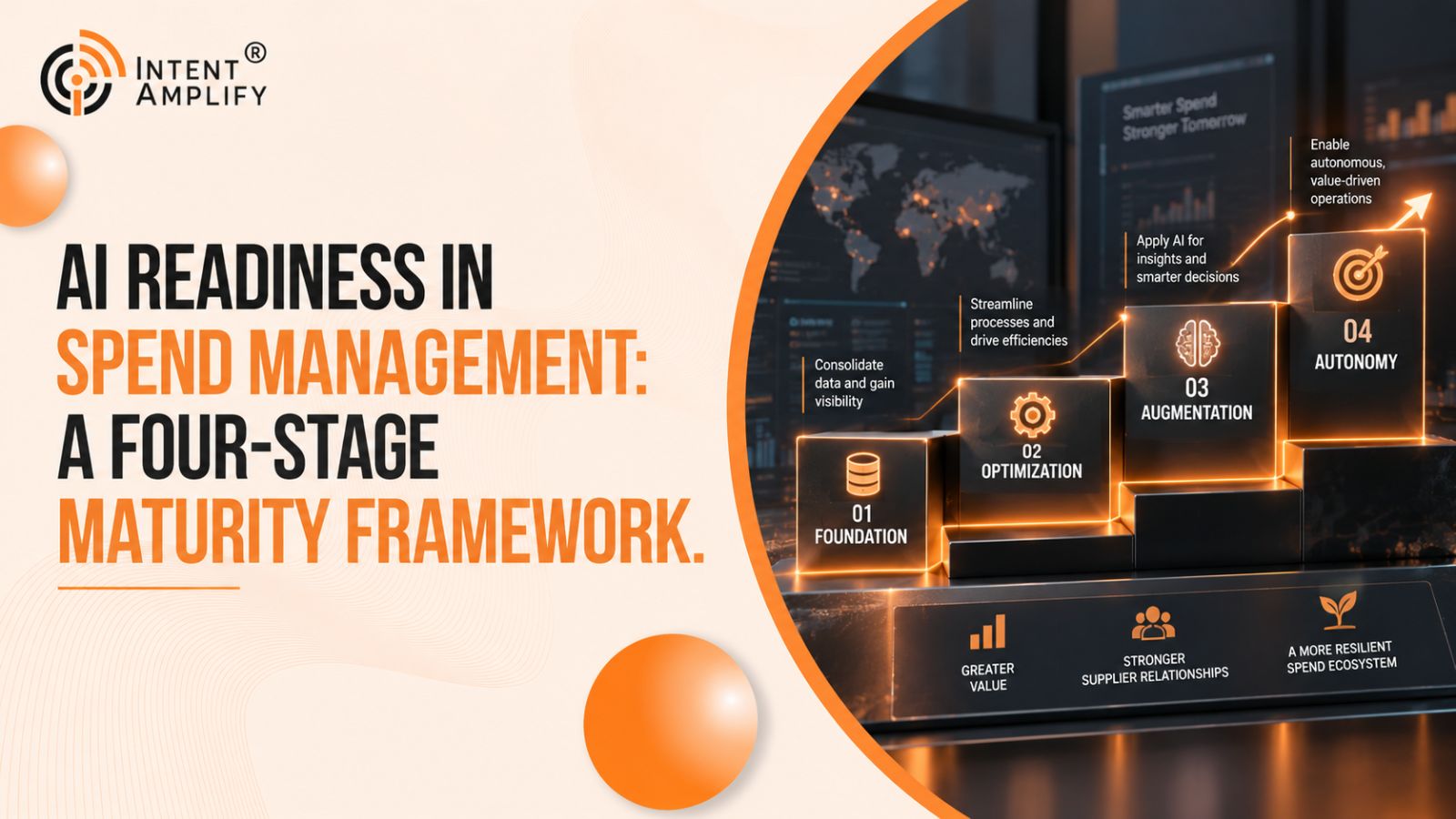
The move toward Autonomous Spend Management is best understood as a maturity journey. Coupa’s 2026 source material describes four stages: tactical AI support, digital assistants, collaborative AI partners, and preparation for fully autonomous operations. Progress depends not only on AI capability but also on data quality, process standardization, governance, integration, supplier participation, change management, and measurement.
The report’s central finding is that readiness is multidimensional. An organization can have access to advanced AI while remaining operationally unprepared for autonomous decisions. Conversely, foundation work in data, workflow design, and governance can create immediate value while preparing the organization for more advanced AI later.
MARKET CONTEXT FROM THE SOURCE
Coupa’s 2026 source material describes a business environment shaped by economic volatility, geopolitical uncertainty, supply-chain disruption, tariff complexity, price volatility, sustainability requirements, and growing expectations for measurable AI outcomes. It argues that traditional spend environments can struggle because data and processes remain fragmented across functions and systems.
Coupa’s 2026 source material positions Coupa Autonomous Spend Management as an AI-native response built around a business trade network connecting buyers and suppliers. The model combines Design-to-Pay workflows, supplier participation, community-generated spend data, and a portfolio of AI agents.
SOURCE-DERIVED PLATFORM CONTEXT
Coupa’s 2026 campaign source states that Coupa AI is informed by more than $8 trillion in transactional spend data from over 10 million buyers and suppliers. These figures are presented here as Coupa-attributed claims; organizations should validate current platform, data-governance, privacy, and security details directly with Coupa for their intended use case.
Coupa’s 2026 source material also organizes Coupa’s strategic roadmap into four pillars: enhance the Design-to-Pay platform for buyers; empower supplier engagement and discovery; create richer buyer-seller collaboration; and build an AI agent-native engagement layer.
These source-derived facts establish the context for the maturity framework below. They do not, by themselves, establish the readiness or expected results of any specific organization.
MATURITY STAGE 1: TACTICAL AI SUPPORT
Operating profile
Organizations at Stage 1 use AI primarily to assist operational work. Coupa’s 2026 source material describes agents acting as advisors while the organization may still experience disjointed processes, unstructured purchasing, and limited strategy.
Typical priorities
- Improve intake and routing.
- Reduce repetitive manual work.
- Support matching and compliance checks.
- Identify obvious process exceptions.
- Create a baseline for current performance.
Primary risks
- Deploying AI into inconsistent workflows.
- Using incomplete or unstructured data.
- Treating isolated automation as end-to-end transformation.
- Failing to establish baseline metrics.
Evidence required to advance
- Priority workflows documented.
- Critical data owners identified.
- Core policies and exception rules defined.
- Baseline KPIs available.
- Users trained on the role of AI assistance.
MATURITY STAGE 2: DIGITAL ASSISTANTS
Operating profile
Stage 2 reflects more unified spend processes and greater stakeholder alignment. AI is embedded into workflows as a digital assistant, supporting sourcing, contract lifecycle management, intake, spend analysis, monitoring, and related activities.
Typical priorities
- Create frictionless intake paths.
- Improve visibility through reports and dashboards.
- Use AI-supported spend analysis and monitoring.
- Expand structured sourcing and contract workflows.
- Improve supplier information and participation.
Primary risks
- Scaling assistants without consistent governance.
- Creating multiple AI experiences that do not share context.
- Ignoring supplier-side process friction.
- Allowing recommendations to become de facto decisions without defined accountability.
Evidence required to advance
- Consistent workflow adoption.
- Documented decision rights.
- Reliable supplier and contract data.
- Defined human-review thresholds.
- Demonstrated improvement against at least one verified baseline.
MATURITY STAGE 3: COLLABORATIVE AI PARTNERS
Operating profile
At Stage 3, agents become more consistent collaborators in strategic activities. Coupa’s 2026 source material highlights category strategy as an area where AI can support analysis, scenario development, business-needs understanding, supplier landscape evaluation, and risk considerations.
Typical priorities
- Use agents to accelerate strategic analysis.
- Connect category planning with execution.
- Coordinate specialized agents across workflows.
- Strengthen buyer-supplier collaboration.
- Expand scenario analysis while preserving human accountability.
Primary risks
- Overreliance on recommendations that are not sufficiently explainable.
- Unclear ownership across multi-agent workflows.
- Insufficient monitoring of changing data and business conditions.
- Expanding autonomy faster than controls mature.
Evidence required to advance
- Agent recommendations are measurable and reviewable.
- Exception rates and escalation patterns are understood.
- Cross-functional governance is operating consistently.
- Audit trails support post-decision review.
- Users demonstrate appropriate reliance rather than blind acceptance.
MATURITY STAGE 4: AUTONOMOUS OPERATIONS
Operating profile
Coupa’s 2026 source material describes Stage 4 as an environment in which AI agents make and execute more decisions with minimal human intervention across an end-to-end Design-to-Pay platform. Sourcing, procurement, invoicing, contracts, risk management, payments, and expenses are connected through a common operating foundation.
Readiness prerequisites named by the source
- Data quality foundation.
- Process standardization.
- Governance frameworks.
- Change management.
Additional executive requirements
- Clear autonomy thresholds.
- Continuous monitoring.
- Strong exception management.
- Accountability for agent actions.
- Verified performance evidence.
- A defined rollback or intervention path for high-impact workflows.
Primary risks
- Automating incorrect assumptions at scale.
- Control gaps between agents or systems.
- Insufficient human visibility into exceptions.
- Performance drift as conditions change.
- Unverified claims of value or readiness.
CROSS-STAGE READINESS DIMENSIONS
Data readiness
Question: Is the information required for the decision complete, structured, current, permissioned, and governed?
Stage progression: from identifying fragmented data to using trusted data across increasingly autonomous workflows.
Process readiness
Question: Is the workflow standardized enough to automate?
Stage progression: from mapping the current process to managing end-to-end autonomous execution with explicit exceptions.
Governance readiness
Question: Are human and AI decision rights explicit?
Stage progression: from basic review of AI assistance to formal autonomy thresholds, monitoring, and auditability.
Integration readiness
Question: Can systems and participants exchange the context required for the workflow?
Stage progression: from isolated assistance to connected Design-to-Pay orchestration.
Supplier readiness
Question: Can suppliers participate effectively in the intended process?
Stage progression: from basic onboarding and information quality to real-time collaboration across forecasts, quality, inventory, and transactions.
Measurement readiness
Question: Is there a verified baseline for the intended outcome?
Stage progression: from establishing current-state metrics to continuous performance monitoring and evidence-based expansion.
Change readiness
Question: Do people understand their roles as AI takes on more work?
Stage progression: from AI literacy to redesigned roles, escalation practices, and confidence in autonomous workflows.
EXECUTIVE KPI SCORECARD
The correct KPI set depends on the use case. The following measures are appropriate candidates, but this report does not claim any current or future performance level.
Cycle time — elapsed time through the target workflow.
Manual touch rate — percentage of transactions requiring human intervention.
Exception rate — percentage of transactions leaving the normal path.
Policy compliance — share of activity following defined controls.
Supplier participation — share of relevant suppliers using the intended digital workflow.
User adoption — share of target users completing work through the designed path.
Data quality — completeness, accuracy, and timeliness of critical fields.
Decision escalation — volume and type of agent decisions requiring human review.
Outcome realization — verified business result tied to the original use-case hypothesis.
READINESS SCORING METHOD
Leaders can rate each dimension as Foundation, Developing, Operational, or Autonomous-Ready.
Foundation: ownership or evidence is incomplete.
Developing: standards and controls are defined but inconsistently applied.
Operational: the dimension is working reliably for the target use case and is measurable.
Autonomous-Ready: the dimension has sufficient evidence, governance, and monitoring to support increased agent autonomy.
A single overall score should not hide weak dimensions. For example, strong technology and integration do not compensate for unclear decision rights. Readiness should be limited by the weakest critical control required for the use case.
IMPLEMENTATION PRIORITIZATION
Coupa’s 2026 source material recommends focusing on pain-point intensity, financial impact, and change readiness. A practical prioritization model can add data readiness and decision risk.
Pain-point intensity: How much friction or compliance exposure exists today?
Business impact: How meaningful is the outcome if the process improves?
Change readiness: Are users and leaders prepared to adopt a new model?
Data readiness: Is the required information sufficiently reliable?
Decision risk: What is the consequence of an incorrect automated action?
High-impact, high-readiness, lower-risk workflows are strong candidates for early implementation. High-impact but poorly governed workflows should begin with foundation work rather than immediate autonomy.
RESEARCH INTERPRETATION
Coupa’s 2026 source material presents several customer examples and performance outcomes. This report does not generalize those results to other organizations. Customer outcomes depend on scope, baseline, implementation, adoption, process design, and other conditions not established by Coupa’s 2026 source material.
Coupa’s 2026 source material also cites external research, including the 2025 Deloitte Global Chief Procurement Officer Survey and MIT NANDA. Because this report is grounded only in Coupa’s 2026 source material and does not independently verify those publications, their cited findings are not used as independent evidence here.
EXECUTIVE DECISION FRAMEWORK
Before approving a move to greater autonomy, require evidence for seven questions:
1. What specific decision or workflow is being delegated?
2. What verified baseline demonstrates the current problem?
3. What data will the agent use, and who owns its quality?
4. What rules govern the agent’s action space?
5. When must a human intervene?
6. What KPI will determine whether the change works?
7. What evidence is required before autonomy expands?
If any answer is unknown, the organization has identified a readiness gap—not necessarily a reason to stop, but a requirement to resolve.
WHERE THE CAMPAIGN E-BOOK FITS
“Simplified Expense Management: The Definitive Guide for Beginners” provides the source framework behind this report. It introduces Coupa’s business trade network, four roadmap pillars, community-generated AI approach, and four-stage journey toward Autonomous Spend Management.
GOVERNANCE MATURITY ACROSS THE FOUR STAGES
Governance should evolve with the role AI plays in the workflow.
At Stage 1, leaders need basic ownership, acceptable-use guidance, review practices, and clear limits on AI assistance.
At Stage 2, governance must cover embedded recommendations, data access, human-review thresholds, and consistency across digital assistants.
At Stage 3, organizations need stronger controls for collaborative agents, including recommendation quality, multi-agent coordination, overrides, and audit trails.
At Stage 4, governance becomes an operating capability for autonomous decisions, continuous monitoring, exception management, intervention, and accountability.
The important principle is proportionality.
A low-impact, reversible recommendation does not require the same control environment as a material action affecting a supplier, contract, payment, or compliance obligation.
Organizations should classify decisions by impact, reversibility, policy sensitivity, and confidence in the underlying data.
That classification can determine the permitted autonomy level and required review.
Maturity is demonstrated when these rules operate consistently in practice, not merely when a policy document exists.
Evidence should include observed exceptions, overrides, escalations, and control outcomes.
DATA READINESS AS AN OPERATING DISCIPLINE
Data readiness is often described as a prerequisite, but it is better treated as a continuing discipline.
Spend workflows depend on supplier identities, categories, contracts, orders, receipts, invoices, payment information, policies, and other contextual records.
Each critical field should have an owner, quality expectation, update process, permission model, and exception path.
At early maturity stages, the objective may be to identify fragmentation and establish ownership.
At later stages, the objective shifts toward maintaining reliable context for increasingly automated decisions.
Leaders should distinguish completeness from fitness for purpose.
A dataset can be technically complete while still being too stale, inconsistent, or ambiguous for a particular decision.
Readiness reviews should therefore ask what information the agent needs, how current it must be, and what happens when confidence is insufficient.
Missing or conflicting context should trigger defined handling rather than silent assumptions.
This is especially important when decisions cross organizational boundaries and depend on supplier-provided information.
SUPPLIER AND ECOSYSTEM READINESS
The maturity framework is incomplete if it measures only internal capability.
Coupa’s 2026 source material positions supplier engagement and buyer-seller collaboration as core parts of the future model.
That means readiness must include the external path through which suppliers provide information, receive documents, resolve exceptions, and participate in collaborative workflows.
At Stage 1, leaders can identify where supplier interactions remain manual or inconsistent.
At Stage 2, they can improve profiles, intake, catalogs, and structured transaction participation.
At Stage 3, collaboration can extend into more strategic activities where shared context matters.
At Stage 4, external workflows must support reliable automation without obscuring accountability or exceptions.
Useful evidence can include participation, data completeness, exception patterns, and the time required to resolve supplier-side issues.
The purpose is not to maximize a generic supplier metric.
It is to determine whether external participation supports the target workflow at the intended autonomy level.
MEASUREMENT DESIGN BY MATURITY STAGE
Measurement should become more demanding as the organization advances.
Stage 1 needs a trustworthy current-state baseline and evidence that bounded assistance improves the intended workflow without creating unacceptable control issues.
Stage 2 should add adoption, exception, and workflow-consistency measures because assistants are embedded more broadly.
Stage 3 should examine recommendation quality, human overrides, escalation patterns, and whether strategic users rely on agents appropriately.
Stage 4 requires continuous outcome and control monitoring because agents may execute more decisions directly.
Leaders should preserve stable metric definitions across the evaluation period.
Changing a KPI definition after implementation can make apparent improvement difficult to interpret.
They should also separate leading indicators from realized outcomes.
For example, higher use of an intended workflow can indicate adoption, but it does not by itself prove financial or operational value.
Likewise, fewer manual touches may indicate automation, but leaders still need evidence that decision quality and controls remain acceptable.
A mature measurement model connects activity, control, adoption, and business outcomes without treating any single metric as sufficient.
MATURITY REVIEW CADENCE
Readiness is not permanent.
Data changes, suppliers change, policies evolve, workflows are redesigned, and AI behavior can be affected by new context.
Organizations should therefore establish a review cadence appropriate to the impact of the use case.
The review should examine performance evidence, exceptions, overrides, control incidents, data-quality issues, user behavior, and supplier participation.
It should also confirm that autonomy boundaries still match business risk.
When evidence weakens, the correct response may be to reduce scope, increase review, or return a workflow to an earlier maturity posture while issues are resolved.
When evidence remains strong, leaders can consider expansion against predefined criteria.
This makes the four-stage framework a continuing management system rather than a one-time transformation label.
Explore the e-book: Simplified Expense Management: The Definitive Guide for Beginners
CONCLUSION
AI readiness in spend management cannot be reduced to technology availability. The maturity journey is an operating-model progression. Data, workflows, governance, supplier participation, measurement, and people must mature alongside agent capability. Organizations that treat each stage as an evidence gate can pursue autonomy deliberately—building confidence through verified outcomes rather than assumptions.
REFERENCES
1. Gartner — Assess the Readiness of Your Procurement Organization for AI Adoption (13 March 2026): https://www.gartner.com/en/documents/7592798
2. Gartner — How to Prioritize AI Use Cases in Procurement (2026): https://www.gartner.com/en/documents/8150329
3. Deloitte — CFO Insights: AI Cost, Risk and ROI (18 March 2026): https://www.deloitte.com/us/en/programs/chief-financial-officer/articles/cfo-insights-ai-cost-risk-roi.html
4. Microsoft — AI in Financial Services: Bringing Trusted Data into the Flow of Work (25 June 2026): https://www.microsoft.com/en-us/microsoft-cloud/blog/financial-services/2026/06/25/ai-in-financial-services-bringing-trusted-data-into-the-flow-of-work/
5. Oracle — Oracle Expands AI Agent Studio for Fusion Applications with Agentic Applications Builder (24 March 2026): https://www.oracle.com/news/announcement/oracle-expands-ai-agent-studio-for-fusion-applications-with-agentic-applications-builder-2026-03-24/