
Industry Context: The Agent Workforce Is Becoming an Operating-Model Question
Agentic AI is moving the supply-chain conversation beyond individual copilots and isolated automation. The more consequential question is how multiple agents should operate across supplier risk, plant operations, and aftermarket service without recreating the same functional silos that already slow enterprise decisions.
The DataRobot and Supply Chain Now on-demand webinar, $2.5B in 72 Hours: What Agentic AI Looks Like When It Actually Works, presents examples across these domains and describes a tariff scenario involving $2.5 billion in revenue risk addressed in 72 hours rather than weeks, with human sign-off retained throughout the workflow.[1]
The lesson is not that organizations need as many agents as possible. It is that an agent workforce should be designed as a portfolio of bounded jobs. Each digital role needs a trigger, evidence set, tools, permissions, escalation path, owner, and success measure.
For supply-chain leaders, this makes orchestration more important than agent count.
Emerging Trend: From Isolated Agents to Coordinated Decision Workflows
A supply-chain agent may qualify supplier exposure. A planning agent may assemble shortage context. A plant agent may investigate an operational exception. An aftermarket agent may prepare service options. Each role can be useful independently, but the larger value emerges when the handoffs are designed deliberately.
One agent's output should not automatically become another agent's verified fact. Handoffs need to preserve provenance, confidence, unresolved questions, and the authority attached to each recommendation.
This matters because the domains operate with different evidence and consequences. Procurement may own supplier terms. Planning may own demand and inventory assumptions. Operations may own production constraints. Finance may own economic baselines. Service may own warranty and customer-priority rules. IT may control system access.
DataRobot's manufacturing offering describes AI workflows that connect operational signals with scenario modeling, ranked responses, and approved actions in enterprise systems.[2]
Expert Perspective: Every Agent Needs an Operating Contract
The “agent workforce” metaphor is useful only if it reinforces accountability.
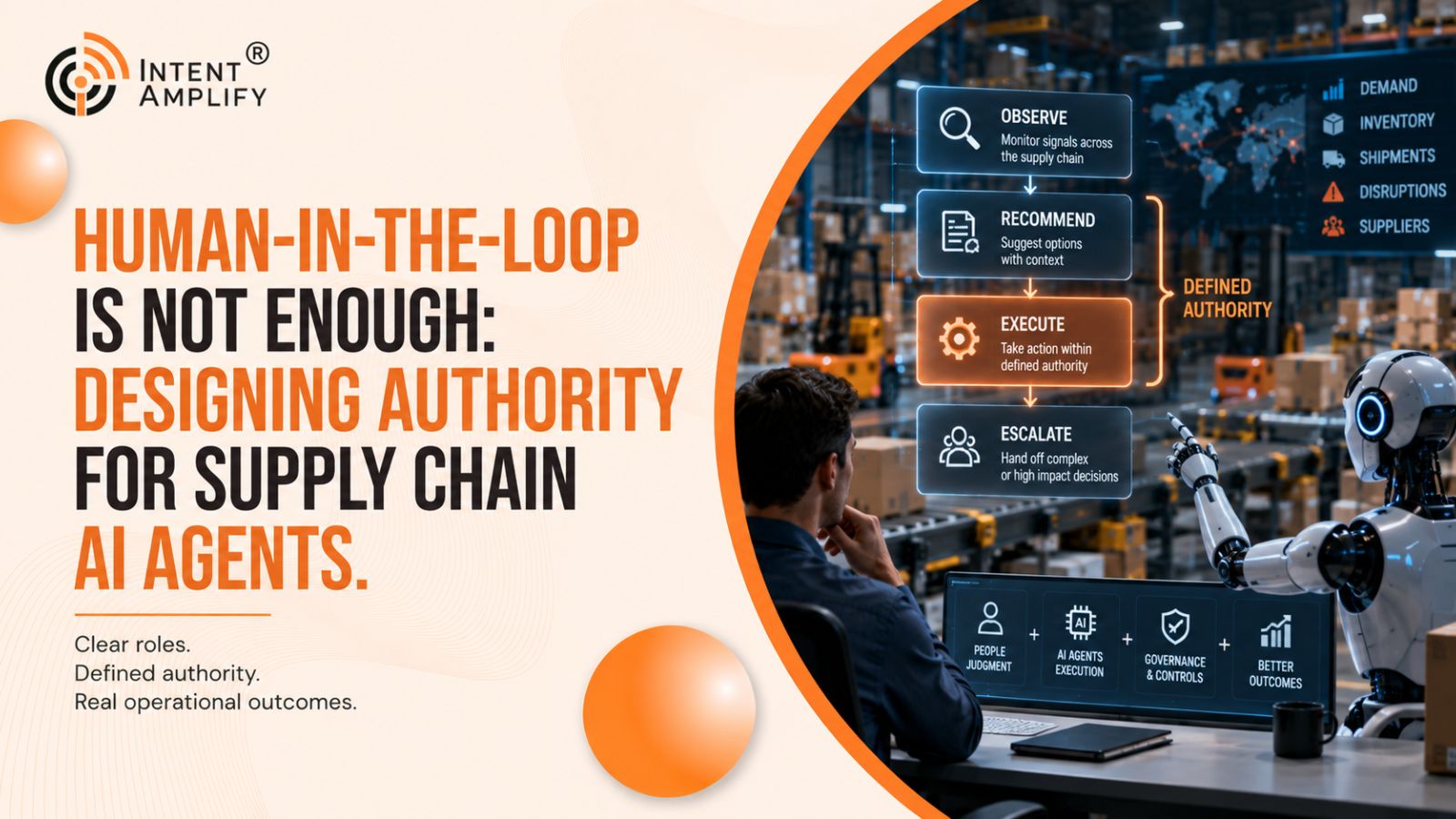
A human employee has a role, access policy, manager, performance expectations, and escalation path. A production agent needs the digital equivalent. Its operating contract should define purpose, trigger, evidence, permitted tools, recommendation types, execution permissions, human approvals, stop conditions, audit requirements, rollback path, KPI, and accountable owner.
That contract should also state what the agent must not do. An agent that can read supplier data may not be authorized to alter sourcing commitments. An agent that identifies a plant constraint may be able to recommend resequencing without being permitted to change the production schedule. An aftermarket agent may assemble warranty evidence while a human retains authority over a high-cost service decision.
DataRobot's enterprise work on agentic AI infrastructure emphasizes deployment, monitoring, governance, and operational control as organizations move agents into production environments.[3]
Market Implications: Different Domains Need Different Autonomy Models
Supply-chain, plant, and aftermarket workflows should not inherit one universal autonomy policy.
Supplier-risk decisions often require multi-tier dependency context, commercial terms, inventory positions, demand assumptions, and sourcing authority. The cost of delay can increase when response windows close or alternative supply becomes constrained.
Plant operations work on a different clock. Equipment signals, throughput changes, quality conditions, maintenance needs, and production constraints can create immediate operational consequences. An agent may help connect an anomaly to likely business impact, but maintenance, quality, production, and safety rules need to remain explicit.
Aftermarket service introduces another decision model. Warranty eligibility, parts availability, technician capacity, failure history, customer priority, service cost, and retained margin can all shape the next action.
DataRobot's collaboration with Chevron on agentic AI for autonomous inspections illustrates the broader move toward agentic systems operating closer to real-world industrial processes.[4]
Orchestration Matters More Than Agent Count
A collection of isolated agents can recreate organizational fragmentation in digital form.
If every agent maintains separate context, permissions, evidence rules, and exception logic, teams may gain automation while losing coherence. The stronger operating model standardizes how agents establish identity, access systems, evaluate evidence, record provenance, escalate uncertainty, and report outcomes.
Common controls also make expansion easier. A new agent role should not require governance to be invented from scratch. Reusable patterns for permissions, evidence quality, observability, exception handling, and review can create a more scalable foundation.
Supply Chain Now's discussion of scaling agentic AI from pilots to performance emphasizes the move from experimentation toward enterprise execution.[5]
Recommendations: Building a Production-Ready Agent Workforce
Here are the recommendations from Intent Amplify for supply-chain and manufacturing leaders designing coordinated agentic workflows.
1. Define Jobs Before Agents
Begin with recurring operational jobs rather than generic agent capabilities. Document the trigger, evidence, decision boundary, expected output, owner, and measurable outcome for each role.
2. Separate Observation from Authority
Distinguish what an agent can observe, qualify, recommend, approve, execute, and verify. These are different permissions and should not be bundled automatically.
3. Standardize Handoff Evidence
When work moves between agents or functions, preserve source provenance, freshness, assumptions, confidence, unresolved questions, and approval status.
4. Design Domain-Specific Escalation
Supplier, plant, and aftermarket workflows carry different consequences. Define escalation thresholds according to business impact, reversibility, evidence quality, safety considerations, customer commitments, and financial exposure.
5. Measure the Workflow, Not the Workforce
Track decision cycle time, exception frequency, failed actions, human overrides, reopened cases, approval delays, and verified outcomes. Agent count and task volume are activity measures, not proof of operational value.
Conclusion: Digital Workforces Need Visible Accountability
Agentic AI can help supply-chain organizations coordinate work that currently crosses multiple systems and functions. But scaling that model requires more than deploying additional agents.
Every digital role needs a bounded job, clear evidence requirements, defined permissions, accountable ownership, safe failure behavior, and measurable outcomes. The handoffs between agents deserve the same design attention as the agents themselves.
The DataRobot and Supply Chain Now webinar provides a practical view of this operating model across supplier risk, plant operations, and aftermarket service.[1]
Build Stronger Demand Around Agentic Supply Chain Transformation
Intent Amplify helps B2B technology companies turn complex agentic AI, manufacturing, and supply-chain transformation themes into credible thought leadership, market education, and demand-generation programs for senior buyers.
Through content strategy, research-led assets, content syndication, and buyer-focused demand generation, Intent Amplify helps technology brands translate advanced enterprise solutions into clear executive value.
Watch the on-demand webinar: $2.5B in 72 Hours: What Agentic AI Looks Like When It Actually Works.
References
1. Supply Chain Now (2026) $2.5B in 72 Hours: What Agentic AI Looks Like When It Actually Works. Available at:
https://supplychainnow.com/2-5b-in-72-hours-what-agentic-ai-looks-like-when-it-actually-works/
2. DataRobot (2026) AI for Manufacturing. Available at:
https://www.datarobot.com/solutions/manufacturing/
3. DataRobot (2026) DataRobot Accelerates Adoption of Agentic AI for the Enterprise on the Dell AI Factory with NVIDIA. Available at:
4. DataRobot (2026) DataRobot and Chevron Collaborate to Advance Agentic AI for Autonomous Inspections. Available at:
5. Supply Chain Now (2026). From AI Pilots to Performance: How Supply Chain Leaders Are Scaling Agentic AI. Available at:
https://supplychainnow.com/ai-pilots-to-performance-how-supply-chain-leaders-scaling-agentic-ai/