
Executive Summary
Physical retail is entering a more demanding phase of AI maturity. The early conversation focused on automation, personalization, self-checkout, and digital convenience. Those capabilities remain important, but they do not fully address the operating reality of modern stores. Enterprise retailers now need systems that can interpret customer intent, connect product discovery to availability, guide associates, prioritize operational tasks, and support governed decisions across the store environment.
Deloitte's 2026 Global Retail Industry Outlook reports that 68% of retail executives expect agentic AI adoption within the next 12 to 24 months, while chat-based tools are already driving 15% to 20% of referrals for some retailers.1
This marks a decisive shift from digital experimentation to AI-enabled commerce execution.
At the same time, Salesforce reported in June 2026 that AI influenced 20% of global online sales, worth $262 billion, and that retailers running their own shopper agents grew sales 59% faster than retailers that had not moved in that direction.2
Product discovery, customer engagement, and retail conversion are no longer shaped only by websites, apps, and store signage. They are increasingly shaped by AI agents that interpret intent before the customer reaches a shelf, checkout counter, or brand-owned channel.
For U.S. enterprise executives, this creates a strategic retail question: how should the physical store evolve when discovery, decision-making, and customer expectations are increasingly AI-mediated?
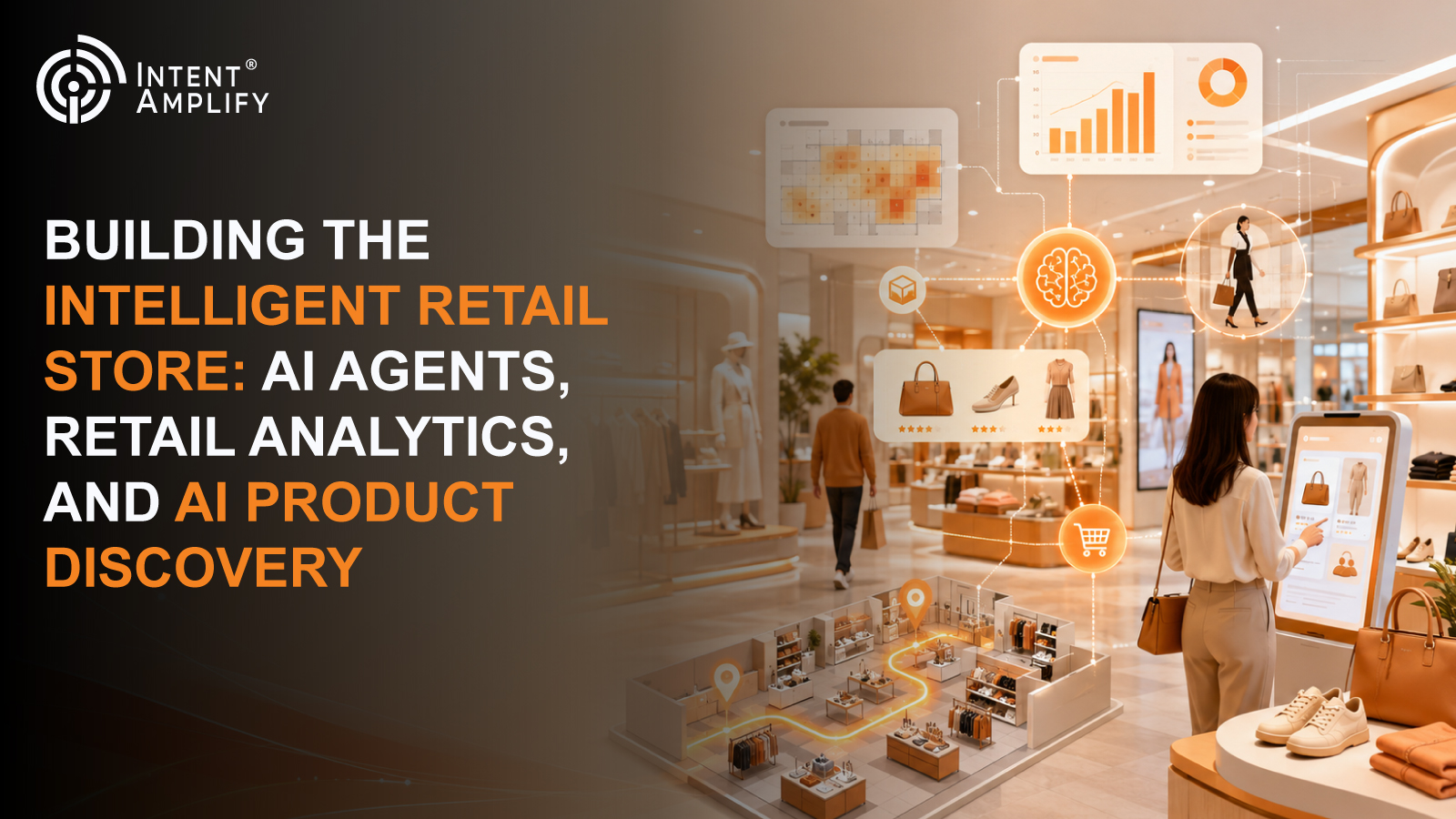
The answer is not to treat stores as legacy channels that need more isolated automation. The answer is to build intelligent retail stores where AI agents, retail analytics, product data, associate workflows, and governance controls operate as a connected system. In this model, analytics does more than report past performance. It guides the next actions. AI agents do more than answer questions. They support task execution, product discovery, service recovery, inventory decisions, and associate enablement. Product discovery does more than improve search results. It helps connect customer intent to available, explainable, and fulfillable choices.
Intent Amplify Research Perspective
The intelligent retail store is not defined by the number of AI tools deployed inside the location. It is defined by whether the store can sense demand, interpret context, guide human action, and improve outcomes across availability, service, conversion, workforce productivity, and trust.
The Store Is Becoming an Intelligence Layer
The physical store has traditionally been measured through sales performance, customer service, fulfillment, and brand experience. Retail operating models are expanding beyond those functions. Stores increasingly serve as intelligence hubs where customer interactions, localized demand, associate activity, inventory movement, returns, shrink indicators, product engagement, and omnichannel fulfillment generate operational signals that support continuous decision-making.
Retail performance is determined by thousands of operational decisions made throughout the trading day. Customer inquiries reveal product intent. Inventory lookups expose availability constraints. Shelf gaps emerge before replenishment workflows begin. Promotional activity generates uneven demand across locations. Click-and-collect orders compete with in-store service capacity. Returns patterns may indicate product quality concerns, merchandising issues, or customer confusion. Individually, these events appear routine. Collectively, they provide the operational context required to improve inventory allocation, workforce deployment, merchandising execution, and customer experience. Enterprise value depends on integrating these signals into a coordinated decision framework rather than managing them as isolated operational events.
McKinsey's The State of AI in 2025 found that 88% of surveyed organizations regularly use AI in at least one business function, while 62% are at least experimenting with AI agents, including 23% scaling agentic systems and 39% experimenting.3
Retail competitiveness increasingly depends on how intelligence is operationalized rather than simply deployed. Competitive differentiation will emerge from embedding AI into merchandising, inventory, workforce, service, and fulfillment decisions instead of limiting its role to customer-facing interactions.
Within an intelligent store, AI agents strengthen operational execution by translating store signals into governed business actions. Product engagement patterns inform associate workflows, recurring customer inquiries improve product information, service exceptions initiate recovery processes, localized demand influences replenishment priorities, and merchandising anomalies are routed to the appropriate operational owner. AI therefore functions as an orchestration capability connecting operational signals with execution across the store environment.
Enterprise value depends on augmenting operational judgment rather than replacing it. Context-aware systems improve responsiveness by interpreting operational conditions earlier, prioritizing actions, coordinating workflows, and supporting store associates with timely, evidence-based recommendations while preserving human accountability for customer service, merchandising, and commercial decisions.
Why Retail Analytics Must Move Closer to the Store Floor
Retail analytics has traditionally measured sales performance, margin, store traffic, assortment effectiveness, inventory productivity, and customer behavior through retrospective reporting. Intelligent retail operations require analytics to evolve into an operational decision capability that supports execution while events are still unfolding.
McKinsey's January 2026 research on agentic AI in merchandising reported that AI-enabled merchandising organizations can reduce time spent on repetitive reporting while increasing focus on strategic decisions through continuous performance analysis, issue identification, and recommendation generation.⁴ The same operating model extends naturally to store execution, where analytical insight supports real-time merchandising, inventory, workforce, pricing, and fulfillment decisions.
Store analytics provides greater value when operational signals are connected to their underlying business drivers. Lower sales performance may originate from demand variability, ineffective merchandising, inventory inaccuracies, limited associate readiness, pricing inconsistency, or fulfillment constraints. Each condition requires a different operational response. Intelligent analytics strengthens execution by identifying probable causes, evaluating operational context, prioritizing corrective actions, and initiating the appropriate workflow through governed operational processes.
Intelligent Store Analytics Operating Model
Analytics Layer | Traditional Retail Use | Intelligent Store Use | Executive Value |
Sales analytics | Track revenue, units, and margin | Detect local demand shifts and recommend action | Faster response to commercial change |
Inventory analytics | Measure availability and stock levels | Identify shelf, backroom, fulfillment, or data causes behind availability gaps | Better conversion and fewer missed sales |
Customer analytics | Segment shoppers and track loyalty behavior | Connect customer intent to associate guidance and product discovery | Stronger personalization with operational context |
Workforce analytics | Track labor schedules and productivity | Match associate capacity to service, replenishment, and fulfillment demands | More precise labor allocation |
Store operations analytics | Review task completion and execution variance | Prioritize next-best operational actions by impact | Higher execution consistency |
Risk analytics | Monitor shrink and exception trends | Route exception signals through governed review workflows | Better protection without over-escalation |
AI Agents as the New Store Operating Layer
AI agents are becoming relevant in retail because stores are full of recurring decisions that require context from multiple systems. Associates may need product, inventory, loyalty, order, promotion, and policy information at the same time. Store managers may need to prioritize labor across service, replenishment, fulfillment, compliance, and exception handling. Retail operations leaders may need to compare execution quality across locations without relying only on lagging reports.
Microsoft's January 2026 retail perspective states that retailers are rethinking commerce end to end, enabling AI agents to work alongside people to support faster and more consistent outcomes across business operations.5
This is the core operating-model shift. AI agents should not be treated as another digital interface. They should become a controlled orchestration layer that helps retail teams move from signal to action.
A store associate agent could help employees answer product questions, locate inventory, complete returns, explain promotions, identify substitutes, or support loyalty-based service. A manager agent could summarize store exceptions, highlight task risks, and recommend which issues require intervention. A product discovery agent could help customers narrow choices based on needs, preferences, fit, budget, availability, and fulfillment options. A replenishment agent could identify demand signals and create task recommendations for human review.
Microsoft's June 2026 update on commerce agent capabilities notes that AI agents can be given standardized access to product discovery, pricing, cart, checkout, order management, returns, exchanges, replenishment, and store operations through commerce system connectivity.6
That kind of architecture matters because stored intelligence depends on access to real operational context, not disconnected AI responses.
Retail AI Agent Operating Model
AI Agent Type | Primary User | Store-Level Role | Required Controls |
Associate support agent | Store associates | Product answers, inventory lookup, service guidance, returns support | Role-based access, approved scripts, override rights |
Store manager agent | Store managers | Exception summary, task prioritization, escalation guidance | Approval thresholds, audit logs, task ownership |
Product discovery agent | Customers and associates | Guided product selection, substitutions, and attribute explanation | Product data validation, disclosure, policy alignment |
Inventory intelligence agent | Operations and inventory teams | Replenishment, shelf gap analysis, availability checks | Data-quality checks, human review for transfers |
Customer recovery agent | CX and store teams | Resolution recommendations for service failures | Fairness rules, margin rules, escalation paths |
Risk and exception agent | Loss prevention and asset protection | Exception triage, signal correlation, investigation support | Bias controls, review protocols, and access monitoring |
Intent Amplify Research Perspective:
AI agents should be evaluated by their ability to improve workflow quality, not by their ability to generate responses. A retail agent that answers quickly but lacks inventory, policy, customer, or operational context may create more friction than it removes.
Product Discovery Is Moving from Search to Intent
Product discovery is undergoing one of the most significant changes in retail. For years, discovery was shaped by search bars, filters, category pages, merchandising rules, paid media, store signage, and associate recommendations. AI agents now introduce a discovery layer where customers ask for outcomes, not just products.
A shopper may not search for a specific item. They may ask for the best product for a trip, event, dietary need, home project, gift, outfit, repair, or budget constraint. In physical retail, this means product discovery must connect digital intent to store-level reality. The customer may arrive with a short list generated by an AI assistant. The associate may need to explain differences quickly. The store may need to confirm whether the products are available, substitutable, or compatible.
Accenture's Talk to My AI Agent: The New Rules of Brand Value surveyed 25,590 consumers across 16 countries in January 2026 and found that 74% would delegate routine tasks to an AI agent if the agent acted strictly on instruction.7
Accenture also found that 32% would let an agent decide what to buy if they make the payment themselves.7
These findings show that product discovery is no longer limited to what retailers present directly. It is increasingly shaped by agents that interpret customer needs before the retailer owns the interaction.
McKinsey's January 2026 work on agentic commerce argues that agentic AI is changing shopping through an automation curve, where different purchase journeys involve different levels of delegation and human involvement.8
For physical retailers, the practical implication is that product content, inventory reliability, promotion accuracy, loyalty context, and associate readiness must become machine-readable and operationally usable.
The Intelligent Retail Store Framework
Building an intelligent retail store requires more than placing AI tools into existing workflows. Retailers need a structured operating model that connects customer intent, product intelligence, store analytics, associate enablement, and governance.
Capability | Executive Question | Why It Matters |
Product intelligence | Are product attributes, availability, pricing, and substitutes complete and usable by AI agents? | Enables accurate AI product discovery and customer guidance |
Store data foundation | Are inventory, task, labor, order, loyalty, and promotion signals connected? | Gives AI agents operational context |
Associate enablement | Can employees use AI to answer, resolve, locate, and recommend without switching across systems? | Improves service quality and productivity |
Retail analytics layer | Can analytics explain drivers and recommend actions, not only report outcomes? | Moves decision-making closer to the store floor |
Workflow orchestration | Are AI-supported actions routed to accountable owners with clear next steps? | Prevents insight from becoming operational noise |
Governance model | Are permissions, approvals, audit trails, and escalation rules embedded? | Protects trust, fairness, and compliance |
Outcome discipline | Can leaders measure conversion, availability, task completion, service recovery, shrink exposure, and associate adoption? | Connects AI investment to business performance |
This framework helps retail executives avoid two common mistakes. The first is treating AI as a customer-facing feature without building the operational foundation required to support it. The second is deploying AI internally without measuring whether it improves store outcomes.
An intelligent retail store should be evaluated by the quality of decisions it supports. Does it help customers find the right product? Does it help associates give better answers? Does it reduce unresolved exceptions? Does it improve availability? Does it help managers prioritize work? Does it support governed service recovery? Does it create feedback loops that improve merchandising, operations, and customer experience?
Governance, Trust, and Human Accountability
As AI agents become more active inside retail environments, governance becomes a scaling requirement. Store-level AI may influence customer recommendations, associate tasks, inventory decisions, service recovery, loss-prevention review, and operational prioritization. These are not low-stakes outputs. They can affect revenue, customer trust, workforce confidence, compliance, and brand perception.
IBM's June 2026 Institute for Business Value study found that only 11% of surveyed technology leaders said they were completely prepared for the expected scale of AI agent deployment. IBM also reported that 77% of technology leaders said AI adoption is moving faster than current governance capabilities.9
For retail executives, the lesson is direct. AI scale without governance can create operational inconsistency. A product discovery agent may recommend unavailable items. A service recovery agent may offer inconsistent resolutions. A workforce agent may prioritize tasks without enough context. A risk agent may over-escalate exceptions. A manager agent may summarize issues but fail to explain the evidence behind recommendations.
Governance should therefore be designed into the store AI architecture from the beginning. Retailers need role-based permissions, data-quality thresholds, human approval steps, exception escalation rules, model monitoring, audit trails, policy alignment, and associate override mechanisms. The goal is not to slow AI adoption. The goal is to make adoption trustworthy enough to scale.
Rethink Retail Report Spotlight: AI Agents Inside the Physical Store
The Rethink Retail report, AI Agents Inside the Physical Store, is valuable because it focuses on the part of retail AI that many transformation conversations still understate: the physical store needs intelligence embedded into daily work. Enterprise leaders do not need another broad argument that AI will change commerce. They need a clearer view of how AI agents can support store associates, improve product discovery, enhance operational visibility, and help physical locations respond to customer intent with greater precision.
For Directors and above across IT, operations, store operations, loss prevention, asset protection, customer experience, and innovation, the report aligns directly with the questions shaping retail AI investment. How should AI agents support frontline teams? Where can store analytics improve execution? How can product discovery become more contextual and useful? What controls are needed before AI influences customer-facing decisions? Which use cases create measurable operational value without weakening trust?
The report's benefit lies in connecting AI agents to practical store use cases rather than treating AI as a disconnected digital layer. It helps leaders evaluate how intelligent store technology can improve associate guidance, product explanation, customer assistance, task orchestration, availability awareness, and service consistency. It also supports a more differentiated retail AI narrative: the future store is not only faster at checkout; it is better at understanding intent, coordinating work, and delivering on customer expectations.
Download the report: AI Agents Inside the Physical Store to explore how AI agents can help physical retailers build more responsive, intelligent, and customer-aware store environments.
Conclusion
The intelligent retail store is becoming a strategic requirement for enterprise retailers that want to compete in an AI-mediated commerce environment. Customers are beginning to rely on AI agents for discovery, comparison, decision support, and task delegation. Retailers are experimenting with AI agents across merchandising, customer engagement, commerce, store operations, and workforce support. The physical store must now evolve from a transaction location into a connected intelligence environment.
That evolution requires three disciplines. First, retailers must strengthen product discovery by making product, inventory, pricing, substitution, and policy data usable by AI agents and associates. Second, they must move retail analytics closer to the store floor so insights can guide action before opportunities are missed. Third, they must embed AI agents into governed workflows where humans remain accountable for judgment, trust, and exception handling.
The future of AI in retail will not be defined by isolated automation. It will be defined by how well retailers connect intelligence to execution. The winners will be the organizations that can interpret customer intent, understand store context, guide associates, prioritize work, and measure outcomes with discipline.
For U.S. enterprise executives, the next move is practical. Identify the store-level workflows where better intelligence can improve customer experience, operational efficiency, associate productivity, and commercial performance. Build the analytics foundation. Strengthen product data. Define governance. Then deploy AI agents where they can improve decisions, not simply generate answers.
That is how retailers move from digital experimentation to intelligent store transformation.
Turn Retail AI Interest into Enterprise Demand
For organizations bringing retail technology, AI agents, customer experience, store operations, retail analytics, or product discovery solutions to market, Intent Amplify helps translate technical value into executive-ready demand generation.
Our work supports B2B technology brands with content strategy, audience intelligence, content messaging, account-based engagement, and pipeline activation designed for complex enterprise buying cycles. In markets where retail buyers are evaluating AI carefully, the right message must clarify business urgency, build trust, and connect innovation to measurable store-level outcomes.
If your team is looking to engage enterprise retail, IT, operations, store operations, customer experience, innovation, loss prevention, or asset protection leaders with sharper content narratives and decision-relevant content, connect with Intent Amplify.
References
- Deloitte, 2026 Global Retail Industry Outlook, 2026
https://www.deloitte.com/global/en/Industries/consumer/perspectives/global-retail-industry-outlook.html - Salesforce, As AI Agents Transform Commerce, Salesforce Unleashes Its Biggest Agentforce Commerce Release Yet, June 2026
https://www.salesforce.com/news/stories/agentforce-commerce-announcement/ - McKinsey & Company, The State of AI in 2025: Agents, Innovation, and Transformation, November 2025
https://www.mckinsey.com/capabilities/quantumblack/our-insights/the-state-of-ai - McKinsey & Company, Merchants Unleashed: How Agentic AI Transforms Retail Merchandising, January 2026
https://www.mckinsey.com/industries/retail/our-insights/merchants-unleashed-how-agentic-ai-transforms-retail-merchandising - Microsoft, Agentic AI in Retail: How Dynamics 365 Powers Commerce Anywhere, January 2026
https://www.microsoft.com/en-us/dynamics-365/blog/business-leader/2026/01/08/agentic-ai-in-retail-how-dynamics-365-powers-commerce-anywhere/ - Microsoft, Dynamics 365 Commerce Introduces Agentic Capabilities with Model Context Protocol, June 2026
https://www.microsoft.com/en-us/dynamics-365/blog/it-professional/2026/06/29/dynamics-365-commerce-introduces-agentic-capabilities-with-model-context-protocol-mcp/ - Accenture, Talk to My AI Agent: The New Rules of Brand Value, January 2026
https://www.accenture.com/us-en/insights/consulting/talk-my-ai-agent - McKinsey & Company, The Automation Curve in Agentic Commerce, January 2026
https://www.mckinsey.com/capabilities/quantumblack/our-insights/the-automation-curve-in-agentic-commerce - IBM Institute for Business Value, New IBM Study Finds CIOs and CTOs Face Growing AI Control Gap as Enterprise Deployment Scales, June 2026
https://newsroom.ibm.com/2026-06-08-new-ibm-study-finds-cios-and-ctos-face-growing-ai-control-gap-as-enterprise-deployment-scales