
Executive Summary
Supply chain leaders have spent years investing in visibility. Control towers, analytics dashboards, forecasting platforms, digital twins, reporting layers, and exception-management workflows have improved awareness across demand, inventory, supplier reliability, logistics constraints, and production exposure. Yet awareness does not automatically improve decision quality. A leadership team can see disruption earlier and still struggle to decide which action protects service, margin, cash, customer commitments, and operational resilience.
That gap explains why the next stage of supply chain transformation must become decision-centric.
Decision-centric supply chain planning focuses on the quality, speed, transparency, accountability, and business impact of planning choices. It does not begin with technology. It begins with the enterprise decisions that repeatedly create friction: constrained allocation, demand-supply balancing, inventory redistribution, supplier risk response, scenario evaluation, planning parameter review, and cross-functional trade-off management.
Explainable AI plays an essential role in this model because supply chain executives cannot responsibly act on opaque recommendations. Agentic AI adds a new capability by helping teams investigate signals, compare scenarios, sequence tasks, and prepare governed recommendations for human review. Human-AI collaboration then defines the operating model, ensuring that machine intelligence supports judgment rather than replacing accountability.
McKinsey’s The State of AI in 2025: Agents, Innovation, and Transformation found that 88% of respondents said their organizations regularly use AI in at least one business function, while nearly two-thirds had not yet begun scaling AI across the enterprise. 1
For U.S. enterprise executives, the message is clear. AI adoption is now broad, but enterprise-scale operating value remains uneven. The organizations that outperform will not be those that deploy the most tools. They will be the ones who redesign decisions.
Supply chain AI is moving from visibility enhancement to decision orchestration. The next value layer will not come from more dashboards alone. It will come from the ability to connect explainability, agentic workflows, governance, and human expertise into a planning model that improves accountable action.
Intent Amplify Perspective
Intent Amplify views the next phase of supply chain competitiveness as a decision-quality challenge, not only a visibility or automation challenge. Control towers, dashboards, forecasting tools, digital twins, and AI platforms can improve awareness, but sustainable value depends on whether enterprises can convert that awareness into governed, explainable, and measurable decisions.
Future-ready supply chains will not be defined by the number of AI tools deployed. They will be defined by how clearly organizations can map high-value decisions, explain AI-supported recommendations, orchestrate workflows, preserve human accountability, and measure business outcomes across service, cost, inventory, cash, resilience, and customer commitments.
Why Supply Chain Planning Needs a Decision-Centric Model
Supply chain planning is no longer a periodic coordination exercise. It is a continuous decision environment shaped by demand volatility, supplier instability, geopolitical disruption, cost pressure, service expectations, and working-capital discipline. Enterprise leaders must make trade-offs across functions that often measure success differently. Sales may prioritize availability. Finance may focus on inventory turns and margin. Procurement may protect supplier terms. Operations may emphasize schedule stability. Customer teams may defend service commitments.
Traditional planning processes were not designed for this level of decision complexity. They rely heavily on meetings, manual reconciliation, spreadsheet analysis, system exports, and informal escalation. Even when data exists, context often sits across multiple systems or teams. The result is a recurring delay between signal detection and approved action.
Decision-centric supply chain planning reframes the operating model around specific choices rather than generic visibility. It asks which decisions are most material, which decisions occur most often, which decisions require explainability, and which decisions can be improved through AI-supported orchestration.
The model is especially relevant for chief supply chain officers, operations executives, planning leaders, CIOs, transformation teams, and supply chain technology buyers. These stakeholders are not only seeking better forecasts. They need faster decisions, clearer ownership, reliable governance, and measurable business outcomes.
McKinsey reported that only 39% of respondents saw any enterprise-level EBIT impact from AI, and most of those respondents said less than 5% of EBIT was attributable to AI use. 1
Intent Amplify Research Desk Observation
Enterprise AI initiatives increasingly succeed when organizations redesign high-value decisions before deploying additional automation. Decision quality, not information volume, is emerging as the primary competitive advantage in modern supply chains.
A model may predict demand more accurately, but business value depends on whether the enterprise can change inventory posture, production timing, allocation rules, supplier response, or customer commitments in a governed and measurable way. This is why decision-centric planning must begin with ownership, explainability, workflow design, and outcome accountability.
The Limits of Visibility-Led Transformation
Visibility has been a necessary stage in supply chain modernization. Control towers and analytics platforms helped leaders identify late shipments, stock imbalances, demand shifts, order risks, and capacity concerns faster than legacy reporting cycles allowed. However, visibility often stops at awareness. It may show a problem without helping leaders determine the best response.
A dashboard can show that demand is rising in one channel. It cannot always determine whether the enterprise should increase production, shift stock, ration supply, adjust service promises, escalate suppliers, or protect margin through pricing discipline. A report can show that inventory is building in one location. It may not explain whether the issue is forecast error, slow-moving stock, lead-time drift, quality-release timing, or outdated safety-stock logic.
This distinction is critical. Visibility answers “What is happening?” Decision intelligence answers “What should happen next?” Explainable AI helps clarify why a signal matters. Agentic AI can help assemble the evidence, compare options, and make the decision. Human leaders remain responsible for judgment, trade-offs, and accountability.
Many supply chain AI programs underperform because they are designed around information availability rather than decision throughput. Better data access is useful, but the competitive advantage comes when teams shorten the path from signal to governed action.
A decision-centric model therefore requires leaders to identify decision bottlenecks. These may include excessive manual review, unclear escalation paths, inconsistent planning assumptions, weak master data, delayed scenario comparison, competing functional incentives, or lack of financial visibility. Once those bottlenecks are clear, technology can be aligned to the right problem.
Explainable AI as the Trust Layer
Explainable AI is the foundation of decision-centric supply chain planning because planning decisions affect real commitments. A recommendation to adjust demand, rebalance inventory, substitute supply, or modify production may have financial, service, compliance, and customer implications. Leaders must understand the reasoning behind the recommendation before they can approve it responsibly.
Explainability matters most when decisions involve ambiguity. A planner may need to know whether a demand deviation comes from a temporary promotion, a structural market shift, a customer-order anomaly, a delayed shipment, or a weak planning parameter. Finance may need to understand how inventory moves affect cash exposure. Operations may need clarity on how production changes affect plant stability. Commercial leaders may need to see which customers face service risk.
McKinsey reported that 51% of respondents from organizations using AI had experienced at least one negative consequence from AI, with inaccuracy among the most reported issues.1
In a supply network, inaccuracy is rarely a small error. It can lead to excess stock, avoidable expediting, missed allocation, production disruption, weak service performance, or erosion of trust between functions. Explainability therefore becomes more than a technical feature. It is a management control.
The trust layer should provide clear answers to four executive questions: What signal triggered the recommendation? Which assumptions shaped the output? Which constraints were considered? Which trade-offs are created across service, cost, cash, margin, and risk?
Without this clarity, AI recommendations remain difficult to govern. With it, planners can challenge outputs, refine assumptions, and make better decisions with confidence.
Agentic AI as the Orchestration Layer
Agentic AI expands the planning conversation by supporting multi-step workflows. It can help interpret objectives, retrieve approved data, compare scenarios, sequence tasks, prepare decision packages, and support escalation. In supply chain planning, this capability matters because high-value decisions rarely depend on one data point.
McKinsey found that 62% of respondents said their organizations were at least experimenting with AI agents, including 23% scaling agentic systems and 39% experimenting. 1
For supply chain leaders, agentic AI should not be interpreted as unrestricted autonomy. The more practical opportunity is governed by orchestration. A supervised agent can examine a demand spike, identify affected products, check available stock, compare transfer options, test margin impact, flag supplier constraints, and prepare a recommendation for human review. The system accelerates analysis while preserving decision accountability.
This orchestration layer is especially useful in scenarios where planning teams repeatedly lose time. Examples include demand-supply exception review, inventory rebalancing, supplier delay response, lead-time validation, capacity constraint analysis, and working-capital optimization. In each case, the value comes from reducing manual investigation and improving decision readiness.
Agentic AI should first be applied to supervised planning workflows where the decision logic is visible, the data boundaries are clear, and human approval remains mandatory. This creates a practical path from explainable AI to autonomous planning without turning critical operational decisions into unmanaged automation.
Human-AI Collaboration as the Operating Layer
Decision-centric supply chain planning requires a clear view of how people and intelligent systems work together. Human-AI collaboration is not a soft change-management theme. It is the operating layer that determines whether AI-supported decisions become trusted, measurable, and scalable.
Microsoft’s 2026 Work Trend Index Annual Report found that 86% of AI users treat AI output as a starting point rather than a final answer, staying responsible for the thinking behind the work.2
This finding directly applies to planning. A governed agent may prepare a recommendation, but a planner must still evaluate customer priorities, supplier relationships, contractual commitments, service risks, and business context. The human role shifts from data assembly toward decision ownership.
Microsoft also reported that as AI takes on more work, users identified quality control of AI output at 50% and critical thinking at 46% as the two most important human skills. 2
For supply chain organizations, this means talent strategy must evolve. Planning teams need the ability to interrogate AI recommendations, validate assumptions, interpret scenarios, and decide when human judgment should override machine output. Governance teams need monitoring and audit capabilities. IT leaders need integration standards. Finance leaders need outcome measurement.
The strongest model is not human versus AI. It is role clarity: machines gather context and prepare options; humans define intent, evaluate trade-offs, approve action, and remain accountable for outcomes.
Intent Amplify Decision-Centric Supply Chain Framework™
The Intent Amplify Decision-Centric Supply Chain Framework™ gives enterprise leaders a structured way to evaluate where explainable AI, agentic AI, and human-AI collaboration should be applied. It is designed for organizations seeking to modernize planning without losing governance discipline, decision ownership, or executive accountability.
This framework helps leaders move from visibility to accountable action by mapping high-value decisions, clarifying the logic behind AI-supported recommendations, orchestrating approved workflows, preserving human judgment, embedding governance, and measuring business outcomes after execution.
Table 3: Intent Amplify Decision-Centric Supply Chain Framework™
|
Framework Pillar |
Core Question |
Required Capability |
Executive Outcome |
|
Decision Mapping |
Which planning choices create the most value or risk? |
Decision inventory, value assessment, ownership mapping. |
Focuses AI investment on high-impact planning moments. |
|
Explainable Intelligence |
Can teams understand why a recommendation exists? |
Model reasoning, assumption visibility, constraint analysis. |
Builds trust across planning, finance, operations, procurement, and commercial teams. |
|
Agentic Orchestration |
Can approved systems prepare the decision path? |
Scenario comparison, task sequencing, workflow routing. |
Reduces manual investigation and shortens decision cycles. |
|
Human Governance |
Where must judgment remain mandatory? |
Approval rules, override rights, escalation design. |
Preserves accountability in high-consequence decisions. |
|
Outcome Measurement |
Can value be tracked beyond activity metrics? |
Service, cost, inventory, margin, cash, resilience, and risk KPIs. |
Connects AI adoption to measurable business performance. |
|
Framework Pillar |
Core Question |
Required Capability |
Executive Outcome |
This framework helps leaders avoid one of the most common transformation mistakes: deploying intelligent tools before defining the operating model. A decision-centric approach starts with the business decision, then applies the right level of explainability, orchestration, governance, automation, and human control.
For example, inventory redistribution may be suitable for AI-assisted recommendations with planner approval. Supplier substitution may require finance, procurement, and quality review. Customer-priority allocation may need executive escalation. Parameter updates may be automated only after repeated validation and clear thresholds.
The framework does not assume that every workflow should become autonomous. It helps executives decide where autonomy belongs.
Governance, Controls, and Readiness for Autonomy
Agentic AI changes the risk profile because these systems can do more than summarize or predict. They may retrieve sensitive information, recommend operational changes, trigger workflows, interact with enterprise tools, or influence decisions with financial and customer impact.
IBM’s June 2026 Institute for Business Value study of 2,000 senior technology executives found that only 11% believe they are fully ready for the scale of AI agent deployment expected in the next year, while 77% said AI adoption is already outpacing current governance capabilities.3
The same IBM study reported that organizations embedding control directly into AI systems experience 25% fewer incidents than those relying on manual governance. 3
This is highly relevant to decision-centric supply chain planning. Embedded control should include access permissions, decision thresholds, escalation triggers, audit trails, human approval requirements, model monitoring, data lineage, financial guardrails, and exception review.
Readiness for autonomy should be staged. The first stage is an explainable recommendation. The second is AI-assisted scenario preparation. The third is supervised workflow execution. The fourth is limited autonomous action inside predefined guardrails. The final stage is continuous optimization with human governance and periodic review.
No enterprise should skip stages. Autonomy without readiness can accelerate weak processes, expose poor data, or amplify fragmented incentives. Governed progression allows confidence to build through evidence.
Executive Decision-Centric Supply Chain Scorecard
A decision-centric operating model must be measured differently from a visibility initiative. Dashboards may track alerts, exceptions, or forecast changes, but an executive scorecard should assess whether AI-supported workflows improve decision maturity, governance readiness, explainability, human oversight, AI orchestration, organizational adoption, and business outcomes.
Table 4: Executive Decision-Centric Supply Chain Scorecard
|
Scorecard Area |
What It Measures |
Executive Relevance |
|
Decision Maturity |
Whether priority planning decisions are defined, owned, and connected to business value. |
Shows whether AI is focused on decisions that matter. |
|
Governance Readiness |
Approval paths, audit trails, escalation rules, access controls, and policy compliance. |
Confirms that AI-supported workflows remain controlled. |
|
Explainability |
Quality of evidence, assumptions, constraints, confidence levels, and trade-offs behind recommendations. |
Builds trust across planning, finance, operations, procurement, and commercial teams. |
|
Human Oversight |
Ability of planners and leaders to review, challenge, approve, override, or escalate recommendations. |
Preserves accountability in high-consequence decisions. |
|
AI Orchestration |
Ability to sequence tasks, compare scenarios, route workflows, and monitor follow-up. |
Shows whether agentic AI improves decision flow rather than adding complexity. |
|
Organizational Adoption |
Planner usage, cross-functional alignment, override patterns, and workflow adoption. |
Reveals whether AI is becoming part of daily planning discipline. |
|
Business Outcomes |
Changes in service reliability, inventory exposure, expediting cost, working capital, resilience, and risk. |
Connects decision-centric AI adoption to measurable enterprise performance. |
PwC’s 2026 Digital Trends in Operations survey found that 83% of operations and supply chain respondents said AI agents and automation will accelerate the breakdown of traditional functional silos, yet only 27% had fully embedded an AI strategy across business units. 4
PwC also reported that 87% of respondents said poor data quality had hampered progress in achieving value from digital initiatives. 4
These findings reinforce the importance of measurement discipline. A company may increase the number of AI-generated recommendations while still failing to improve outcomes. The stronger test is whether decisions become faster, more explainable, better governed, more widely adopted, and more clearly connected to service, cost, cash, inventory, and resilience outcomes.
Where the OMP Ebook Fits
The OMP Ebook, Making AI Work for You: From Explainable to Agentic, is timely because many supply chain leaders are moving beyond the first wave of AI adoption. The enterprise conversation is shifting from forecast accuracy and visibility to decision orchestration, autonomous planning readiness, and human-AI collaboration.
For U.S. enterprise executives evaluating supply chain AI, AI scenario planning, decision intelligence, agentic AI, explainable AI, and autonomous planning, the Ebook connects directly to the next stage of transformation. It helps leaders examine how AI can support better planning choices without reducing accountability or weakening governance.
The OMP asset aligns with a clear market need. Supply chain leaders face pressure to act faster, but they cannot afford uncontrolled autonomy in workflows that affect service, cost, inventory, working capital, supplier performance, and customer commitments. The value of AI is not measured by how independently it operates. It is measured by how effectively it improves human-led decisions in high-consequence environments.
Enterprise Decision-Centric Supply Chain Readiness Assessment
The OMP eBook, Making AI Work for You: From Explainable to Agentic, helps supply chain leaders understand how explainable AI can evolve into agentic AI while preserving governance, human accountability, and planning discipline.
The next step is to assess whether the organization is ready to scale decision-centric planning. An Enterprise Decision-Centric Supply Chain Readiness Assessment can evaluate decision maturity, governance readiness, explainability, workflow orchestration, human oversight, operational resilience, organizational adoption, and business impact.
Download the eBook as a starting point for a structured conversation on decision intelligence, agentic AI, human-AI collaboration, and governed supply chain transformation.
About Intent Amplify
Intent Amplify helps organizations translate complex supply chain, AI, and decision-intelligence solutions into executive-ready demand generation. Our work supports B2B technology brands with content strategy, audience intelligence, executive messaging, account-based engagement, sponsored research, and pipeline activation for complex enterprise buying cycles.
For teams bringing advanced supply chain planning, AI orchestration, or decision-intelligence solutions to market, Intent Amplify connects technical value with decision-relevant narratives that build trust, clarify urgency, and support measurable growth.
Conclusion
Building a decision-centric supply chain is not about adding another layer of intelligence to existing processes. It is about redesigning how the enterprise decides.
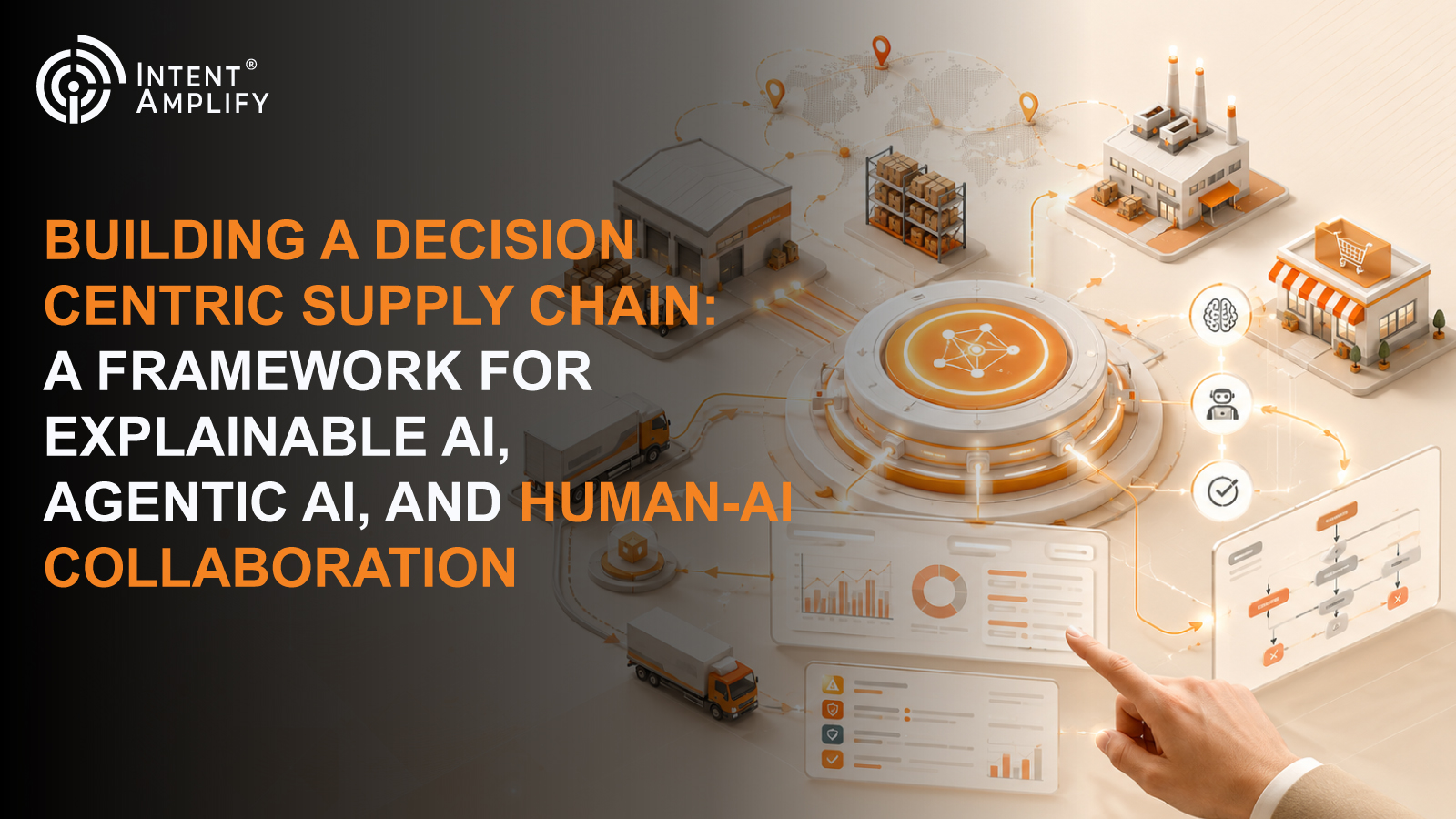
Explainable AI provides the trust layer. Agentic AI provides the orchestration layer. Human-AI collaboration provides the operating layer. Governance provides the control layer. Measurement provides the proof layer.
Together, these capabilities help leaders move beyond visibility into accountable action. They allow supply chain teams to understand why a signal matters, evaluate what options exist, decide who should approve action, and measure whether the outcome improved service, cost, inventory, cash, or resilience.
For U.S. enterprise executives, the mandate is practical. Start with the decisions that matter most. Map ownership. Strengthen data reliability. Require explainability. Apply agentic workflows where they reduce friction. Keep human judgment central. Expand autonomy only when controls, evidence, and outcomes support it.
The organizations that succeed will not be the ones that automate the most planning work. They will be the ones who know which decisions should be prioritized, trusted, explained, governed, measured, and improved over time.
References
-
McKinsey & Company, The State of AI in 2025: Agents, Innovation, and Transformation, November 5, 2025
https://www.mckinsey.com/capabilities/quantumblack/our-insights/the-state-of-ai -
Microsoft, 2026 Work Trend Index Annual Report: Agents, Human Agency, and the Opportunity for Every Organization, May 2026
https://www.microsoft.com/en-us/worklab/work-trend-index/agents-human-agency-and-the-opportunity-for-every-organization -
IBM Institute for Business Value, New IBM Study Finds CIOs and CTOs Face Growing AI Control Gap as Enterprise Deployment Scales, June 8, 2026
https://newsroom.ibm.com/2026-06-08-new-ibm-study-finds-cios-and-ctos-face-growing-ai-control-gap-as-enterprise-deployment-scales -
PwC, 2026 Digital Trends in Operations: How AI Reinvents Enterprise Performance, 2026
https://www.pwc.com/us/en/services/consulting/supply-chain-operations/library/digital-trends-operations-survey.html