
Table of Contents
- Executive Summary
- The RAG Promise and the Production Reality Gap
- Five Hidden Cost Drivers Behind RAG Overruns
- The Enterprise RAG Maturity Model: Five Stages
- Case Study: SRS Distribution and the Production Inflection Point
- What a Production-Grade Pipeline Requires
- How Progress Software Closes Each Maturity Gap
- What Leaders Should Do Next
- Conclusion: From Pipeline Liability to Competitive Infrastructure
- References
Executive Summary
Retrieval-Augmented Generation, or RAG, has moved from experimental architecture to mainstream enterprise infrastructure. Across U.S. organizations, it now supports customer service bots, compliance assistants, internal knowledge systems, financial planning workflows, support automation, and executive decision tools.
The promise is easy to understand. Instead of asking a large language model to answer from general training data alone, RAG grounds outputs in enterprise content. It retrieves relevant documents, knowledge-base articles, operational data, or policy records before generating a response. In theory, that should reduce hallucinations and make generative AI more useful in real business environments.
In practice, the gap between a working proof of concept and a durable enterprise pipeline is becoming one of the most expensive problems in AI delivery.
Gartner has predicted that more than 30% of generative AI projects will be abandoned after proof of concept by the end of 2025 because of poor data quality, inadequate risk controls, escalating costs, or unclear business value.1
McKinsey's 2026 AI Trust Maturity Survey of approximately 500 organizations found that only about one-third had reached a governance and agentic-controls maturity level of three or higher.2
Accenture's research across 2,000 companies found that only 7% had achieved the data-readiness threshold required to scale advanced AI. 3
This is not primarily a model failure. It is a pipeline failure. The most expensive breakdowns occur around ingestion, retrieval architecture, governance, evaluation, access control, observability, and change management. These weaknesses create delays, rework, hallucination risk, compliance exposure, and failed projects.
This whitepaper introduces the Enterprise RAG Maturity Model, a five-stage framework designed for AI leaders, machine learning practitioners, data engineering teams, and enterprise architects responsible for scaling RAG systems beyond proof of concept. It examines the cost drivers behind RAG overruns, the data and governance requirements that determine pipeline durability, and how Progress Software's Agentic RAG platform gives enterprises a practical path from prototype to production.
The RAG Promise and the Production Reality Gap
When U.S. enterprises first adopted RAG, the value proposition was compelling. Independent large language models could generate fluent answers, but they often lacked grounding in enterprise truth. RAG promised a better pattern: retrieve relevant internal content first, then generate an answer anchored in that evidence.
For early demos, the approach often worked beautifully. A team selected a curated document set. The chatbot answered policy questions. A knowledge assistant summarized support articles. A compliance prototype pulled from trusted materials. The retrieval pipeline operated within a controlled environment, and the initial results validated the promise of RAG.
Then production arrived.
Production brought older file formats, unstructured data, permission boundaries, multimodal content, conflicting versions, legacy repositories, compliance requirements, user concurrency, latency expectations, and executive scrutiny. The system that performed well in a narrow proof of concept suddenly had to survive operational reality.
That is where costs begin to climb.
McKinsey's 2025 State of AI survey of 1,933 organizations found that while 88% of enterprises now use AI in at least one function, only 39% report any earnings before interest and taxes impact at the enterprise level, and most attribute less than 5% of EBIT to AI. 4
The discrepancy between adoption and impact is not surprising. Many AI programs have working prototypes, but far fewer have production-grade systems. In RAG, the difference comes down to pipeline maturity: ingestion quality, retrieval precision, evaluation discipline, security controls, and feedback loops.
Deloitte's 2026 State of AI in the Enterprise report shows a similar gap. Worker access to AI increased by 50% in 2025, yet only 34% of organizations were truly redesigning business processes around AI. 5
A RAG system deployed without production-grade ingestion, indexed retrieval, evaluation metrics, access controls, and feedback loops will degrade. Output quality slips. Latency grows. Sensitive data exposure becomes more likely. Engineering teams spend months retrofitting controls they should have designed into the first architecture.
The financial risk is no longer theoretical. EY's Responsible AI Pulse Survey of 975 C-suite leaders, conducted in July and August 2025, found that 99% of organizations reported financial losses from AI-related risks, with 64% reporting losses above $1 million and an average exposure of $4.4 million per affected company. 6
For teams operating RAG systems in customer-facing, regulated, or mission-critical environments, those figures illustrate the financial consequences of inadequate governance and operational controls.
Five Hidden Cost Drivers Behind RAG Overruns
Cost overruns in RAG deployments follow a consistent pattern. The causes look technical at first, but they are often organizational as well. The same five failure points appear repeatedly.
Failure Point 1: Data Readiness Deficits
Accenture's research across 2,000 organizations found that only 7% had reached the data-readiness level required to scale advanced AI. Constraints included siloed data warehouses, inconsistent metadata schemas, and limited lineage tracking. 3
McKinsey's April 2026 research found that eight in 10 companies cite data limitations as the primary roadblock to scaling AI systems. 7
When ingestion is treated as a one-time setup task, the cost arrives later. Outdated documents remain in the corpus. Metadata breaks. Content freshness erodes. Teams build engineering workarounds for problems that should have been solved before launch.
Organizations that treat ingestion as a one-time setup activity rather than an ongoing operating discipline often encounter content freshness failures within 90 days of go-live.
Failure Point 2: Retrieval Architecture Mismatch
Early RAG systems often rely on basic semantic search. That can work in a narrow knowledge base with clean documents and predictable user questions. It breaks quickly in enterprise environments where content is heterogeneous, permissions matter, and precision requirements are high.
As RAG becomes foundational, basic retrieval is not enough. Production environments need hybrid retrieval that can combine vector search, keyword search, metadata filtering, knowledge graph traversal, and reranking. Without that architecture, enterprise teams may ship a system that performs well in demos but fails when users ask difficult, domain-specific, or permission-sensitive questions.
Failure Point 3: Evaluation Gaps
Demo pipelines are often evaluated manually. A team runs a few representative prompts, reviews the outputs, fixes the obvious misses, and proceeds. Production systems need more.
They require continuous measurement across faithfulness, answer relevance, citation coverage, hallucination rate, retrieval precision and recall, latency under load, and cost per query.
IBM's 2025 Cost of a Data Breach Report found that 63% of breached organizations had no AI governance policy, and 97% of AI-related breaches involved systems lacking proper access controls. 8
Where evaluation is absent, failures accumulate quietly. By the time they show up as compliance incidents, bad answers, or customer escalations, the remediation cost is much higher.
Teams that invest in evaluation infrastructure early typically reduce remediation costs significantly compared with organizations that implement those controls only after a production incident.
Failure Point 4: Governance and Access Control Deficits
A RAG system that retrieves across customer records, financial projections, legal briefs, engineering files, and human resources documents without role-based access at the retrieval layer is a breach scenario waiting to happen.
For RAG systems operating in healthcare, finance, government, or regulated enterprise workflows, these figures represent the floor, not the ceiling. Controls cannot sit only at the application layer. They must be embedded in retrieval.
Failure Point 5: Lack of Observability and Feedback Loops
Without observability, a RAG system can degrade while appearing healthy. Retrieval quality declines. Document contribution patterns shift. Cost per query rises. Users begin rephrasing questions to compensate for weak answers. None of that may appear in the dashboard if the pipeline was not designed to measure it.
Deloitte's enterprise AI infrastructure survey found that the percentage of organizations with 31 or more production-ready AI use cases is expected to increase from 44% in 2025 to 67% by 2028. 9
The organizations capable of reaching that velocity will not be the ones treating observability as an afterthought. They will be the ones who build monitoring into the pipeline from day one.
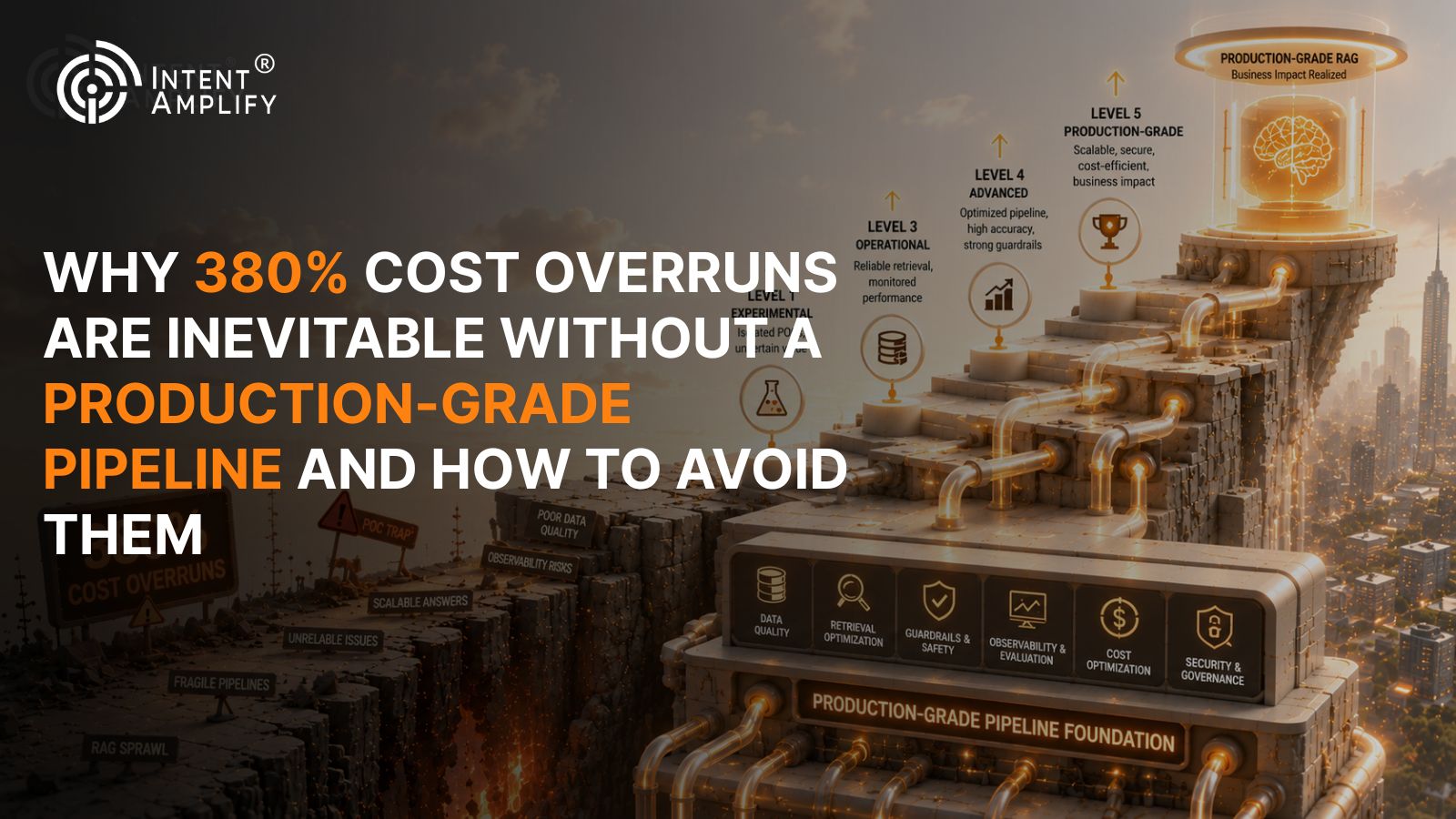
The Enterprise RAG Maturity Model: Five Stages
Stage 1: Ad-Hoc RAG (Prototype)
At Stage 1, RAG exists as a demonstration asset. The content set is curated, clean, and limited. Retrieval usually relies on basic vector search. Evaluation is manual. Access controls are not specific to the RAG system. The demo may impress users, but the architecture is not ready for production.
S&P Global Market Intelligence found that 42% of organizations abandoned most AI initiatives in 2025, up from 17% in 2024, while the average organization scrapped 46% of AI proof-of-concept projects before production. 10
Stage 1 architectures contribute heavily to that pattern. They prove interest but not durability.
Stage 2: Structured RAG (Early Deployment)
At Stage 2, the system has been deployed to a limited internal audience. Use cases are defined. Ingestion pipelines handle a few document types consistently. Retrieval quality is measured occasionally. Hallucination risk is controlled through human review rather than systematic evaluation.
The problem emerges during expansion. A new business unit wants access. A different content format appears. A permission model becomes more complex. Suddenly, the team discovers that the initial architecture was not built for scale.
Gartner's finding that 60% of AI projects lacking AI-ready data would be abandoned by 2026 applies directly to Stage 2 systems when expansion is attempted. 1
Stage 3: Governed RAG (Controlled Production)
Stage 3 is the first level of genuine production maturity. Ingestion pipelines handle multimodal content, including text, audio, video, and structured data. Retrieval uses a hybrid search. Evaluation is systematic and automated. Role-based access controls are embedded at the retrieval layer. Governance is auditable.
This is where many U.S. enterprises are aiming their 2026 RAG investments. It is also the point where architectural shortcuts become expensive.
Stage 3 represents the production inflection point. Organizations that reach it with the right architecture can sustain value. Those that arrive with a collection of disconnected point solutions often face a second rearchitecting cycle within 12 months, adding $500,000 to $2 million in unplanned engineering costs depending on scope.
Stage 4: Adaptive RAG (Scaled Enterprise)
At Stage 4, RAG operates across multiple functions and data domains. Retrieval includes knowledge graph traversal alongside vector and keyword search. Evaluation is continuous. Cost-per-query optimization is measured. Governance integrates with enterprise identity management. Retrieval, indexing, generation, and orchestration function as modular, independently upgradable components.
Accenture found that organizations acting across all five of its identified AI value imperatives are 2.5 times more likely to realize enterprise-level results. 11
Stage 4 is where RAG begins to look less like an AI application and more like enterprise infrastructure.
Stage 5: Agentic RAG (Production Intelligence Infrastructure)
At Stage 5, RAG functions as the foundational knowledge runtime for autonomous and semi-autonomous agents. Retrieval becomes context-aware and dynamic, triggered by agent reasoning rather than direct user queries alone. Evaluation operates in real time, with automated circuit breakers for low-confidence outputs. Governance integrates with compliance frameworks and produces audit-ready logs for every retrieval event.
McKinsey's 2026 research found that organizations investing $25 million or more in responsible AI initiatives are more likely to realize earnings before interest and taxes above 5%.2
Stage 5 is where that impact becomes measurable, defensible, and compounding.
Case Study: SRS Distribution and the Production Inflection Point
SRS Distribution, a large building-products distributor, implemented Progress Agentic RAG, powered by Nuclia architecture, to change how employees access and act on unstructured information.
Patrick Garcia, Chief Digital, AI, and Innovation Officer at SRS Distribution, said that Progress Agentic RAG, which the company began using as Nuclia, fundamentally changed how the organization accessed and acted on information, delivering fast, accurate, and verifiable insights from unstructured data.12
Progress Agentic RAG provided an agent-powered ingestion pipeline capable of handling multilingual text, audio, video, and other content formats without requiring custom development for each modality. Its NucliaDB database combined vector storage with semantic search, keyword search, metadata filtering, knowledge graph traversal, and multimodal understanding.
That architecture addresses the retrieval mismatch that characterizes many Stage 1 and Stage 2 deployments. The platform's RAG Evaluation Metrics, or REMi, tooling adds built-in evaluation, traceability, and answer-quality monitoring from initial deployment, helping AI teams establish observability and governance before systems reach production scale.
For AI platform leaders and enterprise architects, many RAG cost overruns stem from architectural rework rather than model limitations. Organizations that establish production-grade ingestion, retrieval, evaluation, and governance capabilities early are often able to scale more efficiently while avoiding costly redesign cycles.
Section 5: What a Production-Grade Pipeline Requires
Hybrid Retrieval Architecture
Semantic vector search is necessary, but it is not sufficient. Production systems require hybrid retrieval that combines vector similarity, keyword search for exact-match requirements, knowledge graph traversal for relational queries, and metadata filtering for access control and document versioning.
This is especially important in regulated industries, where retrieval errors can create compliance consequences measured in millions of dollars.
Embedded Evaluation Metrics
Systems must continuously measure faithfulness, answer relevance, citation coverage, hallucination rate, retrieval precision and recall, latency, and cost per query.
IBM's 2025 breach data confirms that ungoverned AI systems contributed to an average $10.22 million U.S. breach cost. 13
Systematic evaluation embedded in the pipeline is the primary mechanism for preventing those conditions from forming.
Role-Based Access and Audit Logging
Every retrieval event should be governed by the same access controls applied to source data. Every retrieval event should also generate an auditable log showing which documents contributed to which response.
This is non-negotiable under the Health Insurance Portability and Accountability Act, SOC 2, and the NIST AI Risk Management Framework, which provides foundational governance guidance for U.S. enterprise AI deployments. 14
Modular, Composable Architecture
Production RAG systems must treat retrieval, indexing, generation, and orchestration as independently upgradable components.
Deloitte found that production-ready use cases are expected to climb from 44% of enterprises in 2025 to 67% by 2028. 15
Composable platforms are the architecture that enables that velocity without proportional engineering cost growth.
How Progress Software Closes Each Maturity Gap
The maturity gaps outlined in this framework are not primarily model challenges. They are infrastructure, governance, retrieval, and evaluation challenges. Progress Software's Agentic RAG platform was designed to address those production constraints as organizations move from proof of concept to enterprise-scale deployment.
For teams operating at Stage 1 and Stage 2 maturity, ingestion often becomes the first scaling bottleneck. Progress Software's no-code ingestion pipeline handles multilingual text, audio, video, and other content types without custom engineering for each format, helping reduce deployment complexity as data environments expand.
Progress Software Chief AI Officer Ed Keisling has described the production constraint directly: as organizations move beyond proofs of concept, gaps in relevance, governance, cost, and evaluability surface quickly, and production constraints reshape how retrieval, reasoning, and model choice must be evaluated.
That constraint awareness is engineered into the Progress Agentic RAG approach.
For organizations moving into controlled production environments, retrieval architecture often becomes the defining factor between scalability and rework. NucliaDB provides hybrid retrieval that combines vector storage, semantic search, keyword search, metadata search, knowledge graph traversal, and multimodal understanding in a single system. That directly addresses the retrieval architecture mismatch that pushes Stage 2 systems into costly rearchitecting.
For AI platform teams, evaluation is one of the most important indicators of production readiness. The built-in RAG Evaluation Metrics tooling gives Stage 3 and Stage 4 organizations a systematic evaluation infrastructure, supporting answer-quality tracking, traceability, and audit logs that regulated enterprises need.
For Stage 4 and Stage 5 organizations, Progress Agentic RAG supports multi-model integration and compatibility with leading enterprise-ready large language models, giving teams control over model selection. As the large-language-model landscape changes, enterprises can preserve their retrieval and governance infrastructure rather than replacing it.
Production-grade AI systems require governance frameworks that align with enterprise security, compliance, and operational requirements. Progress positions its Agentic RAG platform to support those enterprise standards.
Enterprise teams ready to translate these principles into working architecture can use the companion ebook as a practitioner resource for ingestion, retrieval, evaluation, and governance decisions.
Read the Ebook: The RAG Cookbook
Operational Priorities for Scaling Enterprise RAG
Conduct a RAG Maturity Diagnostic Before Expanding
Map the current system against the five-stage maturity model before expanding use cases, onboarding new data domains, or increasing production workloads. The cost of diagnosing gaps at this stage is a fraction of the cost of discovering them in production.
Accenture found that data reinventors, the 7% of organizations with genuine AI-ready data infrastructure, realize profit-margin uplifts of up to 1.6 times over industry peers. 3
That margin differential begins with an honest maturity assessment.
Redirect 50% to 70% of the Budget to Data Readiness
McKinsey's 2025 research established that winning organizations earmark 50% to 70% of RAG initiative budgets for data readiness, including extraction, normalization, governance metadata, and retention controls. 3
Most enterprise teams invert this ratio. They spend heavily on model selection while underfunding ingestion and data quality, the two areas every production-grade system depends on.
Implement Evaluation Infrastructure Before Expanding Use Cases
No RAG deployment should expand to additional business functions without a systematic evaluation in place.
IBM's 2025 research confirms that breached organizations operating without AI governance policies absorbed $10.22 million in average U.S. breach costs. 13
Evaluation infrastructure is the mechanism that prevents ungoverned conditions from forming.
Embed Access Controls at the Retrieval Layer
Controls applied only at the application layer are insufficient for production RAG. Access controls must be embedded in the retrieval pipeline itself.
IBM's 2025 report found that 97% of AI-related breaches occurred in organizations without proper AI access controls.8
The retrieval layer is where that gap has to close.
Minimize Integration Debt as RAG Scales
Organizations building production RAG on composed stacks of point solutions carry higher integration debt. The architecture may look flexible early, but maintenance costs compound as use cases expand.
McKinsey's 2026 AI trust research found that organizations with explicit accountability for responsible AI achieve higher maturity scores than those without clear ownership.
As RAG deployments expand across functions, data domains, and workflows, architectural complexity becomes a larger constraint than model selection. Teams that reduce integration overhead and establish clear ownership models are often able to scale more efficiently over time.
Conclusion: From Pipeline Liability to Competitive Infrastructure
The 380% cost-overrun pattern is not inevitable. It is architectural.
Organizations that build RAG for demonstration and then force that architecture into production spend multiples of the original budget on rework, remediation, governance gaps, and the consequences of ungoverned AI in mission-critical workflows.
Accenture found that data reinventors realize profit-margin uplifts of up to 1.6 times over peers.3
Deloitte found that enterprises with robust data strategies saw a roughly fourfold increase in GenAI agent adoption within two quarters of implementation. 5
The compounding advantage is real and measurable. For AI platform teams and enterprise architects, the challenge is building retrieval, evaluation, and governance capabilities that can scale with enterprise adoption. Progress Software's Agentic RAG platform is designed to support that transition through agent-powered ingestion, hybrid retrieval, embedded evaluation, multimodel flexibility, and production-grade governance, helping teams establish a foundation that can evolve without repeated architectural redesign.
The organizations that reach Stage 4 and Stage 5 RAG maturity in 2026 will not simply have better AI demonstrations. They will have enterprise AI infrastructure capable of turning institutional knowledge into governed, traceable, and operationally reliable intelligence at scale.
The organizations that scale AI successfully will not be the ones with the most advanced models. More often, they will be the ones that invest early in retrieval quality, evaluation discipline, governance, and production-grade architecture.
To start building, read the ebook
About Intent Amplify
Intent Amplify Intelligence provides research-led cybersecurity insights for security leaders, technology decision-makers, and enterprise teams. Our coverage focuses on emerging threats, cloud security, identity risk, Zero Trust, artificial intelligence security, third-party exposure, compliance, and cyber resilience.
We help organizations understand how fast-changing cyber risks affect business continuity, operational trust, and digital growth. For technology leaders exploring how post-quantum readiness, supplier governance, procurement automation, and third-party risk management are converging, this whitepaper offers a practical starting point for clearer decision-making.
To learn more or connect with our team, visit: Intent Amplify
References
- Gartner, Gartner Predicts 30% of Generative AI Projects Will Be Abandoned After Proof of Concept by the End of 2025, July 29, 2024
- McKinsey & Company, State of AI Trust in 2026: Shifting to the Agentic Era, March 2026
- Accenture, AI-Ready Data for Advanced AI, 2026
- McKinsey & Company, The State of AI, 2025
- Deloitte AI Institute, The State of AI in the Enterprise, 2026
- EY, How Responsible AI Translates Investment into Impact, October 2025
- McKinsey & Company, Building the Foundations for Agentic AI at Scale, April 2026
- IBM Newsroom, IBM Report: 13% of Organizations Reported Breaches of AI Models or Applications, 97% of Which Reported Lacking Proper AI Access Controls, July 30, 2025
- Intent Amplify, The Enterprise RAG Maturity Model: Why 380% Cost Overruns Are Inevitable Without a Production-Grade Pipeline and How to Avoid Them, June 2026
- S&P Global Market Intelligence, AI Experiences Rapid Adoption, But With Mixed Outcomes, 2025
- Accenture, The Front-Runners' Guide to Scaling AI, 2026
- Progress Software, Progress Software Unveils Breakthrough SaaS RAG Platform Designed to Make Trustworthy AI Easier to Deploy, September 2025
- IBM, Cost of a Data Breach Report, 2025
- National Institute of Standards and Technology, AI Risk Management Framework, 2023
- Deloitte, Enterprise AI Infrastructure Survey: A 2028 Outlook, April 2026