
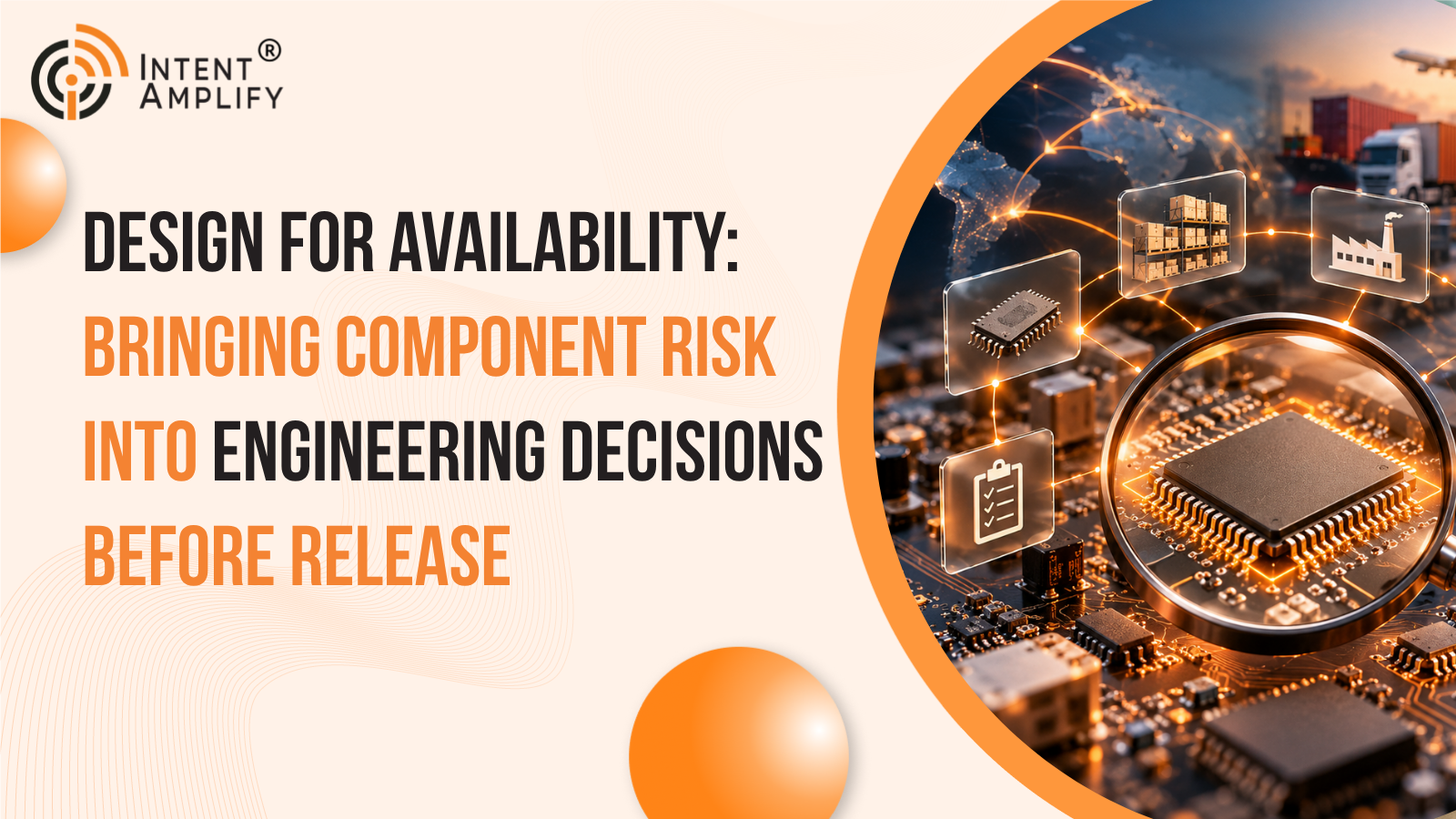
A component can satisfy every electrical requirement and still create a production problem.
That is the central tension behind design for availability. Electronics engineering has traditionally optimized component selection around function, performance, footprint, cost, and qualification requirements. Supply-chain conditions may be reviewed, but often only later in the sourcing process. By the time procurement identifies an availability or lifecycle concern, the design may already be difficult to change.
The result is a preventable mismatch between design intent and supply reality.
Design for availability moves relevant component risk upstream. It asks engineering and procurement to evaluate not only whether a part works, but whether the product has enough sourcing flexibility to remain buildable when market conditions change.
Altium’s recent supply-chain resilience guidance describes this as “resilience by design”: building flexibility and redundancy into the BOM from the beginning and supporting those decisions with current component and supply-chain intelligence [1].
For engineering leaders, this is not a request to turn designers into buyers. It preserves engineering options before a sourcing constraint turns into a redesign.
Why Availability Has Become an Engineering Input
A BOM contains technical choices, but those choices create downstream sourcing consequences.
A single-source device may be the best fit for the design. It may also create a dependency that becomes difficult to unwind after layout, validation, certification, or production planning. A technically equivalent alternate may exist, but if it has not been reviewed early, switching later can require engineering effort at exactly the moment the business has the least time.
This is why availability should be treated as one of the inputs to component selection rather than as a final procurement check.
SEMI’s 2026 Semiconductor Supply Chain Management Survey covers supply-chain planning, supplier dynamics, manufacturing, customer demand, capability assessment, and market outlook across the semiconductor value chain [2]. The breadth of those topics is a reminder that component availability is shaped by multiple interacting conditions. Engineering teams do not need to predict all of them. They do need a process that can absorb relevant changes before release decisions become expensive to revisit.
Design Now, Source Later Creates a Timing Problem
The traditional sequence is understandable.
Engineering chooses components. The design progresses. A BOM is released. Procurement then evaluates sourcing in detail.
The weakness is timing.
If procurement finds a constrained, obsolete, or commercially problematic component after the design is locked, the organization has fewer response options. Engineering may need to reopen work. Procurement may need to search for substitutes under time pressure. Manufacturing may face schedule uncertainty. Program teams may have to choose between delay, redesign, higher cost, or greater sourcing risk.
Altium’s supply-chain resilience guidance argues for the opposite model: combine resilience by design with end-to-end visibility, including current availability, lead times, lifecycle status, and shared information between engineering and procurement [1].
The operating goal is not to make every part multi-sourced. It is to know where flexibility matters and to make that decision intentionally.
Component Risk Is Not a Single Data Point
Availability is often reduced to a stock number, but design risk is more complex.
A component can have inventory today and still present lifecycle risk. It can have multiple distributors but still depend on a single manufacturer. It can have an alternate that matches a footprint but not the full technical requirement. It can look commercially attractive at prototype quantities and become problematic at production scale.
This means component risk needs context.
Engineering needs technical context: function, specifications, qualification, form-fit-function requirements, and the consequences of substitution.
Procurement needs supply context: sourcing options, lifecycle information, lead times, commercial conditions, and supplier exposure.
Program and operations teams need product context: which builds, launches, customers, or schedules could be affected.
When those views remain separate, the organization can have plenty of data but still make slow decisions.
The Electronics Market Reinforces the Need for Granular Visibility
Industry indicators can help leaders understand direction, but they cannot substitute for BOM-level analysis.
ECIA’s June 2026 Industry Pulse reported its average market sentiment index at 154.1, a five-year high at that point. The same report noted that respondents still lacked confidence in future market direction and forecast a decline for July. ECIA’s Industry Pulse also tracks product lead times, cancellations, decommits, component categories, and end markets [3].
That combination is instructive. Market sentiment can be strong while uncertainty remains. Conditions can differ by component category and application.
For an engineering team, “the market is improving” is not enough information to approve a critical part. The relevant question is whether this part, for this product, at this volume and timing, creates an acceptable level of exposure.
Design for availability makes that question explicit.
Alternates Are Most Valuable Before They Are Urgent
An alternate component is often discussed as a response to a shortage. That is the least convenient time to begin evaluating one.
The stronger approach is to identify where alternate flexibility matters during design and to preserve that option before production pressure arrives.
That does not mean adding substitutes indiscriminately. It means prioritizing components where a sourcing disruption would have a high product impact and where engineering has realistic substitution choices.
Mouser’s 2026 procurement guidance emphasizes that modern electronics sourcing requires teams to stay ahead of shortages, manage supplier relationships, preserve flexibility, and use digital tools to support decisions across the product timeline [4]. For engineering teams, the implication is practical: availability should be treated as a design input, with sourcing flexibility reviewed before release rather than after a constrained part becomes a production issue.
The important principle is decision readiness. When an alternate has already been considered in a technical and sourcing context, the organization can respond to a change more deliberately. When it has not, every disruption starts a new investigation.
Engineering and Procurement Need a Shared Decision Surface
Design for availability fails if it becomes another handoff.
Engineering cannot make strong sourcing decisions without current supply context. Procurement cannot make strong substitution decisions without technical context. The answer is not to transfer ownership from one function to the other. It is to create a shared decision path.
A useful workflow is straightforward.
Engineering identifies the component and the technical boundaries for substitution.
Supply intelligence provides current lifecycle, availability, and sourcing context.
Procurement assesses commercial and supplier implications.
The team evaluates whether the part is acceptable, whether an alternate should be qualified, or whether the design should change before release.
The decision and rationale remain attached to the BOM.
Altium BOM Portal is designed around this model, giving procurement early and continuous visibility into BOM data and supporting risk analysis, supplier comparison, consolidation, lifecycle monitoring, and alternative evaluation while designs remain flexible [5].
That is the practical difference between “procurement has access to the BOM” and genuine engineering-procurement collaboration.
A Design-for-Availability Readiness Framework
Engineering organizations can test their current process without launching a large transformation.
Start with five questions.
- First, when is supply context introduced? If detailed component risk appears only after design release, the process is structurally late.
- Second, which components receive deeper review? Not every resistor needs executive attention. Teams need criteria for parts whose failure or unavailability would materially affect product delivery.
- Third, are alternate requirements defined before a shortage? Engineering should know what technical boundaries an alternate must satisfy and when qualification work is justified.
- Fourth, can procurement see design context without rebuilding it manually? If buyers rely on exported spreadsheets and email explanations, collaboration will slow when conditions change.
- Fifth, can the organization trace the decision? A future reviewer should understand why a part was selected, why an alternate was approved, or why a known risk was accepted.
A process that answers those questions consistently is better positioned to manage availability as a design consideration rather than an emergency sourcing task.
Where Altium BOM Portal Fits
The Altium campaign focuses on a specific operating gap: spreadsheet-centric BOM management can separate engineering choices from the supply-chain intelligence needed to protect them.
BOM Portal provides a dedicated environment for managing BOMs with supply context and cross-functional review. The campaign whitepaper frames the move beyond spreadsheets as a resilience decision, not simply a tooling upgrade.
For electronics teams evaluating the approach, the most useful test is to examine decision timing.
When does engineering first learn that a selected part has meaningful supply exposure? When does procurement first gain enough design context to recommend an alternative? How many manual steps are required to connect the issue to the affected product? How long does it take to move from identifying risk to an approved action?
Those questions expose whether the organization is designing for availability or discovering availability after design.
Download the Altium whitepaper, Building Supply Chain Resilience: Transforming BOM Management for Modern Electronics, to assess where dedicated BOM management can bring supply intelligence earlier into engineering and procurement decisions.
FAQs
1. What does design for availability mean?
Design for availability means considering relevant sourcing, lifecycle, and component-risk information during engineering decisions rather than waiting until after design release. It complements technical design criteria; it does not replace them.
2. Does design for availability require multiple sources for every component?
No. The goal is intentional risk management. Some components may legitimately remain single-source because of technical or commercial requirements. The important point is to understand the exposure, ownership, and contingency before it becomes urgent.
3. Who owns component-risk decisions?
Ownership is shared but role-specific. Engineering determines technical suitability and substitution constraints. Procurement contributes sourcing and commercial context. The organization should define who approves the final action for different risk types.
4. How does BOM management support design for availability?
A dedicated BOM environment can keep product structure, component context, supply intelligence, alternatives, and review activity closer together. That reduces manual reconciliation and helps teams evaluate risk while design choices are still flexible.
Conclusion
Supply-chain resilience is partly an engineering outcome.
Procurement remains essential to sourcing strategy, supplier relationships, and commercial execution. But many of the most consequential supply-chain options are created or removed during design. A component choice can preserve flexibility or concentrate risk. An alternate can be evaluated early or discovered under pressure. A sourcing concern can be addressed while the schematic is still flexible or after the product is already committed.
Design for availability brings that reality into the engineering process without asking engineers to become supply-chain forecasters.
The goal is simpler: give engineering and procurement enough shared, current context to recognize meaningful component risk and make an intentional decision before release.
That is the operating shift behind modern BOM management. The organization stops treating the BOM as the end of engineering and begins using it as the shared point where design intent and supply reality are reconciled.
Download Altium’s “Building Supply Chain Resilience: Transforming BOM Management for Modern Electronics” whitepaper to assess when spreadsheet-led BOM management is no longer sufficient and how dedicated BOM management can improve supply-chain visibility, engineering-procurement collaboration, and earlier component-risk decisions.
References
1. Altium, Supply Chain Resilience by Design Through End-to-End Visibility, November 14, 2025
https://resources.altium.com/p/supply-chain-resilience-by-design
2. SEMI, Semiconductor Supply Chain Management Survey, 2026
https://www.semi.org/en/industry-groups/supply-chain-management-survey
3. Electronic Components Industry Association, ECIA’s Industry Pulse: Electronic Component Trends and Sentiment June 2026, June 26, 2026
4. Mouser Electronics, 10 Strategies for Successful Electronics Procurement, 2026
5. Altium, BOM Portal Introductory Tutorial, updated August 4, 2026
https://resources.altium.com/p/BOM-portal-introductory-tutorial