
INTRODUCTION
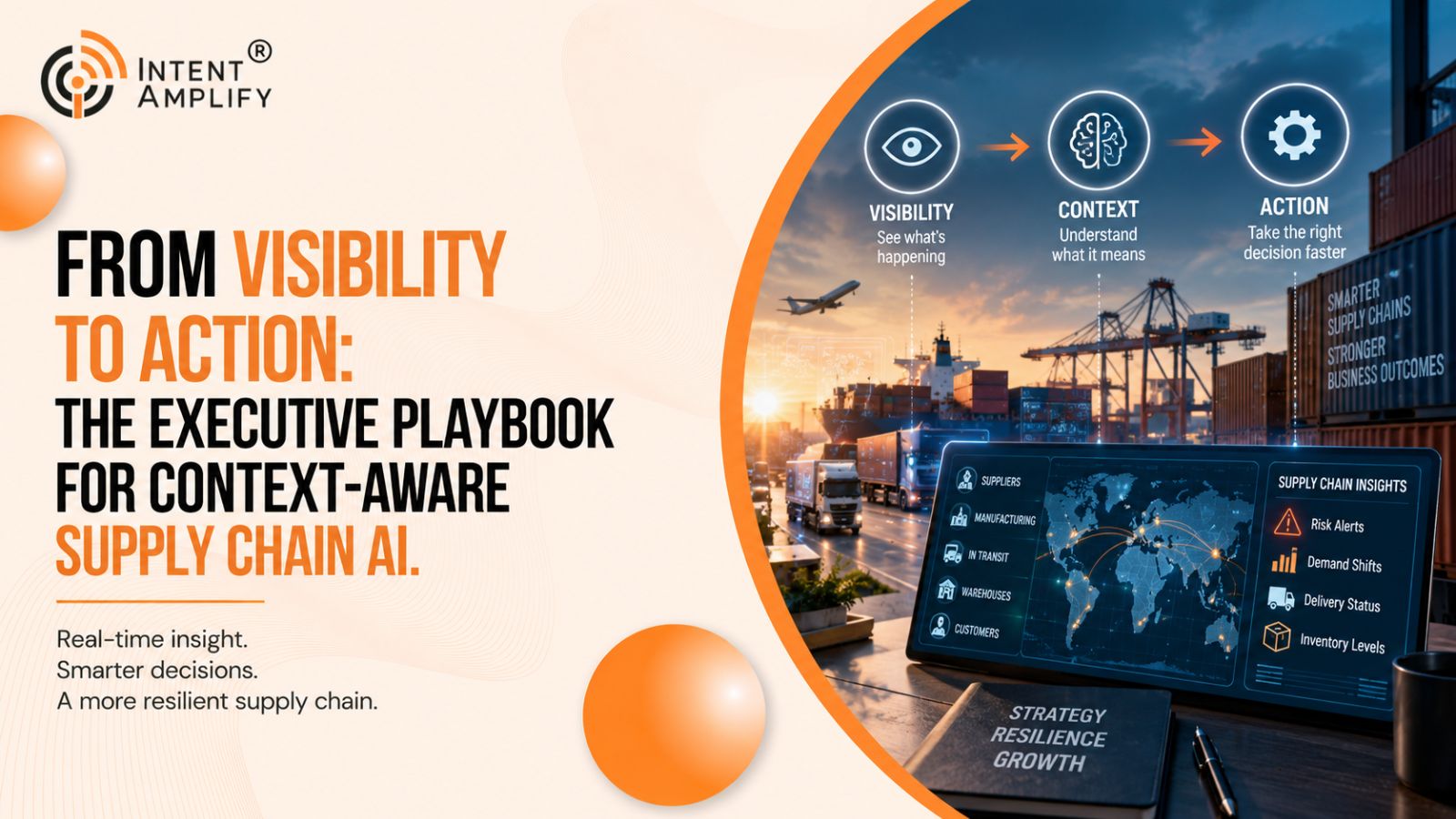
Supply-chain visibility answers an essential question: what is happening? Operational AI raises the next question: what should happen now?
Closing the gap between those questions requires context. An alert, forecast, inventory position, supplier update, or logistics event rarely contains enough information on its own to support a high-quality operational decision. Leaders need to understand how the event connects to the wider process, which constraints matter, what business rules apply, who owns the decision, and what action can be taken without creating unintended consequences.
This executive playbook provides ten moves for turning supply-chain visibility into context-aware action. It is designed for leaders evaluating how AI agents and people can work side by side across planning, procurement, logistics, inventory, fulfillment, and operations.
MOVE 1: START WITH A DECISION, NOT AN AI FEATURE
Choose a recurring operational decision where better context could materially improve speed, consistency, or coordination. Examples include shortage response, supplier exception triage, logistics recovery, inventory rebalancing, order prioritization, and production constraint management.
Define the business objective, current friction, decision owner, downstream consequences, and what a better outcome would look like. This keeps AI tied to a real operating problem.
MOVE 2: MAP THE PROCESS THAT PRODUCES THE DECISION
Document how the workflow actually runs across systems and teams. Identify the trigger, process steps, handoffs, exceptions, delays, workarounds, and decision points.
The purpose is not documentation for its own sake. The map reveals where context is lost, where people spend time assembling information, where automation already exists, and where AI could create value without taking uncontrolled authority.
MOVE 3: DEFINE THE MINIMUM TRUSTED CONTEXT
List the information required to interpret the situation correctly. Depending on the use case, this may include orders, inventory, supplier commitments, production schedules, transport status, service priorities, contracts, approved substitutions, cost thresholds, or prior exception history.
Separate useful context from unnecessary data. More data does not automatically produce a better decision. The objective is decision-grade context: trusted information with clear meaning and relevance to the workflow.
MOVE 4: CONNECT PROCESS INTELLIGENCE TO AI REASONING
Process intelligence helps reveal how work actually flows across systems and where deviations occur. AI can then use that operational picture to summarize situations, identify patterns, evaluate options, and recommend next actions.
This combination is more useful than treating AI as a layer that sits above disconnected records. The process provides the operating reality. AI provides additional reasoning and synthesis. Humans provide objectives, judgment, authority, and accountability.
MOVE 5: CREATE AN AUTHORITY MAP
For each major workflow step, define whether the AI may observe, recommend, execute, or escalate.
Observe means monitoring, retrieving, summarizing, classifying, or detecting.
Recommend means proposing an action for human review.
Execute means performing an approved action inside explicit conditions.
Escalate means transferring responsibility when uncertainty, impact, or policy requires judgment.
Authority should reflect the impact and reversibility of the action. A low-risk, reversible update may support more autonomy than a supplier change, production reallocation, premium freight decision, or customer-impacting commitment.
MOVE 6: DESIGN THE HUMAN HANDOFF
Human review is not a failure of AI. In complex operations, escalation is a core capability.
Define what triggers the handoff, who owns it, what context transfers, and what response is expected. A planner or operations leader should receive the event summary, relevant process history, material constraints, actions already taken, options considered, and the reason the AI stopped.
The goal is continuity. The human should continue the workflow, not reconstruct it.
MOVE 7: INSTRUMENT THE DECISION
Before piloting the workflow, decide what evidence will be collected. Track process performance, decision quality, and control behavior.
Process measures should reflect the actual use case: cycle time, exception backlog, delay, rework, throughput, service exposure, inventory impact, or similar operational indicators.
Decision evidence can include recommendation acceptance, overrides, exception outcomes, or differences between expected and observed results.
Control evidence should show whether the AI stayed within its authority, used the required context, escalated when necessary, and left a reconstructable trail.
MOVE 8: PILOT ASSISTED EXECUTION FIRST
For many workflows, the strongest first step is not full autonomy. It is assisted execution: continuous monitoring, context assembly, prioritization, summarization, recommendation, and routing.
This creates operating evidence while preserving human authority over higher-impact actions. It also exposes data gaps, process ambiguity, and exception patterns before the organization expands responsibility.
A pilot should be deliberately bounded by workflow, population, geography, business unit, supplier group, or another practical dimension.
MOVE 9: SCALE ONE DIMENSION AT A TIME
Scaling can mean more users, more events, more process scope, more systems, or greater AI authority. These are different changes and should not automatically happen together.
A workflow that performs well at recommendation level has not automatically earned permission to execute. A workflow that performs well for one category of exceptions has not automatically earned permission across all exceptions.
Expand one dimension where practical, review the evidence, and preserve the ability to identify which change affected performance.
MOVE 10: CREATE A CONTINUOUS OPERATING LOOP
Context-aware AI is not a one-time deployment. Processes change. Suppliers change. Policies change. Business priorities change. Data changes. Human teams develop new workarounds. New exceptions appear.
Establish a recurring review of process behavior, context quality, agent authority, escalations, overrides, outcomes, and improvement opportunities. Repeated human interventions should be treated as learning signals. They may indicate that the data, rule, process, or authority design needs adjustment.
THE ONE-PAGE CONTEXT-AWARE DECISION CANVAS
For each use case, capture:
- Business objective
- Operational trigger
- Decision owner
- Current process
- Required context
- Authoritative data sources
- Material constraints
- AI role by step
- Permitted actions
- Prohibited actions
- Human escalation triggers
- Evidence retained
- Success measures
- Expansion criteria
- Review cadence
This canvas gives business, operations, procurement, planning, IT, data, security, governance, and finance teams a common way to evaluate the workflow.
THREE PRACTICAL APPLICATIONS
SHORTAGE RESPONSE
An agent can monitor material availability and assemble the operational picture when a shortage emerges. The context may include affected production orders, current and inbound inventory, alternate materials, supplier commitments, customer priorities, and logistics options. The agent can recommend responses while escalating decisions that cross financial, supplier, or production thresholds.
LOGISTICS RECOVERY
A transport delay becomes more actionable when shipment status is connected to inventory, production dependency, customer commitments, route alternatives, cost thresholds, and service risk. AI can prioritize which disruptions require intervention and recommend recovery options rather than flooding teams with undifferentiated alerts.
SUPPLIER EXCEPTION MANAGEMENT
Not every supplier deviation deserves equal attention. Context-aware AI can distinguish routine variance from exceptions that threaten production, service, or strategic commitments. It can assemble supplier history, order dependencies, alternative supply, and prior resolution patterns to support faster triage.
EXECUTIVE GOVERNANCE QUESTIONS
Which decision are we improving?
What context changes the decision?
Which sources are trusted?
What may the AI do?
What remains human-owned?
What forces escalation?
How is the decision observed?
What evidence justifies expansion?
Who owns correction when the workflow behaves unexpectedly?
A 30-60-90 DAY EXECUTION SEQUENCE
DAYS 1–30 — Map the workflow, define the decision, establish context requirements, baseline the current process, and create the initial authority map.
DAYS 31–60 — Pilot-assisted execution. Use AI for monitoring, context assembly, prioritization, recommendation, and bounded actions where permissions are already clear. Review exceptions frequently.
DAYS 61–90 — Evaluate outcomes and expand only where evidence supports the next step. Improve context, adjust authority, strengthen handoffs, and add scope deliberately.
This is a planning sequence rather than a deployment promise. Actual timing depends on process complexity, integration, data readiness, security, governance, and organizational capacity.
WHAT GOOD LOOKS LIKE
A context-aware supply-chain workflow does not simply generate a plausible recommendation. It can explain the operational situation that produced the recommendation. It uses trusted context. Its authority is explicit. Human intervention is designed. Actions are observable. Exceptions create learning. Expansion is evidence-led.
That is the difference between adding AI to a supply chain and building an operating model in which AI can participate responsibly.
THE CONTEXT STACK: WHAT THE AGENT NEEDS TO KNOW
The ten moves become easier to execute when leaders organize context into layers. The first layer is event context: what changed, when it changed, and which object or transaction is affected. The second is process context: how the workflow reached the current state, which steps have occurred, and where deviation or delay exists.
The third layer is relationship context. A supply-chain event rarely stands alone. Orders connect to customers, materials connect to production, shipments connect to inventory, suppliers connect to contracts, and decisions connect to financial and service consequences. The fourth layer is policy and constraint context: what rules, thresholds, qualifications, commitments, and permissions limit the available response.
The fifth layer is ownership context. The operating system should know who owns the decision, which actions require approval, and where an exception should go. The sixth is outcome context: what happened after a similar action, which recommendations were accepted or overridden, and what evidence should inform future review.
Not every workflow requires every possible data point. The purpose of the context stack is to make the minimum trusted context explicit. Leaders can then identify which layer is missing when an AI recommendation is incomplete or an agent cannot proceed.
BUILDING THE AUTHORITY MAP IN PRACTICE
An authority map should be specific enough that a frontline user can understand the division of responsibility. Begin by listing the major actions inside the workflow rather than assigning one autonomy level to the entire use case.
For each action, identify whether AI may observe, recommend, execute, or must escalate. Then document the conditions. An agent may be permitted to execute a routine update only when required data is present, the action is reversible, the impact remains below an approved threshold, and no unusual exception exists. The same workflow can require human approval when any of those conditions change.
Next, identify explicit prohibitions. Prohibited actions are as important as permitted actions because they prevent ambiguity at the edge of the workflow. A system can be technically capable of contacting a supplier, changing an order, or initiating a recovery action without being authorized to do so.
Finally, connect each escalation condition to an owner. An escalation without ownership simply moves the bottleneck. The authority map should state who receives responsibility and what context must accompany the handoff.
THE HUMAN EXPERIENCE OF CONTEXT-AWARE AI
A strong operating model should improve the human experience of supply-chain decision-making. The goal is not to surround planners, buyers, logistics teams, and operations leaders with more alerts. It is to reduce the work required to understand which events matter and what decision is required.
When an exception appears, the AI can assemble the relevant process history, dependencies, constraints, and options. The person can then apply judgment to a decision-ready case instead of collecting information from multiple systems. Where the action is low-impact and explicitly permitted, the agent can proceed and leave an observable record.
This changes the role of the human from information collector to accountable decision-maker. It also makes escalation more productive. A person receiving an exception should understand why the agent stopped, what it already established, and what remains unresolved.
The design principle is simple: AI should compress operational search and synthesis without obscuring ownership.
FOUR PILOT PATTERNS
PATTERN 1 — EXCEPTION PRIORITIZATION
Use AI to monitor events and distinguish routine variance from exceptions that warrant attention. This is useful where teams face high alert volume and spend significant time deciding what to investigate first. The agent can remain at the observe or recommend level while the organization evaluates whether the prioritization is useful and whether the required context is reliable.
PATTERN 2 — CONTEXT ASSEMBLY
Use AI to prepare a decision-ready case for a human owner. The system can gather the event, process history, affected objects, constraints, and relevant options. This pattern creates value without requiring execution authority and can expose which data or relationships are missing from the workflow.
PATTERN 3 — RECOMMENDED ACTION
Use AI to compare permitted options and recommend a response. The human remains the decision owner. Review recommendation acceptance, overrides, escalation reasons, and outcome evidence to determine whether the workflow is dependable.
PATTERN 4 — BOUNDED EXECUTION
Allow the agent to perform a defined, reversible action when explicit conditions are met. The workflow should retain evidence of the context used, permission boundary, action taken, and resulting outcome. Bounded execution should be treated as a specific permission, not a general promotion of the agent to autonomous status.
These patterns give leaders multiple ways to create operating evidence before increasing authority.
THE EXECUTIVE PILOT BRIEF
Before a pilot begins, leaders should be able to answer a concise set of questions. What business decision is being improved? Which process produces that decision? What is the current source of delay, inconsistency, or coordination cost? What minimum context is required? Which data sources are authoritative? What AI role is permitted? What actions are prohibited? Who owns approval and escalation? What evidence will be retained? What operating measures will be reviewed? What condition would justify expansion?
The brief should also define scope. A pilot can be bounded by process variant, geography, supplier group, material category, business unit, customer segment, or another operationally meaningful dimension. A narrow scope is not a weakness. It helps the organization learn which changes produce the observed result.
The pilot should avoid combining too many changes at once. Expanding the user population, connecting new systems, adding new decisions, and increasing execution authority simultaneously makes it difficult to understand what caused improvement or failure.
DESIGNING THE REVIEW LOOP
A context-aware AI workflow should have a review rhythm from the beginning. The review can examine process performance, context quality, recommendation behavior, approvals, overrides, escalations, execution outcomes, and any unusual incidents.
The objective is diagnosis rather than simple scorekeeping. If recommendations are repeatedly overridden, determine whether the issue is missing context, incorrect data, an incomplete rule, a changed process, or a difference in business judgment. If escalations are concentrated around one exception type, determine whether the workflow needs better context or a different authority boundary.
The review should also confirm that successful operation has not created hidden expansion. Teams can gradually rely on an agent for more decisions even when formal permissions have not changed. Keeping the authority map visible helps ensure actual practice remains aligned with the approved operating model.
FROM PILOT TO SCALE: THREE SEPARATE DECISIONS
When a pilot performs well, leaders should separate three scaling decisions.
The first is volume: should the same workflow handle more transactions? The second is scope: should it cover additional suppliers, regions, products, teams, or process variants? The third is authority: should the AI receive permission to perform a new action or act under broader conditions?
These decisions should not be treated as interchangeable. A workflow can scale volume without increasing authority. It can expand to a new geography while remaining recommendation-only. It can receive a narrow execution permission without changing the population it serves.
Separating the decisions improves control and makes evidence easier to interpret.
THE OPERATING MODEL FOR MULTI-AGENT SUPPLY CHAINS
As organizations introduce multiple agents, shared context and authority become even more important. Different agents may monitor supply, analyze inventory, evaluate logistics, or coordinate workflow steps. The business still needs a coherent view of who is responsible for the final action.
The operating model should identify which agent contributes which analysis, what context is shared, how conflicting outputs are handled, and where human ownership sits. One agent should not implicitly authorize another unless the workflow contains an explicitly approved rule for that interaction.
A multi-agent design should also preserve observability. An authorized reviewer should be able to reconstruct the sequence of contributions that led to a recommendation or action. Distributed intelligence should not create distributed accountability.
WHEN TO REDUCE AUTONOMY
Evidence-led scaling includes the possibility of reducing authority. Processes change, data quality can deteriorate, new suppliers or systems can introduce exceptions, and business policy can change.
If the workflow begins producing unusual outcomes, required context becomes unreliable, or escalation behavior changes unexpectedly, leaders can move an action from execute back to recommend while the issue is investigated. This is not necessarily a failure of the AI program. It is a sign that authority is being managed as an operating control.
The same principle applies when a workflow expands into a new environment. Previous evidence may not automatically transfer to a materially different process variant. Start with the level of authority supported by the new context and build evidence again.
A FIELD GUIDE FOR EXECUTIVE SPONSORS
Executive sponsors do not need to inspect every technical detail, but they should insist on several operating truths. The business decision must be explicit. The required context must have named sources and owners. AI authority must be visible. Human escalation must be designed. Evidence must be retained. Expansion must be tied to observed performance rather than aspiration.
Sponsors should also ask whether the workflow improves the actual operating system. A sophisticated agent that creates another isolated queue or forces users to reconstruct context has not solved the orchestration problem. A simpler workflow that reduces search, improves prioritization, preserves accountability, and creates learning may be the stronger outcome.
The executive standard is not maximum autonomy. It is dependable participation by AI inside a process the organization understands and can govern.
CONCLUSION
Visibility is necessary, but visibility alone does not create action. Operational AI becomes useful when the organization connects events to process context, context to decisions, decisions to authority, and actions to measurable outcomes.
Leaders should begin with one bounded decision, establish the minimum trusted context, give AI a clearly defined role, preserve accountable human judgment, and scale only from observed evidence.
The result is not an autonomous supply chain for its own sake. It is a more responsive operating system in which humans and AI agents can reason from the same reality and act with clearer boundaries.
Join the September 17 webinar, “Operational AI in the Supply Chain: How Context Empowers Agents and Humans to Operate Side by Side,” for a deeper discussion of how context can help turn AI insight into dependable operational action.
REFERENCES
1. Celonis — Supply Chain Transformation: https://www.celonis.com/solutions/supply-chain-transformation/
2. Celonis — Context Model: https://www.celonis.com/platform/context-model
3. Celonis — Enterprise AI: https://www.celonis.com/solutions/ai
4. NIST — Artificial Intelligence Risk Management Framework (AI RMF 1.0): https://www.nist.gov/publications/artificial-intelligence-risk-management-framework-ai-rmf-10
5. NIST — Generative AI Profile (NIST AI 600-1): https://www.nist.gov/publications/artificial-intelligence-risk-management-framework-generative-artificial-intelligence