
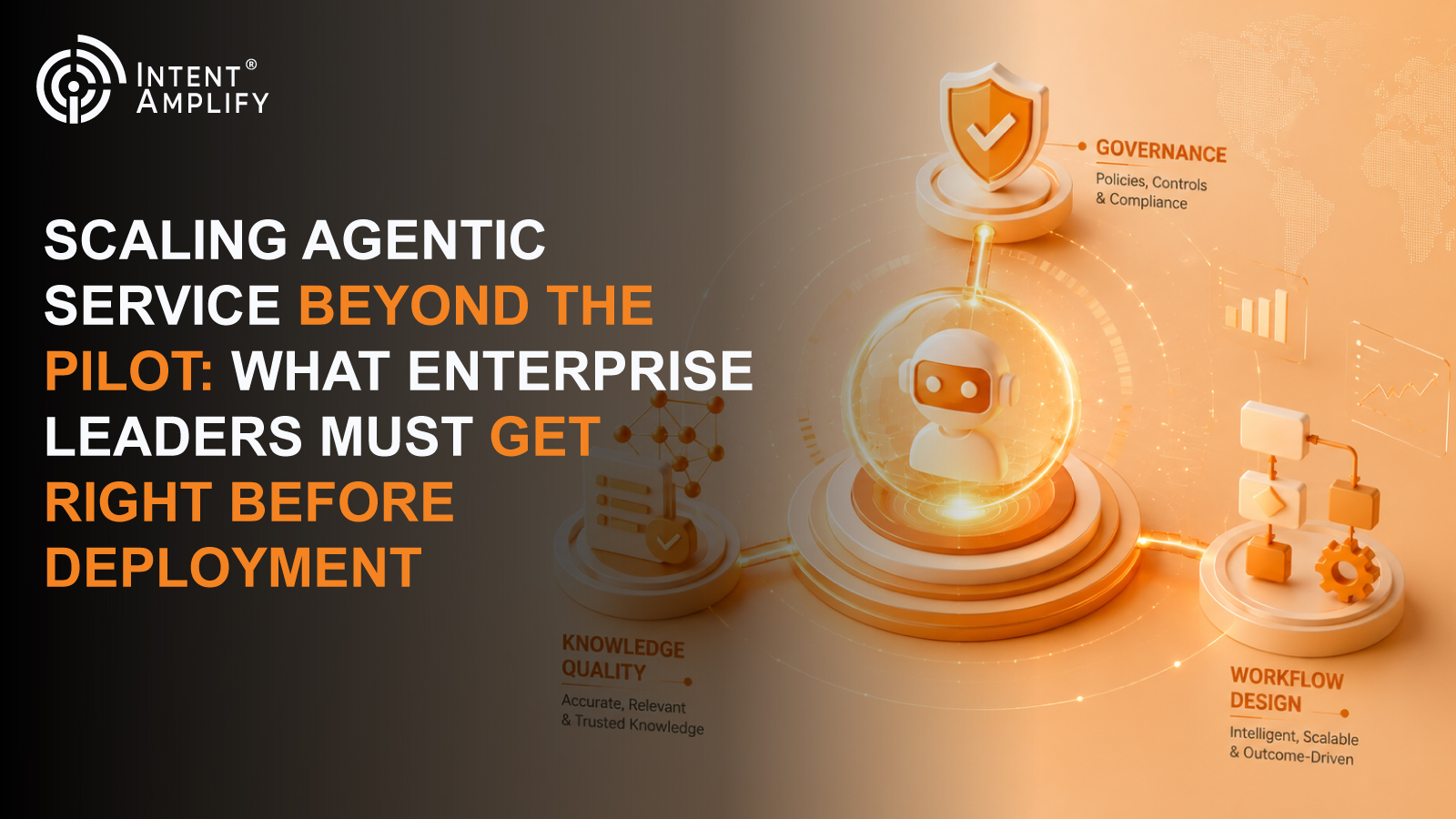
Agentic service is moving from innovation theater to operational decision-making. For customer service, customer experience, IT service management, help desk, contact center, and service delivery leaders, the question is no longer whether AI agents can automate isolated tasks.
The sharper question is whether the enterprise is ready to let autonomous systems interpret intent, trigger workflows, retrieve knowledge, escalate exceptions, and influence service outcomes at scale.
The difference matters. Traditional service automation has largely been rule-based: route a ticket, populate a field, send a notification, or deflect a simple query. Agentic AI service introduces systems that can reason across context, plan multi-step actions, use enterprise tools, and adapt based on changing customer or operational signals.
McKinsey’s June 2025 analysis positions service operations as one of the first enterprise functions where agentic AI can move organizations past experimentation and into measurable productivity and customer experience impact. 1
Microsoft’s 2025 Dynamics 365 updates reinforce the same direction: autonomous service agents are being designed to discover customer intent, manage cases, improve knowledge quality, and support proactive engagement journeys across service channels. 2
Pilots often succeed because they are narrow, supervised, and insulated from enterprise complexity. Deployment fails when leaders underestimate the governance, data, workflow, security, and change-management architecture required to make an autonomous service dependable.
From Pilot Success to Production Risk
The market signal is strong, but so is the caution. Gartner predicted in June 2025 that more than 40% of agentic AI projects will be cancelled by the end of 2027 due to escalating costs, unclear business value, or inadequate risk controls. In the same research, Gartner projected that by 2028, 15% of day-to-day work decisions will be made autonomously through agentic AI, and 33% of enterprise software applications will include agentic AI capabilities. 3
Together, these projections suggest that enterprise AI risk increasingly lies in operational execution rather than model capability. Organizations that scale successfully will differentiate themselves through disciplined deployment rather than rapid experimentation.
This is the central tension for enterprise leaders: agentic AI is becoming structurally important, yet many organizations are not prepared to scale it responsibly.
In our analysis, the failure pattern is rarely caused by the model alone. It is usually caused by weak deployment readiness. Service leaders run a promising pilot around ticket deflection, case summarization, knowledge recommendations, or customer intent discovery. The pilot performs well in a controlled environment. Then, when the system is exposed to fragmented knowledge bases, inconsistent service workflows, unclear escalation rules, legacy ITSM environments, and uneven data governance, performance becomes harder to trust.
Enterprise leaders must therefore stop treating agentic service as a technology evaluation and start treating it as a service transformation program. The correct question is not “Which AI agent should we buy?” It is “Which service decisions are we prepared to automate, under what controls, with what measurable business outcome?”
Register for the Live Workshop
What Enterprises Must Get Right Before Deployment
Every production deployment should answer five governance questions before autonomy is expanded.
1. Define the Service Decisions Agents Are Allowed to Make
Agentic service requires a decision-rights framework. Leaders need to specify which actions an AI agent can recommend, which it can execute autonomously, and which require human approval.
This is especially critical in customer care, IT operations, live chat, tech support, and contact center environments where a single incorrect action can create customer dissatisfaction, security exposure, compliance risk, or operational disruption.
Gartner’s October 2025 customer service research identified high-value AI use cases across customer engagement, employee enablement, operations support, and agentic AI for complex workflows and multi-step service requests. 4
That finding should guide deployment design. Not every workflow deserves autonomy. Routine, low-risk, high-volume interactions are better candidates than emotionally sensitive complaints, regulated account actions, high-severity incidents, or identity-linked support requests.
A practical starting point is to classify use cases into four tiers: assist, recommend, execute with approval, and execute autonomously. This gives CX, customer support, IT, and transformation leaders a shared control model before deployment begins.
2. Build an AI-Ready Knowledge Base
Agentic service quality depends heavily on knowledge quality. If the enterprise knowledge base is outdated, duplicative, poorly tagged, or disconnected from real case outcomes, AI agents will scale inconsistency faster than human teams ever could.
Microsoft’s Customer Intent Agent updates in 2025 show how agentic systems are being designed to analyze support conversations and cases, identify intent, and automate parts of the resolution process. 5
That capability is powerful only when the underlying knowledge environment is reliable. In practice, this means service leaders need ownership for knowledge governance, refresh cadence, content approval, taxonomy, access controls, and feedback loops from resolved cases.
For customer success, help desk, service desk automation, and ITSM transformation teams, an AI-ready knowledge base is not a documentation project. It is a service performance asset.
Before deployment, organizations should measure knowledge article freshness, duplicate resolution paths, search failure rates, escalation reasons, and the percentage of tickets resolved using approved knowledge.
This is an area where Intent Amplify can support enterprise teams through AI readiness research, knowledge maturity assessments, persona-led content mapping, and service workflow analysis that identifies where knowledge gaps will limit agentic AI value.
3. Reengineer Workflows Before Automating Them
Agentic service should not be layered on top of broken workflows. If service processes are fragmented across CRM, ITSM, contact center, ticketing, identity, and knowledge systems, an AI agent will struggle to deliver consistent outcomes.
The strongest deployments start with workflow optimization. Leaders should map where customer or employee requests enter, what data is required to resolve them, which systems must be accessed, where delays occur, and which decisions drive escalation. This is particularly important for MTTR reduction, ticket deflection, AI-powered ITSM, and customer support automation initiatives.
McKinsey’s September 2025 customer care analysis described the emerging service model as an intelligent, orchestrated system where AI resolves matters while humans elevate relationships and experiences. 6
Agentic service represents an orchestration layer that coordinates enterprise knowledge, workflows, systems, policies, and human expertise to deliver consistent service outcomes.
Before scaling, leaders should identify the top 10 service workflows by volume, cost, complexity, and customer impact. Then they should determine which workflow steps can be eliminated, redesigned, or safely delegated to AI agents.
4. Establish AI Governance and Guardrails Early
AI governance cannot be added after deployment. It must be embedded into the operating model before agentic service reaches production. This includes model monitoring, prompt and workflow controls, audit trails, exception handling, human override paths, privacy safeguards, cybersecurity controls, and compliance reporting.
The need for guardrails is becoming more pronounced as agentic systems gain operational autonomy. Gartner projected in June 2025 that guardian agent technologies will account for 10% to 15% of agentic AI markets by 2030, reflecting rising demand for systems that monitor, constrain, and secure agent behavior. 7
For enterprise service environments, this indicates a clear market direction: autonomous service requires autonomous oversight mechanisms as well as human governance.
A mature AI governance framework should answer five questions: What can the agent access? What can it change? What must it log? When must it escalate? Who is accountable when it fails?
For cybersecurity and IT operations teams, this also means agentic service must be assessed as part of the enterprise risk surface. AI agents may interact with customer data, internal systems, APIs, knowledge repositories, identity workflows, and operational records. Security reviews should include access minimization, data leakage risks, adversarial prompt exposure, third-party integrations, and auditability.
5. Measure Business Value Beyond Deflection
Many agentic service pilots are judged by ticket deflection or average handle time. These metrics matter, but they are not sufficient for enterprise-scale deployment. Leaders need a broader performance model that connects AI customer service to customer experience, service quality, employee productivity, cost optimization, and risk reduction.
Gartner’s December 2025 survey found that 55% of customer service leaders reported stable staffing levels while handling higher customer volumes, underscoring AI’s role in improving efficiency rather than simply eliminating roles. 8
This is important for executive messaging. Agentic service should not be framed only as headcount reduction. The stronger business case is capacity creation: fewer repetitive tasks, faster resolution, more consistent answers, better agent experience, and more time for complex, relationship-led work.
Recommended metrics include containment rate, assisted resolution rate, escalation quality, first-contact resolution, MTTR, cost per resolved interaction, customer effort score, quality assurance variance, knowledge reuse rate, compliance exceptions, and human override frequency. For ITSM environments, leaders should also track incident categorization accuracy, change-risk detection, mean time to acknowledge, and mean time to restore.
Intent Amplify can help enterprises translate these metrics into executive-ready narratives, ROI frameworks, market education assets, and decision-maker content that speaks to customer experience, IT, service delivery, and transformation leaders.
Collectively, these measures shift executive reporting from AI activity to business performance, enabling leaders to evaluate whether agentic service improves customer outcomes, operational efficiency, and organizational resilience.
Register Now.
The Human Role Changes, It Does Not Disappear
One of the most important deployment realities is that agentic service does not remove the need for human expertise. It changes where expertise is applied. Human agents, service managers, CX leaders, knowledge owners, and IT operations teams become supervisors of service quality, exception handlers, relationship managers, and process designers.
This aligns with Gartner’s March 2025 polling, which found that 95% of customer service leaders planned to retain human agents to strategically define AI’s role, supporting a “digital first, but not digital only” strategy. 9
While this data predates June 2025, it remains relevant as a baseline for interpreting later 2025 findings on stable staffing and AI-assisted volume handling.
The implication for deployment is clear: workforce planning must be part of the roadmap. Service teams need training on AI oversight, escalation review, knowledge feedback, prompt interpretation, and risk identification. Leaders also need to communicate how agentic service will improve work, not just monitor it.
Organizations that realize the greatest value from agentic service redesign human work around judgment, exception handling, governance, and relationship management rather than routine execution.
A Practical Deployment Roadmap
Enterprise leaders preparing to scale agentic service should follow a staged roadmap.
First, assess AI readiness across data, knowledge, workflow, governance, systems integration, and talent.
Second, prioritize high-impact service use cases where volume, repeatability, and risk profile support automation.
Third, define decision rights and guardrails before production deployment.
Fourth, modernize the knowledge base and workflow architecture. Fifth, deploy in controlled phases with human oversight, measurable KPIs, and rollback mechanisms. Sixth, establish a recurring AI performance review cadence across CX, IT, operations, risk, and business leadership.
Accenture’s 2026 platform strategy research argues that organizations need to modernize digital cores, define how humans, platforms, and AI agents work together, and build adaptive architectures for agentic AI at scale. 10
That view is consistent with what we see in service transformation: the winners will not be the companies with the most pilots. They will be the companies with the strongest operating architecture for trusted autonomy.
The sequence matters because governance introduced after deployment is significantly more difficult to operationalize than governance designed into the operating model from the outset.
What Leaders Should Do Now
Agentic service will reshape customer support, customer experience, IT operations, service desk automation, contact center strategy, and enterprise service delivery. The organizations that gain an advantage will be those that treat deployment as a disciplined transformation initiative.
Before scaling, leaders should be able to prove that they have selected the right use cases, prepared the data and knowledge base, redesigned workflows, defined governance, protected customer and operational data, trained human teams, and established a metrics model that connects AI performance to business outcomes.
For enterprises evaluating agentic AI, the immediate priority is not faster experimentation. It is deployment readiness.
Intent Amplify helps technology leaders, CX teams, service transformation executives, and AI solution providers build the research-backed market narratives, buyer education assets, readiness frameworks, and executive content needed to accelerate informed adoption.
If your organization is planning to scale agentic service beyond the pilot stage, now is the time to pressure-test the roadmap, validate the market message, and equip decision-makers with evidence-led guidance.
Contact Intent Amplify to explore how intelligence-led demand activation can support your next campaign.
References
[1] McKinsey & Company, “The future of customer experience: Embracing agentic AI,” June 11, 2025. link: https://www.mckinsey.com/capabilities/operations/our-insights/the-future-of-customer-experience-embracing-agentic-ai
[2] Microsoft, “AI-powered proactive engagement and conversational journeys with Microsoft Dynamics 365 in public preview,” June 3, 2025. link: https://www.microsoft.com/en-us/dynamics-365/blog/business-leader/2025/06/03/ai-powered-proactive-engagement-and-conversational-journeys-with-microsoft-dynamics-365-in-public-preview/
[3] Gartner, “Gartner Predicts Over 40% of Agentic AI Projects Will Be Canceled by End of 2027,” June 25, 2025. link: https://www.gartner.com/en/newsroom/press-releases/2025-06-25-gartner-predicts-over-40-percent-of-agentic-ai-projects-will-be-canceled-by-end-of-2027
[4] Gartner, “Gartner Says the Most Valuable AI Use Cases for Customer Service and Support Fall Into Four Areas,” October 8, 2025. link: https://www.gartner.com/en/newsroom/press-releases/2025-10-08-gartner-says-the-most-valuable-ai-use-cases-for-customer-service-and-support-fall-into-four-areas
[5] Microsoft, “Automate intent discovery and resolution with Customer Intent Agent,” August 19, 2025. link: https://www.microsoft.com/en-us/dynamics-365/blog/it-professional/2025/08/19/automate-intent-discovery-and-resolution-with-customer-intent-agent/
[6] McKinsey & Company, “Agentic AI in customer care: What’s on leaders’ minds,” September 25, 2025. link: https://www.mckinsey.com/capabilities/operations/our-insights/operations-blog/agentic-ai-in-customer-care-whats-on-leaders-minds
[7] Gartner, “Gartner Predicts that Guardian Agents will Capture 10-15% of the Agentic AI Market by 2030,” June 11, 2025. link: https://www.gartner.com/en/newsroom/press-releases/2025-06-11-gartner-predicts-that-guardian-agents-will-capture-10-15-percent-of-the-agentic-ai-market-by-2030
[8] Gartner, “Gartner Survey Finds Only 20% of Customer Service Leaders Report AI-Driven Headcount Reduction,” December 2, 2025. link: https://www.gartner.com/en/newsroom/press-releases/2025-12-02-gartner-survey-finds-only-20-percent-of-customer-service-leaders-report-ai-driven-headcount-reduction
[9] Gartner, “Gartner Predicts 50% of Organizations Will Abandon Plans to Reduce Customer Service Workforce Due to AI,” June 10, 2025. link: https://www.gartner.com/en/newsroom/press-releases/2025-06-10-gartner-predicts-50-percent-of-organizations-will-abandon-plans-to-reduce-customer-service-workforce-due-to-ai
[10] Accenture, “The New Rules of Platform Strategy in the Age of Agentic AI,” 2026. link: https://www.accenture.com/us-en/insights/strategy/new-rules-platform-strategy-agentic-ai