
logo
logo
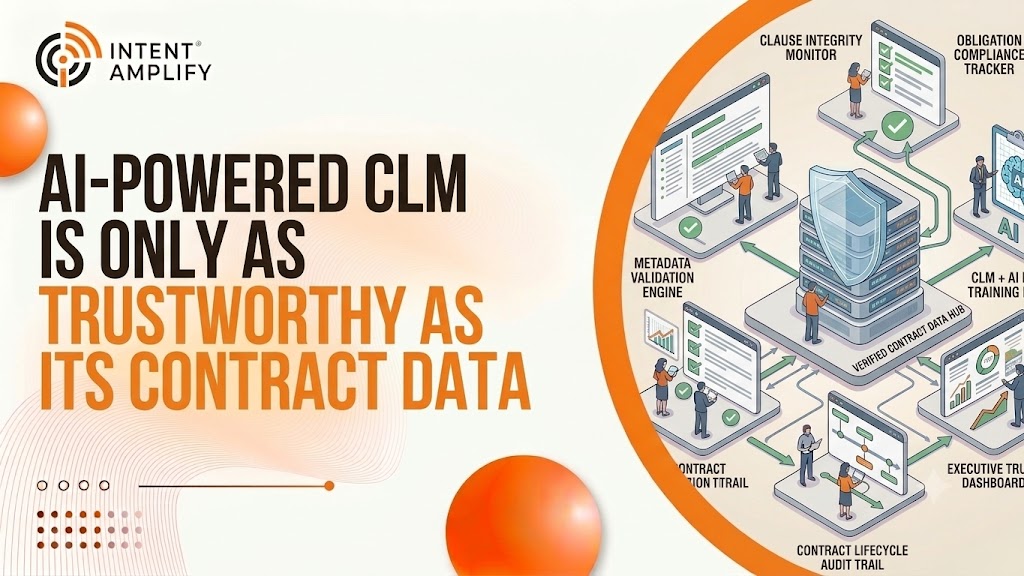
AI-Powered CLM Is Only as Trustworthy as Its Contract Data

EXPERT INSIGHT

AI-Powered CLM Is Only as Trustworthy as Its Contract Data

A practical contract-data governance model for making AI-powered CLM more accurate, explainable, permission-aware, auditable, and reliable over time.

Executive Overview

Trustworthy contract intelligence requires authoritative documents, standardized metadata, source traceability, permissions, validation, monitoring, and correction across the entire AI-enabled workflow.

Written for Legal Operations, Procurement Operations, Data, IT, Privacy, Security, Compliance, and AI governance leaders, AI-Powered CLM Is Only as Trustworthy as Its Contract Data applies current public evidence to the Contract Data Trust Model. Its governing proposition is that trustworthy contract intelligence requires authoritative documents, standardized metadata, source traceability, permissions, validation, monitoring, and correction across the entire AI-enabled workflow. Internal deployment, customer, revenue, pipeline, ROI, and performance outcomes are not asserted. Any external use of this expert insight 1 remains subject to claim, legal, brand, and channel approval.

1. Define the Authoritative Contract Record

AI needs clarity about controlling documents, amendments, versions, and status. For Legal Operations, Procurement Operations, Data, IT, Privacy, Security, Compliance, and AI governance leaders, that shift matters because duplicate or superseded files can generate conflicting answers. The AI-Powered CLM Is Only as Trustworthy as Its Contract Data perspective turns the issue into a concrete operating question: which decision should improve, which contract population is in scope, who owns the next action, and what evidence will show that the result is reliable? The useful move is to resolve authority before extraction. This framing gives the reader a practical starting point without assuming that software, AI, or a content download has already changed business performance.

Sources [4] and [9] support the direction of this section but have different evidence bases. Agiloft material describes its platform and product approach; those statements remain vendor claims unless independently verified. Independent or public-framework evidence helps explain why AI needs clarity about controlling documents, amendments, versions, and status, but it does not prove the condition of a specific enterprise. The reader should therefore test the argument through a reconciled record with controlling-version evidence. If the source record, definition, owner, or result cannot be reproduced, the evidence state remains partial, and the organization should correct only the affected workflow.

A value-first implementation would establish source hierarchy, version rules, document relationships, and archival controls. Under the Contract Data Trust Model, the team records the before-state, configures the minimum workflow, assigns an accountable owner, and verifies a reconciled record with controlling-version evidence. The control should show what happens when data is missing, AI confidence is low, a deadline is missed, or a business owner disagrees with the output. This makes the section useful to practitioners and gives executives a defensible basis to resolve authority before extraction. Expected benefits such as faster answers, clearer obligations, improved renewal readiness, or better visibility remain hypotheses until the organization measures them against an authoritative baseline.

2. Standardize Meaning

Shared fields require shared definitions. For Legal Operations, Procurement Operations, Data, IT, Privacy, Security, Compliance, and AI governance leaders, that shift matters because renewal, obligation, risk, and value can be interpreted differently across teams. The AI-Powered CLM Is Only as Trustworthy as Its Contract Data perspective turns the issue into a concrete operating question: which decision should improve, which contract population is in scope, who owns the next action, and what evidence will show that the result is reliable? The useful move is to approve meanings with Legal, Procurement, and Finance. This framing gives the reader a practical starting point without assuming that software, AI, or a content download has already changed business performance.

Sources [4] and [10] support the direction of this section but have different evidence bases. Agiloft material describes its platform and product approach; those statements remain vendor claims unless independently verified. Independent or public-framework evidence helps explain why shared fields require shared definitions, but it does not prove the condition of a specific enterprise. The reader should therefore test the argument through a governed data dictionary. If the source record, definition, owner, or result cannot be reproduced, the evidence state remains partial, and the organization should correct only the affected workflow.

A value-first implementation would create business definitions, formats, allowable values, and ownership. Under the Contract Data Trust Model, the team records the before-state, configures the minimum workflow, assigns an accountable owner, and verifies a governed data dictionary. The control should show what happens when data is missing, AI confidence is low, a deadline is missed, or a business owner disagrees with the output. This makes the section useful to practitioners and gives executives a defensible basis to approve meanings with Legal, Procurement, and Finance. Expected benefits such as faster answers, clearer obligations, improved renewal readiness, or better visibility remain hypotheses until the organization measures them against an authoritative baseline.

3. Validate AI at the Use-Case Level

Performance depends on contract type, clause language, scan quality, and task. For Legal Operations, Procurement Operations, Data, IT, Privacy, Security, Compliance, and AI governance leaders, that shift matters because one overall accuracy figure can hide high-impact failures. The AI-Powered CLM Is Only as Trustworthy as Its Contract Data perspective turns the issue into a concrete operating question: which decision should improve, which contract population is in scope, who owns the next action, and what evidence will show that the result is reliable? The useful move is to set risk-based review thresholds. This framing gives the reader a practical starting point without assuming that software, AI, or a content download has already changed business performance.

Sources [5], [9], [10] support the direction of this section but have different evidence boundaries. Agiloft material describes its platform and product approach; those statements remain vendor claims unless independently verified. Independent or public-framework evidence helps explain why performance depends on contract type, clause language, scan quality, and task, but it does not prove the condition of a specific enterprise. The reader should therefore test the argument through false positive, false negative, correction, and agreement records. If the source record, definition, owner, or result cannot be reproduced, the evidence state remains partial, and the organization should correct only the affected workflow.

A value-first implementation would test representative samples and confidence bands with subject-matter reviewers. Under the Contract Data Trust Model, the team records the before-state, configures the minimum workflow, assigns an accountable owner, and verifies false positive, false negative, correction, and agreement records. The control should show what happens when data is missing, AI confidence is low, a deadline is missed, or a business owner disagrees with the output. This makes the section useful to practitioners and gives executives a defensible basis to set risk-based review thresholds. Expected benefits such as faster answers, clearer obligations, improved renewal readiness, or better visibility remain hypotheses until the organization measures them against an authoritative baseline.

4. Preserve Explainability and Auditability

Users need to see why a summary, extraction, or risk flag exists. For Legal Operations, Procurement Operations, Data, IT, Privacy, Security, Compliance, and AI governance leaders, that shift matters because unsupported output weakens adoption and defensibility. The AI-Powered CLM Is Only as Trustworthy as Its Contract Data perspective turns the issue into a concrete operating question: which decision should improve, which contract population is in scope, who owns the next action, and what evidence will show that the result is reliable? The useful move is to require traceability for consequential use cases. This framing gives the reader a practical starting point without assuming that software, AI, or a content download has already changed business performance.

Sources [5], [9] support the direction of this section but have different evidence boundaries. Agiloft material describes its platform and product approach; those statements remain vendor claims unless independently verified. Independent or public-framework evidence helps explain why users need to see why a summary, extraction, or risk flag exists, but it does not prove the condition of a specific enterprise. The reader should therefore test the argument through reproducible output and audit logs. If the source record, definition, owner, or result cannot be reproduced, the evidence state remains partial, and the organization should correct only the affected workflow.

A value-first implementation would link outputs to source text, model or rule, timestamp, user, and correction history. Under the Contract Data Trust Model, the team records the before-state, configures the minimum workflow, assigns an accountable owner, and verifies reproducible output and audit logs. The control should show what happens when data is missing, AI confidence is low, a deadline is missed, or a business owner disagrees with the output. This makes the section useful to practitioners and gives executives a defensible basis to require traceability for consequential use cases. Expected benefits such as faster answers, clearer obligations, improved renewal readiness, or better visibility remain hypotheses until the organization measures them against an authoritative baseline.

5. Govern Access and Data Use

Contracts contain sensitive commercial, personal, and regulated information. For Legal Operations, Procurement Operations, Data, IT, Privacy, Security, Compliance, and AI governance leaders, that shift matters because broad access or unclear provider use can create privacy and confidentiality risk. The AI-Powered CLM Is Only as Trustworthy as Its Contract Data perspective turns the issue into a concrete operating question: which decision should improve, which contract population is in scope, who owns the next action, and what evidence will show that the result is reliable? The useful move is to align AI access with contract sensitivity. This framing gives the reader a practical starting point without assuming that software, AI, or a content download has already changed business performance.

Sources [3], [4], [9] support the direction of this section but have different evidence boundaries. Agiloft material describes its platform and product approach; those statements remain vendor claims unless independently verified. Independent or public-framework evidence helps explain why contracts contain sensitive commercial, personal, and regulated information, but it does not prove the condition of a specific enterprise. The reader should therefore test the argument through access reviews and data-use records. If the source record, definition, owner, or result cannot be reproduced, the evidence state remains partial, and the organization should correct only the affected workflow.

A value-first implementation would apply least privilege, purpose limitation, retention, provider review, and incident controls. Under the Contract Data Trust Model, the team records the before-state, configures the minimum workflow, assigns an accountable owner, and verifies access reviews and data-use records. The control should show what happens when data is missing, AI confidence is low, a deadline is missed, or a business owner disagrees with the output. This makes the section useful to practitioners and gives executives a defensible basis to align AI access with contract sensitivity. Expected benefits such as faster answers, clearer obligations, improved renewal readiness, or better visibility remain hypotheses until the organization measures them against an authoritative baseline.

6. Monitor the System Over Time

Data and model behavior can change after launch. For Legal Operations, Procurement Operations, Data, IT, Privacy, Security, Compliance, and AI governance leaders, that shift matters because silent errors can accumulate if only individual outputs are reviewed. The AI-Powered CLM Is Only as Trustworthy as Its Contract Data perspective turns the issue into a concrete operating question: which decision should improve, which contract population is in scope, who owns the next action, and what evidence will show that the result is reliable? The useful move is to manage humans on the loop as well as in the loop. This framing gives the reader a practical starting point without assuming that software, AI, or a content download has already changed business performance.

Sources [4], [5], [10] support the direction of this section but have different evidence boundaries. Agiloft material describes its platform and product approach; those statements remain vendor claims unless independently verified. Independent or public-framework evidence helps explain why data and model behavior can change after launch, but it does not prove the condition of a specific enterprise. The reader should therefore test the argument through ongoing quality dashboards and corrective actions. If the source record, definition, owner, or result cannot be reproduced, the evidence state remains partial, and the organization should correct only the affected workflow.

A value-first implementation would track accuracy trends, anomalies, overrides, drift, complaints, and exceptions. Under the Contract Data Trust Model, the team records the before-state, configures the minimum workflow, assigns an accountable owner, and verifies ongoing quality dashboards and corrective actions. The control should show what happens when data is missing, AI confidence is low, a deadline is missed, or a business owner disagrees with the output. This makes the section useful to practitioners and gives executives a defensible basis to manage humans on the loop as well as in the loop. Expected benefits such as faster answers, clearer obligations, improved renewal readiness, or better visibility remain hypotheses until the organization measures them against an authoritative baseline.

The Contract Data Trust Model

Analyst-created execution model: trustworthy contract intelligence requires authoritative documents, standardized metadata, source traceability, permissions, validation, monitoring, and correction across the entire AI-enabled workflow

Control question

Required evidence

Executive use

Define the Authoritative Contract Record

A reconciled record with controlling-version evidence

Resolve authority before extraction

Standardize Meaning

A governed data dictionary

Approve meanings with legal, procurement, and finance

Validate AI at the Use-Case Level

False positive, false negative, correction, and agreement records

Set risk-based review thresholds

Preserve Explainability and Auditability

Reproducible output and audit logs

Require traceability for consequential use cases

Source: Intent Amplify analyst-created execution model based on the referenced evidence. It is not an external standard.

Executive Recommendations

· To define the authoritative contract record, resolve authority before extraction; verify the result through a reconciled record with controlling-version evidence.

· To standardize meaning, approve meanings with Legal, Procurement, and Finance; verify the result through a governed data dictionary.

Limitations and Practical Risks

Limits specific to AI-Powered CLM Is Only as Trustworthy as Its Contract Data: The campaign workbook contains targets and assumptions, not verified results. Product capabilities are described from Agiloft sources and should be read as vendor claims unless supported by an independent source. The WorldCC figure comes from a survey of nearly 200 businesses conducted with commercial partners and should not be universalized. AI and CLM outcomes depend on contract data quality, workflow design, governance, adoption, integration, and the selected use case. This content is operational guidance, not legal advice, and it does not promise revenue, cost savings, risk elimination, MQL volume, or conversion performance.

Executive Conclusion

AI-Powered CLM Is Only as Trustworthy as Its Contract Data leads to one practical conclusion: trustworthy contract intelligence requires authoritative documents, standardized metadata, source traceability, permissions, validation, monitoring, and correction across the entire AI-enabled workflow. The reader should use The Contract Data Trust Model to diagnose the current state, select a bounded use case, name owners, and define evidence before scaling. A content click can indicate interest, but it does not prove readiness or buying authority. The next commercial step should follow explicit interest and verified ICP fit, while implementation claims remain tied to measured customer evidence.

References

Agiloft, Agiloft Astra general availability announcement, 14 July 2026. https://www.agiloft.com/news/agiloft-announces-general-availability-of-agiloft-astra [3]

Agiloft, What Is Data Governance and Why Is It Important for AI-Powered CLM?, 28 May 2026. https://www.agiloft.com/blog/what-is-data-governance-and-why-is-it-important-for-ai-powered-clm/ [4]

Agiloft, AI governance is the next big priority in legal tech, 6 February 2026. https://www.agiloft.com/blog/ai-governance-is-the-next-big-priority-in-legal-tech-heres-how-clm-is-leading-the-way [5]

NIST, Artificial Intelligence Risk Management Framework: Generative Artificial Intelligence Profile, updated 8 April 2026. https://www.nist.gov/publications/artificial-intelligence-risk-management-framework-generative-artificial-intelligence [9]

NIST AI Resource Center, AI RMF Core: Govern, Map, Measure, Manage, accessed 6 August 2026. https://airc.nist.gov/airmf-resources/airmf/5-sec-core/ [10]

Let us connect for more