

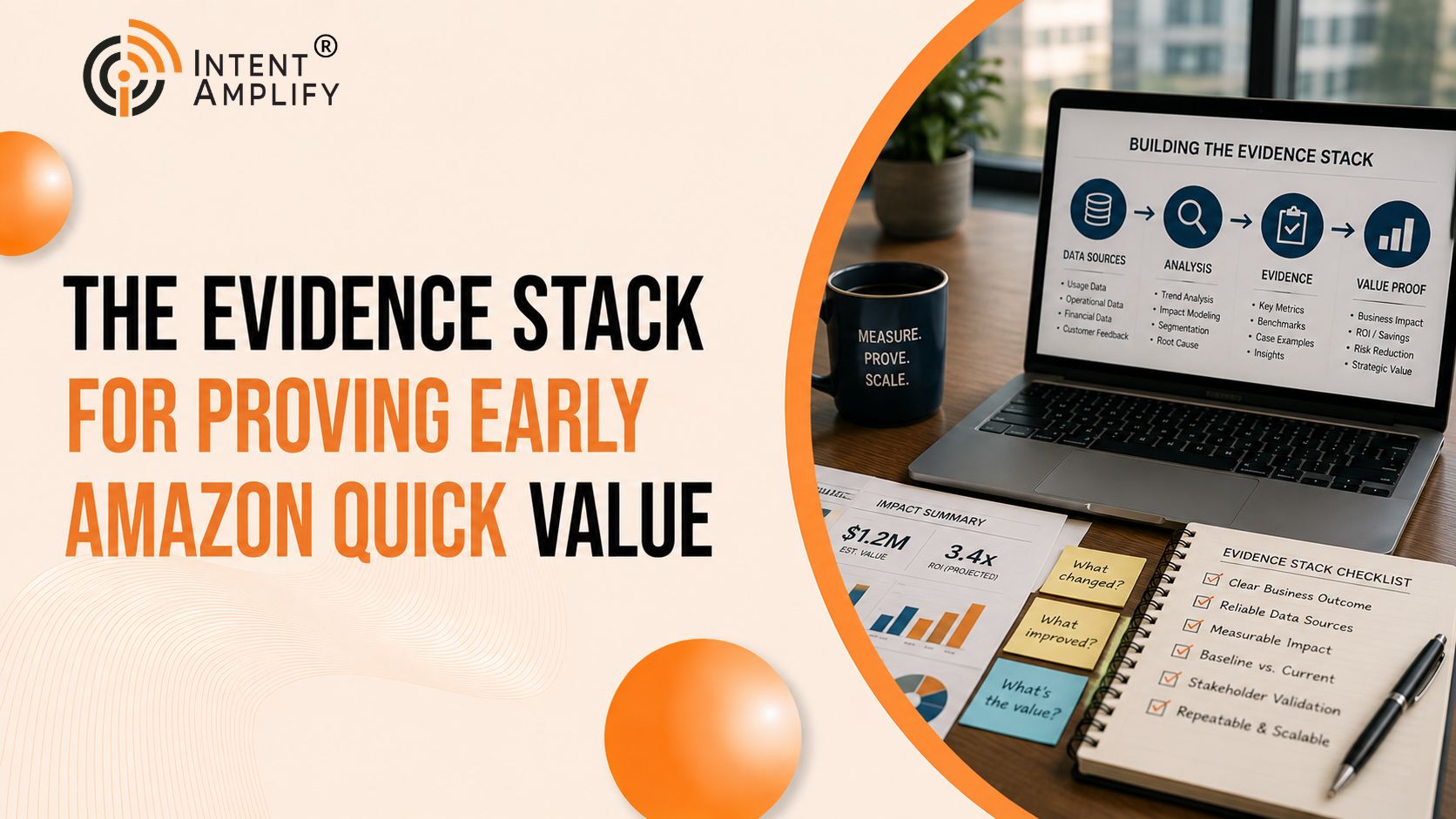
Executive Summary: Early AI Value Needs Evidence, Not Activity
Enterprise AI has entered a more demanding phase. Launching an AI assistant, connecting enterprise data, or generating high user engagement may demonstrate technical progress and employee interest, but none of those signals alone proves business value.
For executives evaluating Amazon Quick, the more important question is whether the organization can connect AI-assisted work to an observable business outcome quickly enough to inform the next investment decision.
Amazon Quick is designed to bring AI-powered assistance, business intelligence, research, data analysis, and workflow automation into the flow of work. AWS describes Quick as an AI-powered service that can automate tasks, analyze data, build applications, conduct research, and use AI agents against connected enterprise data and applications. Its capabilities increasingly extend from answering questions to executing actions and automating multi-step workflows. [1]
That progression - from question to answer, answer to decision, and decision to action - also changes how enterprises should measure early value.
A strong early-value case should not begin with a broad claim such as "AI improved productivity." It should begin with a bounded workflow and build an evidence trail showing who was eligible to use the capability, whether the right context was available, whether users returned to it, whether it influenced decisions, whether those decisions resulted in completed actions, and what control effort was required.
This report introduces a seven-layer Early-Value Evidence Stack for Amazon Quick. The objective is not to manufacture an ROI claim within 45 days. It is to determine whether a focused implementation can generate enough credible evidence within that period to support an executive decision to expand, remediate, redesign, or stop.
Why Amazon Quick Value Cannot Be Proven by Adoption Alone
AI measurement frequently starts with the metrics that are easiest to collect: users activated, prompts submitted, sessions completed, documents generated, dashboards viewed, or workflows initiated.
Those metrics are useful, but they answer a narrow question: Are people using the capability? Executives need answers to harder questions:
- Is AI being used in a workflow that matters?
- Is it working from trusted and authorized enterprise context?
- Are users returning because it is useful?
- Is it changing or accelerating decisions?
- Are those decisions becoming completed business actions?
- What human review, correction, exception handling, and governance effort is required?
- Is the evidence strong enough to justify broader deployment?
This distinction becomes especially important with Amazon Quick because the product is designed to span several layers of enterprise work. Current AWS documentation describes Quick capabilities that include natural-language AI interaction, Quick Sight analytics, Quick Flows for AI-powered workflows, and Quick Automate for business-process automation using agents that can make contextual decisions and execute actions across applications. [1]
AWS has also continued expanding Quick's agentic capabilities. In June 2026, AWS announced autonomous agents with configurable autonomy levels, ranging from step-by-step approval to broader goal-based execution. AWS also added multi-dataset analytics and an activity experience that can support actions such as responding to communications and approving requests. [2]
As AI moves closer to action, usage becomes less sufficient as evidence of value.
The Evidence Principle: Follow the Workflow From Eligibility to Outcome
A defensible Amazon Quick value case can be represented as a chain:
Eligible Workflow -> Trusted Context -> Repeat Use -> Decision Influence -> Action Completion -> Control Burden -> Scale Decision
|
Evidence Layer |
Question It Answers |
Evidence to Retain |
|
1. Workflow Eligibility |
Are we measuring the right cases and users? |
Eligible population, cohort and exclusions |
|
2. Context Fitness |
Did Quick have access to appropriate, trusted information? |
Source-quality and permission tests |
|
3. Repeat Use |
Are eligible users returning to the workflow? |
Cohort trends, bypass and abandonment reasons |
|
4. Decision Influence |
Did the assistance affect judgment or speed? |
Case-linked influence classification |
|
5. Action Completion |
Did the resulting decision become an observable action? |
Authoritative downstream status |
|
6. Control Burden |
What review and correction effort was required? |
Review effort, overrides, errors and exceptions |
|
7. Scale Readiness |
Is the evidence strong enough for the next investment decision? |
Expand-remediate-redesign-stop recommendation |
Source: Intent Amplify early-value measurement framework.
The important principle is that no single layer substitutes for the others. High adoption cannot compensate for poor context. Strong answer quality cannot prove downstream action. Faster completion cannot establish value if human review effort rises substantially. And a positive average cannot justify scaling if a small number of high-consequence failures remain unresolved.
Layer One: Establish Workflow Eligibility
Measurement becomes unreliable when teams cannot define which cases should have used the AI-supported workflow in the first place.
Suppose an insurer is evaluating an AI-assisted claims knowledge workflow. Counting every employee as a potential user would distort adoption. The relevant denominator may instead be claims specialists handling a defined category of cases during the evaluation period.
A manufacturer evaluating maintenance knowledge retrieval might define eligibility by plant, equipment category, technician role, or incident type. Retail and CPG organizations might define the population around merchandising exceptions, customer-service cases, product-information requests, or commercial planning tasks.
Before measuring adoption, the team should establish: Eligible cases -> eligible users -> excluded conditions -> observation period.
Evidence to retain
The evidence owner should maintain the eligible-case population, user cohort, exclusions, workflow owner, observation window, and rationale for the selected scope.
Executive test
Can leadership explain exactly which business cases were supposed to use Amazon Quick - and which were not? If the answer is no, subsequent adoption and productivity measures should be treated as directional rather than conclusive.
Layer Two: Prove Context Fitness
An AI response can be well written and still be unsuitable for an enterprise decision.
The relevant question is whether the assistance is grounded in the right information under the right permissions.
AWS documentation shows that Amazon Quick can work across connected data sources and enterprise applications. Permission management controls which resources and actions users can access, while Quick's data-access architecture applies controls at source and integration levels. AWS states that users querying connected content can only access information they have permission to view. [3][4]
Evidence to retain
Maintain a context-quality rubric, representative role-based test cases, failed-access cases, source conflicts, stale-information cases, and remediation owners.
Executive test
Would the organization trust the same information and permissions if the workflow were expanded to a larger population tomorrow?
Layer Three: Separate Repeat Use From Initial Curiosity
Initial adoption can be driven by novelty, mandatory training, executive sponsorship, or curiosity. Repeat use provides a stronger signal - but only when measured against eligible workflows.
Instead of reporting only monthly active users, teams should examine: Eligible cases -> Quick used -> Quick reused -> Quick bypassed -> workflow abandoned.
Bypass is especially informative. If employees repeatedly return to established manual processes, leadership needs to understand why. The cause may be missing sources, slower workflow execution, insufficient trust, permission friction, poor output quality, or simply a use case that does not benefit enough from AI assistance. Those findings are not measurement failures. They are evidence.
Evidence to retain
Track cohort-based repeat use together with bypass and abandonment reasons rather than presenting an isolated engagement percentage.
Executive test
Are users returning because Amazon Quick makes the target workflow materially more useful, or merely because the technology is available?
Layer Four: Measure Decision Influence
The strongest early-value evidence begins to emerge when AI assistance changes what happens next.
For each representative case, the workflow owner can classify Amazon Quick's influence as confirmed, changed, accelerated, escalated, or unaffected.
This approach is stronger than a general satisfaction score because it connects AI assistance to a business judgment. Consider a manufacturing engineer investigating an equipment issue. A positive experience rating tells leadership that the engineer liked the tool. A case record showing that relevant maintenance history was surfaced, the diagnosis was accelerated, and a maintenance action was subsequently created tells leadership much more.
Evidence to retain
Record the influence category against a representative business case, along with the workflow owner and the source used to validate the classification.
Executive test
Can the organization point to specific decisions that were confirmed, changed, accelerated, or appropriately escalated because of the AI-assisted workflow?
Layer Five: Follow the Decision Into Action
A decision is not necessarily a business outcome. Value becomes more credible when the evidence trail continues into the system where work is actually completed.
That might mean a claims task created and resolved; a maintenance action assigned and closed; a merchandising exception corrected; a customer issue routed and completed; a commercial-plan action approved; a follow-up created in a CRM; or another authoritative downstream event.
This layer is increasingly relevant as Amazon Quick expands its ability to connect AI assistance with enterprise applications and actions. AWS describes Quick as supporting workflows and agents that can execute actions across connected applications, and its integration library includes both built-in and extensible mechanisms for working with enterprise tools. [1][5]
Evidence to retain
Track actions as created, assigned, completed, reversed, or abandoned, using the receiving system as the authoritative source whenever possible.
Executive test
Can leadership trace AI-assisted decisions to observable downstream completion? Without that connection, claims of business impact should remain qualified.
Layer Six: Calculate the Control Burden
AI can make one part of a workflow faster while making another part more expensive. That is why early-value measurement should include the effort required to review, correct, approve, override, and investigate AI-supported work.
A workflow that saves five minutes of research but introduces ten minutes of mandatory verification has not created the productivity gain suggested by the first metric.
Net Workflow Contribution = Gross Time or Effort Avoided - New Review, Correction and Exception Effort.
This is not a complete ROI calculation. It is a way to prevent gross productivity claims from being mistaken for net value. Control-burden measures can include reviewer minutes per case, correction rate, material-error rate, overrides, false escalations or false holds, permission failures, exception-handling volume, rework, and additional governance effort.
Amazon Quick provides administrative and permission mechanisms intended to support enterprise controls, including IAM-related access management, custom permission profiles, data-source controls, and enterprise security capabilities. [3][6]
Evidence to retain
Measure control workload by risk tier and workflow stage, with enough detail to estimate whether the operating burden is sustainable at larger scale.
Executive test
Does the benefit remain meaningful after the organization includes the human and governance work required to use the capability responsibly?
Layer Seven: Turn Evidence Into a Scale Decision
The purpose of a 45-day early-value cycle should not be to declare that enterprise AI has "succeeded." It should be to make the next decision better.
|
Decision |
When It Makes Sense |
|
Expand |
Evidence is sufficiently strong across workflow, context, use, action and controls |
|
Remediate |
The workflow is promising, but identifiable evidence or implementation gaps remain |
|
Redesign |
The use case or operating model needs material change before further investment |
|
Stop |
Evidence suggests insufficient value, unacceptable risk, or poor workflow fit |
The executive memo should not hide missing evidence. If context fitness is partial, usefulness claims should remain limited to the sources actually tested. If downstream completion cannot be observed, the team should not claim completed business outcomes. If control burden is high, the cost and capacity required for review should accompany any recommendation to scale.
What a 45-Day Evidence Window Should Actually Prove
A 45-day horizon should be treated as a bounded evidence window, not as a universal promise of ROI. The objective is to move from an untested AI opportunity toward enough evidence for an executive decision.
Days 1-10: Define
Select one workflow, establish the eligible population, name the accountable sponsor, identify governing sources, define permissions, establish the baseline, and agree on the next executive decision.
Days 11-25: Observe
Run representative cases. Capture context quality, usage, bypass behavior, exceptions, decision influence, and control effort.
Days 26-35: Validate
Trace decisions into downstream actions. Investigate failures and contrary cases. Compare observed performance with the baseline and test whether the initial value hypothesis still holds.
Days 36-45: Decide
Prepare the evidence stack and determine whether the appropriate next step is to expand, remediate, redesign, or stop.
The output of the cycle should give executives a decision record containing scope + baseline + evidence + exceptions + economics + next action.
Contrary Evidence Is Part of the Business Case
AI programs can become biased toward proving the initial hypothesis. A better evidence model deliberately preserves the strongest contrary explanation.
- a high-consequence incorrect answer;
- an inaccessible authoritative source;
- a user group that consistently bypasses the workflow;
- a permission configuration that does not scale;
- excessive human review;
- a weak or absent business sponsor;
- or an action that repeatedly fails
These cases matter because scale amplifies both value and failure. The executive review should therefore ask: What evidence would cause us not to expand? Answering that question before the evaluation begins makes the final recommendation substantially more defensible.
The Evidence Charter: Agree on Proof Before the Pilot Produces Data
Teams should define evidence rules before observing the first case. An Evidence Charter can establish:
|
Element |
What Must Be Defined |
|
Workflow |
Specific process being evaluated |
|
Sponsor |
Executive accountable for the business decision |
|
Eligible population |
Users and cases included in measurement |
|
Baseline |
Current workflow state and comparison measure |
|
Authoritative sources |
Systems permitted to verify context and outcomes |
|
Access boundaries |
Roles, permissions and prohibited actions |
|
Evidence owner |
Person accountable for collection quality |
|
Decision date |
When leadership will review the evidence |
|
Counter-signals |
Evidence that would challenge expansion |
|
Decision options |
Expand, remediate, redesign or stop |
Evidence states should remain distinguishable: Verified | Partial | Unknown | Conflicting. This prevents a strong metric in one layer from obscuring missing evidence elsewhere.
Applying the Evidence Stack Across Industries
The framework remains consistent, but the workflow and evidence source should change by industry.
|
Industry |
Potential Starting Workflow |
Evidence That Matters |
|
Insurance |
Claims research, underwriting support, policy knowledge, service |
Case handling, source authority, decision influence, downstream claims or service action |
|
Manufacturing |
Maintenance, engineering knowledge, quality investigation, field service |
Diagnosis time, technical-source quality, maintenance action, rework and review burden |
|
Retail |
Store operations, merchandising, product knowledge, customer service |
Eligible requests, resolution actions, content accuracy, exception volume |
|
CPG |
Commercial planning, brand intelligence, sales support, supply-chain knowledge |
Decision cycle, source coverage, follow-through, review and exception effort |
The objective is not to begin with the largest possible enterprise deployment. Start with a workflow that is consequential enough to matter but bounded enough to observe.
The Executive Workshop: Five Questions Before Funding the Next Stage
An effective early-value discussion should begin with a real workflow rather than a product demonstration.
1. What business decision are we trying to improve?
Name the workflow, case type, current friction and accountable owner.
2. What evidence would prove improvement?
Establish the baseline, eligible population and authoritative downstream measure.
3. What context can Amazon Quick legitimately use?
Identify governing sources, access boundaries, conflicts and permission requirements.
4. What could invalidate the business case?
Define unacceptable errors, control burdens, bypass patterns and missing evidence.
5. What decision will we make when the evidence window closes?
Set the date and criteria for expand, remediate, redesign, or stop.
If those questions cannot be answered, the organization may not yet have an AI implementation problem. It may have a use-case definition problem.
From Early Evidence to AI Business Outcomes
The evidence stack creates a progression from AI activity toward measurable business outcomes:
- Usage tells you that people tried
- Repeat use tells you they may find it
- Decision influence tells you it affected
- Action completion tells you something
- Control-adjusted evidence tells you whether that change may be economically and operationally
- Scale readiness tells leadership what to do
That progression matters as Amazon Quick evolves further into agentic work. In 2026, AWS expanded Quick with autonomous agents capable of operating with configurable levels of autonomy. Greater autonomy increases the importance of understanding not only whether an agent completes a task but also which information it used, which actions it performed, which controls applied, and what happened downstream. [2]
Early-value measurement therefore becomes part of the operating model for agentic AI - not merely a justification exercise after deployment.
Conclusion: The Best Early-Value Proof Is a Better Executive Decision
The strongest case for Amazon Quick will not be built from a large number of prompts, impressive demonstrations, or isolated productivity anecdotes. It will come from an evidence chain that executives can inspect.
For enterprises evaluating Amazon Quick, that means beginning with a bounded business workflow and following the evidence through eligibility, context, repeat use, decision influence, action completion, control burden, and scale readiness.
A 45-day horizon can be useful when it creates discipline around that process. It establishes a defined period in which teams can test a value hypothesis, expose evidence gaps, understand operating requirements, and prepare the next investment decision.
The result does not need to be an artificial declaration of success. A decision to remediate a source, narrow permissions, redesign a workflow, or stop a weak use case can be just as valuable as a decision to expand. What matters is that leadership knows why.
For AWS-based enterprises evaluating how Amazon Quick can move from initial use to measurable business value, the next step is to identify one workflow where the evidence can be observed from beginning to end.
Download the Live in 45 with Amazon Quick: First Value Fast Brochure
Explore a focused approach to connecting Amazon Quick implementation with a faster path to first-value evidence.
For organizations with an active initiative, a First-Value Mapping Session can begin with one workflow, its accountable owner, known source and permission constraints, the AWS environment, and the date of the next investment decision. The desired output is not another generic AI demonstration. It is a clearer view of workflow fit, evidence gaps, implementation requirements, and the next best action.
References
- Amazon Web Services (AWS), What is Amazon Quick? Amazon Quick User https://docs.aws.amazon.com/quick/latest/userguide/what-is.html
- Amazon Web Services (AWS), Amazon Quick announces autonomous agents, multi-dataset analytics, and redesigned activity feed, June 17, 2026. https://aws.amazon.com/about-aws/whats-new/2026/06/amazon-quick/
- Amazon Web Services (AWS), Permissions - Amazon Quick. https://docs.aws.amazon.com/quick/latest/userguide/permissions.html
- Amazon Web Services (AWS), Data access integrations - Amazon Quick. https://docs.aws.amazon.com/quick/latest/userguide/data-access-integrations.html
- Amazon Web Services (AWS), Amazon Quick adds third-party AI agents and expands built-in actions library, January 8, 2026. https://aws.amazon.com/about-aws/whats-new/2026/01/3p-agent-in-quick/
- Amazon Web Services (AWS), Best practices for security in Amazon Quick. https://docs.aws.amazon.com/quick/latest/userguide/best-practices-security.html