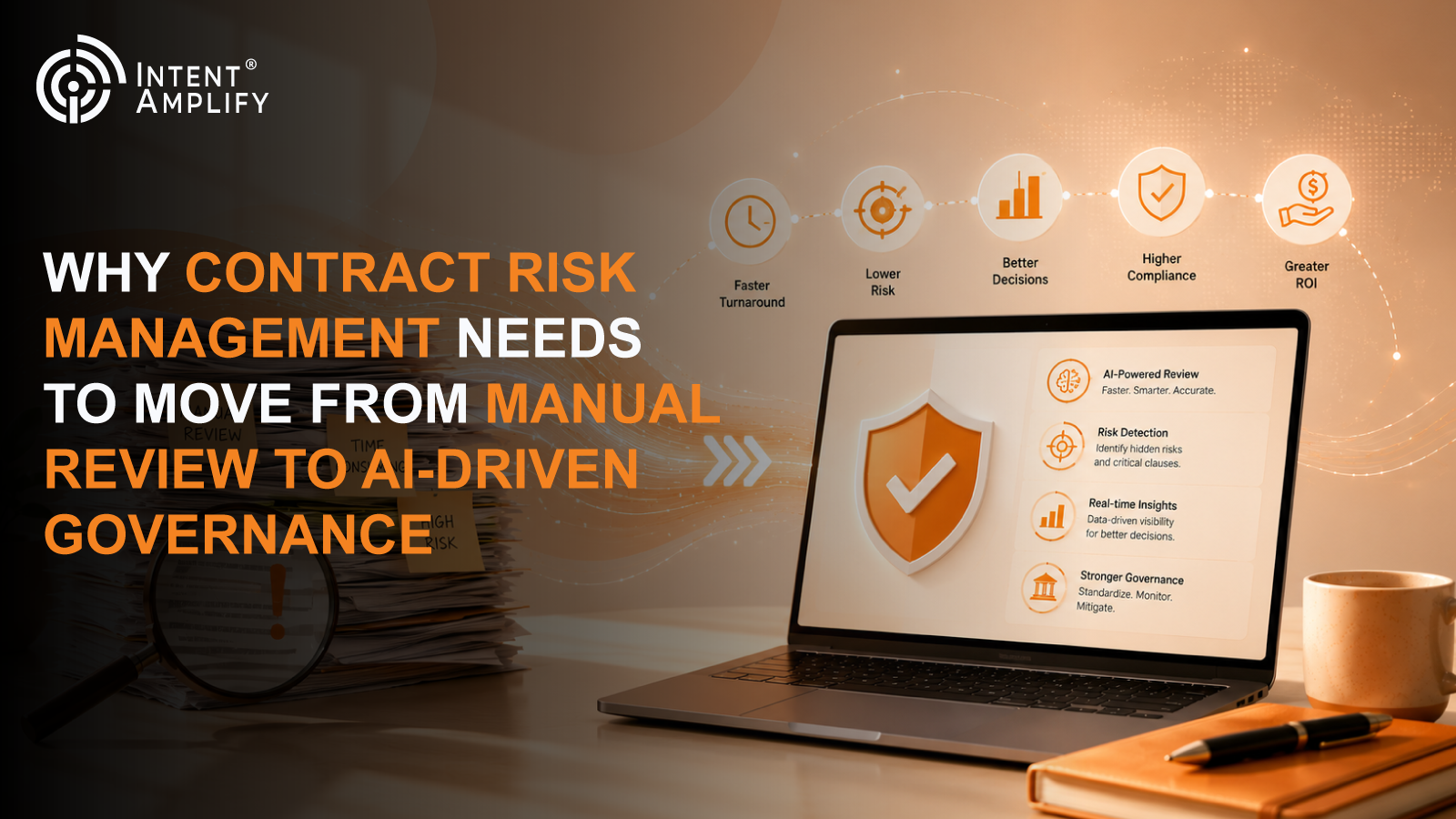
Contract risk rarely begins as a visible crisis. It often starts as a clause variation no one flagged, a renewal date that was tracked in the wrong spreadsheet, a supplier obligation that never reached the right owner, or a liability provision that looked acceptable during negotiation but became costly after signing. Therefore, manual review alone can no longer support enterprise-scale contract risk management.
Agiloft’s report, Eliminating the Silent Threat: How Agiloft Minimizes Risk, is built around this hidden risk problem. The report examines how AI-powered CLM can standardize contract language, improve review consistency, support decision-making, and measure risk-reduction outcomes across the contract lifecycle.
Contract lifecycle management has expanded beyond drafting, storage, and retrieval. Modern CLM platforms help legal, procurement, finance, and executive teams identify risk earlier, govern exceptions consistently, and act before exposure develops into disputes, audit findings, or avoidable costs.
Why Manual Review Is Losing Ground
Manual review was never designed to monitor enterprise-scale contract portfolios after signature. Contracts continue to create obligations, renewal exposure, compliance duties, supplier commitments, and financial risk long after the document is signed.
In large enterprises, those risks are spread across thousands of agreements, business units, suppliers, and systems. A legal team may understand clause language but lack a real-time view of portfolio risk. A procurement team may know the supplier relationship, but not every obligation or renewal trigger. A finance leader may approve spending without full visibility into contract leakage. An executive sponsor may need contract risk reporting that cannot be assembled quickly without manual research.
AI-driven governance changes the model from document-by-document review to portfolio-level visibility.
KEY FIGURES AT A GLANCE
Enterprise AI adoption has moved into the mainstream, with 88% of organizations reporting regular AI use in at least one business function, up from 78% the previous year. McKinsey also found that 62% of respondents say their organizations are at least experimenting with AI agents, including 23% that are scaling agentic AI somewhere in the enterprise and 39% that have begun experimenting. Yet only about one third of respondents say their companies have begun scaling AI programs across the enterprise, which shows why workflow readiness and governance remain major barriers.1
McKinsey’s research also found that 64% of respondents say AI is enabling innovation, while only 39% report enterprise-level EBIT impact from AI, reinforcing that adoption does not automatically equal business value. AI risk is also becoming more visible, with 51% of respondents from organizations using AI reporting at least one negative consequence, and nearly one-third reporting consequences linked to AI inaccuracy.1
Microsoft’s 2026 Work Trend Index surveyed 20,000 AI-using workers across 10 countries and analyzed trillions of anonymized Microsoft 365 productivity signals, showing that organizational factors account for 67% of reported AI impact, compared with 32% for individual mindset and behavior.2
Microsoft also found that only 19% of AI users fall into the “Frontier” zone, where individual capability and organizational readiness reinforce each other, while 16% are stalled and 10% are blocked by organizations that have not caught up.2
Contract Risk Is a Portfolio Problem
The older review model assumes risk can be managed one contract at a time. That assumption breaks down when enterprises need to understand patterns across hundreds or thousands of agreements.
A single nonstandard clause may be manageable. A pattern of nonstandard clauses across a region, supplier category, or customer segment becomes a governance issue. One missed renewal may be an operational mistake. Repeated missed renewals become a contract process failure. One untracked obligation may be recoverable. A portfolio of untracked obligations becomes compliance exposure.
AI contract review, contract data extraction, clause management, and contract analytics help teams identify risk patterns across the portfolio rather than waiting for risk to surface in individual agreements. The result is earlier visibility into emerging exposure, stronger prioritization of review activities, and more consistent governance across the contract lifecycle.
For legal leaders, the value is earlier visibility into clause deviations and legal exposure. For procurement leaders, it is stronger supplier contract intelligence, renewal tracking, and vendor obligation monitoring. For executive sponsors, it is a clearer view of contractual commitments, compliance exposure, and risk concentration.
Standardization Turns Risk into a Governed Process
Agiloft’s report emphasizes standardized contract language as a foundation for risk reduction.
That point matters because inconsistent contract language makes risk harder to detect, compare, and govern.
When business units use different templates, when fallback clauses are not tracked, and when exceptions are approved outside a structured workflow, legal teams lose portfolio control. Procurement teams may accept supplier terms that are difficult to monitor. Compliance teams may inherit obligations that were never operationalized. Executives may believe contract risk is controlled when the portfolio is actually full of unmeasured variation.
AI-powered CLM can support a more disciplined model. Approved clause libraries, deviation tracking, automated routing, contract playbooks, and risk scoring can help teams separate acceptable variation from exposure that needs review. The goal is not to remove negotiation flexibility. The goal is to make exceptions visible, explainable, and governed.
AI-Driven Governance Extends Beyond Signature
Many contract risks do not fully emerge during negotiation. They appear after signature, when obligations must be fulfilled, renewals must be managed, suppliers must perform, and compliance terms must be monitored.
This is why risk governance needs to extend across the entire contract lifecycle.
AI contract data extraction can identify renewal dates, service terms, compliance obligations, commercial commitments, and risk clauses. Contract analytics can reveal where exposure is building. Automated contract compliance tracking can alert teams when obligations need attention. Contract dashboards can give leaders a clearer view of risk by supplier, clause type, business unit, region, or renewal window.
Microsoft’s finding that organizational factors account for 67% of reported AI impact is relevant here because contract AI will not succeed as a standalone tool.2
It must be connected to workflow design, ownership, governance, and decision rights. If contract intelligence surfaces a risk but no team owns the next action, the system has created awareness without control.
Procurement Risk Needs Earlier Signals
Procurement risk is often embedded in supplier contracts. Renewal terms, pricing commitments, service levels, compliance obligations, audit rights, and termination provisions all influence commercial performance, yet many procurement teams continue to manage these elements through manual tracking or fragmented systems.
The result is avoidable commercial and compliance exposure. Supplier disputes may trigger lengthy searches for governing agreements. Renewal deadlines may pass before sourcing teams evaluate alternatives. Compliance obligations may surface only during an audit. Spend commitments can be difficult to validate when contract data remains disconnected from procurement analytics.
AI-driven CLM gives procurement teams earlier visibility into contractual commitments and emerging risk. With trusted contract data, organizations can identify upcoming renewals, compare supplier obligations, support vendor consolidation, monitor compliance, and strengthen supplier performance management.
Legal Operations Needs Focused Human Review
The future of legal work is not less judgment. It is a better-targeted judgment.
McKinsey’s finding that 51% of AI-using organizations have experienced at least one negative consequence is a reminder that AI must be supervised carefully in high-value business processes.²
For legal operations, that means AI should not be treated as an unchecked decision engine. It should act as a risk detection and prioritization layer that helps legal teams focus on the contracts, clauses, and obligations that deserve human attention.
NIST’s AI Risk Management Framework is directly relevant because it emphasizes trustworthiness considerations across AI design, development, use, and evaluation.⁴ In CLM, that principle should translate into approved data sources, validated extraction rules, audit trails, role-based permissions, human review for high-risk outputs, and accountability for AI-assisted decisions.
AI-driven governance works best when it makes legal review more precise, not less responsible.
What Agiloft Brings to the Conversation
Agiloft’s report addresses a growing enterprise challenge: managing contractual risk across large agreement portfolios where manual review alone cannot provide continuous visibility. The message is particularly relevant for legal, procurement, and executive leaders responsible for balancing governance, compliance, and commercial performance.
For legal and contract teams, the focus is earlier risk detection, standardized language, and more efficient review. Procurement and supply chain leaders gain stronger visibility into supplier obligations, renewal exposure, and contract performance. Executive sponsors benefit from clearer insight into contractual risk, compliance exposure, and portfolio-level accountability.
Modern contract lifecycle management extends beyond contract discovery. Effective CLM enables organizations to understand, govern, and act on the commitments embedded within their agreements.
Download Eliminating the Silent Threat: How Agiloft Minimizes Risk
Agiloft’s report gives legal, procurement, and executive teams a practical view of how AI-powered CLM can help standardize contract language, streamline reviews, empower decision-makers, and measure risk-reduction ROI.
Download Now
About Intent Amplify
Intent Amplify helps organizations move from market insight to measurable growth through GTM strategy, demand intelligence, pipeline activation, executive roundtables, sponsored research, targeted content, webinars and panels, vendor intelligence, and strategic consulting.
For teams that need sharper positioning, stronger executive engagement, and more effective activation, Intent Amplify connects strategy, content, and market intelligence into a practical growth engine.
Contact Us
Executive Takeaway
Contract risk management needs to move from manual review to AI-driven governance because enterprise risk no longer sits in a single clause, document, or department. It spreads across obligations, renewals, supplier commitments, compliance terms, and approval workflows.
The organizations that modernize CLM will not remove legal judgment from the process. They will strengthen it by using AI contract management, contract analytics, standardized language, and governed workflows to surface risk earlier and make reviews more focused. In that model, contracts stop acting as silent threats and become governed intelligence that protects business value before exposure becomes visible.
References
- McKinsey and Company (2025). The State of AI in 2025: Agents, Innovation and Transformation. Available at: https://www.mckinsey.com/capabilities/quantumblack/our-insights/the-state-of-ai
- Microsoft (2026). 2026 Work Trend Index: Agents, Human Agency, and the Opportunity for Every Organization. Available at: https://www.microsoft.com/en-us/worklab/work-trend-index/agents-human-agency-and-the-opportunity-for-every-organization
- National Institute of Standards and Technology (2026) AI Risk Management Framework. Available at: https://www.nist.gov/itl/ai-risk-management-framework