
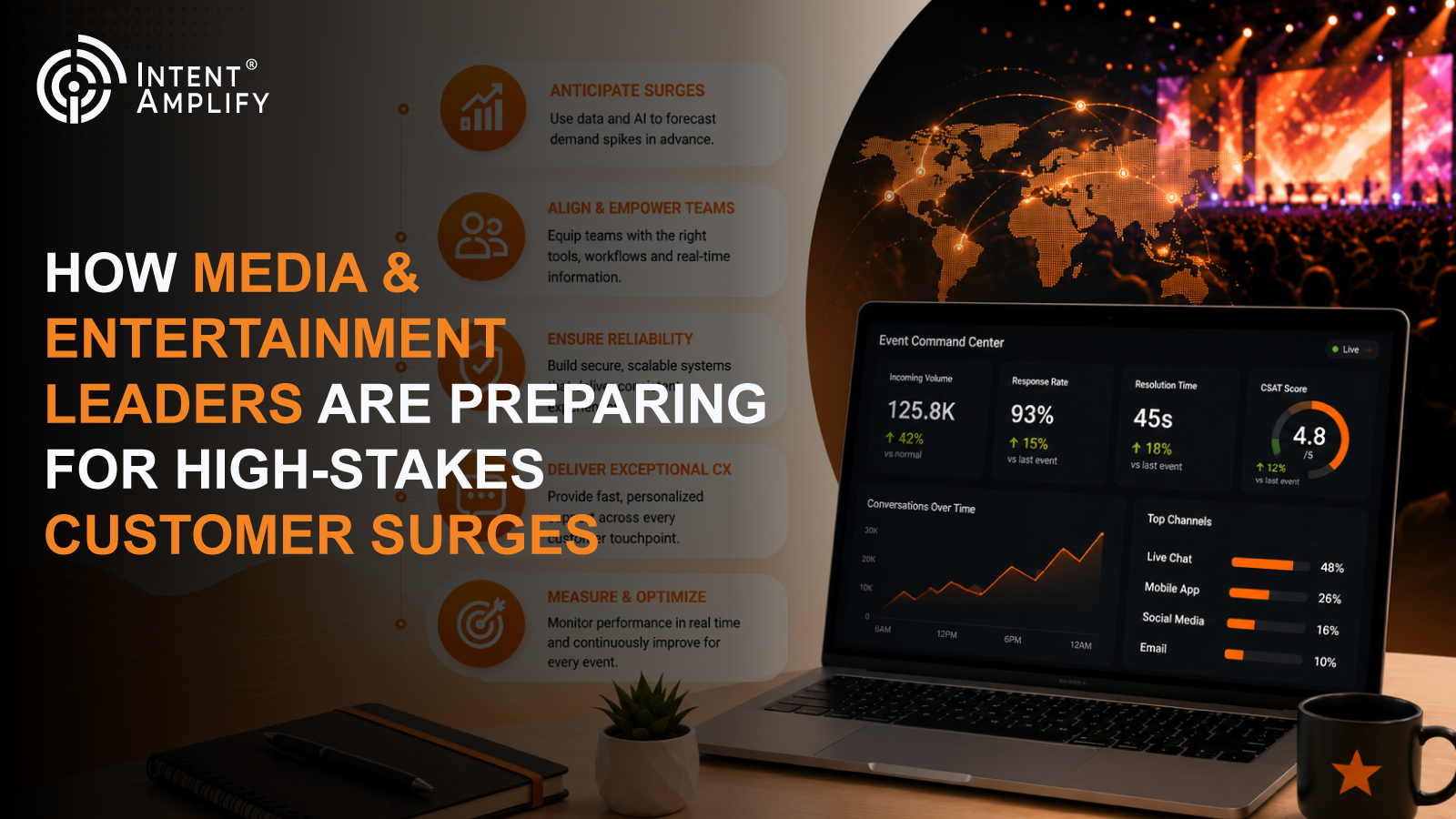
A live sports event is minutes from starting. A streaming premiere has just dropped. A ticket presale opens, and thousands of fans are trying to log in, pay, redeem, stream, or recover access at the same time. In that moment, customer service is no longer a support function relegated to the back of the experience. It becomes part of the experience itself.
For media and entertainment leaders, customer surge management has become a serious test of operational readiness. High-pressure events now arrive through live broadcasts, ticketing windows, gaming launches, app updates, subscription changes, and content releases across every major service channel.
The challenge is not only volume, because timing matters just as much. If a customer gets help after kickoff, after a livestream ends, or after tickets sell out, the response may be accurate, while the experience is already damaged. Therefore, CX leaders are building surge plans around prediction, AI customer service, workforce optimization, proactive communication, and human-AI collaboration.
Why Surge Readiness Is Becoming a CX Priority
Media and entertainment demand is increasingly fragmented as audiences move between streaming apps, sports packages, gaming communities, creator content, podcasts, and live event ecosystems. Deloitte’s 2025 Digital Media Trends report found that consumers spend an average of 6 hours per day on media and entertainment, which shows how competitive the attention economy has become. For CX teams, every service failure now happens where customers already have alternatives. [1]
Subscription pressure adds another layer, as customers are more sensitive to the value they receive from each platform they pay for. Deloitte also found that 47% of consumers say they pay too much for streaming services, while 41% say SVOD content is not worth the price. When customers already question value, a failed login, unclear billing rules, or slow response can quickly become a customer retention issue. [1]
Live sports raise the stakes further because access problems happen during moments fans cannot revisit with the same urgency. Hub Entertainment Research’s 2025 Evolution of Sports survey found that 72% of avid sports fans say sports are more important than any other TV content, and 87% would likely subscribe to a new service if it carried a favorite sport. That creates opportunity, but it also creates customer trust risk when access or support breaks during the event window. [2]
Where High-Stakes Surges Hit Hardest
High-stakes surges usually cluster around five pressure points. Live events create login, blackout, buffering, and device-access issues that demand real-time routing. Streaming premieres create playback, subtitle, regional access, and app-stability questions that require AI-powered support. Ticketing moments create payment failures, QR code issues, and presale confusion. Billing changes create cancellation risk. Outages create duplicate contacts and public complaints that require incident command and approved response scripts.
These moments may look different, but they expose the same operational need. Teams need support for scalability that can handle sudden demand without losing accuracy, empathy, or control.
The New Surge Model: Predict, Deflect, Assist, Escalate
Predict the Spike Before It Hits
Many media and entertainment surges are knowable because a game has a start time, a finale has a release date, and a presale has a launch window. Leaders can use event calendars, marketing plans, product updates, rights changes, and historical contact data to estimate demand by channel, issue type, and urgency. Peak demand management has evolved into a planning discipline focused on likely issues, overloaded channels, priority customer groups, and escalation paths.
Deflect Repetitive Demand with AI Customer Service
AI customer service is becoming the first line of defense for repetitive and time-sensitive questions such as password resets, device setup, payment confirmation, event access, and known-issue updates.
Zendesk’s 2025 CX Trends Report found that 75% of CX leaders expect 80% of customer interactions to be resolved without human intervention in the next few years. For media and entertainment teams, this signals a shift from support capacity as headcount alone to capacity built through customer service automation, AI implementation, knowledge quality, and human expertise. [3]
Assist Agents with Better Context
Surges do not reduce the need for human agents because they make agent productivity more important. During high-volume periods, agents need customer history, summaries, sentiment signals, suggested replies, and relevant knowledge articles so they can resolve complex issues faster.
Salesforce’s 2025 State of Service research found that reps using AI spend 20% less time on routine cases, which frees an estimated 4 hours per week for more complex work. That matters during a customer support surge because agent time should go toward high-risk, emotional, or exception-heavy cases. [4]
Zendesk also reported that agents believe an AI copilot would help them do their job better, while 90% of CX Trendsetters report positive returns on AI tools for agents. The opportunity is to create a hybrid workforce model where AI agents handle predictable volume and human teams manage judgment, empathy, and brand-sensitive escalation. [3]
Escalate What Requires Human Judgment
The strongest service operations separate routine demand from risk-heavy demand. Refund disputes, accessibility support, repeated failed logins, public complaints, billing errors, and churn-risk customers need fast escalation.
AI governance becomes essential when automated support influences refunds, billing, accessibility, account access, or customer-retention outcomes. Responsible AI must produce trusted answers that support customer experience KPIs.
CX leaders preparing for the next high-volume event can explore practical strategies for balancing automation, agent support, and real-time escalation in the upcoming webinar, Turning High-Stakes Surges into Successes.
What Surge-Ready Leaders Measure Differently
Standard CX metrics are useful, but surge performance needs real-time visibility into what is breaking, where customers are stuck, and when human escalation is needed.
|
Metric Category |
What to Track During a Surge |
|
Volume |
Contact volume by channel, top issue drivers, backlog growth |
|
Speed |
First response time, average resolution time, and queue abandonment |
|
Automation |
Self-service resolution rate, bot-to-agent handoff rate |
|
Quality |
CSAT, recontact rate, sentiment, resolution accuracy |
|
Business impact |
Refund volume, social escalation, cancellation, or churn signals |
Amdocs’ 2025 CX20 Global Report found that 80% of business leaders believe they are meeting customer expectations, but only 24% of customers agree. That gap is especially dangerous during high-stakes media moments because poor experiences become visible quickly. [5]
Proactive Communication as a Surge Pressure Valve
One of the most effective ways to reduce customer service surge demand is to prevent avoidable contacts. Event-day login reminders, device checks, how-to-watch guides, known-issue banners, refund explainers, and real-time status updates can stop duplicate tickets.
NiCE’s 2025 Global Happiness Index found that 72% of consumers report experiencing benefits from AI and automation in customer service, while 69% trust companies using AI as much as or more than companies that do not. Therefore, well-designed automation can strengthen customer loyalty when it delivers timely, useful, and transparent support. [6]
The best support ticket during a surge is the one the customer never has to open because proactive communication lowers volume and protects agent capacity.
Readiness Happens Before the Queue Builds
The future of customer service in media and entertainment will depend on the work that happens before the visible spike. Leaders are building AI-ready knowledge bases, testing automated answers, training agents on event-specific issues, preparing response templates, and creating escalation rules before launch.
An AI readiness assessment can show whether knowledge bases, customer data, routing logic, workflows, and compliance controls are ready for peak-demand conditions.
Surge readiness also requires post-event analysis after the demand spike settles. Teams should review which issues drove volume, where customers abandoned self-service, how AI agents performed, whether human handoffs worked, and which moments created churn risk. Useful post-event metrics include deflection accuracy, bot-to-agent handoff rate, recontact rate, queue abandonment, CSAT by issue type, refund volume, social escalation, and churn signals.
Final Takeaway
High-stakes customer surges are becoming a defining test for media and entertainment brands. The companies that perform best will build connected operating models around prediction, AI customer service, workforce optimization, customer service automation, proactive communication, real-time triage, and human escalation.
For CX leaders, customer surge management is no longer a temporary response plan. It is a competitive capability because when customers are trying to watch, buy, access, stream, or resolve an issue in the moment, the quality of support becomes part of the entertainment experience itself.
As media and entertainment organizations rethink surge readiness, the advantage will belong to teams that can combine AI-powered support and human expertise without losing speed, accuracy, or trust. For CX leaders preparing for the next high-stakes demand spike, the practical next step is to assess whether their support model can predict, deflect, assist, and escalate before the queue becomes the story.
If your team is planning a demand-generation program around CX transformation, AI-powered service, or customer surge readiness, get in touch with Intent Amplify to discuss how to reach the decision-makers that matter.
References
- Deloitte (2025) 2025 Digital Media Trends. Available at: https://www.deloitte.com/us/en/insights/industry/technology/digital-media-trends-consumption-habits-survey/2025.html.
- TVTechnology (2025) Study: Sports Is the MVP of Content for Streamers, but Fan Frustration Is Growing. Available at: https://www.tvtechnology.com/news/study-sports-is-the-mvp-of-content-for-streamers-but-fan-frustration-is-growing.
- Zendesk (2025) 2025 CX Trends Report. Available at: https://www.zendesk.com/newsroom/articles/2025-cx-trends-report/.
- Salesforce (2025) 2025 State of Service. Available at: https://www.salesforce.com/news/stories/state-of-service-report-announcement-2025/.
- Amdocs (2025) CX20 Global Report: CX Without Illusions. Available at: https://www.amdocs.com/insights/research/cx20-report-cx-without-illusions.
- NiCE (2025) 2025 Global Happiness Index. Available at: https://www.nice.com/announcements/nice-research-reveals-customer-service-happiness-is-rising-as-general-happiness-declines-with-72-of-consumers-citing-ai-as-a-key-driver.
- Access Newswire (2025) New Research from Amdocs Finds 80% of Business Leaders Believe the Future of Customer Experience Depends on AI. Available at: https://www.accessnewswire.com/newsroom/en/computers-technology-and-internet/new-research-from-amdocs-finds-80-of-business-leaders-believe-the-1034600.