
If your team is exploring AI-powered search, content intelligence, website modernization, or better knowledge delivery, Progress’ ebook may be a useful resource.
It looks at how enterprise content storage can be transformed into an answer engine for more useful digital experiences.
Enterprise websites are no longer just digital brochures or content repositories. For CX leaders, buyers, CISOs, CSOs, and technology decision-makers, the expectation has shifted from “search and browse” to “ask and get a trusted answer.”
This newsletter positions Progress Software Corp around a timely enterprise challenge: how organizations can convert static website content, PDFs, documentation, and knowledge assets into contextual, citation-backed answers that improve decision-making, buyer engagement, and digital trust.
Static Website Search: A Growing Business
Enterprise websites were designed for navigation. Buyers, employees, partners, and analysts were expected to browse menus, filter resources, open PDFs, compare pages, and assemble their own answer. That model is no longer aligned with how security buyers and technical stakeholders consume information.
A chief information security officer evaluating a vendor does not want ten search results for “identity risk,” “AI governance,” or “incident response.” They want a precise answer: What does this platform protect? How does it support compliance? Which use case applies to my environment? Where is the evidence? Static search gives them content. The market now expects context.
The implication is often underestimated. When official websites, portals, and knowledge centers fail to answer directly, users route their questions elsewhere: public large language models, shadow AI tools, internal chat threads, outdated sales decks, or improvised spreadsheets.
That creates three risks at once: inconsistent messaging, uncontrolled data movement, and a weaker trust chain between enterprise content and business decisions.
Microsoft’s 2025 Digital Defense Report states that Microsoft processes more than 100 trillion security signals daily across endpoints, cloud services, identity systems, and intelligent cloud and edge environments. For CISOs, that scale reinforces a core reality: the challenge is not a lack of information; it is the ability to retrieve the right information fast enough to act. [1]
The same pattern exists in enterprise content. Most organizations already own thousands of useful assets: web pages, technical briefs, product documentation, FAQs, analyst reports, compliance resources, support articles, implementation guides, and customer-facing explainers. But those assets sit across content management systems, cloud repositories, portals, and disconnected microsites. Traditional keyword search can locate documents, but it rarely resolves intent.
For buyers, that matters. The buying committee is technical, skeptical, and time-constrained. A weak search experience can make a strong solution appear fragmented. Worse, it can push prospects toward external AI summaries that may not reflect approved claims, current documentation, or regulatory nuance.
Accenture’s June 2025 State of Cybersecurity Resilience report found that 90% of companies lack the maturity to counter today’s AI-enabled threats, while 77% lack the foundational data and AI security practices needed to safeguard critical models, data pipelines, and cloud infrastructure. [2]
Enterprise website search is no longer just a digital experience issue. It is part of the trust architecture. If an organization cannot control how its own content becomes answers, it cannot fully control how customers, employees, and partners understand its risk posture.
Read the eBook: Websites Supercharged: Content Storage Transformed into an Answer Engine.
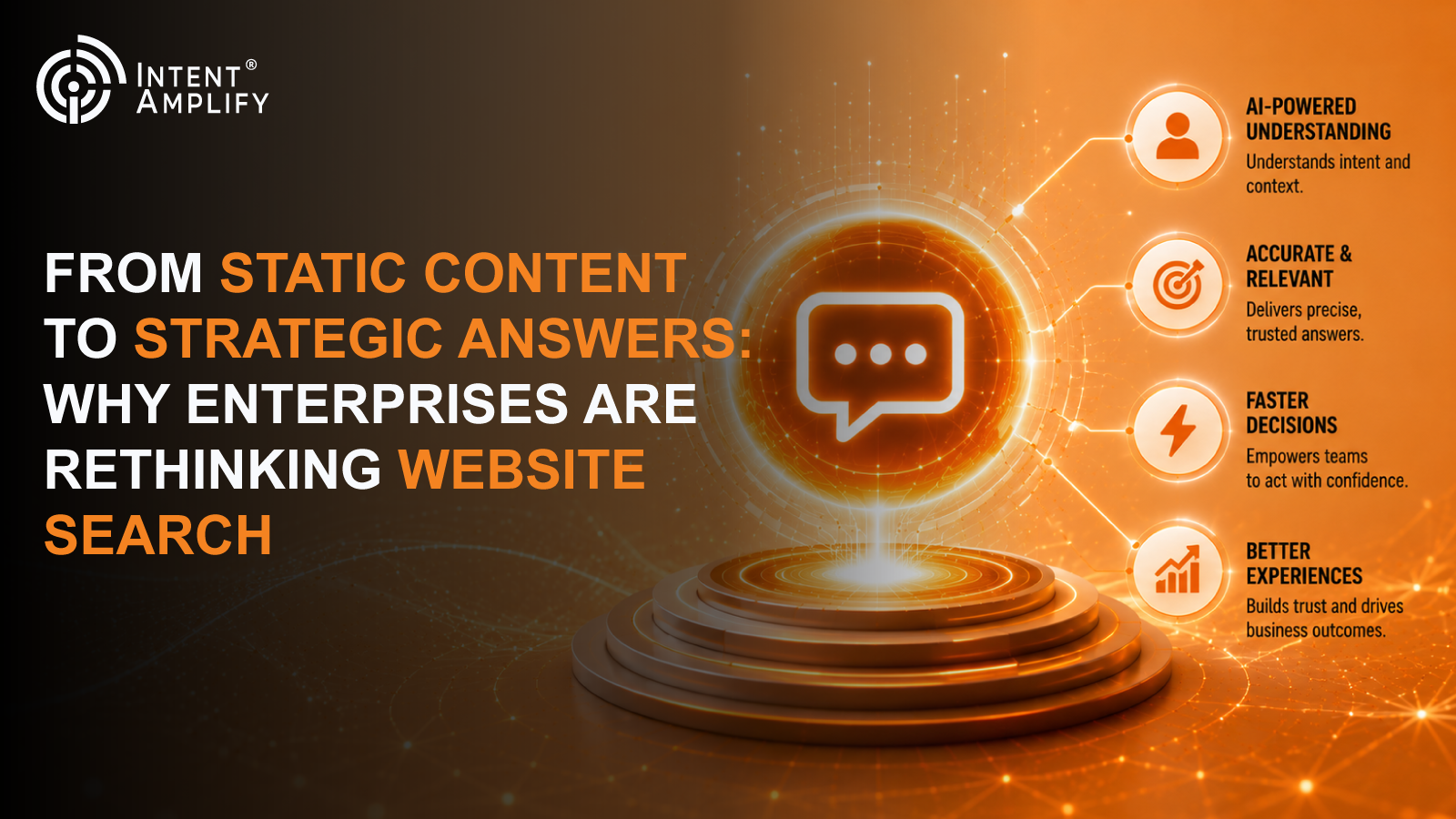
It addresses a market shift that leaders are already experiencing: organizations need to convert static content repositories into contextual, trusted answer layers powered by agentic retrieval-augmented generation, or RAG.
Generative search is a way to turn website and content management system assets into a trusted answer engine that accelerates customer journeys, empowers internal teams, and unlocks unstructured content value. [7]
The Answer Engine is where AI and Trust Intersect
The rise of agentic AI is accelerating the move from content discovery to answer delivery. In practical terms, users are shifting from “show me the page” to “tell me what applies to my situation.” That shift is not cosmetic. It changes the architecture of digital trust.
McKinsey’s 2025 Global Survey on AI, fielded from June 25 to July 29, 2025, found that 88% of respondents report regular AI use in at least one business function. McKinsey also found that 23% of respondents are scaling agentic AI somewhere in the enterprise, while another 39% have begun experimenting with AI agents. [4]
This is the signal CISOs should track: AI adoption is already broad, but governance and enterprise-scale value remain uneven. McKinsey reports that most organizations are still in experimentation or pilot phases, with only about one-third having begun to scale AI programs across the enterprise. [4]
For website search, that means many organizations are at a dangerous midpoint. Employees and buyers expect AI-grade answers, but the underlying content systems were built for page retrieval, not grounded reasoning. Without governance, prompt-driven search can create hallucinations, expose restricted content, weaken brand control, or produce answers without traceable sources.
Gartner’s 2025 research sharpens the point. The firm predicts that 40% of enterprise applications will be integrated with task-specific AI agents by the end of 2026, up from less than 5% in 2025. Gartner also states that these agents will move enterprise applications beyond individual productivity toward smarter workflow and human-agent interaction. [5]
The control questions are familiar to teams: Who can ask? What can be retrieved? Which sources are trusted? How are answers cited? Can logs be audited? How are hallucinations reduced? What happens when the system cannot answer confidently?
Deloitte’s October 2025 Midyear Cyber Threat Trends report reinforces the broader threat context. Deloitte observed that cybercriminals are using AI-powered tools, deepfake videos, modular toolkits, and generative AI scams to lower skill barriers and automate phishing and social engineering. [6]
Instead of asking a model to generate from general knowledge, RAG retrieves approved content first and generates an answer from that evidence base. In the Progress framing, agentic RAG can ingest web pages, PDFs, videos, and other formats, then surface citation-backed insights tailored to user intent across languages and formats. [7]
For enterprises, that capability can support multiple high-value scenarios:
A prospect asks how a solution supports zero trust, and receives a grounded answer citing product pages, architecture briefs, and implementation resources.
A partner asks for the latest compliance documentation, and receives a response tied to current approved assets rather than an outdated PDF.
A support engineer searches for incident response guidance and receives an answer assembled from policies, runbooks, and technical notes, with traceable source references.
A CISO evaluating vendors can compare claims quickly without leaving the brand-controlled environment.
The strategic point is simple: the organization that owns the answer layer owns more of the buyer’s trust journey.
Build a governed answer layer, not another search box
Enterprises should approach generative search as a controlled answer infrastructure. The goal is not to replace websites. The goal is to make owned content more discoverable, more useful, and more defensible.
The first requirement is source governance. Content must be classified by authority, freshness, audience, sensitivity, and business purpose. Public product pages, internal runbooks, partner documentation, legal-approved claims, and technical implementation guides should not be treated as equal retrieval sources. A credible answer engine starts with a clean content graph.
The second requirement is identity-aware retrieval. If a user does not have permission to access a source document, the answer engine should not retrieve from it or reveal its substance indirectly. Microsoft’s 2025 report notes that more than 97% of identity attacks are password spray or brute force attacks, and modern multifactor authentication reduces the risk of identity compromise by more than 99%. [1] For generative website search, this reinforces the need to connect answer systems with strong identity, access, and session controls.
The third requirement is retrieval quality management. The system should be able to define its retrieval strategy, use approved large language models, customize prompts, and support production-grade pipelines. Progress Agentic RAG documentation states that the platform can index any type of data in any language, define a retrieval strategy, use any LLM to gain insights from data, and customize prompts. [8]
The fourth requirement is traceability. Every generated answer should include citations, source links, confidence signals, or audit records. This matters especially in spaces where inaccurate claims can affect risk assessments, procurement decisions, and compliance posture.
The fifth requirement is security-by-design deployment. Accenture’s June 2025 cybersecurity resilience research found that only 42% of organizations are striking a balance between AI development and security investment, and only 28% embed security into transformation initiatives from the outset. [2]
That gap should be a warning. Generative search projects that begin as digital experience initiatives still need CISO involvement from day one.
Universal Format Support: PDFs, Video and Structured Sites
Progress Software Corp’s eBook frames generative search as more than a chatbot. It discusses how agentic RAG-powered search can scale beyond marketing into sales, support, and product workflows, turning siloed assets into adaptive personalized experiences. [7]
For CX leaders and digital experience teams evaluating this shift, download The Progress eBook to assess how agentic RAG can transform existing website and CMS content into a trusted answer engine.
Use it as a practical starting point for conversations between security, marketing, IT, and revenue teams.
Turning answer-engine interest into a qualified pipeline
At Intent Amplify, we track how emerging technology themes translate into buying-group behavior and demand signals. Interest in agentic RAG continues to grow, but enterprise engagement depends on demonstrating measurable business value. Faster evidence discovery, safer AI adoption, reduced content fragmentation, stronger trust signals, and improved buyer self-education are often more compelling than technology features alone.
For vendors bringing generative search, agentic RAG, CMS modernization, or AI-governance solutions to market, success depends on aligning messages to stakeholder priorities. CISOs evaluate risk and governance. CSOs focus on resilience and operational continuity. CIOs assess architecture and integration requirements. Marketing leaders prioritize digital experience and engagement. Revenue teams focus on buyer acceleration and pipeline performance.
Contact Intent Amplify to explore how intelligence-led demand activation can support your next campaign.
References
[1] Microsoft (2025), Microsoft Digital Defense Report 2025.
[2] Accenture (2025), State of Cybersecurity Resilience 2025, published June 25, 2025.
[3] Gartner (2025), Gartner Survey Finds Just 15% of IT Application Leaders Are Considering, Piloting, or Deploying Fully Autonomous AI Agents, published September 30, 2025.
[4] McKinsey & Company (2025), The State of AI in 2025: Agents, Innovation, and Transformation, survey fielded June 25–July 29, 2025.
[5] Gartner (2025), Gartner Predicts 40% of Enterprise Apps Will Feature Task-Specific AI Agents by 2026, published August 26, 2025.
[6] Deloitte (2025), Midyear Cyber Threat Trends for 2025, published October 21, 2025.
[7] Progress (2025/2026), Websites Supercharged: Content Storage Transformed into an Answer Engine.
[8] Progress Agentic RAG Documentation, Agentic RAG, the RAG-as-a-Service Platform.
[9] Intent Amplify, Buying Group Intelligence & Pipeline Activation.