
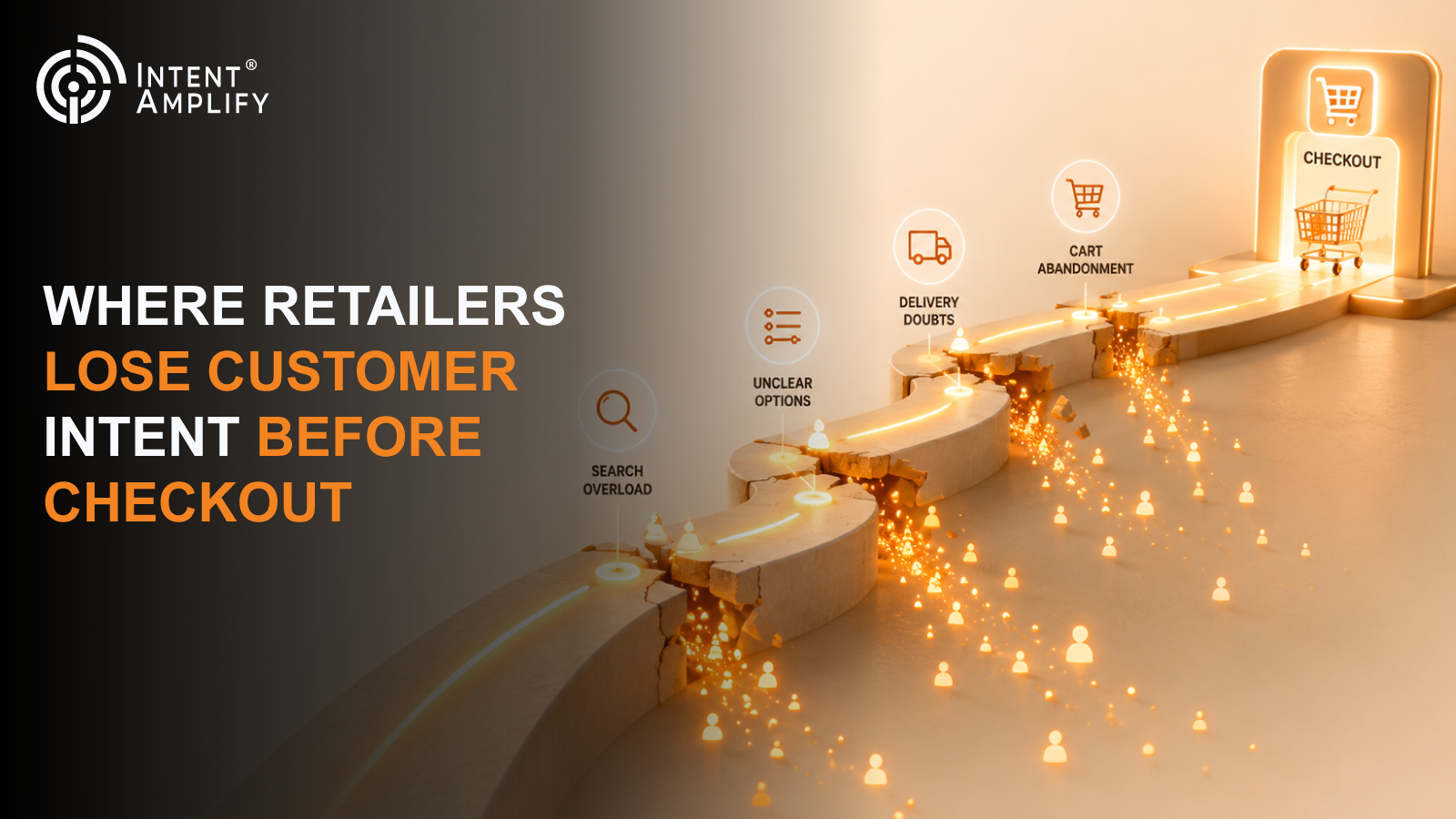
Preview: Retailers often blame checkout abandonment, but customer intent usually starts leaking much earlier, across discovery, product confidence, payment expectations, and trust.
Retailers love to talk about checkout as if it is the grand finale of commerce, the sacred moment where conversion either happens or collapses. That is comforting. It is also incomplete. By the time a shopper reaches the payment screen, many retailers have already lost the sale through bad search, weak product clarity, slow digital experiences, confusing fulfillment promises, limited payment visibility, or trust signals that look like they were assembled during a fire drill.
The real issue is not only cart abandonment. It is intent abandonment. A customer can arrive interested, motivated, and ready to buy, then quietly disappear before ever entering checkout. No dramatic exit. No angry email. Just another shopper drifting back to Google, Amazon, a competitor app, or a physical store where the price tag is at least honest enough to sit still.
For Director+ leaders in IT, Operations, Security, and Strategy/Innovation, this is where the checkout performance conversation needs to mature. Rethink Retail’s report focuses on the checkout performance gap, pointing to a larger operating truth: conversion does not begin at payment. It begins the moment a customer decides the journey is worth continuing.
The Sale Is Lost in the “Almost” Moments
A shopper who searches, filters, compares, checks availability, reads reviews, or looks for delivery options is not casually wandering. They are signaling intent. Retailers lose that intent when the experience fails to answer the next reasonable question.
That question changes by category. An apparel shopper may want size confidence. A grocery shopper may want pickup accuracy. A QSR customer wants the order flow to remember the location, menu, and payment preference without turning lunch into a software implementation project. A fuel, convenience, or hospitality customer may simply want speed, clarity, and no operational weirdness.
In 2025, Constructor found that 84% of shoppers typically begin product searches on Google, 63% often begin on Amazon, and only 23% often start directly on a retailer’s website. That means many retailers are not defending intent from the beginning of the journey; they are trying to win it back after marketplaces and search engines have already shaped expectations.1
Discovery Is No Longer Just a Search Bar
Retail discovery used to mean helping shoppers find a SKU. Now it means interpreting intent across need, occasion, urgency, budget, geography, channel, and fulfillment preference. Someone searching for “running shoes” may be browsing. Someone searching “wide running shoes pickup today near me” is practically waving a credit card in the air.
Retailers lose that customer when search results are generic, filters are clumsy, or inventory visibility cannot keep up with reality. This is especially painful for brands operating across stores, apps, kiosks, delivery partners, loyalty programs, and franchise or distributed environments. Every disconnected system adds another small opportunity for intent to leak.
Constructor’s 2025 report also notes that 68% of shoppers say retailer search still needs an upgrade, while 66% admit they turn to Amazon in “rage-quit” moments. That is not simply a search issue. It is a conversion challenge that begins during discovery. 1
The Product Page Is a Confidence Engine, Not a Brochure
Once shoppers find a product, meal, service, or location, the next test is confidence. They need to know whether the item is available, whether the delivery or pickup promise is real, whether the price will mutate at checkout, and whether the retailer can complete the transaction without turning the customer into unpaid QA staff.
This is where many retailers still underperform. Product pages are often overloaded with marketing but underpowered on decision support. Menus lack clarity. Promotions lack consistency. Store inventory is vague. Returns and substitutions hide in the shadows. The customer does not need poetry. They need certainty.
Checkout.com’s 2025 trust research found that 46% of consumers say peer reviews and third-party content are the most important factors in building trust in a brand or product. That stat matters before checkout because shoppers often need external validation before they commit to a cart, booking, order, or store visit.3
Micro-Friction Is Where Intent Goes to Die Quietly
Retailers often imagine abandonment as the result of a single catastrophic failure. More often, it is death by twelve tiny paper cuts. A slow-loading page. A filter that resets. A login wall. A loyalty ID that refuses to behave. A pickup promise that changes without explanation. A promo code box that makes customers feel like they are being punished for optimism.
The same pattern appears in physical commerce. Long lines, self-checkout errors, POS lag, unavailable associates, broken kiosks, mismatched promotions, or payment terminal issues all weaken intent before the customer completes the transaction. The shopper may still buy once. They may not come back.
Contentsquare’s 2025 Digital Experience Benchmarks analyzed over 90 billion user sessions across 6,000 websites and found that conversion rates dropped 6.1% year over year while the cost of an online visit rose 9%. In plain terms, retailers are paying more to attract traffic while converting less of it.4
The same research found that 40% of online visits showed user frustration, and slow-loading content caused 53% of users to exit after viewing just one page. That is pre-checkout intent loss in its purest form: the customer had enough interest to arrive, then the experience convinced them not to continue.4
Payment Expectations Start Before the Payment Screen
Payment friction is not confined to checkout. Customers form expectations about payment long before they enter card details. Retailers lacking visible support for preferred payment methods, digital wallets, stored credentials, loyalty-linked payments, gift cards, or fast in-store payment experiences introduce uncertainty into the purchase journey.
Payment choice is part of a broader convenience equation that begins well before checkout. DHL’s 2025 E-Commerce Trends Report, based on 24,000 online shoppers across 24 markets, found shoppers abandon purchases when critical fulfillment preferences are unavailable, with 81% abandoning when a preferred delivery option is not offered. Worldpay’s Global Payments Report 2025 identified a similar shift in payment behavior, reporting digital payment methods such as wallets, account-to-account payments, BNPL, and crypto account for 66% of global online shopping value.
The findings point to a consistent conclusion: shoppers evaluate convenience throughout the customer journey rather than at checkout alone. Payment flexibility, delivery choice, and transaction simplicity all influence purchase intent before the payment screen appears. [Sources: DHL E-Commerce Trends Report 2025 and Worldpay Global Payments Report 2025.⁵ ⁶]
Checkout.com also found that 66% of consumers identify payment performance as the primary driver of trust at checkout. Payment reliability therefore extends beyond finance and IT operations. It functions as a trust signal that shapes customer confidence in a retailer's ability to complete the transaction successfully.³
For a closer look at where retail journeys lose momentum before checkout, explore the full report: The Checkout Performance Gap
Omnichannel Gaps Break the Promise Before Checkout
This issue extends far beyond e-commerce. Apparel, specialty retail, grocery, convenience, QSR, hospitality, vending, travel, fuel, and retail technology businesses all operate across messy physical and digital journeys. Customers do not care which system is at fault. They only know the app said one thing, the store said another, and now their intent is evaporating in real time.
DHL’s 2025 E-Commerce Trends Report, based on 24,000 online shoppers across 24 global markets, found that 81% of shoppers abandon carts when preferred delivery options are missing. Delivery clarity sits before final checkout for many shoppers because it answers the practical question: “Can this retailer actually meet my need?” 7
Baymard Institute’s checkout research puts the broader challenge in perspective, reporting that 70.19% of e-commerce visitors abandon their shopping cart. Cart abandonment is the visible symptom. The more dangerous losses happen even earlier, before the cart exists and before analytics teams can neatly label the failure.8
What Retail Leaders Should Measure Before Checkout
Retailers seeking to close the checkout performance gap need visibility into intent before it becomes a cart. Key indicators include search exits, filter failures, product-page abandonment, inventory-check abandonment, mobile performance, promotion confusion, pickup-flow drop-offs, loyalty-login friction, payment-method visibility, and the gap between product interest and checkout initiation.
The issue extends beyond user experience into operations, fulfillment, inventory management, payments, and customer trust. When customers abandon after discovering the store cannot fulfill what the website promises, the root cause may involve inventory systems, POS integration, staffing, location data, or fulfillment workflows. When payment options are unclear, the source of friction may sit across payment strategy, digital experience, and trust. When search results fail to match customer intent, the problem may stem from discovery architecture, merchandising logic, search configuration, or product data quality.
Many sales are lost before checkout begins. Discovery friction, weak product confidence, inconsistent fulfillment signals, and unclear payment expectations erode intent long before customers reach the payment screen.
To build content syndication campaigns that reach high-intent retail decision-makers, connect with Intent Amplify.
References
- Constructor (2025) State of Ecommerce 2025. Available at: https://s3.amazonaws.com/media.mediapost.com/uploads/CONSTRUCTOR_2025-state-of-ecommerce.pdf.
- Constructor (2025) State of Ecommerce 2025. Available https://contentsquare.com/press/2025-digital-experience-benchmarks/
- Checkout.com (2025) Trust in the Digital Economy 2025. Available at: https://www.checkout.com/guides-and-reports/digital-economy-report
- Contentsquare (2025) 2025 Digital Experience Benchmarks. Available at: https://contentsquare.com/press/2025-digital-experience-benchmarks/
- Deutsche Post (2025) E-commerce Trends Report 2025. Available at: https://www.deutschepost.com/en/business-customers/e-commerce-trends-report-2025.html
- Worldpay (2025) Global Payments Report 2025. Available at: https://worldpay.com/en/insights/articles/gpr-2025-released
- DHL Group (2025) DHL E-commerce Trends Report 2025. Available at: https://group.dhl.com/en/media-relations/press-releases/2025/dhl-e-commerce-trends-report-2025.html
- Baymard Institute (2025) Checkout Usability Research. Available at:https://baymard.com/research/checkout-usability