
Executive briefing
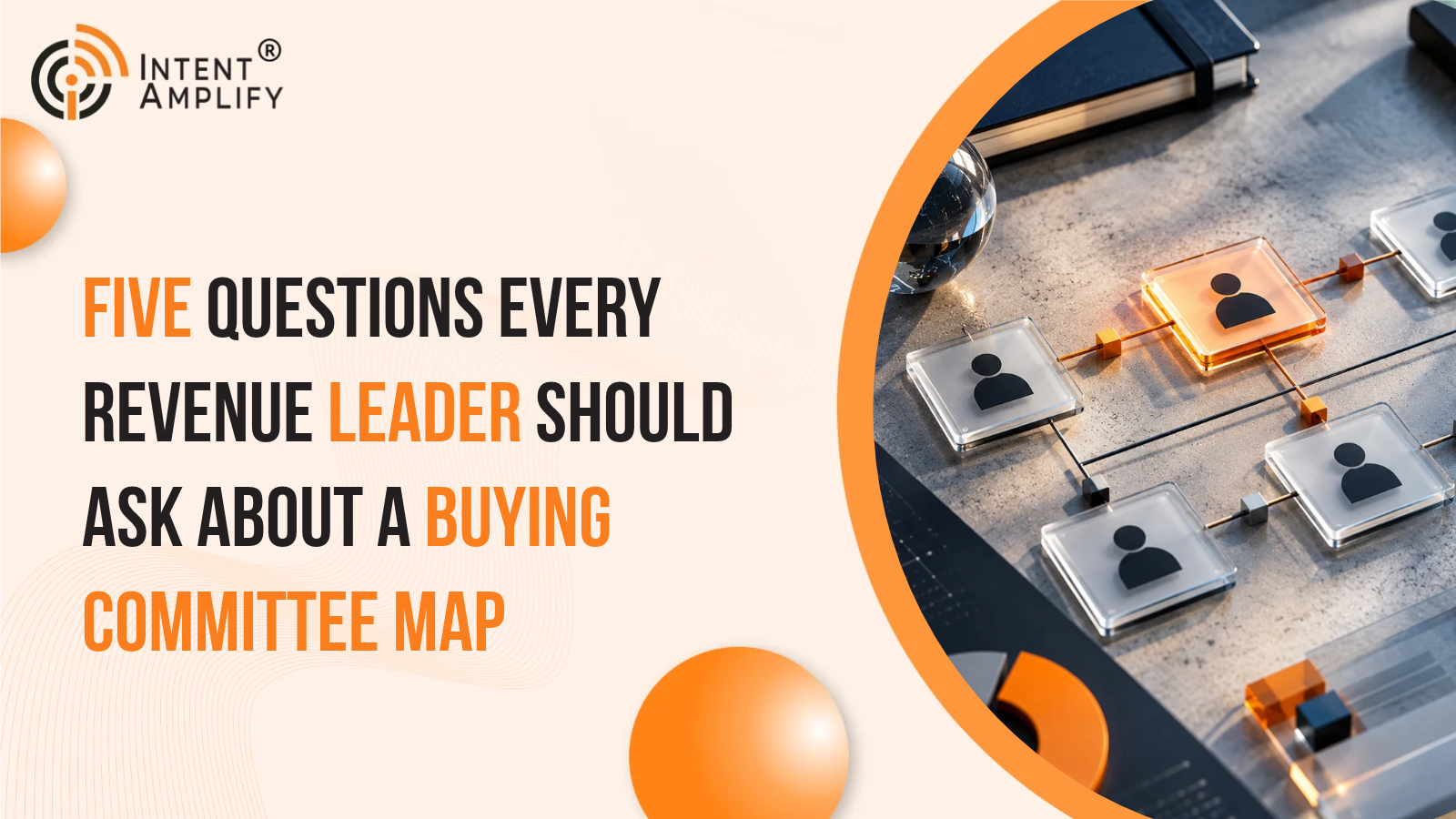
A committee map filled with names is not the same as a committee map supported by evidence. One contact can be a strong technical resource but have no commercial authority; another may influence a purchasing requirement without ever requesting a sales call. Forrester's 2026 business buying report describes growing collaboration in buyer groups and greater procurement influence [1]. The practical response is to define the tasks behind a technology purchase and label what has actually been established.
Take the following five questions into the next Sales and Marketing review. They are designed for a short working discussion, not as a substitute for verification at the named account.
Question 1: Which purchase decision are we mapping?
A regional division buying a developer tool may involve different people from a global infrastructure renewal. Specify the offer, use case, business unit and decision boundary before asking for committee coverage.
Executive test: Can the account owner state the purchasing question in one sentence? If not, the contact list may be describing the organization rather than an actual buying decision.
Question 2: Who is confirmed, and who is only plausible?
Salesforce documents evaluator and decision-maker contact roles within opportunities [2]. Microsoft describes opportunity stakeholder relationships that are attached to a specific sales record [3]. Both show why involvement should be documented in context.
Executive test: For each named stakeholder, can the team show the source that supports the role? Titles and departments may explain relevance but do not, alone, establish budget authority.
Question 3: What does each role need to understand?
A technical evaluator may need a deployment plan. An operational sponsor may need the effect on current workflows. Finance may need cost assumptions; procurement may require an approved purchasing process. Assign the question first and select the asset afterward.
Executive test: Would the message still make sense if the recipient had no active project? If it wrongly presumes a purchase, rewrite it as a relevant research question.
Question 4: What evidence is behind the engagement?
Intent Amplify Buyer Intelligence separates account and role criteria from supported engagement context [4]. A resource request is a real event if captured appropriately, but it does not automatically confirm the influence of a whole committee.
Executive test: Can the team name the event, person or account linkage, timestamp and permitted follow-up? Count registration as registration, not attendance, and avoid treating inferred role coverage as confirmed engagement.
Question 5: What will Sales accept as progress?
HubSpot's lifecycle-stage definitions distinguish MQL, SQL and Opportunity [5]. Intent Amplify Pipeline Activation describes carrying validated account, contact and program context to a responsible Sales owner [6]. Neither makes qualification automatic.
Executive test: Have Sales and RevOps agreed the exact criteria for an accepted next step, a genuine qualified conversation and a CRM opportunity? If not, do not present an increase in mapped names as pipeline growth.
The one-page management view
Include decision units assessed; required buying tasks; confirmed named participants; inferred roles; unknown roles; permitted contacts; observed engagement events; handoffs accepted by Sales; and downstream dispositions. State the population, reporting period and source system beside each measure.
Discuss one exception at each weekly review. A role that Sales rejects because it belongs to the wrong division leads to a different fix than a relevant stakeholder whose permission has expired. An evidence log helps leadership choose the right correction instead of calling for more contact volume.
Intent Amplify perspective
Buyer Intelligence supports a defensible account and role definition; Managed Demand Generation can connect approved audience and content; Pipeline Activation supports the next contextual Sales action. Service scope must be defined before execution. Committee coverage remains an evidence measure, not a revenue result.
Three common reporting traps to avoid
Trap one: Counting every executive in a target account as a buyer. Fix: Record role relevance independently of title and require decision-specific evidence for authority claims. Trap two: Calling every resource request an engaged buying committee. Fix: Preserve each event and the actual identity link, then keep other roles separate. Trap three: Reporting a fuller committee diagram as a revenue gain. Fix: Tie commercial outcomes to their authorized Sales and CRM records.
These corrections do not require a new technology platform. They begin with the next review meeting and a few unambiguous data definitions. Ask each owner to show one example that would fail the rules and explain what the team should do with it.
A decision for the coming week
Choose one product use case and one business unit. Write down the buying tasks that genuinely matter, the role evidence already held, and the one unanswered question most likely to change the next action. Assign a named review owner and a short date for checking the evidence. If the map improves, report which specific claims became more reliable, not merely how many names were added.
A practical challenge for the next planning meeting
Ask for ten priority accounts and one source-backed sentence describing each confirmed stakeholder. Discuss the uncertain roles separately. Review the approach to Buyer Intelligence: Https://www.intentamplify.com/solutions/buyer-intelligence.
Evidence notes and references
Bracketed citations support the specific factual statements beside them. Role maps, tests and hypothetical cases are proposed editorial frameworks, not independent findings about named customers. Intent Amplify service availability depends on engagement scope. Sources reviewed on October 28, 2026.
- Forrester, The State of Business Buying, 2026 (published December 8, 2025). https://www.forrester.com/report/the-state-of-business-buying-2026/RES186878
- Salesforce Help, Add and Manage Opportunity Contact Roles. https://help.salesforce.com/s/articleView?id=000385380&language=en_US&type=1
- Microsoft Learn, How Stakeholders and Sales Team Members Are Tracked for Opportunities. https://learn.microsoft.com/en-us/dynamics365/sales/stakeholders-sales-team-members
- Intent Amplify, Buyer Intelligence. https://www.intentamplify.com/solutions/buyer-intelligence
- HubSpot Knowledge Base, Use Contact and Company Lifecycle Stages. https://knowledge.hubspot.com/records/use-lifecycle-stages
- Intent Amplify, Pipeline Activation. https://www.intentamplify.com/solutions/pipeline-activation