
Supply chain teams understand inventory debt, technical debt, and process debt. There is another form of accumulated friction worth naming: decision debt.
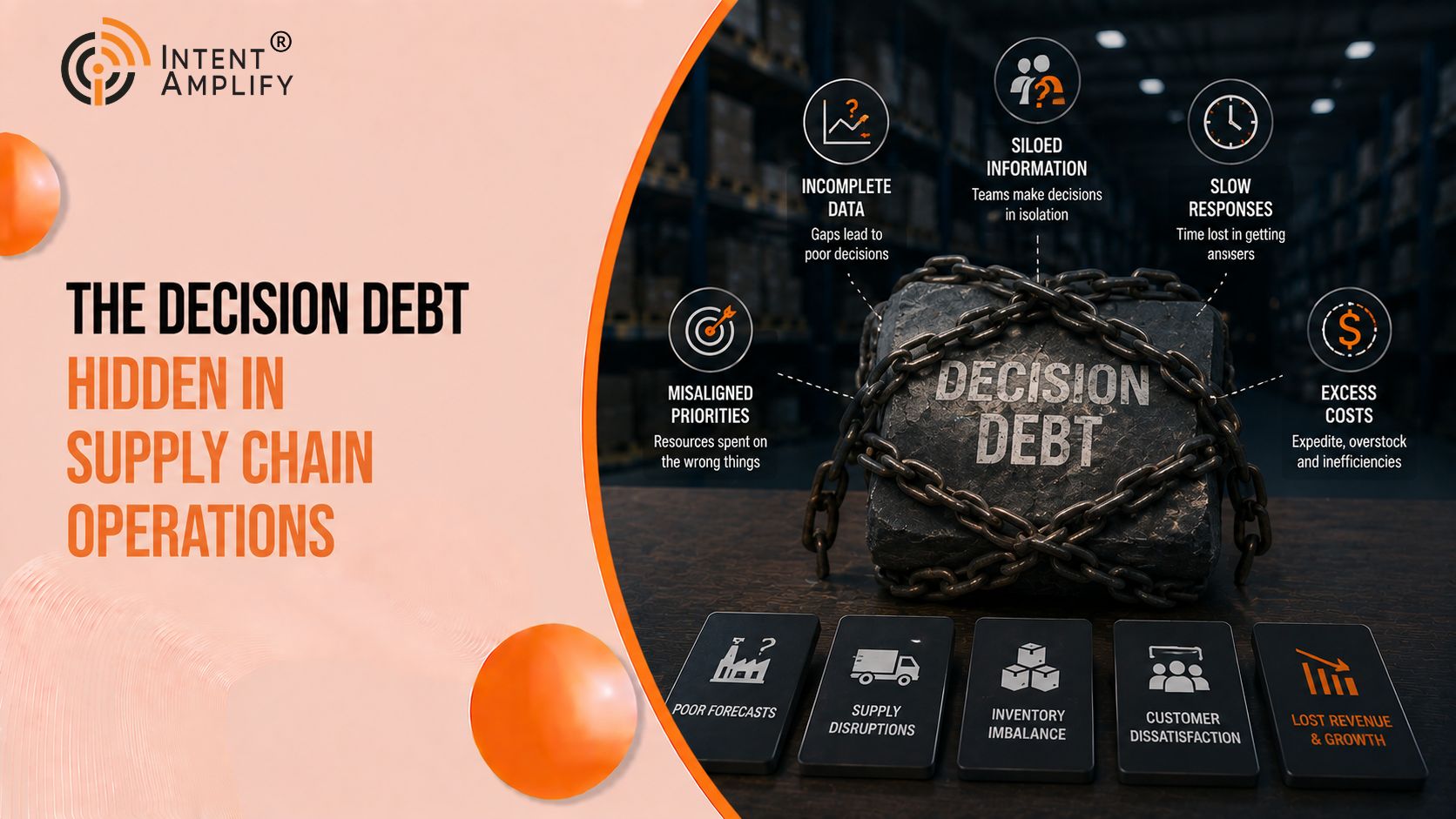
Decision debt builds when recurring exceptions are resolved through one-off effort but the underlying decision process is never improved. Teams repeatedly search for the same data, ask the same people for approval, rebuild the same scenario, and discover the same execution dependency. The immediate disruption gets handled, but the organization remains no more decision-ready for the next one.
WHY DECISION DEBT MATTERS
Persistent volatility increases the frequency of decisions made under imperfect information. If every decision requires manual reconstruction, response capacity becomes constrained. Experienced people become bottlenecks. New team members struggle to understand informal rules. Escalations multiply because authority is not explicit.
The result is slower supply chain responsiveness even when visibility improves.
FIVE SIGNS OF DECISION DEBT
First, teams debate data definitions during time-sensitive exceptions. Second, the same issue is escalated to different leaders depending on who is available. Third, scenario analysis starts from a blank page each time. Fourth, execution steps are discovered only after approval. Fifth, post-event reviews explain what happened but do not change the next response process.
PAYING DOWN THE DEBT
Choose one recurring decision class. Document the earliest reliable signal, minimum decision context, accountable owner, authority limits, response options, and execution dependencies. Then measure the next few occurrences.
This turns experience into an operating asset. The goal is not to automate every decision. It is to stop paying the same coordination cost repeatedly.
WHERE DATA AND AI FIT
A strong data layer reduces the effort required to assemble context. AI can reduce triage, synthesis, and scenario-comparison work. But neither fixes unclear authority. Decision readiness requires technology and operating design to reinforce each other.
THE EXECUTIVE QUESTION
After a disruption is resolved, ask: what did we learn that will make the next decision faster or clearer? If the answer is nothing, decision debt is probably accumulating.
MAKING DECISION DEBT VISIBLE
Decision debt often stays hidden because experienced teams learn to work around it. The disruption gets resolved, but leaders may not see the repeated searches, informal approvals, manual scenario work, and execution handoffs required behind the scenes. Awareness begins by making that recurring friction observable.
For recurring decision classes, teams can maintain a simple register of missing data, unclear ownership, repeated approval delays, manual analysis, and disconnected execution steps. Each item should be tied to verified operating examples rather than assumptions. This makes it possible to prioritize the friction that consumes the most response capacity.
FROM HEROICS TO REPEATABILITY
Strong operators will always matter, but successful workarounds should become organizational learning. When a team solves a difficult exception, ask what can be converted into a standard threshold, data connection, authority rule, response option, or execution playbook. That is how awareness becomes institutional memory instead of remaining personal knowledge.
A QUARTERLY REVIEW
Once a quarter, review high-frequency decision classes and identify repeated effort that can be removed. Measure whether the next occurrences require less searching, fewer ambiguous handoffs, and faster movement from awareness to accountable action. The goal is not to eliminate uncertainty; it is to stop paying the same coordination cost repeatedly.
EXECUTIVE TAKEAWAY
Decision debt is what remains when an exception is resolved but the decision process is not improved. Making that debt visible gives leaders a practical awareness lens for supply chain agility: not only what happened, but which recurring friction is quietly slowing the next response.
HOW DECISION DEBT REDUCES SUPPLY CHAIN AGILITY
Supply chain agility can still fail at the decision layer. An organization may have alternatives available and respond slowly because teams cannot assemble evidence, agree on ownership, or execute the choice in time. Decision debt explains why informal expertise can make one response fast while the next response must rediscover the same process.
THE FOUR FORMS OF DECISION DEBT
Decision debt usually appears in four connected forms. Data debt exists when teams repeatedly search for or reconcile the same information. Ownership debt exists when the accountable decision maker must be discovered through escalation. Scenario debt exists when recurring alternatives are rebuilt manually. Execution debt exists when a decision is approved but implementation remains fragmented.
These forms can reinforce one another. Missing data creates uncertainty, uncertainty increases escalation, escalation delays scenario choice, and delayed choice leaves less time for execution. Naming the categories helps leaders match the remedy to the actual friction instead of treating every response problem as a technology problem.
A DECISION-DEBT REGISTER
A simple register can turn hidden friction into an improvement backlog. For each recurring decision class, record the repeated manual work, its consequence, the evidence showing it occurred, the improvement owner, and the operating change that could remove it. Focus on patterns rather than isolated frustrations.
Examples include repeatedly reconciling order and shipment identifiers before an exception can be assessed, routing the same approval through several leaders because authority is unclear, recreating inventory-reallocation analysis for every shortage, or discovering after approval that the chosen response is difficult to execute.
MANAGING SUPPLY CHAINS UNDER UNCERTAINTY
Uncertainty makes decision debt more expensive because teams have less time to compensate for weak process design. The organization cannot standardize every outcome, but it can standardize how recurring decision classes are recognized, contextualized, owned, and executed. This creates a stable decision process even when the facts remain variable.
Useful standards are lightweight: define the trigger, minimum evidence, decision owner, authority boundary, common response options, and execution path. Teams can then apply judgment within a known structure rather than improvising both the process and the answer at the same time.
HOW TO IMPROVE SUPPLY CHAIN RESPONSE TIME
Improving response time begins with observing where time is repeatedly consumed. Reconstruct several recent exceptions in the same decision class. Identify the data searches, approvals, scenario questions, and execution handoffs that recur. Those repeated elements are candidates for debt reduction.
Data can be pre-connected. Decision briefs can be templated. Authority can be clarified. Common scenarios can be documented. Execution steps can be embedded in the playbook. AI can assist with synthesis where inputs are governed. Each change removes friction from the next occurrence.
Measure improvement against a verified internal baseline. Useful measures include time spent assembling context, ambiguous handoffs, time to accountable owner, decision cycle time, and decision-to-execution time. The objective is to show that the same class of decision is becoming easier to execute.
WHY POST-EVENT REVIEWS OFTEN MISS THE DEBT
Many reviews focus on the disruption itself. A useful review also asks what made the internal decision harder than it needed to be. The organization may not be able to prevent the external event, but it may be able to remove a repeated data search, clarify an approval rule, define a response option, or connect an execution workflow.
The review should therefore produce a decision-system question: what should be different the next time this class of decision appears? If the answer can be translated into data, ownership, scenario, or execution design, the organization has an opportunity to pay down debt.
THE ROLE OF AI IN PAYING DOWN DECISION DEBT
AI can help when decision debt is driven by repeated information work. It can classify exceptions, assemble context, summarize relevant history, compare documented options, or prepare a decision brief. These uses reduce search and synthesis work while keeping the accountable decision with the appropriate role.
AI should not hide unresolved process design. If ownership is unclear, a model cannot create legitimate authority. If data is inconsistent, a fluent summary can obscure uncertainty. If execution is disconnected, recommending an option does not make the option operational. Strong use cases begin with a defined decision and known evidence requirements.
DECISION DEBT AS AN AWARENESS METRIC
Decision debt gives executives a different way to assess transformation progress. Instead of asking only how many systems are integrated or how many alerts are automated, leaders can ask whether recurring decisions require less friction than before.
That question connects technology investment to operating experience. If teams still rebuild the same context and seek the same informal approvals, the debt remains. If the organization can recognize, assess, own, and execute the decision with fewer repeated steps, the capability is becoming more durable.
A 30-DAY STARTING POINT
In the first week, choose one recurring decision class and reconstruct several recent examples. In the second week, identify repeated data, ownership, scenario, and execution friction. In the third week, redesign one or two high-value elements. In the fourth week, document the new response path and define how the next occurrence will be measured.
The objective is one visible proof point: a decision class that is easier to recognize and execute because the organization converted past effort into reusable operating knowledge.
WHY DECISION DEBT COMPOUNDS
Persistent volatility makes recurring decision friction more expensive. A decision-ready supply chain does not need to predict every disruption; it needs to learn from repeated exceptions so the next response requires less searching, less ambiguity, and less coordination. Paying down decision debt turns experience into repeatable decision capability and helps teams move from awareness to accountable action faster.
Download The Decision-Ready Supply Chain
CONCLUSION
Decision debt becomes visible when recurring exceptions keep consuming the same search, approval, scenario, and execution effort. A decision-ready supply chain converts that repeated friction into reusable operating knowledge—clearer evidence, explicit authority, prepared response paths, and faster movement from awareness to accountable action. The objective is not to remove uncertainty; it is to ensure that each disruption leaves the next decision easier to recognize and execute.
REFERENCES
1. McKinsey & Company. “Supply chains: Still vulnerable.” October 14, 2024. Research on supply-chain risk, resilience and operating response. https://www.mckinsey.com/capabilities/operations/our-insights/supply-chain-risk-survey-2024
2. APL Logistics. “Order Planning: Managing Your Supply Chain in the Age of Disruption.” May 20, 2024. Perspective on proactive planning and earlier response under disruption. https://www.apllogistics.com/2024/05/order-planning-managing-your-supply-chain-in-the-age-of-disruption
3. Gartner. “Supply Chain Leaders Should Prioritize Advanced Data Visibility and Scenario Planning to Drive Competitive Advantage Amid Global Uncertainty.” May 19, 2025. https://www.gartner.com/en/newsroom/press-releases/2025-05-19-gartner-says-supply-chain-leaders-should-prioritize-advanced-data-visibility-and-scenario-planning-to-drive-competitive-advantage-amid-global-uncertainty
4. NIST. “Artificial Intelligence Risk Management Framework (AI RMF 1.0).” January 2023. Framework supporting governed AI use and accountable human decision-making. https://www.nist.gov/itl/ai-risk-management-framework
5. IntentTechPub. “The Decision-Ready Supply Chain.” Campaign page for APL Logistics, IA-168 - 26-08-001. https://intenttechpub.com/ebook/the-decision-ready-supply-chain/?mtm_campaign=APL_logistics&mtm_kwd=supply_chain_now&mtm_source=website&mtm_medium=cta_download_now&mtm_content=website&mtm_cid=IA_168_26_08_001&mtm_group=ebook&mtm_placement=marketing