
Executive Snapshot: The Service Model Has Outgrown Basic Automation
Enterprise service organizations have largely solved task automation. The next challenge is operational autonomy. As AI agents begin retrieving knowledge, executing workflows, and coordinating actions across enterprise systems, readiness becomes less about deploying AI and more about governing how AI participates in service delivery.
Agentic service changes the equation because it moves enterprises from AI that assists to AI that acts. Instead of simply recommending a response, an AI support agent can retrieve knowledge, inspect customer history, trigger workflow automation, escalate exceptions, and complete multi-step tasks inside a governed service environment. For CX and IT leaders, this is not another tool rollout with a cheerful product demo and three heroic slides about efficiency. It is the beginning of a new operating model for AI customer service, internal service desks, and connected IT operations.
The urgency is reflected in the 2025 data. McKinsey found that 88% of organizations regularly use AI in at least one business function, while 23% are scaling agentic AI and 39% are experimenting with AI agents. The strategic question is no longer whether enterprises will adopt AI, but whether they can deploy it with the governance, operational maturity, and organizational capabilities required to deliver sustained business value. Agentic service readiness, therefore, depends on more than AI deployment. It requires governance, trusted data, knowledge management, workflow design, human oversight, and measurable business outcomes.1
For Zendesk’s live webinar campaign produced by Intent Amplify, the strategic conversation is therefore not about chasing another shiny AI trend. It is about how CX and IT teams can build a practical agentic service strategy that allows AI to improve resolution speed, service quality, and operational consistency without creating a faster path to risk, confusion, or customer frustration.
What Agentic Service Readiness Really Means
Agentic service readiness is the enterprise capability to let AI participate in service delivery without losing control of quality, trust, compliance or operational performance. The phrase sounds clean in a strategy deck, which is exactly why leaders should be suspicious of it until they define what it actually requires. Readiness is not the presence of AI features inside a platform. It is the ability to combine people, systems, workflows, knowledge, governance, and measurement into a service model that can scale responsibly.
Traditional automation follows predefined rules. Generative AI creates content. Copilots assist human agents. Agentic service goes further because it allows AI systems to reason through a service goal, choose from approved actions, and move work forward across connected systems. That shift is why an AI readiness assessment should become a serious planning exercise for both CX and IT leaders rather than a checkbox buried somewhere in an AI roadmap.
Gartner predicts that by 2029, agentic AI will autonomously resolve 80% of common customer service issues without human intervention, with the potential to reduce operational costs by 30%. That projection is attractive, obviously, because every enterprise enjoys the idea of lower costs until the system automates the wrong thing at scale. The implication is that leaders must define AI guardrails before autonomy expands, including what AI can decide, what data it can access, when it must escalate, and how its actions will be monitored.2
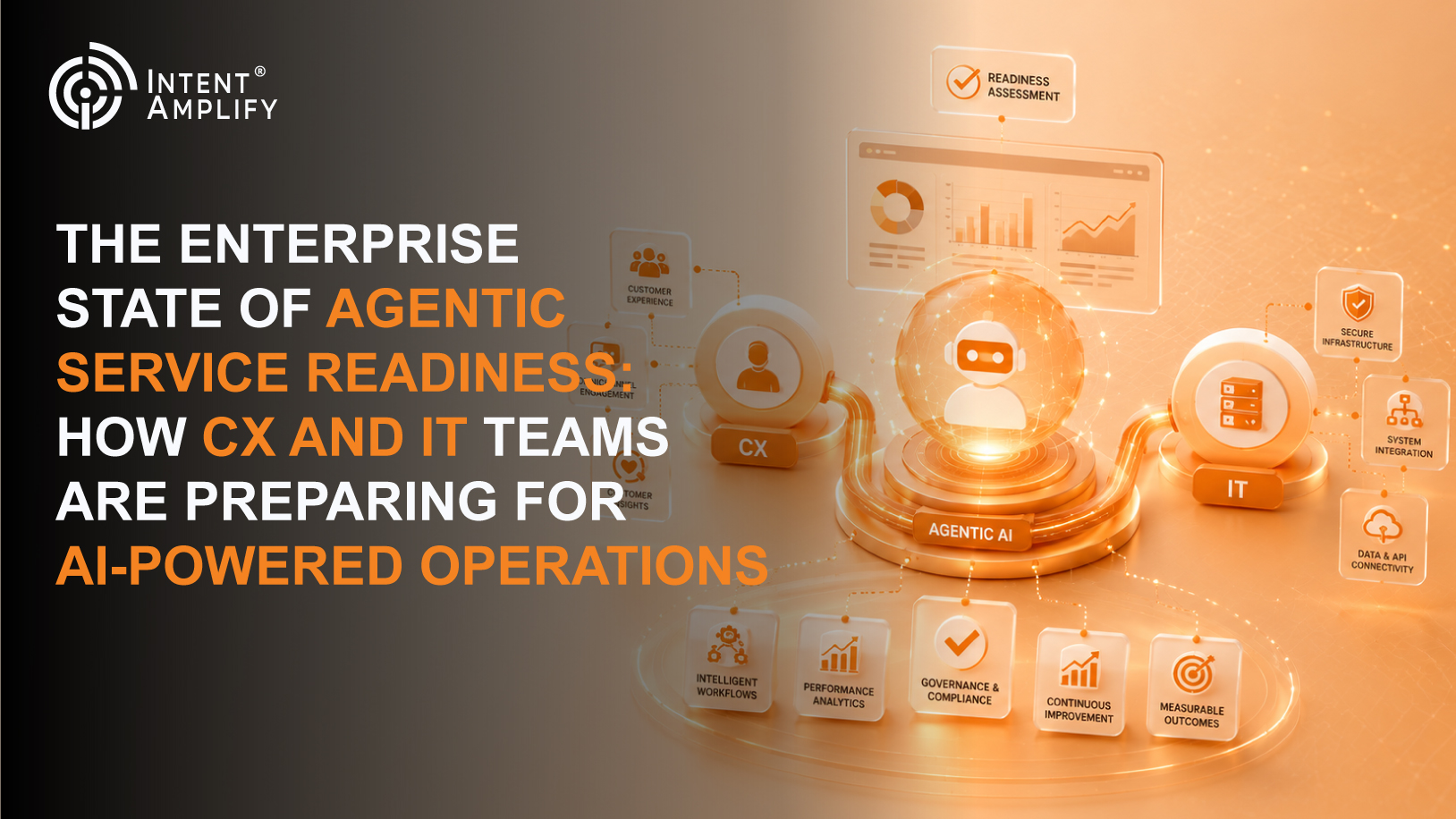
Readiness also requires shared ownership. CX leaders understand customer expectations, journey quality, empathy, loyalty drivers, and customer experience metrics. IT leaders own platform architecture, identity, integration, AI monitoring, service desk automation, and IT service optimization. Agentic service only works when these teams stop treating AI as someone else’s problem and begin managing it as a shared operating layer.
The Readiness Gap: High Momentum Does Not Equal High Maturity
AI has already moved into contact center modernization, customer service AI programs, and IT operations automation roadmaps. CallMiner’s 2025 CX Landscape Report found that 96% of global CX and contact center leaders believe AI, including generative and agentic AI, is key to their CX and contact center strategies, while 80% have at least partially implemented AI, up from 62% in 2024. That means AI is now part of the operating environment rather than a future concept waiting politely in an innovation lab.3
The uncomfortable part is that implementation does not prove readiness. CallMiner also found that 67% of organizations are implementing AI without adequate governance structures, which is worrying for any AI initiative and even more worrying for agentic service because these systems may touch customer records, policies, workflows, payment processes, knowledge bases, and service channels. A governance gap in a passive analytics tool is one thing. A governance gap in a system that can take action is a much more ambitious way to manufacture trouble.3
ServiceNow’s 2025 Enterprise AI Maturity Index adds another dose of reality. It found that enterprise AI maturity averaged 35 out of 100, with fewer than 1% of organizations scoring above 50. In practical terms, many enterprises have AI tools, AI pilots, and AI talking points, but far fewer have the maturity to scale AI safely and repeatedly across service operations. The market may be enthusiastic, but readiness is still limping behind with a clipboard and a polite request for documentation.4
How CX Teams Are Preparing for AI-Powered Service
Designing Journeys Around AI-Led Resolution
CX teams are beginning to decide where AI should lead, where humans must remain involved, and where hybrid models create the strongest service outcome. Simple status checks, password resets, appointment changes, order updates, and knowledge-driven troubleshooting may be strong candidates for AI-led resolution. Emotional escalations, complex product failures, compliance-sensitive requests, and high-value customer issues still require human judgment because some service moments are not improved by pretending a workflow has emotional intelligence.
The goal is not to automate every interaction simply because the technology makes it possible. Organizations that over-automate customer journeys often replace one source of friction with another, forcing customers through AI interactions that cannot resolve their needs before eventually escalating to a human agent. A stronger agentic service strategy uses AI to streamline predictable journeys while preserving human expertise for complex decisions, high-value interactions, and moments that shape trust, retention, and long-term customer value.
Rebuilding Trust in Customer Experience AI
Zendesk’s 2025 CX Trends Report found that CX Trendsetters experience 33% higher customer acquisition rates, 22% higher customer retention rates, and 49% higher cross-sell revenue. These outcomes matter because they connect customer experience AI to growth rather than treating it only as a cost reduction tool. When AI improves speed, personalization, and consistency in ways customers actually value, it can support loyalty and revenue instead of merely trimming service expense.5
Trust becomes the decisive layer. Customers may accept an AI-led service when it is fast, accurate, transparent, and easy to escalate from. They will reject it when it feels evasive, repetitive, or disconnected from the issue they actually raised. CX leaders, therefore, need standards for transparency, personalization, tone, escalation, recovery, and customer control so agentic service does not become a polished new way to make customers feel ignored.
Turning Agents into AI-Orchestrated Specialists
Agentic service does not make human agents irrelevant. It changes the work they do. Agents spend less time handling repetitive service tasks and more time resolving exceptions, supervising AI outputs, improving knowledge management, and managing complex relationships that require judgment. That shift can improve the employee experience when it is supported by training, clean workflows, and realistic expectations rather than dropped onto teams with the usual corporate optimism and one hurried enablement session.
Zendesk found that 73% of agents believe having an AI copilot would help them do their job better. That suggests many frontline teams are not rejecting AI itself. They are rejecting poorly implemented AI that creates extra work while claiming to improve productivity, which is a familiar enterprise betrayal.5
What IT Teams Must Build Beneath the Surface
CX defines what good service should feel like. IT determines whether that service model can scale without breaking, leaking data, or turning into a compliance incident with a friendly interface. Agentic service depends on connected systems across CRM, ticketing, knowledge bases, identity platforms, analytics, product data, workflow engines, and communication channels. Without data readiness, AI support agents cannot understand the customer, context, or next best action.
CallMiner found that 98% of organizations struggle to align CX data and feedback across departments. It also found that 42% still rely on manual processes to analyze CX data, while 62% admit they do not often use CX data to its best advantage. For agentic service, fragmented data is not just inefficient because it weakens resolution quality, personalization, AI risk management, and the ability to create consistent experiences across channels.3
IT leaders also need AI governance frameworks that define permissions, action boundaries, approval rules, audit trails, escalation triggers, and performance monitoring. McKinsey’s 2025 research found that 51% of organizations using AI have experienced at least one negative consequence, with inaccuracy among the most commonly reported issues. As AI becomes more agentic, human validation and AI performance reviews become essential safeguards rather than decorative controls that appear after budget approval.1
This is also where AI-powered ITSM becomes part of the same readiness conversation. Internal service desks face similar questions about which tickets can be automated, where AI help desk automation can reduce load, when service desk automation should escalate, and how IT operations automation can improve reliability without hiding risk behind faster ticket closure.
As CX and IT teams move from AI experimentation to operational readiness, the next challenge is building frameworks that can scale without adding risk or complexity. To explore how enterprise leaders are approaching this shift, register for the agentic service webinar.
Five Readiness Pillars for Scaling Agentic Service
|
Readiness Pillar |
What It Requires |
Why It Matters |
|
Governance |
AI governance frameworks, clear ownership, approval rules, compliance controls, and AI guardrails |
Keeps autonomy from becoming operational chaos |
|
Knowledge Quality |
Accurate, current, structured, and searchable knowledge management |
Determines whether AI can resolve issues reliably |
|
Workflow Design |
Mapped journeys, workflow automation, escalation paths and exception handling |
Turns AI from a response engine into a resolution engine |
|
Data and System Connectivity |
Data readiness across CRM, ticketing, service history, identity, and analytics |
Gives AI the context needed to act intelligently |
|
Measurement |
Customer experience metrics, AI monitoring, AI ROI, resolution quality, escalation rate, and CSAT |
Shows whether AI is creating value or just looking busy |
These pillars reinforce one another. Governance without workflow design creates controls that are difficult to operationalize. High-quality knowledge without connected enterprise systems limits AI's ability to act on trusted information. Monitoring without meaningful customer and operational outcome metrics measures system activity but provides limited evidence that service quality, efficiency, or business performance are improving.
A serious AI action plan should connect these pillars to a broader AI roadmap. Leaders need AI prioritization criteria that separate high-value service workflows from high-risk experiments. They also need measurement models that connect AI ROI to resolution quality, agent productivity, containment accuracy, escalation performance, compliance outcomes, service reliability, loyalty, and customer trust. Otherwise, the organization may celebrate automation volume while quietly scaling poor experiences.
2025 Signals CX and IT Leaders Should Not Ignore
McKinsey found that only about one-third of organizations have begun scaling AI enterprise-wide, even though regular AI use is now widespread. This reinforces the pilot-to-production gap that CX and IT leaders must address before agentic service can become a reliable operating capability rather than a collection of disconnected experiments.1
CallMiner found that 47% of organizations use AI to provide agents with real-time guidance during customer interactions, while 43% use AI to automate repetitive tasks so frontline employees can focus on higher-value work. These are meaningful steps toward agentic service, although they remain mostly assistive unless connected to governed end-to-end workflows. The next level is not merely better suggestions. It is a trusted action inside clearly controlled service environments.3
Stanford HAI’s 2025 AI Index reports that organizations using AI in service operations saw 57% revenue gains and 49% cost savings, although most gains remained modest. The lesson is not that AI magically transforms service economics overnight because apparently reality still insists on participating. The lesson is that value depends on disciplined execution, AI prioritization, and measurable operational improvement.6
Forrester's 2025 State of AI research found that more than 70% of organizations have generative or predictive AI in production, yet many continue to face challenges related to leadership alignment, workforce enablement, governance, and long-term value realization. Production deployment should therefore be viewed as the beginning of enterprise AI transformation rather than its conclusion. Long-term success depends on disciplined execution across governance, operating models, workforce adoption, and measurable business outcomes.7
Strategic Implications for CX and IT Leaders
For CX leaders, the immediate priority is to define what a good AI service means in practice. That includes resolution quality, customer trust, escalation logic, personalization, empathy, and measurable customer experience metrics. Agentic service cannot be evaluated only by containment or ticket deflection because a customer whose issue was contained but not resolved is not a success story. It is churned with a timestamp.
For IT leaders, the priority is building the secure operating layer that makes agentic service scalable. That means integration, identity management, permissioning, AI monitoring, auditability, data governance, observability, and fallback procedures. AI agents should not be treated like clever chatbots with a promotion. They need controls appropriate to the actions they can perform.
For joint CX and IT leadership, the mandate is shared ownership because CX brings experience design and service logic while IT brings architecture, security, data, and scale. Together, they can build an AI transformation model that connects service automation to measurable business outcomes rather than treating AI as scattered pilots. This shared model should include an AI readiness assessment, an AI roadmap, an AI action plan, AI governance frameworks, and recurring reviews of performance, risk, and customer impact.
Closing Perspective: Readiness Will Decide Who Scales
Agentic service is not simply the next stage of customer service automation. It is a new operating model for AI-powered customer and IT service delivery. The enterprises that succeed will not necessarily be the ones that deploy the most AI the fastest. They will be the ones that make AI useful, governed, trusted, measurable, and deeply connected to real service workflows.
That is the strategic relevance behind Zendesk’s agentic service conversation and Intent Amplify’s campaign focus. CX and IT leaders are not being asked to chase another AI trend because the market needs fresh webinar vocabulary. They are being asked to prepare for a service environment where AI can act with greater autonomy, customers expect faster resolution, agents work differently, and operational trust becomes a competitive advantage.
The future of agentic service will be shaped by readiness rather than hype. Without governance, knowledge quality, workflow design, connected data, human oversight, and performance measurement, organizations may scale AI activity without scaling AI value. With those foundations in place, CX and IT teams can move beyond automation and build service operations that are faster, safer, smarter, and genuinely prepared for what comes next.
Agentic service readiness is becoming a boardroom-level conversation for CX and IT leaders. To create campaigns that reach those decision-makers with timely, insight-driven content, get in touch with Intent Amplify.
References
- McKinsey & Company (2025) The State of AI. Available at: https://www.mckinsey.com/capabilities/quantumblack/our-insights/the-state-of-ai.
- Gartner (2025) Gartner Predicts Agentic AI Will Autonomously Resolve 80% of Common Customer Service Issues Without Human Intervention by 2029. Available at: https://www.gartner.com/en/newsroom/press-releases/2025-03-05-gartner-predicts-agentic-ai-will-autonomously-resolve-80-percent-of-common-customer-service-issues-without-human-intervention-by-20290.
- CallMiner (2025) CallMiner 2025 CX Landscape Report Highlights AI's Rapid Growth Despite Governance Gaps. Available at: https://callminer.com/blog/callminer-2025-cx-landscape-report-highlights-ais-rapid-growth-despite-governance-gaps.
- ServiceNow (2025) Enterprise AI Maturity Index 2025. Available at: https://www.servicenow.com/content/dam/servicenow-assets/public/en-us/doc-type/resource-center/white-paper/wp-enterprise-ai-maturity-index-2025.pdf.
- Zendesk (2025) CX Trends Report 2025. Available at: https://www.zendesk.com/newsroom/articles/2025-cx-trends-report/.
- Stanford Institute for Human-Centered Artificial Intelligence (HAI) (2025) AI Index Report 2025: Economy. Available at: https://hai.stanford.edu/ai-index/2025-ai-index-report/economy.
- Forrester (2025) The State of AI, 2025. Available at: https://www.forrester.com/report/the-state-of-ai-2025/RES189955.