
Physical Security Is Becoming an Operating System
A security leader investigating a forced-door event should not have to jump between a local recorder, a badge system, an alarm console, a camera export folder, and a spreadsheet that somehow became business-critical. That is a treasure hunt with legal risk.
In a contemporary corporate setting, video feed, access data, alert notifications, and response steps all must paint the same picture. When a warehouse entry point is broken into, there needs to be an ability for corporate security staff to recognize the access attempt, view the video from the appropriate camera, determine whether the event is an intrusion or a false alarm, and collect evidence without forcing a manual retelling by five individuals.
That is the future of physical security in the enterprise realm: from siloed devices to integrated cloud-based intelligence operations.
For years, physical security was treated as a collection of tools. Cameras recorded. Badges unlocked. Alarms screamed. People handled the messy parts afterward. That model worked when organizations had fewer sites, slower response expectations, and less pressure to prove operational value. Modern enterprises have different problems. They manage offices, warehouses, manufacturing plants, retail stores, healthcare facilities, campuses, property portfolios, and logistics hubs. Every location adds risk, footage, access policies, response procedures, and another place where fragmented systems can quietly ruin the day.
Why the Old Security Model Is Cracking
The issue is not that legacy systems never work. Many still do. The problem is that they do not work well together. Video may be stored locally. Access events may live in a separate platform. Alarm data may be available only through another console. Visitor records may be managed somewhere else entirely. When an incident happens, the security team has to assemble context manually.
That becomes a serious problem for multi-site organizations. A logistics team needs visibility across yards, docks, restricted zones, and vehicle movement. A retail security team needs to investigate loss events across stores without waiting for local footage exports. A healthcare facility needs controlled access to sensitive areas. A campus environment needs fast verification and coordinated response.
Physical security has become a shared operating concern. Facilities teams care about building activity. Operations leaders care about continuity. Compliance teams care about logs and evidence. Finance wants to know whether modernization reduces cost or just adds another subscription. Executives want fewer blind spots and fewer unpleasant surprises.
Cloud Physical Security Is Becoming the Control Layer
Cloud-based physical security matters because security teams need to manage distributed environments without treating each site like a separate kingdom.
With cloud-managed systems, teams can view footage remotely, manage users centrally, check device health, adjust access policies, and support investigations across locations. A regional security director can check whether an incident occurred at a warehouse without waiting for someone to export footage from a local recorder. A facilities leader can verify door status without calling three people. A loss prevention team can compare incidents across stores without wrestling with disconnected systems.
92% of physical security leaders agree that the future of physical security is cloud-based. That is less about cloud enthusiasm and more about exhaustion with fragmented systems. Enterprises want easier scaling, remote access to evidence, and fewer site-by-site workarounds. 1
That does not mean every enterprise is going to be fully cloud-native overnight. Most large organizations still have legacy infrastructure, bandwidth concerns, compliance requirements, local storage preferences, and budget realities. Hybrid cloud is often the practical bridge: local where needed, cloud-managed where it improves control and response.
43% of end users envision hybrid deployments as their preferred approach within the next five years, compared with 18% favoring fully cloud-based implementations and 17% planning to remain fully on-premises. That tells a more grounded story than the usual "everything is moving to the cloud tomorrow" pitch. Enterprises are modernizing in stages because physical environments are messy and expensive, unlike PowerPoint diagrams, which are cheap and lie beautifully.2
Security Model | What It Looks Like | What Hurts |
On-premises | Local servers, local recorders, site-level management | Hard to scale, search, update, and manage |
Hybrid cloud | Local devices with cloud management | Needs planning across network, storage, and policy |
Fully cloud-managed | Centralized platform for video, access, alerts, and administration | Requires strong connectivity and governance |
Patchwork legacy | Multiple vendors, consoles, and manual exports | Slow investigations and inconsistent response |
AI Video Security Is Making Footage Useful
Traditional video surveillance is good at recording things. The problem is what happens afterward. If a team has to scrub through hours of footage to find one person, one vehicle, or one suspicious movement, the system is technically doing its job while making humans do the part that should have been improved years ago.
AI video security changes the value of footage. Instead of treating video as a passive archive, AI-assisted systems help teams search, filter, detect, and verify events faster. Object detection, person search, vehicle identification, motion analytics, line-crossing detection, loitering alerts, and license plate recognition can reduce the time between "something happened" and "we know what happened."
The practical value is speed. A security manager investigating a truck entering a restricted yard does not want every clip from every camera. They want the relevant footage. A retail loss prevention team does not want to manually review an entire afternoon. They want the sequence tied to the incident. A school security team does not want twenty minutes of uncertainty during an emergency. They want verification now.
82% of organizations say AI-based video analytics will have a moderate-to-major impact on their physical security approach. That matters because AI video is no longer a futuristic add-on. It is becoming part of how teams shorten investigations, reduce manual review, and improve situational awareness. 3
The use cases extend beyond security departments. In manufacturing, AI video can support safety investigations and restricted-zone monitoring. In logistics, it helps with yard activity, dock incidents, and vehicle movement. In retail, it strengthens loss prevention and staff safety. In healthcare and education, it supports quicker verification in sensitive environments.
The point is not to pretend AI replaces human judgment. That is how bad automation programs end up in postmortems. AI should reduce noise, surface relevant moments, and help trained teams act with better context.
Access Control Is No Longer Just About Doors
Access control used to be treated as a basic entry function: badge accepted, door opens; badge rejected, someone calls the front desk. That view is too small for modern enterprise security.
Today, access control is an identity and governance layer. It answers questions that matter during routine operations and incidents: Who entered? When? Were they allowed to be there? Was access tied to a role, schedule, visitor record, or exception? Can the organization prove what happened later?
Cloud-based access control makes this easier to manage across locations. Security teams can update permissions remotely, revoke access quickly, apply policies consistently, manage visitors and contractors, and maintain cleaner audit trails. This is especially important for enterprises with frequent staff changes, rotating shifts, restricted spaces, regulated areas, or large contractor ecosystems.
Access control modernization is also shaped by mobile credentials, cloud-hosted management, identity integrations, and touchless entry. These are not cosmetic improvements. For a multi-site enterprise, they reduce administrative friction and improve auditability. If an employee leaves, access should be revoked quickly. If a contractor needs temporary entry, permissions should be controlled and visible. If a door event triggers an investigation, the system should connect the credential event with the relevant footage.
The Real Story Is Convergence
The strongest physical security outcomes happen when cloud, AI video, access control, alarms, and response workflows operate together. More devices alone do not solve the enterprise problem. More connected context does.
A useful modern workflow looks like this:
Detect → Verify → Search → Control → Escalate → Resolve → Review
A forced-door alarm triggers the event. Video verifies whether it is real. AI-assisted search locates related footage. Access control shows who was nearby or whether a credential was involved. Security teams escalate to facilities, operations, law enforcement, or site leadership. Afterward, logs and footage support review, compliance, and process improvement.
That is very different from calling a site manager, requesting footage, checking a badge log, waiting for an export, discovering the camera angle is useless, and then pretending this is just the cost of doing business.
This is why cloud physical security platforms are gaining attention among enterprise buyers. The value is not just a better camera, smarter badge reader, or cleaner interface. The value is the operating model: one where teams can understand incidents faster, manage locations consistently, and reduce manual handoffs.
For teams evaluating how cloud-managed video, access control, and incident workflows come together in practice, a deeper look at Verkada's enterprise cloud physical security approach can help connect the strategy to real deployment scenarios.
Explore the demo deck: Access the demo deck
Operational Resilience Is the Business Case
The phrase "operational resilience" gets abused in B2B content, usually as a fancy way to say "please buy resilient things." In physical security, the idea is concrete. If a facility disruption slows operations, compromises safety, delays response, or prevents leaders from understanding what happened, the business feels it.
Modern physical security supports resilience by improving speed, context, and continuity. Cloud-managed systems allow teams to monitor and investigate remotely. AI video can reduce the time needed to locate key evidence. Access control supports lockdowns, permission changes, and audit trails. Integrated alerts help teams respond with less guesswork.
This matters differently by industry. In manufacturing and warehousing, the concern may be worker safety, restricted zones, equipment protection, and downtime. In logistics, it may be yard security, vehicle movement, dock activity, and inventory risk. In retail, it may be theft, staff safety, and multi-location investigations. In healthcare and education, it may be emergency response, visitor control, and sensitive-area access. In corporate offices and property management, it may be workplace safety, tenant experience, and building operations.
77% of end users say physical security and IT departments now work collaboratively, and more than 50% of end users, integrators, and consultants report IT teams are actively involved in physical security purchasing decisions. This does not mean the campaign should target IT security titles, which remain excluded. It means physical security modernization now touches network readiness, cybersecurity, identity systems, procurement, compliance, and governance. 2
Physical security teams still own the mission, but they cannot modernize in isolation. Facilities, operations, risk, compliance, procurement, finance, and IT stakeholders all shape whether the deployment works or becomes another expensive tool with a login nobody remembers.
Modernization Without Creating a Shinier Mess
The trap in physical security modernization is replacing one fragmented system with another slightly prettier fragmented system. That is not a transformation. That is redecorating the problem.
A better approach starts with visibility gaps. Which sites are hardest to monitor? Where do investigations take the longest? Which systems cannot share data? Which access policies are inconsistent? Which locations create recurring incidents? The answers should guide priorities.
Cloud readiness also matters. Network capacity, bandwidth, storage policies, data retention, cybersecurity controls, admin permissions, and device management all need review before rollout. The physical security team should not discover during deployment that the network cannot support the intended workflow. Surprises are fun at birthday parties, not infrastructure projects.
AI should be tied to specific use cases: vehicle search, after-hours activity, perimeter monitoring, object detection, restricted-zone alerts, or faster footage review. Vague AI adoption produces vague ROI. Specific workflows make value measurable.
Access control should be integrated with video and incident response wherever possible. Door events should not sit in one system while video sits in another, and alarms shout into a third. The goal is a connected record of what happened.
For enterprises evaluating cloud-based physical security platforms, including Verkada, the practical question is not "Which vendor has the nicest camera spec sheet" Specs matter, but the larger question is whether the platform helps teams manage video, access, alerts, users, and evidence across sites with less friction. That is the subtler and stronger Verkada-aligned message: modern physical security is not about adding more tools; it is about making the environment easier to understand and act on.
The Future of Physical Security Is Connected
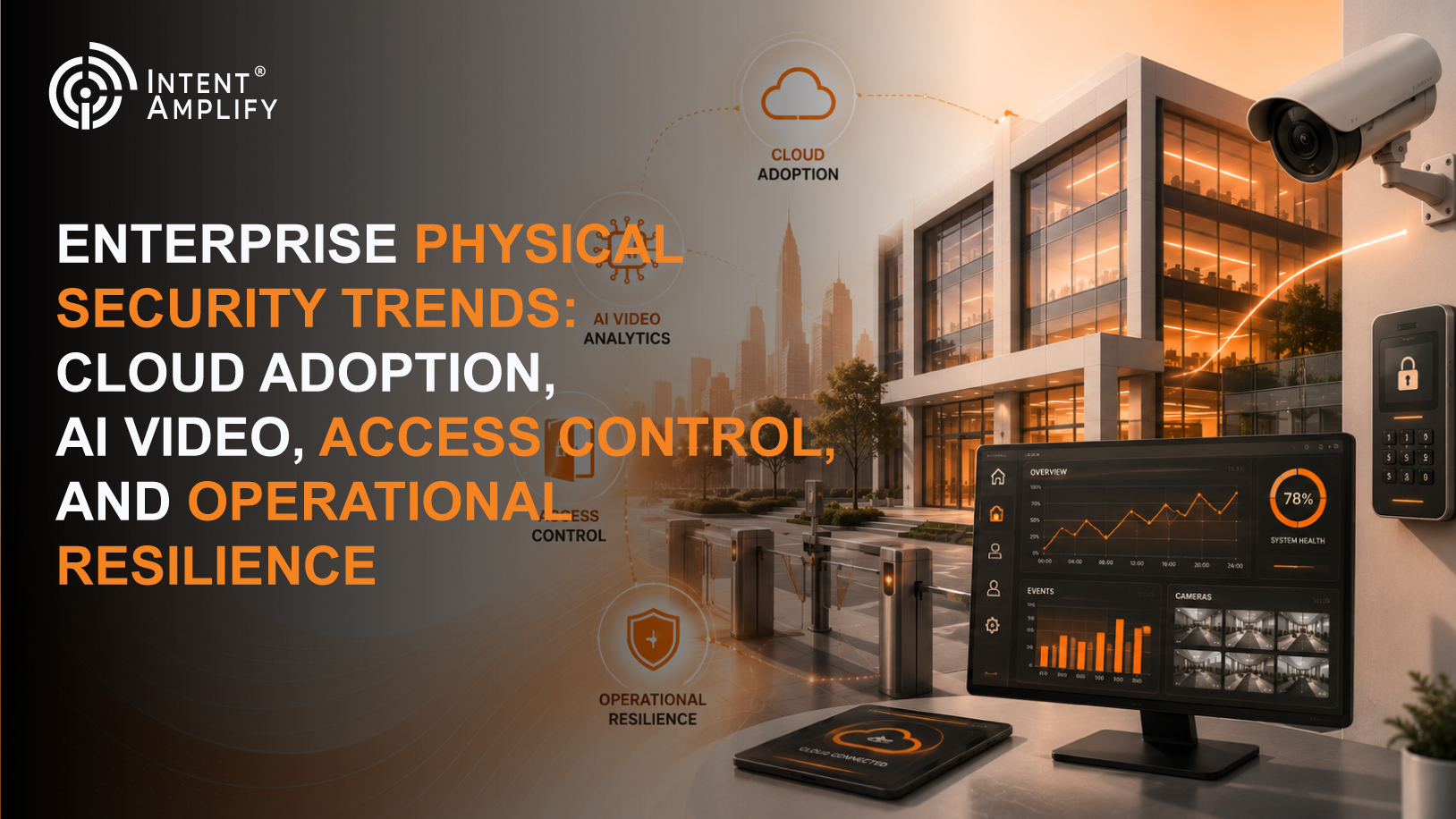
Enterprise physical security is moving from reactive monitoring to connected operational intelligence. Cloud adoption gives teams a better management layer. AI video makes footage easier to search and act on. Access control connects identity with policy and incident context. Operational resilience turns these capabilities into business value.
For large organizations, especially those managing distributed facilities across manufacturing, warehousing, logistics, retail, healthcare, education, corporate offices, financial services, hospitality, property management, government, and religious institutions, the old model is becoming harder to defend. Legacy systems may still function. That does not mean they are fit for enterprise-scale operations. A fax machine also functions. Nobody should build a strategy around it.
The next phase of enterprise physical security will belong to organizations that connect their systems, coordinate their teams, and use security data to make faster decisions. Modern physical security is not just about watching the building. It is about helping the business respond, recover, and keep moving.
For more expert perspectives on cybersecurity, AI security, cloud risk, and enterprise technology trends, explore the latest insights from Cyber Technology Intelligence
References
- Verkada -- The State of Cloud Physical Security: Top Findings -- 2025
- Genetec -- New 2025 State of the Physical Security Industry Report Shows Accelerating Hybrid Cloud Adoption and Its Growing Strategic Influence -- December 2024
- CDW -- Benefits of Modernizing Your Physical Security Infrastructure -- 2025