
Executive Summary
Checkout is no longer the final operational step in commerce. It is a strategic control point where revenue, customer trust, fraud exposure, channel consistency, and payment innovation converge. Across physical stores, mobile commerce, social commerce, marketplaces, and emerging agentic commerce models, the checkout experience is becoming more distributed, more data-intensive, and more vulnerable to performance gaps.
Checkout performance extends beyond transaction speed. Consistent payment choice, low-friction authentication, resilient authorization, fraud-aware routing, and unified visibility now determine whether organizations convert demand efficiently across physical and digital channels. Accenture's 2025 commerce research reports that 75% of consumers recently abandoned a purchase because they felt overwhelmed by the decision-making process, while 83% of shoppers research online before visiting a physical store. These findings indicate that checkout performance begins well before payment and extends across discovery, intent, channel movement, and transaction completion. 1
Consumer behavior is now omnichannel. Deloitte's Q3 2025 retail research found that Gen Z is not a purely digital cohort: 64% use social media to research products, 35% use it to discover products, and 73% shop in person at least once a week.²
Retailers and commerce platforms must support customers who move fluidly between social discovery, online validation, in-store evaluation, and digital or assisted payment. Checkout performance spans the entire buying journey rather than a single transaction event.
AI is reshaping purchase behavior. Accenture's Consumer Pulse Research 2025, based on responses from 18,000 consumers across 14 countries, found 72% of consumers use generative AI tools regularly, and one in two users has already used generative AI to inform a purchase decision.³
McKinsey's October 2025 agentic commerce report projects agentic commerce could orchestrate up to $1 trillion in U.S. B2C retail revenue and between $3 trillion and $5 trillion globally by 2030.⁴
Faster checkout is an expected capability. Commerce leaders face a broader challenge: preparing checkout environments for omnichannel behavior, AI-mediated demand, delegated authorization, flexible payment methods, and fraud risks extending beyond traditional card-present and card-not-present models.
This whitepaper argues that organizations should treat checkout performance as an enterprise capability, not a channel-specific optimization project. Leaders who close the checkout performance gap will be better positioned to improve conversion, reduce abandonment, protect trust, support new payment experiences, and prepare for agentic commerce without creating unmanaged operational or security exposure.
The Checkout Performance Gap: What Is Changing
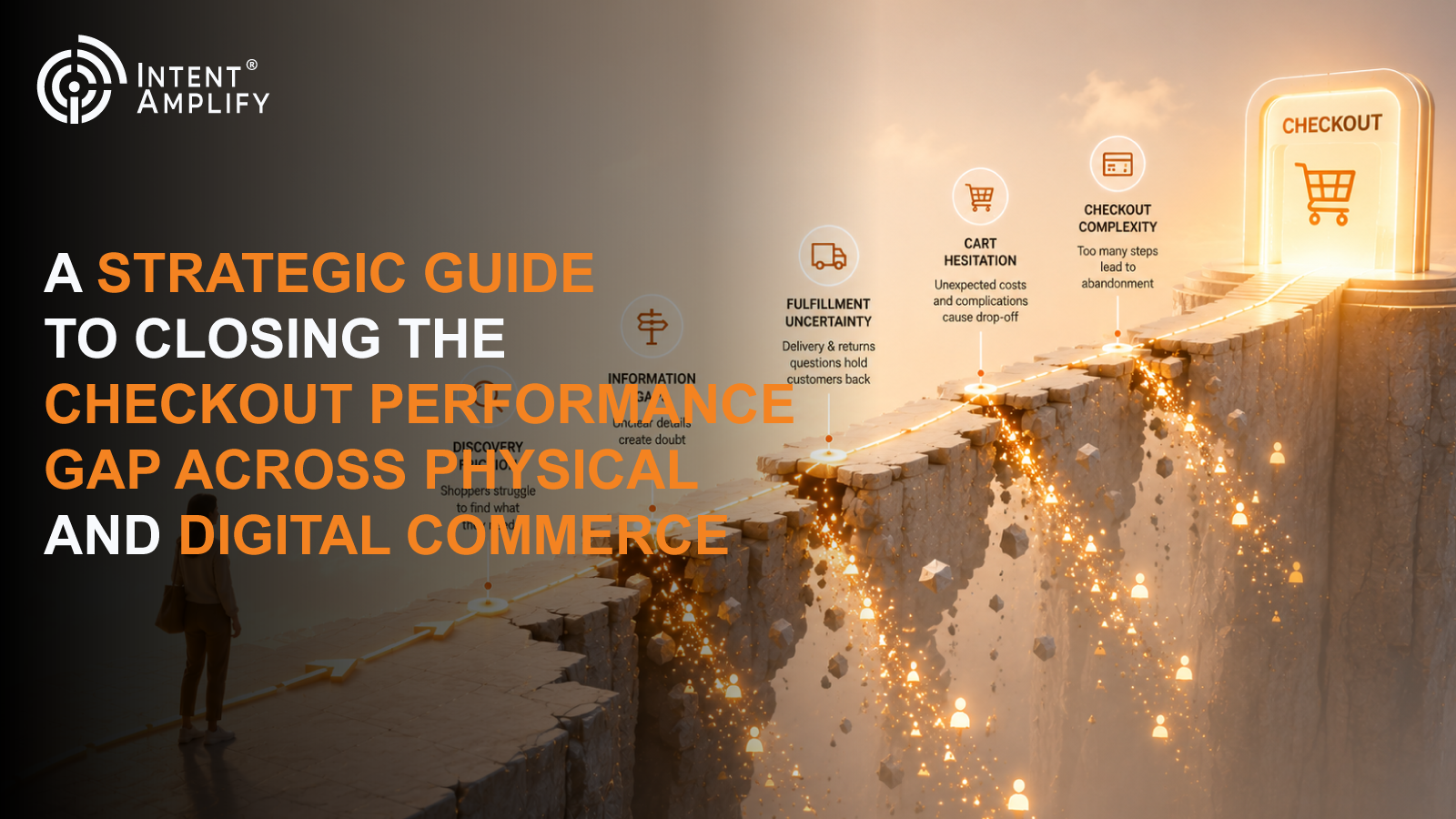
The checkout performance gap refers to the difference between what customers now expect from commerce experiences and what many enterprise checkout environments can consistently deliver. The gap appears in several forms: long in-store queues, failed digital authorizations, limited local payment support, inconsistent wallet acceptance, fragmented fraud controls, poor handoff between online and store journeys, and insufficient data visibility across commerce systems.
Historically, physical and digital checkouts were managed as separate operating environments. Store checkout prioritized point-of-sale reliability, hardware availability, staff productivity, and queue management. Digital checkout prioritized cart completion, gateway availability, authorization rates, payment method coverage, and fraud screening. That distinction is weakening.
Accenture's 2025 research describes commerce as "everything, everywhere, all at once," with consumers shopping through physical and online stores in complex, nonlinear journeys.1
This shift matters because a shopper who discovers a product through social media, researches it online, checks inventory, visits a store, and pays through a mobile wallet does not experience checkout as a single endpoint. The shopper experiences it as a sequence of confidence-building or confidence-eroding interactions.
The operational implication is clear. Checkout must become interoperable across channels. Payment infrastructure, fraud controls, product data, inventory visibility, loyalty, receipts, refunds, and customer identity should not operate as disconnected systems. When they do, the customer feels the friction, and the business loses visibility into where the transaction failed.
Microsoft's July 2025 retail payments analysis reinforces this point. It notes that modern payment foundations need to support secure, flexible checkout experiences across both physical and digital storefronts, including wallet payments, mobile in-store payment capture, Pay by Link, buy now, pay later, and intelligent routing. 5
The performance gap is therefore not a narrow technology problem. It is a coordination problem across customer experience, payment operations, fraud management, store operations, digital product teams, finance, and security.
Why the Gap Is Now a Board-Level Commerce Issue
Checkout performance has become a board-level issue because it directly affects revenue capture, customer loyalty, operational cost, and brand trust. A failed or frustrating checkout journey converts prior investments in marketing, personalization, merchandising, and store experience into lost demand.
The evidence is visible in consumer behavior. Checkout performance should be measured not only through authorization rates or cart abandonment, but through the quality of the entire path to transaction confidence.
The board-level risk is that checkout friction becomes invisible until it shows up as missed growth. A store may believe it has a queue problem when the real issue is limited mobile payment capture.
A digital team may believe it has a conversion problem when the underlying issue is fraud, false positives, insufficient local payment method support, or poor authentication design. A payments team may optimize processing cost without recognizing the customer experience cost of declined or delayed transactions.
Organizations need a more integrated view of checkout performance. That view should include transaction completion, authorization success, payment method availability, fraud decision accuracy, customer effort, queue time, associate productivity, refund and dispute friction, and cross-channel journey completion. Without this evidence base, leaders risk funding isolated improvements rather than solving the structural performance gap.
The Physical Checkout Gap: Lines, Labor, and Limited Flexibility
Physical checkout remains strategically important, even as digital commerce grows. The assumption that younger consumers will eventually abandon stores is not supported by recent evidence. Deloitte's Q3 2025 research describes Gen Z as an "authentically omni-shopping generation" and reports that nearly 50% of total Gen Z spending comes from in-store mass merchandise and grocery purchases. 2
For retailers, this means store checkout cannot be treated as a legacy function. It is part of the omnichannel revenue engine. Yet many physical environments still rely on fixed checkout lanes, traditional payment terminals, manual exception handling, and limited associate mobility. These constraints create visible friction: queues during peak periods, slow payment capture, inconsistent support for wallets or local payment methods, and limited ability to complete transactions where the customer is already receiving service.
Microsoft's 2025 guidance on Dynamics 365 Commerce and Adyen highlights several responses to this issue, including wallet payments, Tap to Pay on iPhone, Android-based payment terminals, and Pay by Link for in-store scenarios.
Microsoft notes that mobile in-store payment capture can reduce checkout lines, enable personalized service where customers are located, and allow inventory checks, product information, and payment processing in a single interaction. 5
Checkout modernization should not start with hardware replacement alone. It should start with journey design. Retailers should ask where customers experience waiting, where associates lose context, where payment options are constrained, and where the transaction is handed off unnecessarily. Only then should they determine which payment mobility, wallet, Pay by Link, self-checkout, assisted selling, or loyalty integration capabilities are needed.
The Digital Checkout Gap: Conversion, Trust, and Authorization Quality
Digital checkout faces a different but equally important performance challenge. The customer expects speed, but the business must balance speed with risk. Too much friction suppresses conversion. Too little control increases fraud, chargeback, account takeover, and policy abuse exposure.
The digital checkout gap is often misdiagnosed as a user interface issue. Interface design matters, but conversion leakage can also result from poor payment orchestration, limited alternative payment support, weak issuer routing, unnecessary authentication prompts, fraud false positives, inconsistent device intelligence, or a lack of localized payment options.
Gartner's July 2025 Hype Cycle for Digital Commerce states that digital commerce remains a key enabler of customer engagement and commercial growth, while organizations still struggle to justify the return on investment of new technology amid economic uncertainty. 6
This matters because checkout investments are often evaluated as narrow payment projects rather than as revenue protection and customer trust initiatives.
The more useful business case links checkout improvements to measurable performance outcomes: improved authorization rates, reduced false declines, higher repeat purchase rates, lower payment operating cost, reduced dispute volume, improved checkout completion, and stronger fraud containment. A digital checkout program should therefore be governed by both commercial and risk metrics.
Microsoft's strategic collaboration reflects the direction of travel. Microsoft stated that Checkout.com will use Azure's cloud infrastructure to accelerate digital payment performance for enterprise merchants and support faster, more secure, scalable digital payments. The announcement also links payment performance to preparation for agentic commerce. 7
This is a significant signal. Checkout infrastructure is becoming a strategic layer for AI-mediated commerce, not merely a payment acceptance function.
Agentic Commerce Will Redefine Checkout Risk and Performance
Agentic commerce will pressure checkout systems in ways many current environments are not designed to handle. In traditional checkout, the customer's identity, intent, cart, and authorization are usually expressed through direct interaction. In agentic commerce, an AI agent may discover products, compare options, assemble baskets, negotiate preferences, and initiate payment on behalf of a customer.
McKinsey's October 2025 report argues that agentic commerce moves commerce toward a world where AI anticipates needs, navigates options, negotiates deals, and executes transactions aligned with human intent. The report estimates that by 2030, agentic commerce could orchestrate up to $1 trillion in US B2C retail revenue and $3 trillion to $5 trillion globally. 4
This shift changes the checkout performance model. The critical question will no longer be only "Can a human complete checkout quickly" It will also be "Can the system verify delegated intent, authorize agent-initiated transactions, detect compromised agents, preserve consent, and manage disputes when the buyer interface is no longer a conventional website or app"
McKinsey specifically notes that agentic commerce will require new approaches for delegated authorization, programmable spend policies, consent attestation, "know your agent" models, and fraud detection adapted to agent behavior. 4
This is where commerce, payments, cybersecurity, and governance converge. Retailers and digital merchants that treat agentic commerce as a front-end experience trend may underinvest in the trust infrastructure required behind the scenes. The checkout stack will need richer transaction metadata, stronger identity controls, tokenization, policy-based authorization, anomaly detection, and dispute processes designed for autonomous or semi-autonomous transaction flows.
Agent-ready checkout will become a competitive differentiator. It will allow organizations to accept new forms of demand without weakening risk governance.
A Five-Part Framework for Closing the Checkout Performance Gap
1. Map checkout as an end-to-end journey, not a payment step
Organizations should map the customer's path from discovery to transaction completion across social, search, marketplace, mobile, store, and assisted channels. The goal is to identify where friction, uncertainty, or handoff failure reduces purchase confidence. This mapping should include payment method availability, identity prompts, loyalty recognition, inventory visibility, shipping options, associate support, and refund expectations.
2. Build a unified performance dashboard
Checkout teams need shared metrics across commerce, payments, fraud, and operations. Recommended metrics include checkout completion rate, authorization rate, false decline rate, payment method usage, queue time, transaction time, fraud loss, chargeback rate, dispute cycle time, refund completion time, wallet adoption, and cross-channel journey completion. Without shared measurement, teams optimize locally and create system-level friction.
3. Modernize payment orchestration across physical and digital channels
Payment orchestration should support multiple wallets, cards, local payment methods, Pay by Link, buy now pay later, intelligent routing, tokenization, and fallback paths. Microsoft's July 2025 retail payments guidance highlights the importance of integrating multiple options to align with customer preferences and operational needs. 5
4. Treat fraud controls as conversion infrastructure
Fraud prevention should not be evaluated only by blocked fraud. It should also be assessed by its effect on legitimate conversion. Leaders should measure false positives, step-up authentication rates, approval quality, device intelligence performance, and the customer impact of manual reviews. The strategic objective is not to remove friction indiscriminately. It is to apply friction only when the risk justifies it.
5. Prepare for agentic checkout governance
Organizations should begin defining how they will validate agent identity, delegated authority, spending constraints, consent records, transaction metadata, and dispute responsibility. McKinsey's 2025 analysis makes clear that agentic commerce will require payment and risk systems to evolve from human-in-the-loop assumptions to protocol-level trust. 4
Implementation Roadmap
Phase 1: Diagnose the performance gap
Start with a cross-functional checkout audit. Include digital commerce, store operations, payments, fraud, security, customer experience, finance, and data teams. Identify where revenue leakage occurs, where customer friction is highest, and where risk controls create unnecessary transaction drag.
Phase 2: Prioritize high-value friction points
Not every friction point deserves equal investment. Prioritize issues that affect high-volume journeys, high-margin products, strategic customer segments, international expansion, or elevated fraud exposure. For many organizations, the priorities will be failed authorizations, poor wallet support, excessive authentication, long store queues, and fragmented refund workflows.
Phase 3: Align checkout modernization with trust architecture
Modernization should include identity, fraud, payment routing, tokenization, data governance, observability, and privacy requirements. Deloitte's September 2025 Connected Consumer Survey, based on approximately 3,500 US consumers surveyed in June 2025, found that consumers want innovation with transparency, control, and data security. 8
This is directly relevant to checkout because payment experiences require customers to exchange trust for convenience.
Phase 4: Build omnichannel operating ownership
Checkout performance should have a named executive owner or steering group. The owner should coordinate technology investment, payment provider strategy, fraud policy, store enablement, and customer experience outcomes. Fragmented ownership is one of the main reasons checkout gaps persist.
Phase 5: Test agent-ready capabilities
Organizations should begin pilot testing AI-mediated discovery, conversational commerce, delegated payment permissions, richer transaction metadata, and policy-based authorization. The objective is not to rush into agentic commerce. It is to understand readiness gaps before agent-led traffic becomes material.
How We Help
Closing the checkout performance gap requires more than vendor selection. It requires research-backed prioritization, executive narrative, buyer education, and market positioning that connects payment performance to revenue, trust, and operational resilience.
Our team helps commerce, payments, cybersecurity, and technology providers translate these shifts into credible market-facing assets. We support executive whitepapers, research reports, buyer guides, campaign narratives, thought leadership programs, and demand-generation content that speaks to decision-makers in the language of business outcomes and technical risk.
For organizations seeking to engage enterprise buyers, we can help define the checkout performance thesis, identify the most relevant buyer pain points, develop evidence-backed messaging, and create assets that move the conversation beyond generic "seamless checkout" claims.
The stronger opportunity is to show how checkout modernization improves conversion, reduces operational friction, strengthens trust, and prepares the organization for AI-mediated commerce.
Recommended next step: commission a checkout performance content diagnostic that assesses current messaging, target buyer priorities, competitive positioning, and evidence gaps. The output should identify which themes deserve flagship content, which proof points need strengthening, and which calls to action are most likely to convert executive interest into qualified engagement.
Strategic Recommendations
First, treat checkout performance as an enterprise growth and trust metric. It should not sit only within payments or digital product teams.
Second, develop a unified checkout performance scorecard that includes conversion, authorization, fraud, customer effort, store queue time, refund friction, and channel handoff quality.
Third, modernize payment acceptance around customer preference and operational resilience, not isolated channel requirements.
Fourth, evaluate fraud tools by their ability to protect revenue while minimizing false declines and unnecessary friction.
Fifth, prepare now for agentic commerce by building governance models for delegated authorization, agent identity, consent attestation, and transaction accountability.
Conclusion
The checkout performance gap is widening because commerce behavior has changed faster than many checkout architectures. Customers move across channels without respecting organizational boundaries.
They research online, discover through social media, purchase in stores, expect mobile payment flexibility, and are beginning to rely on AI tools for product decisions. Soon, AI agents may initiate and complete more of the buying journey on their own.
The organizations best positioned for this shift will not be those that only make payment pages cleaner or point-of-sale terminals faster. They will be the organizations that understand checkout as a connected trust infrastructure. That infrastructure must support customer choice, payment resilience, fraud intelligence, operational visibility, and agent-ready authorization.
Checkout is where customer intent becomes revenue. It deserves the same strategic discipline as acquisition, personalization, and loyalty.
Retail and commerce solution providers looking to strengthen market positioning, content strategy, buyer intelligence, or demand generation around checkout performance can connect with Intent Amplify.
References
[1] Accenture (2025) Elevate your commerce strategy to unlock AI-powered growth. Available at: https://www.accenture.com/us-en/industries/consumer-goods-services/digital-commerce (Accessed: 15 June 2026).
[2] Deloitte (2025) Q3 2025 emerging retail and consumer trends. Available at: https://www.deloitte.com/us/en/Industries/consumer/articles/q3-2025-retail-consumer-trends.html (Accessed: 15 June 2026).
[3] Accenture (2025) Me, my brand and AI: The new world of consumer engagement. Available at: https://www.accenture.com/content/dam/accenture/final/accenture-com/document-3/Accenture-Me-My-Brand-and-AI.pdf (Accessed: 15 June 2026).
[4] McKinsey & Company (2025) The agentic commerce opportunity: How AI agents are ushering in a new era for consumers and merchants. Available at: https://www.mckinsey.com/capabilities/quantumblack/our-insights/the-agentic-commerce-opportunity-how-ai-agents-are-ushering-in-a-new-era-for-consumers-and-merchants (Accessed: 15 June 2026).
[5] Microsoft (2025) Next-Gen Retail Payments: Trends, Tech, and Transformation using Dynamics 365 Commerce + Adyen. Available at: https://www.microsoft.com/en-us/dynamics-365/blog/it-professional/2025/07/16/retail-payments-innovations-trends-tech-and-transformation-using-dynamics-365-commerce-ayden/ (Accessed: 15 June 2026).
[6] Gartner (2025) Hype Cycle for Digital Commerce, 2025. Available at: https://www.gartner.com/en/documents/6675834 (Accessed: 15 June 2026).
[7] Microsoft (2025) Microsoft and Checkout.com unite to elevate enterprise payments performance and build trust in the digital economy. Available at: https://ukstories.microsoft.com/features/microsoft-and-checkout-com-unite-to-elevate-enterprise-payments-performance/ (Accessed: 15 June 2026).
[8] Deloitte (2025) 2025 Connected Consumer: Innovation with trust. Available at: https://www.deloitte.com/us/en/insights/industry/telecommunications/connectivity-mobile-trends-survey.html (Accessed: 15 June 2026).