
Executive Summary
Electronics supply-chain resilience is often treated as a procurement problem that begins after engineering has selected the parts. That operating model puts risk management too late in the product-development cycle.
The bill of materials is where design intent meets supply reality. A technically valid component can still create operational exposure through lifecycle status, constrained availability, limited sourcing options, long lead times, compliance requirements, or the absence of a qualified alternative. When those conditions are discovered after design release, organizations have fewer choices, and each change can involve more engineering, procurement, quality, manufacturing, and program effort.
Altium’s whitepaper, Building Supply Chain Resilience: Transforming BOM Management for Modern Electronics, argues that leading electronics companies are moving beyond spreadsheets toward dedicated BOM management to strengthen resilience, reduce costs, and accelerate time-to-market. Its central premise is practical: BOM management needs to become a dynamic, collaborative process spanning component selection, BOM creation, change management, and manufacturing handoff rather than remaining a static documentation exercise [1].
That shift is increasingly relevant because component conditions remain dynamic. ECIA’s market-trends program tracks sales expectations, cancellations, decommits, and lead-time trends across major electronic-component categories, semiconductor subcategories, and end markets [2]. SEMI’s 2026 Semiconductor Supply Chain Management Survey likewise covers planning, supplier dynamics, manufacturing, customer demand, capabilities, and market outlook across the semiconductor value chain [3].
For engineering and procurement leaders, the implication is not that every external market movement should trigger a design change. It is that product teams need a better way to connect meaningful supply signals to the BOM while design choices are still flexible.
A resilient BOM operating model therefore focuses on decision timing, shared visibility, governed alternatives, ownership, and measurable readiness. The objective is not to predict every shortage. It is to preserve credible options before a disruption turns a component decision into an emergency redesign.
Why Electronics Supply Chain Resilience Must Start with the BOM
Supply-chain resilience becomes tangible at the component level.
A broad market report can indicate improving availability while a specific product remains exposed to a single-source device. A distributor can carry thousands of new products while a critical design still depends on a part approaching end of life. A procurement team can negotiate effectively and still inherit risk that was created months earlier by a design decision made without current sourcing context.
This is why the BOM should be treated as a supply-chain control point rather than a downstream file.
Altium 365’s BOM Portal is designed to create and manage BOM item listings for review and procurement while augmenting BOM data with live parts-availability information and rated alternative-part suggestions. Its documentation describes capabilities for resolving BOM issues, determining preferred supply-chain options, managing lifecycle state, and creating data-rich Managed BOMs from uploaded files or existing projects [4].
The important operating-model change is that supply context can enter the product-development process earlier.
Engineering remains responsible for technical suitability. Procurement contributes supplier, availability, lead-time, lifecycle, and commercial context. Manufacturing needs a controlled handoff. Program and business leaders need to understand when a component issue threatens a product commitment.
When those perspectives remain separated, the organization often discovers exposure through exceptions: a sourcing escalation, an unexpected price increase, an end-of-life notice, a delayed build, or a request for an urgent substitute.
A resilient BOM model aims to identify the decision before the exception.
The Limits of Spreadsheet-Led BOM Management
Spreadsheets remain useful because they are familiar, flexible, and easy to exchange. They can capture part numbers, quantities, manufacturers, suppliers, prices, notes, and status fields with little setup.
The problem begins when a spreadsheet becomes the primary operating system for a BOM that needs continuous supply-chain intelligence and cross-functional governance.
Static files can fragment quickly. Different teams may hold different versions. Supplier checks can become point-in-time lookups. Lifecycle changes may be discovered outside the BOM. Alternative-part decisions can live in email. Engineering context may not travel with procurement analysis. Revision history may be difficult to interpret. A spreadsheet can tell a user what someone entered; it cannot automatically guarantee that the underlying supply condition is still current.
Altium’s whitepaper explicitly positions dedicated BOM management as a move beyond spreadsheet-centric processes [1]. The issue is not that spreadsheets are inherently wrong. It is that the organization eventually asks them to perform work they were not designed to govern.
This creates four recurring constraints.
- First, visibility can become stale. Component conditions change after the file was last updated.
- Second, collaboration becomes sequential. Engineering sends information to procurement, procurement investigates, and questions return to engineering after decisions have already matured.
- Third, alternative-part knowledge is difficult to maintain. A candidate substitute may be found during one sourcing event, but the technical rationale, approval status, and sourcing context may not remain attached to the relevant BOM.
- Fourth, ownership becomes ambiguous. Teams can see a risk but still lack a clear answer to who reviews it, who supplies evidence, who approves a change, and when the issue must be escalated.
The threshold for moving beyond spreadsheets is therefore not a specific BOM size. It is the point at which the cost of fragmented decisions, stale information, repeated reconciliation, or late discovery becomes material.
Early Supply Intelligence as the Risk-Prevention Layer
The first layer of a resilient BOM operating model is early supply intelligence.
This does not mean giving every engineer a stream of market alerts. It means bringing the supply information relevant to a component decision into the workflow at a point when the design can still respond.
Altium’s BOM Portal documentation says the application uses manufacturer and supplier data to provide detailed parts-availability information and alternative-part suggestions [4]. The purpose is to support BOM assessment before manufacturing handoff, not merely to report problems after release.
That timing matters.
If a component is identified as high risk during early design, engineering may have several options: choose another part, adjust the architecture, qualify an alternate, redesign the footprint, or accept the risk with a documented rationale.
If the same issue appears after qualification or production release, each option can carry greater cost and schedule impact.
External market intelligence adds context but should not replace BOM-level judgment. ECIA reports current expectations, cancellations, decommits, and lead-time trends [2]. SEMI’s industry survey provides another view across semiconductor planning and supplier dynamics [3]. These sources can help teams understand the environment, but neither determines whether a specific part is appropriate for a specific design.
The resilient model therefore links external signal, BOM exposure, technical consequence, and accountable action.
A useful review asks four questions:
- What changed in the component or supply environment?
- Which products and BOMs are affected?
- What technical and sourcing options remain?
- Who owns the next decision?
- When those questions can be answered early, supply intelligence becomes a prevention layer rather than an emergency notification layer.
Engineering-Procurement Collaboration as the Operating Layer
BOM resilience depends on collaboration because component decisions combine technical and commercial realities.
Engineering knows why a part was selected. Procurement knows how that part behaves in the supply market. The strongest decision uses both views before the design becomes expensive to change.
Altium’s BOM-management positioning emphasizes engineering-procurement collaboration and the use of enriched supply-chain data to reduce rework and delays [4]. It also describes capabilities for assessing part risk, lifecycle state, availability, pricing, approved vendors, and parts in use across BOMs and projects [4].
The operating principle is more important than any single feature: procurement should not be treated as the team that validates supply only after engineering finishes.
- Instead, organizations can define collaboration points around high-consequence decisions.
- During component selection, procurement context can identify sourcing constraints or concentration.
- During BOM review, engineering and procurement can assess critical items, alternatives, lifecycle status, and availability.
- Before release, the teams can confirm unresolved exceptions and ownership.
- After release, monitoring can focus on material changes rather than forcing a full manual review of every line.
This approach protects engineering focus while bringing supply intelligence into the moments where it can change the outcome.
Alternative-Part Readiness as the Flexibility Layer
An alternative component is valuable only when the organization can use it.
A search result is not an approved substitute. A technically similar part may differ in electrical behavior, package, environmental rating, compliance, thermal performance, firmware interaction, qualification history, or manufacturer-specific characteristics.
Engineering therefore needs to define what equivalence means for the design.
Procurement needs to answer a different question: does the alternate improve the supply position? A substitute may be technically acceptable while remaining exposed to the same manufacturer, limited authorized distribution, poor availability, or an unsuitable lifecycle profile.
A resilient BOM operating model combines those judgments.
The aim is not to pre-qualify multiple alternatives for every line item. That would create unnecessary effort. The aim is to identify components where lack of substitution flexibility could materially affect production, redesign effort, schedule, or product commitments.
DigiKey’s continuing expansion illustrates the breadth of component choice available to designers and procurement teams. In July 2026, DigiKey reported adding more than 27,000 new stocking parts and 104 suppliers in Q2, with more than 373,000 products added to its system during the quarter [5]. More choice can improve discovery, but it also reinforces the need for a governed method to distinguish a possible substitute from a product-ready alternative.
The resilient model therefore records the relationship between the original component, candidate alternatives, technical constraints, supply rationale, qualification status, and approval owner.
That turns alternate planning into designed flexibility.
The Resilient BOM Operating Model
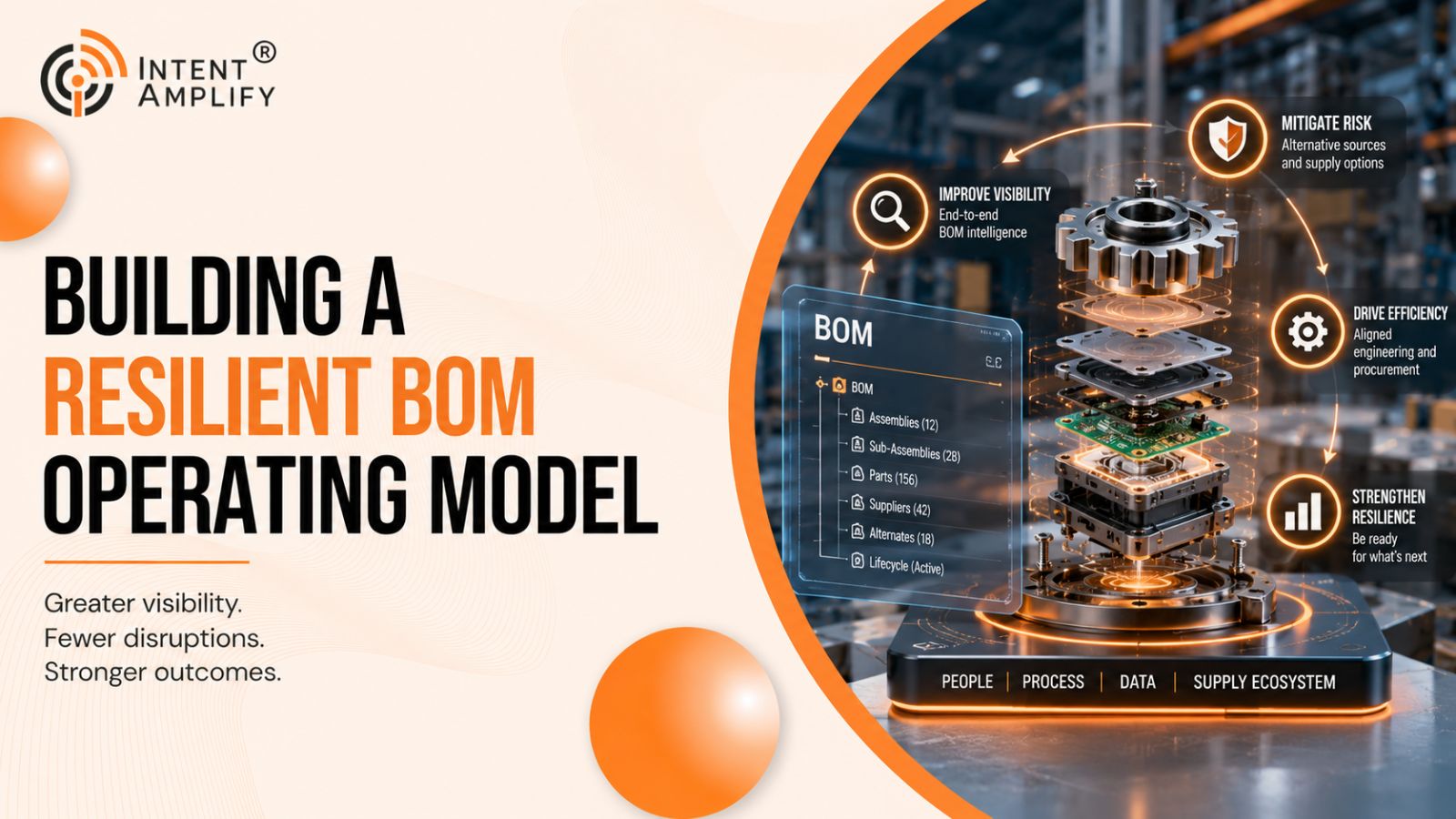
The following framework gives electronics leaders a practical way to move from static BOM administration toward decision-centered resilience.
Table 1: Resilient BOM Framework from Component Selection to Manufacturing Readiness
|
Framework Layer |
Core Question |
Required Capability |
Executive Outcome |
|
Criticality Mapping |
Which components create the greatest delivery or redesign exposure? |
Part criticality, product usage, consequence assessment |
Focuses review on high-impact BOM decisions |
|
Supply Intelligence |
What current conditions could affect the selected part? |
Availability, lifecycle, lead-time, supplier and compliance context |
Identifies meaningful exposure while choices remain flexible |
|
Alternative Readiness |
What credible substitute options exist? |
Technical equivalence rules, sourcing assessment, qualification status |
Preserves response options before disruption |
|
Cross-Functional Review |
Are engineering and procurement working from the same decision context? |
Shared BOM, comments, evidence, ownership |
Reduces sequential handoffs and repeated reconciliation |
|
Governance |
Who can approve, reject, or escalate a BOM change? |
Revision control, lifecycle state, decision record, role clarity |
Creates accountable change management |
|
Manufacturing Readiness |
Is the BOM ready for controlled handoff? |
Resolved exceptions, approved sources, current data |
Improves confidence at release and production transition |
|
Outcome Measurement |
Is the operating model reducing avoidable exposure? |
Decision-cycle, exception, redesign and readiness measures |
Connects BOM process improvement to operational performance |
This framework does not require every organization to adopt the same workflow.
A low-volume engineering team may need lightweight governance around a small number of critical parts. A large product organization may need portfolio-level visibility into parts used across many projects, formal lifecycle states, controlled alternatives, and integration with enterprise systems.
The common principle is that technology should support defined decisions.
The organization first identifies which BOM decisions create material risk, then determines what information, ownership, collaboration, and controls those decisions require. Dedicated BOM management becomes useful when it shortens the path from signal to governed action.
Governance, Controls, and BOM Decision Readiness
Supply-chain visibility without governance can create more alerts without creating better outcomes.
A resilient BOM process should make clear which signals require review, which roles provide evidence, which changes require approval, and what constitutes manufacturing readiness.
Governance should begin with risk tiers.
A commodity passive with broad qualified coverage may need routine monitoring. A specialized semiconductor with a long qualification cycle may require earlier review and executive visibility. A component used across multiple products may deserve portfolio-level monitoring because one change can affect several programs.
The second control is evidence.
When a component is approved, rejected, substituted, or accepted with known risk, the decision should preserve enough context for another team member to understand why. This reduces repeated analysis and helps future reviews distinguish a current decision from an outdated assumption.
The third control is revision discipline.
A BOM should make it clear which state is under review, which state is released, and which changes occurred after release. Collaboration is valuable only if teams know they are working from the same controlled product definition.
The fourth control is escalation.
Not every component issue should reach senior leadership. Escalation should be tied to consequence: production interruption, launch impact, material redesign, customer commitment, significant commercial exposure, or another threshold defined by the organization.
The fifth control is periodic reassessment.
A decision that was reasonable at design release may become weaker as lifecycle, availability, supplier, or product conditions change. Resilience therefore requires selected decisions to be revisited when material evidence changes.
Executive Scorecard for BOM Resilience
A resilient BOM operating model should be measured by decision quality and readiness, not by the number of alerts displayed.
Table 2: Executive Metrics for Measuring BOM Decision Readiness
|
Metric |
What It Measures |
Executive Relevance |
|
Critical-Part Review Coverage |
Share of designated high-impact components reviewed before release |
Shows whether risk is being assessed while design choices remain flexible |
|
Unresolved BOM Exceptions |
Material component issues still open at release checkpoints |
Reveals readiness gaps before manufacturing handoff |
|
Alternative Readiness |
Critical components with technically and commercially credible fallback options |
Measures designed flexibility |
|
Decision Cycle Time |
Time from material supply signal to approved action |
Shows whether collaboration reduces response friction |
|
Late Component Changes |
Material component changes required after design maturity or release |
Indicates where risk is still being discovered too late |
|
Decision Traceability |
BOM changes with clear evidence, owner, rationale, and approval state |
Confirms that collaboration remains governed |
|
Cross-Product Exposure |
Critical parts used across multiple products without adequate mitigation |
Makes portfolio-level concentration visible |
These measures should be interpreted in context. A high number of alternatives is not automatically better. A low number of alerts is not automatically safer. The objective is to make material risks visible early enough, resolve them with the right evidence, and preserve a controlled path to manufacturing.
Where the Altium Whitepaper Fits
Altium’s Building Supply Chain Resilience: Transforming BOM Management for Modern Electronics is directly aligned with this operating-model shift.
The whitepaper focuses on why electronics companies are moving beyond spreadsheets and toward dedicated BOM management. It covers the progression from component selection through BOM creation and manufacturing handoff, with the objective of making BOM management more dynamic, collaborative, and resilient [1].
For engineering leaders, the relevance is earlier visibility into component risk without separating supply context from design decisions.
For procurement leaders, the relevance is access to BOM information while designs remain flexible rather than after engineering has finalized every choice.
For operations and manufacturing stakeholders, the value is a more controlled handoff in which material exceptions, alternatives, lifecycle information, and sourcing decisions have been addressed earlier.
For executives, the broader question is whether the organization has an operating model that can convert component intelligence into accountable action.
Download the Whitepaper: Building Supply Chain Resilience: Transforming BOM Management for Modern Electronics
Conclusion
Building a resilient BOM operating model is not about eliminating supply volatility. It is about changing when and how the organization responds to component risk.
Early supply intelligence provides the prevention layer. Engineering-procurement collaboration provides the operating layer. Alternative-part readiness provides the flexibility layer. Governance provides the control layer. Measurement provides the evidence that the process is improving.
Together, these capabilities move BOM management beyond static documentation.
They allow engineering teams to understand supply exposure while designs remain flexible, procurement teams to contribute sourcing intelligence before release, manufacturing teams to receive a more controlled product definition, and leaders to see where unresolved component decisions could affect delivery.
For electronics organizations, the mandate is practical. Identify the parts that matter most. Bring relevant supply context upstream. Define technical substitution rules. Record decision rationale. Clarify ownership. Revisit material decisions when evidence changes. Measure whether risks are being resolved earlier.
The organizations that improve resilience will not be those that collect the most component data. They will be those that connect the right data to the right BOM decision before the cost of change becomes disproportionate.
References
1. Altium (2026) Building Supply Chain Resilience: Transforming BOM Management for Modern Electronics. Available at: https://resources.altium.com/p/transforming-bom-management-whitepaper
2. Electronic Components Industry Association (2026) Market Trends/Lead Times. Available at: https://www.ecianow.org/market-trends-lead-times/
3. SEMI (2026) Semiconductor Supply Chain Management Survey. Available at: https://www.semi.org/en/industry-groups/supply-chain-management-survey
4. Altium (2026) BOM Portal Technical Documentation. Available at: https://www.altium.com/documentation/altium-365/bom-portal
5. DigiKey (2026) DigiKey Adds Over 27,000 New Parts and 104 Suppliers in Q2 2026. Available at:https://www.digikey.com/en/news/press-releases/2026/july/digikey-adds-over-27000-new-parts-to-in-stock-product-lineup-and-104-suppliers-in-q2-2026