
logo
logo
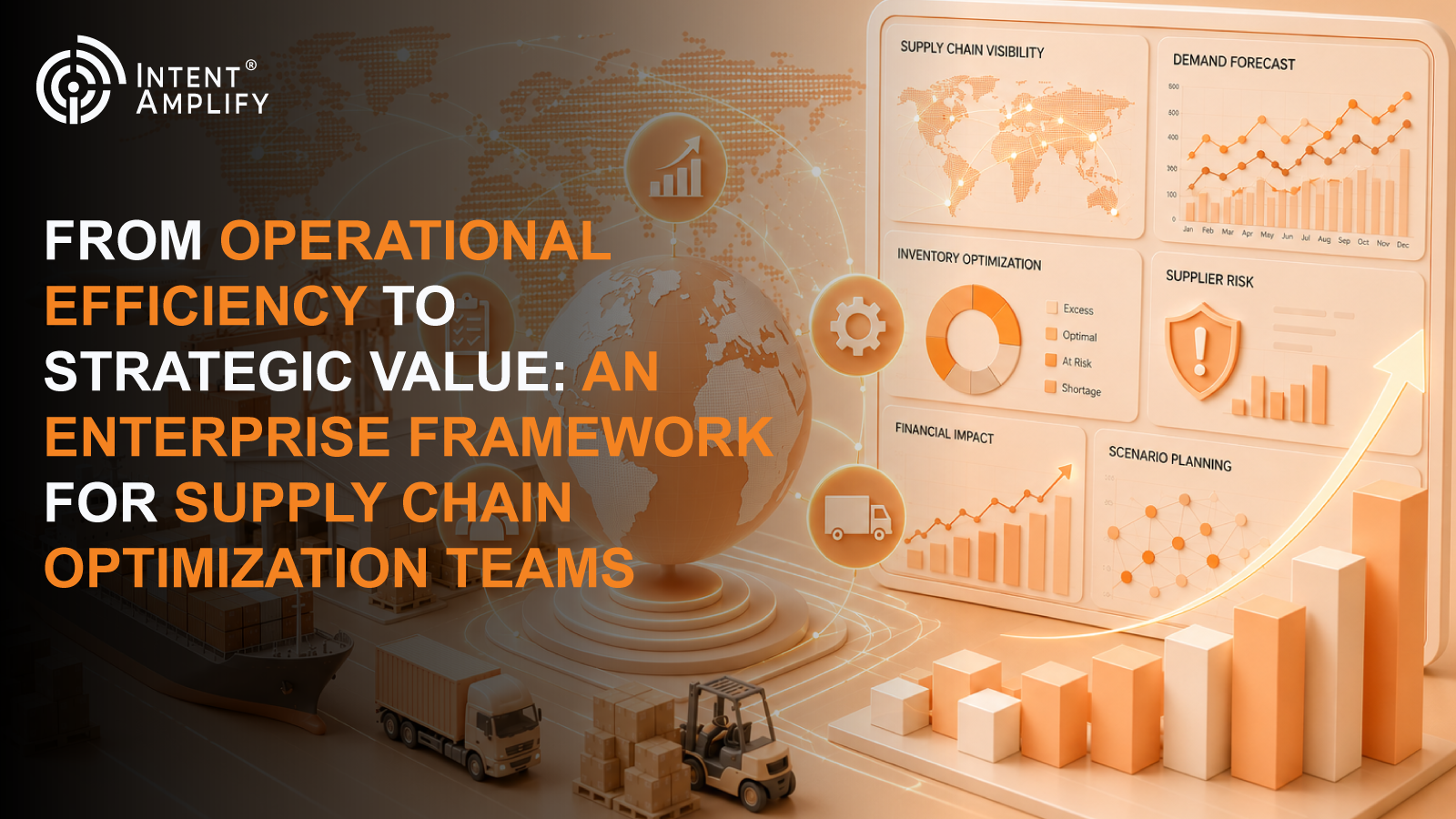
From Operational Efficiency to Strategic Value: An Enterprise Framework for Supply Chain Optimization Teams

WHITEPAPER

From Operational Efficiency to Strategic Value: An Enterprise Framework for Supply Chain Optimization Teams

Supply chain optimization teams are moving beyond cost efficiency toward enterprise decision intelligence. This whitepaper explores how trusted data, scenario planning, workflow integration, and value measurement help planning groups improve resilience, financial discipline, service reliability, and strategic decision-making.

Executive Summary

Supply chain decision teams are being pulled into a larger role. The historical mission was relatively clear: lower cost, improve service, balance inventory, design better networks, and support planning teams with analytical rigor. Those priorities still matter. Yet the operating environment has changed. In 2026, the more urgent question is whether optimization groups can help the enterprise make better decisions before disruption, margin pressure, or customer volatility forces a reactive response.

The evidence is difficult to ignore. McKinsey's 2025 supply chain risk research found that 82% of surveyed companies reported that new tariffs affected their supply chains, with 20% to 40% of their activity affected in some way. 39% reported higher supplier and material costs, while 30% reported reduced customer demand. At the same time, affected companies were not responding through a single lever: 45% were increasing inventories, 39% were pursuing dual sourcing, and 33% were developing nearshoring or onshoring plans.1

Those figures show why advanced planning can no longer remain an occasional modeling exercise. Each response carries trade-offs. More stock may protect service but consume working capital. Dual sourcing may reduce exposure but increase procurement complexity. Nearshoring may lower geopolitical risk but alter cost structure, capacity planning, and network design. The business no longer needs reporting alone; it needs a disciplined decision environment where leaders can compare options, understand trade-offs, and act before volatility turns into margin pressure or service failure.

Technology investment is rising accordingly. The 2025 MHI Annual Industry Report, produced with Deloitte, found that 55% of supply chain leaders are increasing technology and innovation spending. Sixty percent plan to invest more than $1 million, and 19% plan to spend more than $10 million.2 Gartner has also projected that 70% of large organizations will adopt artificial intelligence-based forecasting to predict future demand by 2030.3

This whitepaper introduces an enterprise framework for supply chain decision teams moving from operational efficiency to strategic value. It examines why the role is changing, which capabilities matter most, and how leaders can build a repeatable decision capability across network design, sourcing, production, inventory, transportation, fulfillment, and capacity planning.

This whitepaper also points readers to the webinar, "The Expanding Role of Supply Chain Optimization Teams in Driving Business Impact," as a practical continuation of the discussion. The webinar is positioned as an educational resource for leaders who want to examine how optimization teams can move beyond technical analysis and become stronger contributors to enterprise decision-making.

Across enterprise supply chain content, optimization is often framed as a technology modernization issue. That framing is too narrow. The more important shift is organizational: planning and optimization teams are being asked to support decisions that cut across procurement, finance, operations, customer experience, and executive risk management. In practice, the constraint is rarely only analytical capability. It is the ability to translate model outputs into decisions that business leaders trust, fund, and repeat.

This distinction matters because many organizations already have capable analysts, planning systems, spreadsheets, and specialist modeling tools. What they often lack is a repeatable decision rhythm: common assumptions, governed scenarios, finance-aligned value metrics, and a clear path from analysis to action. Supply chain optimization teams that solve this operating-model challenge will create more durable enterprise value than teams that simply increase the volume of modeling work.

The New Mandate for Supply Chain Decision Teams

The pressure on supply chain leaders is no longer episodic. Tariffs, cost swings, labor availability, supplier risk, demand variability, environmental expectations, and customer-service commitments now intersect continuously. A decision in one area quickly changes the economics of another.

A procurement move can alter transportation patterns. A new production footprint can reshape inventory placement. A distribution change may protect delivery speed while raising fixed costs. A sourcing adjustment can improve resilience while complicating quality management. These are not isolated planning questions. They are enterprise trade-offs.

Consider a consumer goods manufacturer responding to tariff pressure by adding a second supplier closer to the U.S. market. On paper, the move reduces exposure. In practice, it may also change inbound freight economics, require new quality controls, alter inventory buffers, and affect how finance evaluates working-capital requirements. The optimization question is therefore not simply whether the supplier is cheaper or safer. It is whether the full decision improves resilience without creating hidden cost, service, or execution risk elsewhere in the network.

This is where planning analytics groups are becoming more influential. Their work sits at the intersection of data, economics, constraints, service outcomes, and executive choice. When done well, they help the organization understand not only which option is cheapest, but which option is most defensible under uncertainty.

The shift is also cultural. Many planning organizations still operate in a request-response mode. A business stakeholder asks for an analysis. A specialist builds a model. The result appears days or weeks later. That approach can support periodic projects, but it struggles in a market where leaders need faster answers and more frequent scenario comparison.

Modern planning teams need to act earlier in the decision cycle. Instead of waiting for questions, they should surface decision points, identify emerging constraints, prepare scenarios, and help stakeholders understand consequences. The work becomes less about producing an isolated model and more about shaping the way the enterprise makes choices.

This requires a different operating model. It requires stronger data governance, more accessible scenario workflows, clearer assumptions, better cross-functional collaboration, and a shared understanding of value. Most importantly, it requires trust. Executives will not act on an analytical recommendation unless they understand the assumptions, constraints, and business impact behind it.

Why Efficiency Alone No Longer Wins

Efficiency remains essential. No supply chain leader can ignore cost discipline, asset utilization, inventory productivity, or fulfillment performance. But efficiency alone is now too narrow as the primary lens for enterprise planning.

Volatility has changed the meaning of efficiency because the lowest-cost answer can also become the most fragile when demand, tariffs, supplier performance, labor availability, or transportation capacity shifts unexpectedly. A lean inventory position may be financially attractive until demand spikes or inbound flow stalls. A consolidated supplier base may improve purchasing leverage while increasing exposure. A facility decision may look efficient under baseline assumptions but perform poorly under tariff, fuel, or labor shifts.

The strongest organizations now think in portfolios of options. They want to know how a network performs under different demand profiles, what cost exposure looks like under alternative sourcing strategies, which sites become bottlenecks under growth, and how customer commitments change when transportation capacity tightens.

Accenture's research on autonomous supply chains reinforces this value case. Its analysis found that autonomous approaches could reduce order lead times by 27%, improve productivity by 25%, lower carbon emissions by 16%, and cut disruption recovery times by roughly 60%. Accenture also found that only 25% of respondents had begun the journey toward autonomy, while median autonomy maturity stood at just 16%.4

That gap is revealing. The potential value is large, but readiness remains limited. Technology can accelerate planning, but it cannot compensate for weak data, unclear ownership, disconnected workflows, or poor adoption. Decision maturity is not created by software alone. It emerges when the organization connects tools, processes, governance, and human judgment.

IBM's Institute for Business Value found that 74% of supply chain leaders say generative artificial intelligence enables better visibility, insights, and decision-making across ecosystems.5

That view reflects a broader market direction: leaders want intelligence that helps them see across functions, partners, and time horizons. Yet visibility without scenario discipline can still leave teams uncertain about what to do next.

Deloitte's 2026 analysis of agentic supply chains argues that global supply chain complexity is increasing and that agentic artificial intelligence can help manufacturers manage risk and unlock new value.

The report notes that more than half of surveyed supply chain executives are already deploying AI agents to automate workflows, while Gartner estimates cited by Deloitte suggest that by 2030, 50% of cross-functional supply chain management solutions will use intelligent agents to autonomously execute decisions across the ecosystem. Deloitte's central point is especially relevant for planning and analytics groups: organizations should redesign workflows around the complementary strengths of humans and agents rather than simply adding AI agents to existing operating models. 6

The greater value lies in moving from awareness to action. Visibility can tell leaders that demand is shifting, but decision maturity helps them determine which network, inventory, sourcing, or production response creates the most defensible enterprise outcome.

Five Capabilities That Separate Tactical Analysis from Enterprise Value

A mature planning analytics function needs five capabilities to become a true strategic partner.

The foundation is decision-grade data, because every optimization recommendation inherits the quality and credibility of the assumptions behind it. Models are only as credible as the information behind them. Demand signals, service policies, lead times, freight rates, cost-to-serve assumptions, supplier constraints, capacity rules, inventory targets, customer priorities, and working-capital implications must be maintained with discipline. Poor inputs do not merely weaken accuracy. They undermine executive confidence.

PwC's 2025 Digital Trends in Operations Survey found that 92% of operations and supply chain leaders say technology investments have not fully delivered expected results, with 47% citing integration complexity and 44% pointing to data issues. For supply chain decision teams, this is a practical warning that better tools alone will not create better decisions if core data, workflows, and system integration remain fragmented. 7

Once the data foundation is trusted, the next maturity marker is scenario fluency. Leaders rarely need one answer. They need a structured comparison of alternatives. What if tariffs rise further? What if a supplier underperforms? What if a key customer shifts volume? What if a regional warehouse becomes capacity-constrained? Scenario fluency allows teams to translate uncertainty into options.

Trade-off visibility is where optimization starts to become a cross-functional management discipline. Procurement, logistics, manufacturing, finance, sales, and service teams often optimize against different goals. A mature approach makes those tensions visible. It shows when one function's improvement creates another area's burden. This is where scenario analysis becomes a language for alignment.

The fourth is explainability. A recommendation that cannot be explained will not be adopted. Executives need to understand why a scenario is preferred, what assumptions govern the result, where risk remains, and which constraints matter most. Planners need the ability to challenge outputs based on operational reality. Finance needs confidence that value estimates are not inflated.

From the Intent Amplify Research Desk perspective, explainability is becoming one of the most underappreciated requirements in supply chain optimization. The technical answer may be correct, but adoption often depends on whether a finance leader can understand the value logic, whether an operations leader can challenge the constraint assumptions, and whether an executive team can see why one trade-off is preferable to another. In that sense, explainability is not only a model-design issue. It is a governance and trust issue.

The final capability is workflow integration, because even strong scenario analysis loses value when it sits outside the cadence of business decision-making. Scenario analysis creates lasting value only when it is embedded into recurring business rhythms. That includes sales and operations planning, integrated business planning, sourcing reviews, network design cycles, budget planning, capital allocation, logistics planning, and disruption-response routines.

These capabilities shift the function from analysis provider to decision infrastructure. The difference may sound subtle, but it is material. An analysis provider answers questions. Decision infrastructure helps the enterprise ask better questions, compare paths, and act with discipline.

The Decision-to-Value Framework for Modern Planning Groups

Enterprise decision maturity can be understood through five layers: trusted data, flexible modeling, governed scenarios, business workflow, and measured value.

Layer One: Trusted Data

The foundation is a shared data layer that business users trust. This includes master data quality, cost assumptions, capacity constraints, demand history, service rules, transportation lanes, supplier terms, inventory policies, and customer-segment priorities.

The tariff findings from McKinsey show why this matters. Companies facing disruption were simultaneously increasing inventory, pursuing dual sourcing, and exploring nearshoring or onshoring.1 Each move changes the operating equation. Without trusted data, leaders cannot compare those options credibly.

Trusted data also needs ownership. If cost assumptions are outdated or constraints are undocumented, a technically sound model can still produce misleading guidance. Supply chain leaders should treat planning inputs as managed business assets, not as temporary project files.

Layer Two: Flexible Modeling

The second layer is modeling flexibility. Different decisions require different analytical lenses. Strategic network design requires one approach. Inventory placement requires another. Transportation routing, production allocation, supplier balancing, and fulfillment strategy each bring unique constraints.

A scalable capability should support both strategic studies and recurring decisions. It should allow specialists to build rigorous models while enabling business users to explore approved scenarios without starting from scratch every time. This is how organizations shorten the path from analysis to action.

Layer Three: Governed Scenarios

The third layer is scenario governance. A scenario is not simply a model output. It is a structured business case built on assumptions, constraints, and objectives. Which forecast was used? Which costs changed? Were service requirements fixed or relaxed? Did the model include tariff exposure? Were capacity limits updated? Were sustainability targets considered?

Governance prevents confusion. It allows different stakeholders to compare options using consistent assumptions. It also creates traceability, which matters when large capital, sourcing, or network decisions are involved.

Layer Four: Embedded Workflows

The fourth layer is integration into business routines. Scenario modeling should not exist only in specialist software or periodic projects. It should appear where decisions are made: planning meetings, executive reviews, sourcing events, resilience planning, and budget cycles.

This is where many organizations lose momentum. They invest in analytical tools, but the workflow remains manual. A small expert group becomes a bottleneck. Business stakeholders wait for results. Opportunities pass. Embedding scenario analysis into recurring processes turns it into a usable capability rather than a specialized event.

Layer Five: Value Measurement

The final layer is the measured impact. Cost reduction matters, but it is not the only value source. Advanced planning can improve working capital, protect revenue, raise service levels, reduce recovery time, improve asset utilization, lower emissions, and support better investment decisions.

The 2025 MHI and Deloitte report shows that leaders are investing heavily in this future, with 55% increasing spending and 19% planning more than $10 million in investment.2 As spending rises, finance leaders will expect clearer return narratives. Planning analytics groups should therefore define value metrics early, validate them with finance, and report outcomes in terms the enterprise recognizes.

Independent Market Signal: Why Decision Workflows Are Becoming Strategic

The direction of market investment suggests that supply chain leaders are not simply modernizing tools; they are trying to redesign how decisions are made. The MHI and Deloitte findings show rising technology investment, while PwC's operations research points to a persistent execution gap caused by integration complexity and data issues. Read together, these signals show why optimization maturity cannot be judged by software adoption alone. The more meaningful test is whether the organization can connect data, scenarios, workflow, governance, and financial accountability into a repeatable operating model.

This is where planning and optimization teams become more strategic. In a stable environment, a specialist group can support periodic analysis. In a volatile environment, the same group needs to become a standing decision capability that helps leaders evaluate cost, service, resilience, and risk together. That shift is broader than any individual vendor, platform, or webinar. It reflects a structural change in how enterprises are organizing supply chain judgment.

Field Lens: How Planning Teams Are Expanding Their Business Impact

The webinar, "The Expanding Role of Supply Chain Optimization Teams in Driving Business Impact," gives readers a practical way to continue exploring the role change many planning organizations are already navigating. Planning analytics groups are no longer limited to occasional network studies or narrow analytical requests. They are being asked to support decisions across design, sourcing, production, inventory, transportation, fulfillment, and capacity planning.

This expansion reflects a simple business reality: planning questions are becoming more frequent, more connected, and more financially consequential. A network model that once supported a multiyear redesign may now need to inform ongoing tariff response, customer-growth planning, or supplier diversification. An inventory model may need to balance service protection, capital pressure, and fulfillment promises. Transportation scenarios may need to account for cost, capacity, speed, and risk together.

The webinar's strongest idea is that planning teams are becoming proactive decision partners. That phrase is useful because it changes expectations. A proactive partner does not simply deliver the lowest-cost answer. It helps leaders understand the business consequences of each path.

For U.S. organizations, this framing is especially relevant. The domestic operating environment is shaped by changing trade policy, regional manufacturing decisions, labor constraints, transportation economics, and customer-service expectations. A decision model that cannot accommodate those variables will feel outdated quickly.

The larger opportunity is not higher model volume; it is the ability to make high-quality decisions repeatable across functions, planning cycles, and disruption scenarios.

Webinar Spotlight: Expanding the Role of Supply Chain Optimization Teams

The webinar, "The Expanding Role of Supply Chain Optimization Teams in Driving Business Impact," provides a practical next step for leaders evaluating how planning and optimization groups can increase their enterprise relevance. Its value lies in the topic it brings forward: optimization teams are no longer being measured only by their ability to produce models, reports, or cost scenarios. They are increasingly expected to help business leaders make better decisions across sourcing, production, inventory, transportation, fulfillment, network design, and capacity planning.

This makes the webinar especially relevant to organizations that already have analytical talent but still struggle to convert analysis into repeatable business impact. Many supply chain teams can model alternatives. Fewer have a mature operating rhythm for aligning assumptions, comparing trade-offs, validating value with finance, and moving recommendations into execution.

Readers should approach the webinar as an educational discussion on role expansion, decision maturity, and business impact. The strongest use of the asset is not to validate a specific platform claim, but to help leaders reflect on how their own optimization teams can become more proactive, commercially relevant, and embedded in enterprise planning workflows.

Leaders who want to explore this role shift in a more practical format can access the webinar, "The Expanding Role of Supply Chain Optimization Teams in Driving Business Impact." The session is relevant for supply chain, planning, analytics, operations, and transformation leaders examining how optimization teams can move closer to measurable business outcomes.

The most useful way to approach the webinar is to bring three questions back to the organization: Where are optimization teams still operating reactively? Which recurring decisions would benefit from better scenario governance? And how can planning groups build stronger credibility with finance, operations, and executive stakeholders?

Continue the discussion through the webinar.

What Leaders Should Do Next

First, map today's planning analytics role. Is the group responding to requests, or is it shaping recurring decisions? Does it support only strategic network studies, or does it influence tactical planning, resilience, sourcing, inventory, and fulfillment choices? This diagnostic reveals whether the function is an analytical service or an emerging value engine.

Second, prioritize high-value decision domains. Not every use case needs to be transformed at once. Begin with decisions that have material financial or service implications: inventory placement, capacity allocation, supplier mix, transportation mode selection, network changes, production footprint, and fulfillment strategy.

The right starting point will vary by sector. A retailer may begin with inventory placement and fulfillment promises because service reliability directly affects revenue and customer retention. A manufacturer may prioritize supplier mix, capacity allocation, and production footprint because resilience and margin protection are tightly linked. A logistics-heavy organization may focus first on transportation mode selection, network design, and lane-level cost volatility. This sector-specific prioritization helps leaders avoid broad transformation programs that look impressive but fail to change the decisions that matter most.

Third, standardize assumptions. Every scenario should have clear documentation for demand, cost, constraints, service rules, capacity, and risk factors. When assumptions are visible, discussions become more productive. When they are hidden, stakeholders debate the model instead of the decision.

Fourth, connect scenario analysis with finance. Savings, margin impact, working-capital effects, capital avoidance, revenue protection, and service improvement should be translated into financial terms. This creates credibility and helps executive teams compare initiatives.

Fifth, design workflows before expanding tools. Technology helps, but adoption depends on how work gets done. Optimization should fit into monthly planning, leadership reviews, sourcing events, disruption response, and budget cycles.

Finally, invest in translators. The future of decision intelligence is not only technical. Teams need people who can interpret model outputs, explain trade-offs, challenge assumptions, and help stakeholders make decisions under uncertainty.

Conclusion: Building the Decision Engine for a More Volatile Market

Supply chain decision intelligence is becoming an enterprise value capability because business conditions demand it. Volatility is now a standing feature of the operating environment. Leaders need a disciplined way to evaluate options, understand consequences, and act before disruption becomes financial damage.

The move from efficiency to strategic value requires trusted data, flexible modeling, governed scenarios, embedded workflows, and measured outcomes. It also requires a broader identity for planning and analytics teams. They are no longer simply model builders or analytical support groups. They are becoming decision partners to the enterprise.

For U.S. supply chain organizations, the strategic message is direct: advanced planning should be treated as a decision engine for the enterprise, not as a periodic analytical exercise. Organizations that build this capability carefully can improve efficiency while also strengthening resilience, financial discipline, service reliability, and executive confidence in complex trade-off decisions.

For leaders examining how their planning and optimization teams can create broader business impact, the webinar, "The Expanding Role of Supply Chain Optimization Teams in Driving Business Impact," offers a useful next step. It extends the core question raised in this whitepaper: how can supply chain optimization teams move from analytical support to enterprise decision partnership?

Access the webinar

About Intent Amplify

Intent Amplify helps businesses turn complex ideas into market-ready content experiences that educate buyers, build category authority, and support demand generation. Through analyst-led research, editorial strategy, partner content programs, and targeted technology publishing, Intent Amplify connects enterprise audiences with the insights they need to make confident decisions.

For supply chain technology leaders exploring how optimization, artificial intelligence, and decision intelligence can reshape planning workflows, this whitepaper offers a starting point. The next step is a more practical conversation about audience priorities, asset strategy, and how to position complex supply chain solutions for decision-makers who need clarity before commitment.

To discuss research-led content programs, partner content initiatives, or technology publishing opportunities, contact Intent Amplify.

References

  1. McKinsey & Company, Supply Chain Risk Pulse 2025: Tariffs Reshuffle Global Trade Priorities, December 2025
    https://www.mckinsey.com/capabilities/operations/our-insights/supply-chain-risk-survey

  2. MHI and Deloitte, The Digital Supply Chain Ecosystem: Orchestrating End-to-End Solutions, March 2025
    https://www.mhi.org/content/2/2285545/new-mhi-and-deloitte-report-focuses-on-orchestrating-end-to-end-digital-supply-chain-solutions

  3. Gartner, Gartner Predicts 70% of Large Organizations Will Adopt AI-Based Supply Chain Forecasting to Predict Future Demand by 2030, September 2025
    https://www.gartner.com/en/newsroom/press-releases/2025-09-16-gartner-predicts-70-percent-of-large-orgs-will-adopt-ai-based-supply-chain-forecasting-to-predict-future-demand-by-2030

  4. Accenture, Making Autonomous Supply Chains Real, 2026
    https://www.accenture.com/us-en/insights/supply-chain/making-autonomous-supply-chains-real

  5. IBM Institute for Business Value, Scaling Supply Chain Resilience: Agentic AI for Autonomous Operations, April 2025
    https://www.ibm.com/thought-leadership/institute-business-value/en-us/report/supply-chain-ai-automation-oracle

  6. Deloitte, Resilient by Design: The Agentic Supply Chain, March 31, 2026
    https://www.deloitte.com/us/en/insights/industry/manufacturing-industrial-products/agentic-supply-chain-artificial-intelligence-manufacturing.html

  7. PwC, PwC's 2025 Digital Trends in Operations Survey, May 2025
    https://www.pwc.com/us/en/services/consulting/supply-chain-operations/digital-supply-chain-survey.html

Yash Lad

Yash Lad

Research Analyst

Let connect with us