
EXECUTIVE SUMMARY
Volatility is no longer an exception that can be managed by temporarily abandoning the plan. It is part of the operating environment. Tariffs shift, geopolitical risks emerge, demand changes, capacity tightens, and forecasts can lose relevance before an organization has time to respond. In that environment, the defining supply chain capability is not perfect prediction. It is the ability to detect a meaningful change early, understand what the change puts at risk, decide who owns the response, and execute while practical options still exist.
That is the logic of a decision-ready supply chain. Decision readiness changes the executive question from “How accurate is our forecast?” to “How much usable decision time do we have when reality diverges from the forecast?” The difference matters. A signal that arrives earlier but does not reach a decision owner creates visibility without action. A decision made quickly but based on fragmented data creates speed without confidence. A strong recommendation that cannot be translated into operational execution creates intelligence without impact.
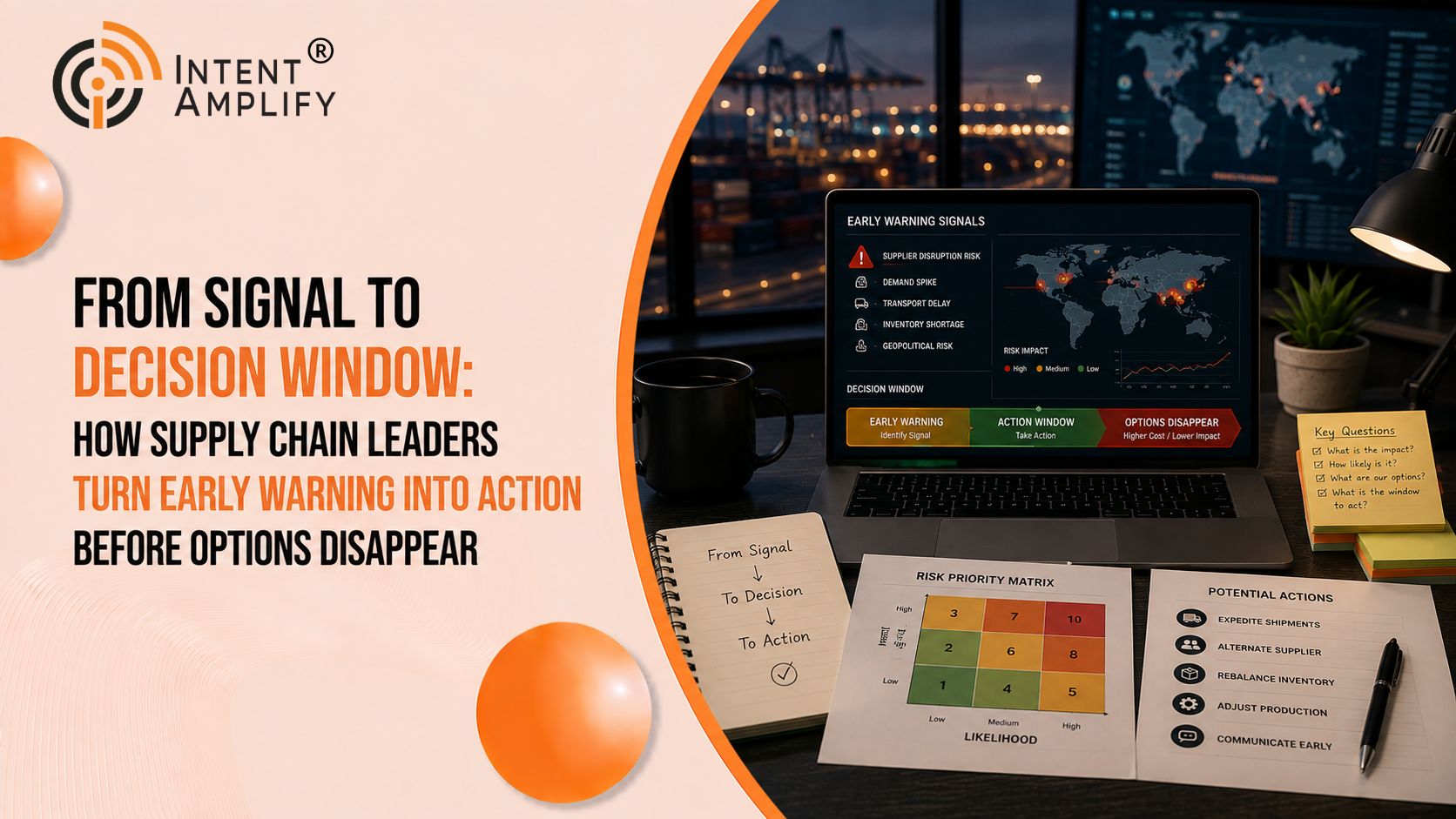
The executive objective is therefore to protect the decision window: the period between the first reliable indication that conditions have changed and the point at which the organization’s feasible response options materially narrow. The longer that window remains open, the more choices leaders can evaluate. The shorter it becomes, the more the organization is forced into expensive, reactive moves.
This whitepaper presents a practical operating model for protecting that window. It focuses on five connected capabilities: earlier signals, a trusted data layer, risk translation, explicit decision ownership, and execution readiness. Together, they create a supply chain that can respond intelligently even when perfect information does not exist.
THE NEW EXECUTIVE PROBLEM: DECISION TIME, NOT JUST FORECAST ACCURACY
For decades, planning disciplines have rewarded accuracy. Better demand forecasts, tighter inventory plans, more precise capacity models, and more detailed network assumptions all remain valuable. But persistent volatility creates a structural limitation: even a high-quality forecast is a representation of expected conditions at a point in time. When those conditions change, the value of the forecast depends on how quickly the organization can recognize the change and reframe its decisions.
This is why supply chain decision making has become an executive operating capability rather than a planning sub-process. The issue is not whether teams can generate more information. Most enterprises already have large volumes of operational data. The issue is whether that information creates enough shared understanding to support a timely decision.
Consider a shipment that is still at origin when an emerging capacity constraint becomes visible. If the organization detects the constraint early, it may still have routing, mode, consolidation, prioritization, or inventory options. If the same issue is identified after cargo is committed, those options can shrink rapidly. The business has not merely lost time; it has lost choice.
The decision-ready model treats choice as a strategic asset. Leaders should ask three questions whenever conditions change: What changed? What is at risk? What can we still do about it? These questions are deliberately simple because they force the organization to move from observation to consequence to action.
DEFINE THE DECISION WINDOW
A decision window begins when a signal is credible enough to merit attention. It closes progressively as operational commitments, lead times, capacity constraints, contractual conditions, or customer requirements remove alternatives.
Not every signal deserves escalation. A decision-ready organization distinguishes noise from material change by linking signals to predefined business exposures. For example, a port condition becomes decision-relevant when it threatens a customer promise, production requirement, inventory position, cost threshold, or service objective. The signal alone is not the decision. Its business consequence is what creates urgency.
This framing helps executives avoid two common failures. The first is dashboard saturation, where teams monitor more indicators without improving response. The second is alert fatigue, where every deviation appears urgent and decision owners become overwhelmed. The solution is not fewer data sources by default. It is clearer rules for translating data into business significance.
A practical decision-window design should identify the signal, affected flow or node, business exposure, latest useful decision point, accountable owner, approved response paths, and execution dependencies. This creates a repeatable bridge between visibility and action.
EARLIER VISIBILITY CREATES OPTIONS ONLY WHEN IT IS ACTIONABLE
Supply chain visibility is often discussed as an end state: more tracking, more milestones, more dashboards, more real-time feeds. Decision readiness treats visibility differently. Visibility is valuable when it changes the timing or quality of a decision.
Earlier visibility at origin is especially important because origin is where many options remain available. Before freight is committed to a constrained path, teams may be able to change bookings, prioritize orders, rebalance inventory, adjust mode, sequence production, or coordinate with suppliers and customers. Once downstream commitments accumulate, the same disruption can become more expensive to address.
This is why executives should evaluate visibility investments against an “option creation” test. Does the signal arrive early enough to change an operational choice? Does it identify what is affected? Can it be connected to customer, inventory, production, or financial exposure? Does a named role receive it with authority to act? Can the chosen response be executed through existing operating processes?
If the answer to those questions is no, additional visibility may improve awareness without improving outcomes. Decision-ready visibility is therefore not about seeing everything. It is about seeing the right change early enough to preserve meaningful options.
BUILD A DATA LAYER THAT SUPPORTS DECISIONS, NOT ANOTHER VIEW OF THE PROBLEM
The campaign premise is clear: more data does not automatically lead to better or faster decisions. Fragmented data can actually increase decision friction. Teams debate whose number is correct, reconcile different identifiers, interpret conflicting milestones, and spend critical time reconstructing context.
A decision-ready supply chain needs a strong data layer that creates shared operational meaning. This does not require every source to become identical. It requires enough consistency that decision makers can trust the relationship between a signal and the business object it affects.
Executives should prioritize a small set of foundational questions. Can the organization connect shipment, order, inventory, supplier, location, customer, and service data where needed? Are critical milestones defined consistently? Can teams distinguish event time from data-receipt time? Are exceptions associated with the relevant business exposure? Can the organization trace the source and freshness of decision-critical data?
The goal is not a perfect enterprise data program before action begins. The goal is a reliable decision context. When a disruption occurs, leaders should not need a manual data-reconciliation project before they can decide.
TRANSLATE SIGNALS INTO RISK
Early warning becomes strategically useful when it is translated into risk. That translation should answer: what could happen if we do nothing, how soon could the impact occur, which commitments are exposed, and what response options remain?
This is where supply chain risk management and operational decision making intersect. Traditional risk registers can identify categories of exposure, but a decision-ready operating model connects emerging conditions to current flows and commitments. The emphasis shifts from static risk description to time-sensitive risk interpretation.
A practical approach is to classify exceptions by consequence rather than by data source. A carrier update, supplier delay, geopolitical development, weather event, capacity change, or demand shift may originate in different systems, yet all can affect the same executive outcomes: continuity, customer service, working capital, margin, or strategic commitments.
By organizing around consequences, teams can establish decision thresholds. Some exceptions can remain within standard operating procedures. Others require cross-functional coordination. A smaller set requires executive intervention because the exposure is material, the options are narrowing, or the decision crosses functional boundaries.
MAKE DECISION OWNERSHIP EXPLICIT
One of the most expensive forms of supply chain latency is organizational ambiguity. Teams may know that a condition has changed but still lose time determining who can approve a response. Visibility without ownership creates a queue.
Decision ownership should be designed before disruption occurs. For recurring decision classes, organizations can define the accountable role, required inputs, authority limits, escalation path, and expected response time. The objective is not to centralize every decision. It is to place decisions at the lowest level that has the information and authority to act responsibly.
Executives should distinguish three roles. The signal owner validates that a meaningful change has occurred. The decision owner evaluates the business trade-off and selects a response. The execution owner translates that response into operational action and confirms completion. In some situations one person may hold multiple roles, but the responsibilities should remain explicit.
This structure also improves accountability after the event. Instead of asking why “the organization” responded slowly, leaders can identify whether latency occurred in detection, interpretation, decision, approval, or execution.
USE AI AS DECISION SUPPORT, NOT AS A SUBSTITUTE FOR ACCOUNTABILITY
AI can strengthen decision readiness when its role is bounded and practical. Three roles are especially useful.
First, AI can help detect and prioritize signals by identifying patterns, anomalies, or combinations of events that merit attention. Second, it can help assemble decision context by connecting relevant operational information and summarizing what is affected. Third, it can support option evaluation by comparing scenarios, constraints, and likely trade-offs.
These roles do not eliminate the need for decision ownership. AI output should be treated as decision support whose quality depends on data, context, governance, and the consequences of the decision. High-impact actions still require appropriate human accountability and operational controls.
The executive opportunity is to reduce the time teams spend searching, reconciling, and assembling context so they can spend more time evaluating trade-offs. The strongest AI use case is not “make the supply chain autonomous.” It is “make the decision process faster, clearer, and more consistent where automation is appropriate.”
CONNECT THE DECISION TO EXECUTION
A decision has no operational value until it changes what the network does. This is the final and often overlooked link in decision readiness.
Organizations should map common decisions to executable playbooks. A playbook does not need to prescribe one response. It should identify available actions, required approvals, system steps, partner coordination, customer communication, and confirmation criteria. The purpose is to reduce avoidable execution friction after a decision is made.
For example, a routing decision may require changes across booking, transportation management, warehouse instructions, supplier communication, financial approval, and customer commitments. If those dependencies are discovered only after the decision, the apparent speed of decision making can be misleading.
Decision-ready execution therefore measures end-to-end response time, not meeting time. The clock stops when the chosen action is operationally committed and visible to the relevant stakeholders.
THE EXECUTIVE OPERATING MODEL
A decision-ready supply chain can be organized around a six-step loop:
Detect: identify a material change early.
Contextualize: connect the signal to affected orders, inventory, capacity, customers, or commitments.
Assess: determine what is at risk and how quickly options are narrowing.
Decide: assign the accountable owner and select the response.
Execute: translate the decision into operational actions across systems and partners.
Learn: review where time was lost and improve thresholds, data, playbooks, or authority.
This loop should be embedded into normal operations rather than reserved for crisis management. Persistent volatility means decision readiness is a daily management discipline.
MEASURE WHAT MATTERS: DECISION LATENCY AND OPTION PRESERVATION
Traditional supply chain KPIs remain important, but decision readiness requires additional operational measures. Leaders can track signal-to-awareness time, awareness-to-owner time, owner-to-decision time, decision-to-execution time, percentage of material exceptions with a named owner, percentage of recurring decisions covered by playbooks, and percentage of exceptions detected before the last useful decision point.
These measures do not require invented benchmarks. Each organization should establish its own baselines from verified operational data and improve from there. The important shift is to make latency visible. When leaders can see where decision time is being consumed, they can improve the operating system rather than simply urging teams to “move faster.”
A 90-DAY EXECUTIVE ACTION AGENDA
DAYS 1–30: MAP THE DECISION PATH
In the first 30 days, identify a small number of high-value decision classes where volatility frequently creates cost, service, or continuity exposure. Map the current signal-to-execution path and document where ownership, data, or authority is unclear.
DAYS 31–60: DEFINE OWNERSHIP AND RESPONSE RULES
In days 31–60, define decision thresholds, owners, minimum data requirements, escalation rules, and response playbooks. Prioritize the data connections that materially reduce ambiguity. Do not begin with a broad technology replacement unless evidence shows it is required.
DAYS 61–90: MEASURE AND REFINE
In days 61–90, instrument the process. Measure decision latency, review exceptions, and identify where options were lost before action. Use those findings to refine visibility, AI support, data quality, and execution workflows.
VISIBILITY AND AWARENESS: THE EXECUTIVE COMMUNICATION LAYER
Decision readiness also depends on how clearly material change is communicated. Executives do not need a larger stream of operational alerts. They need a concise view of the decisions that are forming: what changed, which commitment is exposed, how much time remains, what options are still feasible, and who owns the next choice.
This communication layer turns visibility into organizational awareness. It allows planning, logistics, procurement, customer, finance, and leadership teams to work from the same decision context without requiring every stakeholder to interpret raw operational data.
A useful executive brief should separate verified facts from assumptions, identify the freshness of decision-critical information, and make unknowns explicit. That discipline improves trust and prevents urgency from turning uncertainty into false certainty.
For recurring decision classes, the format can be standardized. The result is faster comprehension, more consistent escalation, and a clearer record of why a choice was made. Awareness becomes part of the operating model rather than an accidental outcome of who happened to see an alert.
CONCLUSION: PROTECT THE ABILITY TO CHOOSE
The most resilient supply chains will not be those that predict every disruption. They will be those that preserve the ability to choose when conditions change.
Decision readiness is the operating discipline that protects that ability. It combines earlier signals with trusted context, clear ownership, practical AI support, and executable response paths. The result is not perfect information. It is something more useful in a volatile environment: enough understanding, authority, and time to act before constraints become costly.
For executives, the mandate is straightforward. Stop measuring visibility only by how much the organization can see. Measure it by how much decision time it creates. Stop treating data volume as a proxy for intelligence. Measure whether teams can establish shared context quickly. Stop treating a decision as complete when a meeting ends. Measure whether the network actually changed.
A decision-ready supply chain is built around one strategic question: when reality changes, how much meaningful choice remains? Organizations that can answer that question early—and act on it consistently—will be better positioned to navigate uncertainty without waiting for perfect information.
REFERENCES
- APL Logistics. “Order Planning: Managing Your Supply Chain in the Age of Disruption.” May 20, 2024. Perspective on proactive order planning, earlier visibility and resilient decision-making. https://www.apllogistics.com/2024/05/order-planning-managing-your-supply-chain-in-the-age-of-disruption
- APL Logistics. “Supply Chain Visibility: What Does It Really Mean?” April 26, 2023. Perspective on visibility, event context and actionable supply-chain information. https://www.apllogistics.com/2023/04/supply-chain-visibility-what-does-it-really-mean
- Port of Los Angeles. “Port Optimizer™.” Digital infrastructure integrating port ecosystem data to support planning and response to dynamic conditions. https://www.portoflosangeles.org/business/supply-chain/port-optimizer
- Gartner. “Supply Chain Leaders Should Prioritize Advanced Data Visibility and Scenario Planning to Drive Competitive Advantage Amid Global Uncertainty.” May 19, 2025. https://www.gartner.com/en/newsroom/press-releases/2025-05-19-gartner-says-supply-chain-leaders-should-prioritize-advanced-data-visibility-and-scenario-planning-to-drive-competitive-advantage-amid-global-uncertainty
- McKinsey & Company. “Supply chains: Still vulnerable.” October 14, 2024. Research on supply-chain risk, visibility, planning and response execution. https://www.mckinsey.com/capabilities/operations/our-insights/supply-chain-risk-survey-2024
- NIST. “Artificial Intelligence Risk Management Framework (AI RMF 1.0).” January 2023. Framework for trustworthy and accountable AI risk management. https://www.nist.gov/itl/ai-risk-management-framework
- IntentTechPub. “The Decision-Ready Supply Chain.” Campaign page for APL Logistics, IA-168 - 26-08-001. https://intenttechpub.com/ebook/the-decision-ready-supply-chain/?mtm_campaign=APL_logistics&mtm_kwd=supply_chain_now&mtm_source=website&mtm_medium=cta_download_now&mtm_content=website&mtm_cid=IA_168_26_08_001&mtm_group=ebook&mtm_placement=marketing