
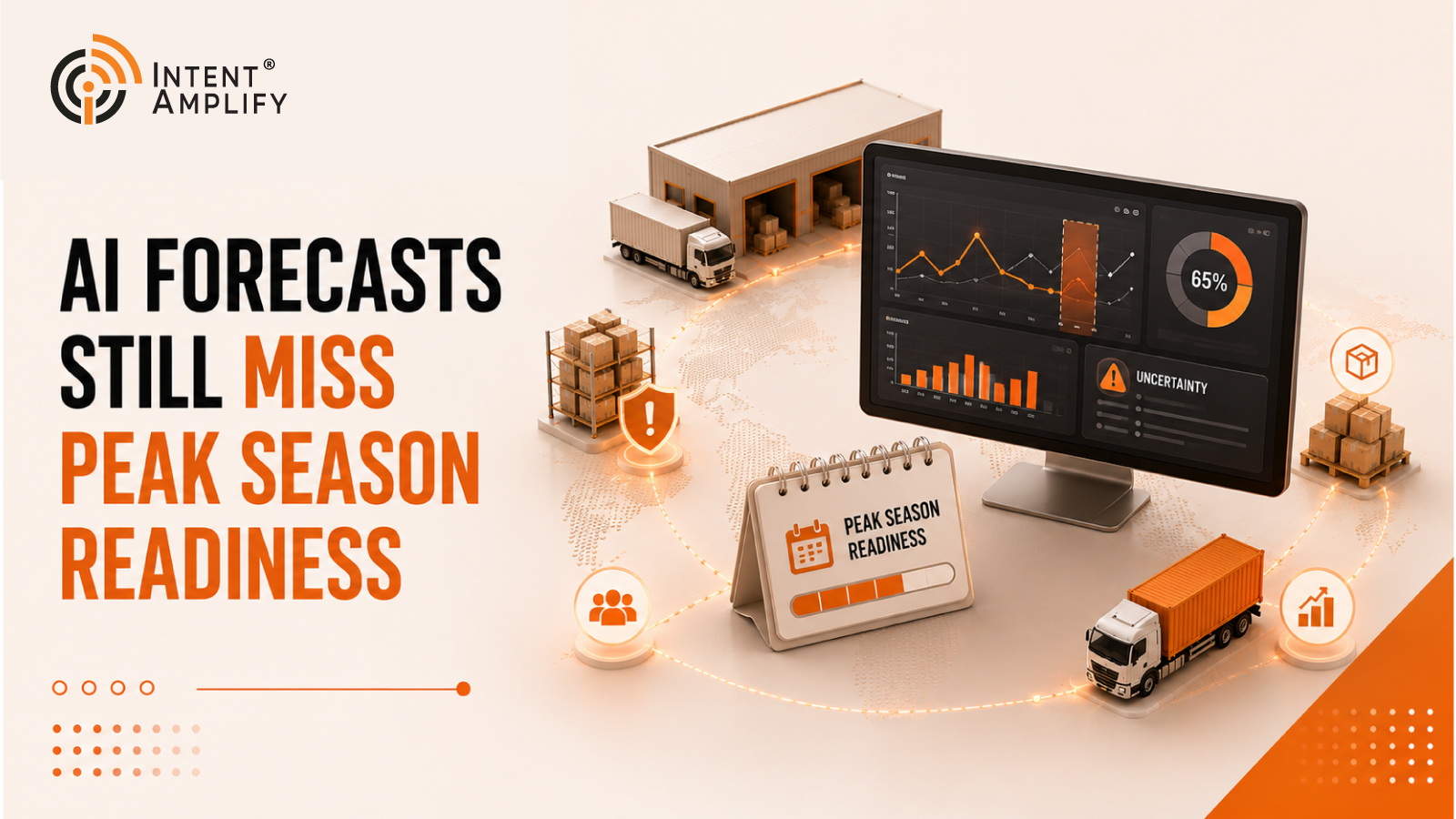
AI forecasting has become one of the most important planning tools for supply chain and logistics leaders. It can detect demand patterns earlier, compare scenarios faster, and help teams understand where pressure may build before peak season arrives.
But a forecast is not the same as readiness.
That distinction matters heading into Peak 2026. Shippers are not only asking what demand may look like. They are asking whether their operating model can respond when the forecast changes, when inventory sits in the wrong place, when carrier capacity tightens, or when customer expectations move faster than the fulfillment network.
The teams that perform best during peak season are usually not the teams with the most confident prediction. They are the teams that know what to do when the prediction becomes imperfect.
AI can signal demand. It cannot own the operating response.
AI demand models are useful because they help teams see patterns that manual planning can miss. They may surface regional demand shifts, category-level volatility, fulfillment timing risk, or early signals that a promotion, market condition, or customer behavior is moving differently than expected.
Those signals can improve planning quality. They can also create a false sense of certainty if leaders treat the model as the plan.
Peak season readiness still depends on practical operating choices: where inventory is positioned, how carrier capacity is allocated, which service levels are protected, how exceptions are handled, and who has authority to make tradeoffs when conditions change.
A forecast can tell a team where pressure may appear. It cannot automatically answer whether the warehouse has enough labor coverage, whether replenishment timing is realistic, whether customer communication needs to change, or whether a late carrier constraint should trigger a different routing decision.
That is why AI forecasting needs to be connected to operational decision-making, not reviewed as a separate analytics exercise.
Four readiness gaps AI forecasts can expose but not solve
1. Inventory placement
A forecast may show rising demand in a region or product category, but readiness depends on whether inventory can be moved, replenished, or substituted before service levels are affected. Leaders need to pressure-test whether inventory is close enough to demand, whether replenishment timing is realistic, and where stockout or overstock risk could create avoidable friction.
2. Carrier and fulfillment capacity
Demand visibility does not guarantee execution capacity. If volume rises in a constrained lane, facility, or delivery window, teams need escalation rules and backup options before service risk becomes visible to customers. The readiness question is not only whether the team sees pressure coming. It is whether capacity decisions are already mapped to likely scenarios.
3. Scenario ownership
Many peak plans describe scenarios without defining decision ownership. That creates delay when conditions change. A stronger plan names the owner for routing decisions, customer communication, inventory allocation, exception handling, and service-level tradeoffs. Without that ownership, forecast signals can become meeting topics instead of operating actions.
4. Customer communication
Peak season planning is not only an internal logistics exercise. Customers experience the plan through delivery promises, order visibility, returns, support interactions, and issue resolution. If forecast signals suggest possible disruption, teams need to decide when and how communication should change. Waiting until pressure is already visible can narrow the response window.
From prediction to preparation
The most useful peak-season planning conversation starts with three questions:
What does the forecast suggest could happen?
What operating decision would we make if that scenario became real?
What evidence would tell us to act before the window closes?
This is where AI models, analyst expectations, and shipper experience become stronger together. AI can highlight early signals. Analysts can frame broader market context. Shippers can identify the operational constraints that determine whether a plan works in practice.
For Peak 2026, logistics leaders should use forecasting as a readiness input, not as the final answer. That means connecting data signals to inventory planning, fulfillment capacity, carrier strategy, exception handling, customer communication, and decision rights.
The goal is not to predict every disruption. It is to reduce the number of decisions that have to be invented under pressure.
A practical readiness check for Peak 2026
Before the busiest shipping window arrives, leaders should ask:
Are the highest-risk demand scenarios tied to clear operating actions?
Are inventory placement decisions reviewed against regional demand signals?
Are carrier and fulfillment constraints mapped to response options?
Are customer communication triggers defined before disruption occurs?
Are decision owners named for the moments when speed matters?
Is the team measuring whether source, channel, and campaign data are captured cleanly enough to evaluate performance later?
If the answer is unclear, the issue may not be forecasting maturity. It may be operating readiness.
Join the discussion
EasyPost's Peak Reality Check 2026: What Shippers, Analysts, and AI Models Are Predicting is designed for supply chain, logistics, fulfillment, operations, product, technology, healthcare, pharma, and executive leaders preparing for Peak 2026.
The session will examine how teams can compare AI demand signals, analyst outlooks, and real-world shipper constraints before peak pressure rises.
Reserve your seat for the webinar and bring one planning assumption your team needs to pressure-test before Peak 2026.