
logo
logo

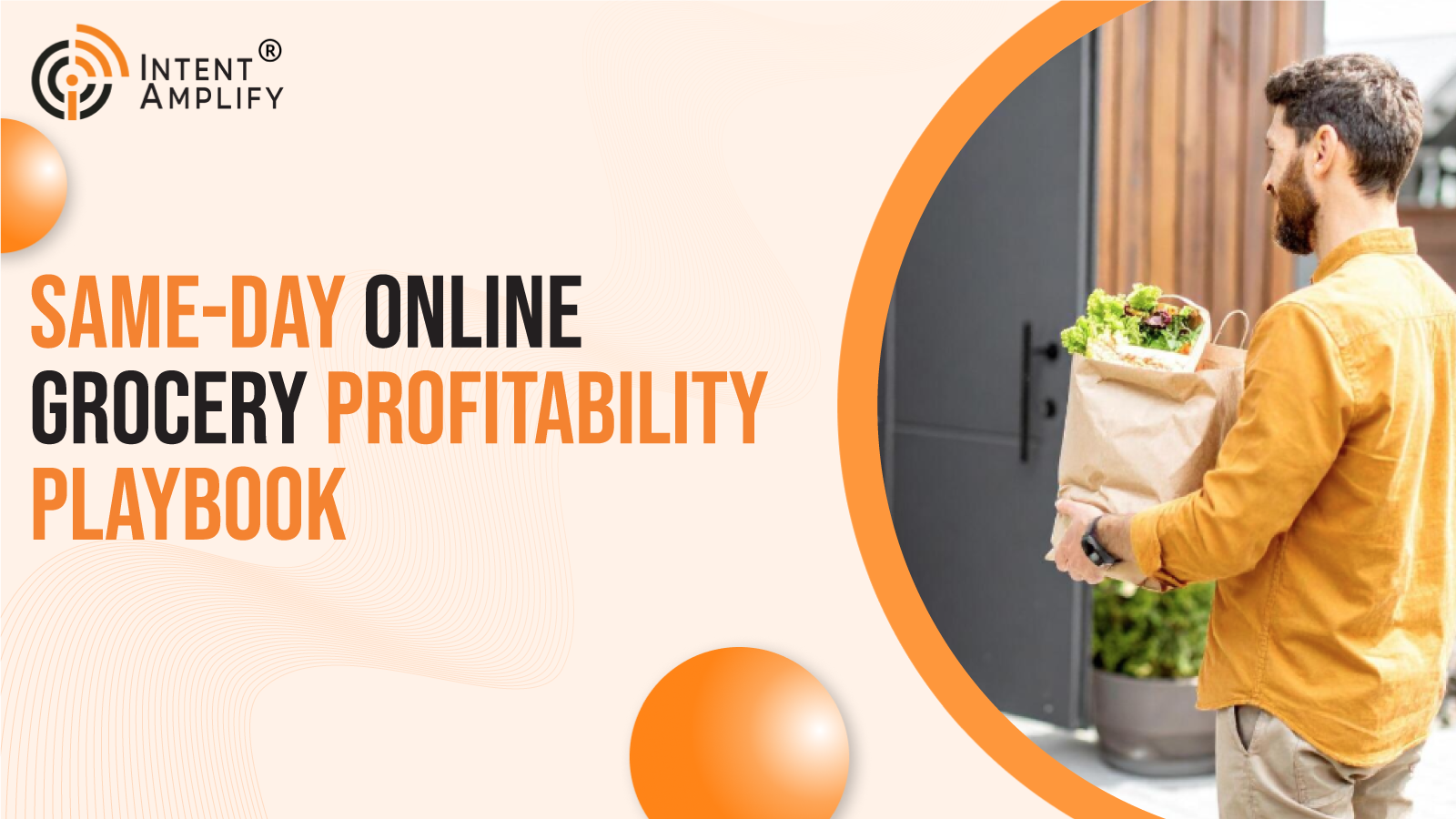
The Same-Day Online Grocery Profitability Playbook: A Mechanic-By-Mechanic Operating Model From Inbound Inventory to the Customer Doorstep

Discover a mechanic-by-mechanic operating model for profitable same-day online grocery. Learn to align customer promise, fulfillment, routing, and economics from inbound inventory to the doorstep.

The Same-Day Online Grocery Profitability Playbook: A Mechanic-By-Mechanic Operating Model From Inbound Inventory to the Customer Doorstep

Executive Brief

Same-day online grocery is not one operating capability. It is a chain of promises and decisions that begins with inbound stock and ends with a complete, on-time order at the customer doorstep. Profitability depends on how customer demand, basket economics, inventory, picking, packing, dispatch, routing, and recovery work together.

RETHINK Retail’s mechanic-by-mechanic session follows one grocery item through that full chain, connecting demand and workforce planning, automated material flow, real-time routing, and last-mile capacity. [1] This eBook converts that operating view into a practical profitability model for ecommerce, operations, supply chain, logistics, finance, product, and strategy leaders.

The central argument is simple: a fast promise becomes commercially durable only when each accepted order fits the retailer’s inventory, labor, node, route, and customer economics. Speed is an output of the system. It should not be treated as the system itself.

Central Argument

Same-day grocery becomes durable when speed is treated as the governed output of customer promise, inventory, fulfillment, route, and order economics - not as an isolated delivery target.

Same-Day Grocery Economics by the Mechanics

McKinsey’s North American analysis shows why fulfillment design matters: picking and delivery can be major incremental costs in online grocery, and different store, micro-fulfillment, dark-store, and warehouse configurations create different economic envelopes. [2] The published basket assumptions are illustrative, not a universal benchmark.

Peer-reviewed research using transaction data from a major grocery retailer finds that delivery fees, assortment size, network characteristics, customer choice, and operational costs should be evaluated together when designing a profitable multichannel service. [3] This means commercial policy and operations cannot be optimized in separate models.

Research on rapid omnichannel grocery fulfillment integrates order-processing cost, vehicle routing, and delivery capacity across stores and distribution centers. [4] Studies of delivery slots and same-day routing similarly show that capacity offers, pricing, and routing decisions should account for the marginal effect of each accepted order. [7] [8] [9]

USDA’s nationally representative U.S. analysis confirms that online grocery serves identifiable customer needs and that pickup and delivery are both meaningful fulfillment modes. [6] Demand is real; the profitability question is which promise, customer mission, basket, node, and route combination can be served repeatedly.

Independent Evidence Base

The evidence base combines the official campaign source, government research, peer-reviewed operations and retail journals, university research repositories, and a clearly scoped consulting analysis. The research does not present a new primary survey, and it does not generalize one retailer’s cost structure to the whole market.

Official and peer-reviewed sources are used to examine fulfillment economics, customer choice, substitution, slot management, dynamic routing, revenue models, future customer behavior after failures, and advance ordering for perishables. [2] [3] [5] [7] [8] [9] [10] [11] [12]

Quantitative findings retain their study context. The operating framework, scorecard, maturity path, and recommendations are proprietary Intent Amplify analysis derived from the combined evidence and are not presented as independent market findings.

Why Speed-First Models Stall

A speed-first model starts with a delivery promise and attempts to make the operation comply. It may increase order acceptance while hiding the conditions that determine contribution: basket size, margin, distance, slot density, inventory accuracy, pick productivity, packing effort, courier supply, and recovery exposure.

The model also divides one customer promise across functions. Ecommerce owns conversion, merchandising owns assortment, supply chain owns inbound and inventory, store or fulfillment teams own picks, logistics owns dispatch and routes, finance owns contribution, and service teams own failures. Without one evidence chain, each function can improve its own metric while total economics deteriorate.

The result is not necessarily poor demand or poor execution. It is an unstable promise. Orders may be accepted before the operation has confirmed whether the basket is available, the fulfillment node is productive, the slot is route-feasible, or the customer economics can absorb failure and recovery.

What Customers Buy and What Operations Must Deliver

Customers are not buying speed in isolation. They are buying confidence that the products they selected are available, substitutions are acceptable, the chosen slot is credible, cold and frozen items remain protected, and problems will be resolved without unnecessary effort.

USDA research identifies convenience and time constraints among the reasons people use online grocery. [6] Research on substitution policy shows that customer acceptance varies by purchase history and category attributes, which means one blanket substitution rule can weaken both experience and economics. [5]

The retailer therefore creates four connected forms of value: promise value, basket value, fulfillment value, and recovery value. A service can be strong in one and weak in another. Leadership should manage the combined proposition rather than assume that a faster delivery window compensates for missing items, poor substitutions, or unreliable handoffs.

Table 1. Four Forms of Same-Day Grocery Value

Value Dimension

Customer Question

Operating Evidence

Decision Guardrail

Promise Value

Will the service meet the mission and time window I selected?

Eligibility, service area, slot, fee, workload, and capacity rules.

Do not offer a speed tier when inventory, pick, dock, route, or courier capacity is outside threshold.

Basket Value

Can I obtain the products and substitutes that make the order worthwhile?

Assortment, stock accuracy, substitution logic, refund rules, and order-level contribution.

Do not expand range without testing availability, pick complexity, margin, and failure exposure.

Fulfillment Value

Can the retailer pick, pack, stage, dispatch, and deliver the order reliably?

Node role, pick and pack standards, cold chain, slot feasibility, route plan, and handoff controls.

Do not treat local throughput as proof of end-to-end capacity.

Recovery Value

Will the retailer resolve an exception fairly and protect the next relationship decision?

Communication, substitution choice, refund or credit, root cause, recovery cost, and future behavior.

Do not measure closure only by ticket resolution; include order economics and later customer response.


The Intent Amplify Same-Day Grocery Profitability Operating Model™

Intent Amplify Same-Day Grocery Profitability Operating Model™

Eight operating layers connecting the customer promise to order-level contribution

01

Customer Promise & Demand Shape

Define the service promise by mission, geography, basket, time window, and willingness to pay; translate forecast demand into workload and capacity.

02

Basket, Price & Fee Economics

Track contribution by basket after product margin, pricing, delivery fees, membership economics, promotions, payment, picking, packaging, and delivery.

03

Assortment, Availability & Substitution

Design an online assortment that can be fulfilled reliably; govern inventory accuracy, availability disclosure, substitution logic, and refund exposure.

04

Inbound, Inventory & Replenishment

Synchronize supplier arrivals, replenishment, perishability, shelf life, storage, and order demand so promised stock is physically available.

05

Picking, Packing & Material Flow

Choose the right node and degree of automation; manage pick path, batching, ergonomics, cold chain, consolidation, staging, and handoff.

06

Slotting, Dispatch & Real-Time Routing

Offer delivery slots and dispatch decisions that reflect marginal route cost, loading time, traffic, order density, and remaining fleet flexibility.

07

Last-Mile Capacity & Service Recovery

Plan couriers and vehicles by interval; protect on-time delivery, temperature, substitutions, communication, refunds, and exception recovery.

08

Profitability Control & Continuous Learning

Use order-level P&L, promise accuracy, capacity utilization, failure cost, cohort behavior, and test results to improve the operating model.

Figure 1. Intent Amplify Same-Day Grocery Profitability Operating Model™ - Eight-Layer Architecture

Table 2. Seven-Stage Decision and Execution Model

Stage

Leadership Question

Required Evidence

Primary Owner

1. Define

Which customer mission and service promise are we supporting?

Mission, geography, basket, time window, fee, eligibility, and decision owner.

Ecommerce / Commercial

2. Forecast

What workload and capacity will accepted demand create?

Order profile, interval forecast, units, zones, substitutions, labor, dock, route, and error bands.

Planning / Operations

3. Design

Which assortment, node, process, and automation fit the cohort?

Availability, replenishment, fulfillment node economics, pick path, packing, staging, and capital criteria.

Supply Chain / Fulfillment

4. Offer

Which slots and prices can be shown without weakening future capacity?

Slot inventory, marginal route cost, customer choice, traffic, service time, and fleet flexibility.

Product / Logistics

5. Execute

Can the order move from pick release to doorstep through controlled handoffs?

Work queue, exception rules, cold chain, dispatch, route updates, courier communication, and proof of delivery.

Operations / Last Mile

6. Reconcile

What did the complete order contribute and what failed?

Margin waterfall, promised and actual service, short picks, substitutions, refunds, credits, and recovery.

Finance / Analytics

7. Learn

What changes in the promise, rules, capacity, or investment?

Cohort analysis, experiment results, root cause, action owners, and completion evidence.

Executive Operating Team

Customer Promise and Demand Shape

The service promise should begin with customer mission, geography, basket, time window, and willingness to pay. A top-up order, an urgent forgotten item, and a weekly household shop create different order profiles and should not automatically receive the same assortment, fee, or speed.

Demand planning should translate order forecasts into the work those orders create: units per order, temperature zones, likely substitutions, pick paths, packing stations, dock movements, vehicle requirements, and courier intervals. This connects customer demand to workforce and capacity before slots are released.

USDA’s evidence supports segmentation of online grocery usage rather than a single generic online shopper. [6] Intent Amplify recommends maintaining a service catalog that states eligibility, customer value, expected workload, operating boundary, and approval owner for every service tier.

Assortment, Availability, and Fulfillment Design

Online assortment is an operating decision. Every additional item can increase customer choice, but it can also add inventory uncertainty, pick-path complexity, replenishment work, substitute exposure, and packing variation. Research on multichannel profitability explicitly connects assortment size with customer choice and operating cost. [3]

The retailer should document which items qualify for same-day service, where the stock signal originates, how frequently it updates, which substitutions are allowed, and when the promise should be withdrawn. Substitution research shows that context matters; customer history and category characteristics should inform the policy. [5]

Fulfillment design should match demand density, service radius, assortment, labor, and capital. Store picking, micro-fulfillment, dark stores, and larger automated nodes can coexist when each has a defined role and transfer rules. [2] The question is not which fulfillment node is universally best. It is which fulfillment node can fulfill a given order cohort at the required service and contribution.

Order Economics and Profitability Control

Order-level contribution is product gross margin plus allocated commercial revenue, less the incremental costs of payment, picking, packing, staging, delivery, refunds, substitutions, and service recovery. The minimum record also captures promotions, packaging, promised and actual service, and the assumptions used to allocate fees or membership revenue.

Research on delivery fees and multichannel profitability [3], online grocery revenue models [10], and advance ordering for perishables [12] demonstrates why commercial terms, order frequency, geography, routing scale, basket characteristics, inventory, spoilage, and fulfillment cost belong in the same analysis.

An average channel margin can be directionally useful but insufficient for decisions. Leaders need to know which combinations of mission, basket, geography, slot, node, and failure type create or destroy contribution, and whether the result changes after repeat behavior is considered.

Slotting, Routing, and Last-Mile Capacity

Delivery slots are perishable capacity. Research on attended home delivery shows that slot offers should balance customer service with cost-effective routing. [7] Differentiated slot pricing research adds customer choice and anticipated routing cost to the decision. [8]

Same-day delivery creates a dynamic problem because each accepted order consumes vehicle and route flexibility that may be needed by later demand. Research on dynamic pricing and routing evaluates anticipatory decisions designed to protect that flexibility. [9]

The operating response is a shared slot and dispatch engine. It should consider pick completion, dock capacity, route density, traffic, service time, vehicle or courier supply, cold-chain limits, and future demand. Commercial teams can still offer choice, but the offer should reflect the real marginal capacity position.

Service Recovery, Governance, and Learning

Failures should be treated as economic and behavioral events, not only as customer-service tickets. Research finds that out-of-stocks, partial fulfillment, refunds, and substitutions can affect the timing and value of later online orders. [11] Recovery policy should therefore reflect both immediate cost and future customer behavior.

Governance assigns owners for demand, assortment, inventory, substitutions, pick design, automation, slot release, dispatch, route changes, cold chain, communication, refunds, and contribution reconciliation. Material rule changes must be traceable.

Service should be reviewed alongside economics. Useful measures include promise accuracy, on-time and in-full delivery, inventory-related failure, substitution acceptance, cost per order, route density, courier utilization, recovery cost, repeat-order timing, and closure of improvement actions.

A Practical Implementation Roadmap

  • Segment the promise by mission, geography, basket, time window, and willingness to pay.
  • Translate demand into interval-level inbound, pick, pack, dock, and courier capacity.
  • Build the order-level contribution waterfall and define loss-making cohort thresholds.
  • Align digital assortment, stock accuracy, replenishment, and substitution rules.
  • Map order cohorts to stores, micro-fulfillment, dark stores, or distribution centers by total economics.
  • Integrate slot release, dispatch, routing, and last-mile capacity into one control loop.
  • Review failure cost, future customer behavior, and completed improvement actions with operational performance.

Same-Day Grocery Profitability Scorecard™

Intent Amplify Same-Day Grocery Profitability Scorecard™

Table. Intent Amplify Same-Day Grocery Profitability Scorecard™

Domain

Executive Assessment Question

Ready-State Evidence

Service Promise Discipline

Is the speed promise segmented by customer mission, geography, basket, fee, and operational feasibility?

Promise catalog, service-area rules, lead-time tiers, price/fee logic, and named approval owners.

Demand & Workforce Planning

Can forecast demand be translated into inbound, pick, pack, dock, and courier requirements by interval?

Forecast hierarchy, order-profile assumptions, workload plan, staffing model, error bands, and capacity thresholds.

Basket Economics

Does each order type have a transparent contribution view after all incremental costs and commercial offsets?

Order-level P&L, margin waterfall, fee and membership treatment, promotion cost, and breakeven thresholds.

Assortment & Availability

Can the online range be fulfilled with accurate stock, controlled substitutions, and visible customer choices?

Assortment rules, inventory accuracy, availability disclosure, substitution policy, and refund/short-pick tracking.

Inventory & Replenishment

Are inbound timing, shelf life, replenishment, and freshness aligned to same-day demand?

Supplier and inbound plan, freshness controls, replenishment triggers, waste measures, and inventory aging.

Picking & Packing

Are pick path, batching, packing, consolidation, staging, and handoff designed for cost, quality, and speed?

Engineered standards, units per labor hour, error and damage rates, temperature controls, and queue visibility.

Automation & Material Flow

Is automation deployed where volume, density, assortment, and process stability justify it?

Node business case, throughput envelope, utilization, exception handling, maintenance plan, and human-work design.

Slot & Route Economics

Do slot availability, pricing, dispatch, and routing protect route density and remaining capacity?

Marginal-cost logic, slot controls, route plan, loading assumptions, travel-time feedback, and dispatch audit trail.

Last-Mile Reliability

Can the operation meet the promise and recover transparently when stock, capacity, traffic, or quality conditions change?

On-time and in-full measures, courier plan, cold-chain evidence, exception playbooks, communication, and recovery cost.

Profitability Governance

Do leaders review contribution, service, failure cost, customer behavior, and improvement actions together?

Executive dashboard, decision rights, experiment register, action owners, investment gates, and closed-loop reviews.

Continue the Discussion

Register for the Mechanic-by-Mechanic Session

Explore the RETHINK Retail session that follows one grocery item from inbound to the customer doorstep and examines demand and workforce planning, material flow, real-time routing, and last-mile capacity.

Register for the Session

Continue the Same-Day Grocery Profitability Journey

Move from executive education to operating assessment through one consistent content and decision path.

Stage

Asset or Offer

Purpose

Top of Funnel

Download the Same-Day Grocery Profitability Checklist

Identify the first gaps across promise design, basket economics, inventory, fulfillment, routing, and governance.

Middle of Funnel

Download the Same-Day Grocery Profitability Playbook

Apply the eight-layer operating model, control questions, implementation roadmap, and scorecard.

Decision Stage

Access the Same-Day Online Grocery Economics 2026 Research Report

Review methodology, independent evidence, operating implications, maturity progression, and executive findings.

Commercial Stage

Request a Same-Day Grocery Profitability Assessment

Evaluate order-level economics, service promise, fulfillment-node design, inventory, fulfillment, last mile, and decision controls.

Activation Stage

Schedule an Executive Operating Model Workshop

Align ecommerce, operations, supply chain, logistics, finance, product, and strategy leaders on priorities and next actions.

Conclusion

Profitable same-day online grocery is not achieved by making every activity faster. It is achieved by deciding which promise to make, which order to accept, where to fulfill it, how to preserve route flexibility, and how to learn from every failure and recovery.

The strongest operating model makes speed selective, inventory credible, capacity visible, economics granular, and accountability shared. When each mechanic is governed as part of one system, same-day becomes a repeatable service rather than an uncontrolled premium promise.

About Intent Amplify

Intent Amplify combines market intelligence, buyer-signal interpretation, content-led engagement, and precision GTM execution to help B2B organizations turn complex market themes into measurable pipeline programs. [13]

Research and Citation Governance

Official publisher, government, peer-reviewed journal, university repository, and clearly scoped consulting sources are used for campaign framing, customer demand, fulfillment economics, inventory, delivery-slot design, routing, and service-recovery claims. Quantitative findings retain their geography, date, method, and sample or modeling limits. Proprietary frameworks and recommendations are presented as Intent Amplify analysis, not as independent market findings. All URLs were checked as accessible public sources on the revision date.

References

[1] RETHINK Retail. What Profitable Same-Day Online Grocery Actually Takes: Mechanic by Mechanic - official webinar page. https://rethink.industries/video/what-profitable-same-day-online-grocery-actually-takes-mechanic-by-mechanic/. Accessed July 29, 2026. Official campaign source following one grocery item from inbound to the customer doorstep and framing the session around demand and workforce planning, automated material flow, real-time routing, and last-mile capacity. Promotional performance percentages are not used in this suite.

[2] McKinsey & Company. Achieving profitable online grocery order fulfillment. McKinsey & Company, May 18, 2022. https://www.mckinsey.com/industries/retail/our-insights/achieving-profitable-online-grocery-order-fulfillment. Accessed July 29, 2026. North American operating analysis identifying picking and delivery as major incremental fulfillment-cost drivers and comparing store picking, micro-fulfillment centers, dark stores, and warehouse configurations. Its basket economics are treated as illustrative, not universal.

[3] Fernandes, Daniela; Neves-Moreira, Fábio; Amorim, Pedro; and Fransoo, Jan C. Optimizing Online Grocery Service: from Customer Understanding to Multichannel Profitability. European Journal of Operational Research, accepted/in press, January 29, 2026. https://research.tilburguniversity.edu/en/publications/optimizing-online-grocery-service-from-customer-understanding-to-/. Accessed July 29, 2026. Peer-reviewed research using transaction data from a major grocery retailer to examine delivery fees, assortment size, network characteristics, customer choice, operational costs, and multichannel profitability.

[4] Dethlefs, Christian; Ostermeier, Manuel; and Hübner, Alexander. Rapid fulfillment of online orders in omnichannel grocery retailing. EURO Journal on Transportation and Logistics, 11, Article 100082, 2022. https://portal.fis.tum.de/en/publications/rapid-fulfillment-of-online-orders-in-omnichannel-grocery-retaili/. Accessed July 29, 2026. Peer-reviewed study of integrated rapid fulfillment across stores and distribution centers, including order-processing cost, vehicle routing, and delivery capacity. The reported cost result is specific to the study design.

[5] Hoang, Dong; and Breugelmans, Els. "Sorry, the product you ordered is out of stock": Effects of substitution policy in online grocery retailing. Journal of Retailing, 99(1), 26-45, 2023. https://www.sciencedirect.com/science/article/pii/S002243592200046X. Accessed July 29, 2026. Open-access research based on computer-simulated purchase experiments with more than 3,000 UK households across five categories, showing that substitution acceptance depends on customer purchase history and category attributes.

[6] U.S. Department of Agriculture, Economic Research Service. Who Shops for Groceries Online? Economic Research Report No. 336, September 2024. https://www.ers.usda.gov/publications/pub-details/?pubid=110065. Accessed July 29, 2026. Nationally representative U.S. analysis of online grocery use, pickup and delivery methods, shopper characteristics, and stated motivations, using the 2022 Eating and Health Module of the American Time Use Survey.

[7] Agatz, Niels; Campbell, Ann M.; Fleischmann, Moritz; and Savelsbergh, Martin. Time Slot Management in Attended Home Delivery. Transportation Science, 45(3), 435-449, 2011. https://pubsonline.informs.org/doi/10.1287/trsc.1100.0346. Accessed July 29, 2026. Peer-reviewed research on selecting delivery-slot offers that balance cost-effective routing with acceptable customer service.

[8] Klein, Robert; Neugebauer, Michael; Ratkovitch, Dimitri; and Steinhardt, Claudius. Differentiated Time Slot Pricing Under Routing Considerations in Attended Home Delivery. Transportation Science, 53(1), 236-255, 2019. https://pubsonline.informs.org/doi/10.1287/trsc.2017.0738. Accessed July 29, 2026. Peer-reviewed research integrating customer choice, differentiated slot pricing, and anticipated routing cost for an e-grocery setting.

[9] Ulmer, Marlin W. Dynamic Pricing and Routing for Same-Day Delivery. Transportation Science, 54(4), 1016-1033, 2020. https://pubsonline.informs.org/doi/10.1287/trsc.2019.0958. Accessed July 29, 2026. Peer-reviewed same-day delivery study examining anticipatory pricing and routing to protect fleet flexibility and improve the set of orders that can be served.

[10] Belavina, Elena; Girotra, Karan; and Kabra, Ashish. Online Grocery Retail: Revenue Models and Environmental Impact. Management Science, 63(6), 1781-1799, 2017. https://pubsonline.informs.org/doi/10.1287/mnsc.2016.2430. Accessed July 29, 2026. Peer-reviewed comparison of per-order and subscription revenue models, with geography, delivery expense, order frequency, and routing scale economies included in the analysis.

[11] Amorim, Pedro; Eng-Larsson, Fredrik; and Rooderkerk, Robert P. Navigating online order fulfillment failures: Impacts on future customer behavior and the role of retailer mitigation. Journal of Retailing, 101(3), 382-408, 2025. https://pure.eur.nl/en/publications/navigating-online-order-fulfillment-failures-impacts-on-future-cu/. Accessed July 29, 2026. Peer-reviewed empirical research showing that out-of-stocks, partial fulfillment, refunds, and substitutions can affect the timing and value of subsequent online grocery orders.

[12] Siawsolit, Chokdee; and Gaukler, Gary M. Offsetting omnichannel grocery fulfillment cost through advance ordering of perishables. International Journal of Production Economics, 239, Article 108192, 2021. https://ideas.repec.org/a/eee/proeco/v239y2021ics0925527321001687.html. Accessed July 29, 2026. Peer-reviewed modeling of advance-order information, perishability, replenishment, cart value, handling time, pick rate, inventory, spoilage, availability, and fulfillment economics.

[13] Intent Amplify. About Intent Amplify. https://intentamplify.com/about/. Accessed July 29, 2026. Official company description used for the About Intent Amplify section.

Download E-Book

The Same-Day Online Grocery Profitability Playbook