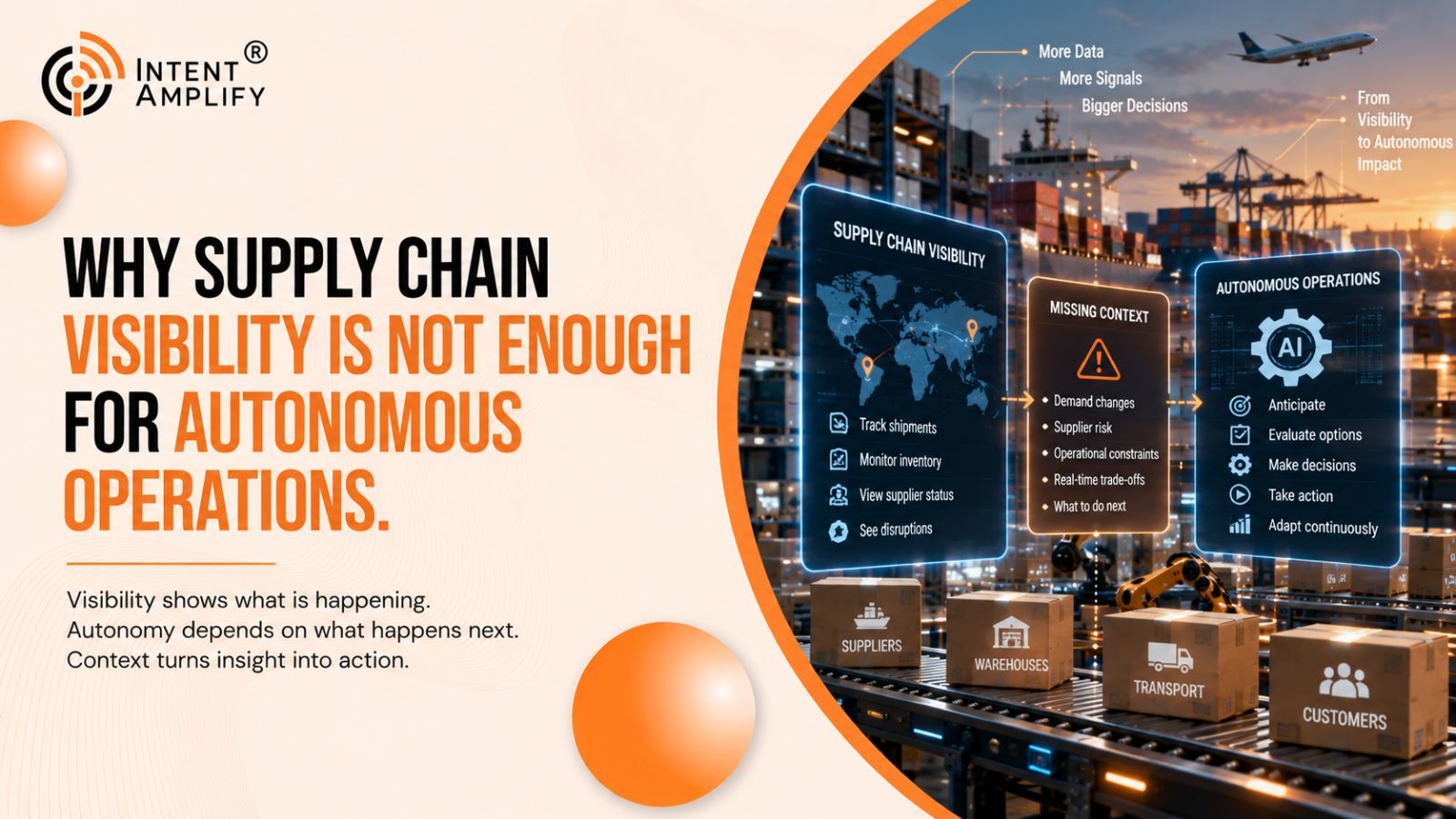

A tracking alert can show that a container has stopped moving. It cannot tell a planner which customer order to protect, whether an alternate route has capacity, or who can approve the response.
That gap explains why supply chain visibility is moving beyond tracking. Modern logistics strategy depends on converting shipment, inventory, supplier, capacity, security, and trade data into action while useful options still exist.
At a Glance
- Supply chain visibility is becoming an enterprise decision discipline connecting logistics events to customer, production, financial, security, and compliance consequences.
- Real-time visibility creates value when teams can activate alternative routing, inventory reallocation, partner escalation, and customer communication.
- Logistics analytics and artificial intelligence can improve prediction, but data quality, decision ownership, and human oversight still determine execution.
Visibility Has Reached a Strategic Inflection Point
Most large organizations no longer lack tracking data. They lack a dependable way to turn it into intervention.
FedEx’s vendor-sponsored 2026 FedEx Delivers First-Ever Future of Logistics Intelligence Report surveyed 700 senior professionals at organizations with 500 or more employees. Although 97% said visibility alone was no longer enough, only 59% used logistics data proactively to prevent problems, and just 18% said their teams could always intervene when shipments were delayed. The findings are directional, but the gap between awareness and action is strategically important. [1]
A milestone becomes useful when it is connected to an order, customer promise, inventory position, production priority, carrier capacity, and response owner. Without that context, a control tower can report disruption accurately while the business still reacts slowly.
A stronger operating model answers four questions: What changed? What is exposed? Which options are viable? Who is authorized to act?
Disconnected Data Is Slowing the Response
The information needed to answer those questions is often distributed across transportation management, warehouse, enterprise resource planning, carrier, customs, supplier, and customer-service systems.
FedEx found that 66% of organizations used three or more systems to manage shipments, while only 4% used one. Only 43% said all relevant teams could access and use the same logistics data on time.[2]
Fragmentation creates different problems across the enterprise. Logistics teams reconcile milestones manually. Operations cannot see production impact quickly. Procurement lacks a current view of supplier and carrier exposure. Technology teams support multiple integrations without common event definitions. Retail leaders learn about delivery risk after customer commitments are already endangered.
The answer is not automatically another platform. Organizations need agreed critical events, shared identifiers, data owners, update thresholds, and escalation rules. The objective is a common operational context.
Network-Level Visibility Is Changing Logistics Strategy
The World Economic Forum and Kearney’s Global Value Chains Outlook 2026, informed by more than 100 expert consultations and over 300 global executives, treats volatility as structural. It emphasizes orchestration and optionality instead of rigid networks built mainly for stable conditions.[3]
The U.S. Department of Transportation’s 2026 National Freight Strategic Plan also prioritizes data-driven planning, multimodal coordination, risk management, and improved supply chain visibility. [4]
In June 2026, USDOT announced a proposed dashboard to connect major freight hubs with carriers, railroads, truckers, and retailers through role-based data access.[5]
For enterprises, global logistics strategy is becoming continuous. Leaders need to see where capacity is tightening and which alternative can be activated without creating another cost, service, security, or compliance problem.
Optionality Turns Early Warning Into Control
An alert has limited value when every alternative still requires a new contract, an untested carrier, fresh customs paperwork, or executive approval.
Organizations should prepare for disruption before it occurs by qualifying alternative carriers and gateways, establishing tiered service strategies, testing multimodal transportation options, and defining inventory-allocation and customer-prioritization rules. Commercial teams need clear visibility into contractual obligations, operations must understand the production implications of supply disruptions, and customer-facing teams should identify which commitments require protection when capacity becomes constrained.
Route optimization must therefore consider more than normal-condition cost. Switching time, capacity, partner depth, freight security, customs readiness, and service value also matter.
A meaningful metric is the percentage of critical flows with an executable alternative, and the time from alert to approved action.
Security and Compliance Belong in the Same Model
Cargo location is only one part of shipment risk. Teams also need confidence in carrier identity, tender changes, handoffs, dwell time, documents, and chain of custody.
Programs should flag unusual carrier changes, unauthorized pickup instructions, unexpected dwell, route divergence, and identity mismatches. A location ping without identity and custody context can create confidence without assurance.
Trade compliance requires the same connection. Tariff and policy changes can trigger revised customs documents, classifications, labels, and clearance requirements. Those changes should be mapped to affected products, suppliers, routes, and orders before freight reaches a border. [6]
Partner Coordination Determines Whether Visibility Becomes Action
Supply chain visibility becomes operationally valuable only when the organizations sharing the network can respond from the same information.
A manufacturer may identify a delayed inbound component, but recovery still depends on whether the supplier confirms availability, the carrier can provide alternative capacity, procurement can approve revised commercial terms, and operations can adjust production. Retailers face a similar challenge when a fulfillment exception affects inventory allocation, store replenishment, or customer delivery commitments. The information may be current, yet the response remains fragmented because each participant works from a different system, priority, or definition of urgency.
Effective partner resilience depends on more than connected systems. Organizations need a shared operating model that specifies when coordinated action is required, who participates in decision-making, what information can be exchanged, and the response time expected for different levels of disruption.
For critical suppliers, carriers, freight forwarders, customs brokers, and warehouse partners, logistics leaders should establish:
- Common definitions for high-impact exceptions
- Named operational and executive escalation contacts
- Minimum data-sharing and update requirements
- Response deadlines for disrupted lanes or orders
- Alternative-capacity and routing commitments
- Freight-security and identity-verification procedures
- Evidence requirements for closure and post-event review
This operating discipline is particularly important when the organization does not directly control the infrastructure causing the delay. A port closure, carrier-capacity shortfall, supplier interruption, or customs hold may sit outside the enterprise boundary, but its customer and financial consequences remain internal.
Customer communication should also be connected to the same workflow. Service teams should not wait for logistics personnel to manually interpret scattered milestones. When an exception crosses a defined threshold, the affected order, revised delivery estimate, available alternative, and approved message should move together.
That approach reduces the risk of conflicting updates. It also helps commercial teams distinguish between a temporary transport delay and a wider continuity issue requiring customer prioritization or executive intervention.
The most mature organizations will measure partner responsiveness alongside internal performance. Useful indicators include the time required to confirm an exception, the percentage of critical partners with tested escalation procedures, the accuracy of shared milestone data, and the success rate of alternative plans.
A visible network is not necessarily a coordinated network. Modern logistics strategy must account for both. The organizations that recover fastest will be those that have already converted partner relationships into practical response arrangements before disruption occurs.
AI Changes the Decision Layer, Not Accountability
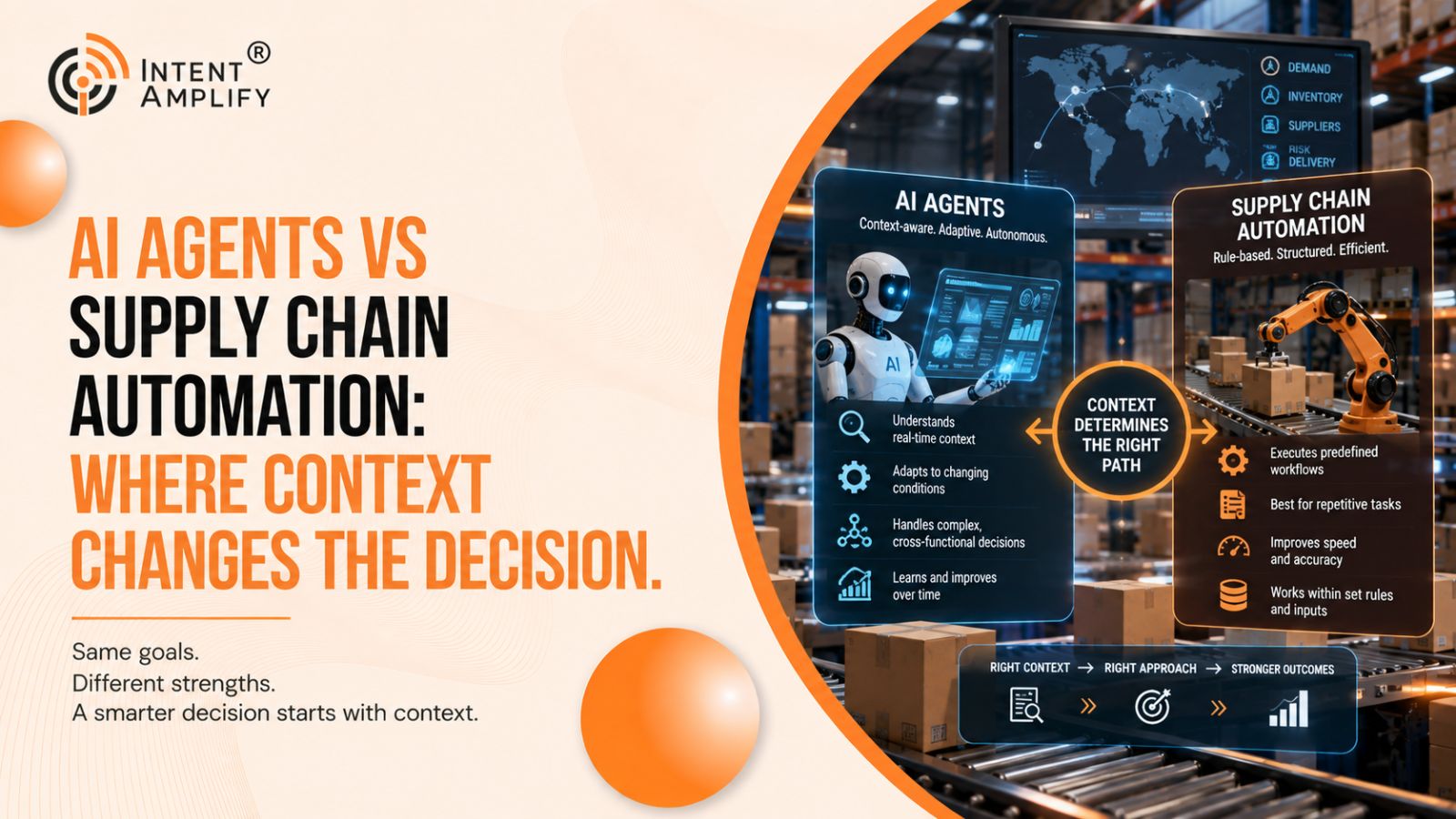
Improving supply chain visibility with AI can help teams detect anomalies, predict delays, rank exceptions, and compare routes. It cannot repair incomplete data, unclear authority, or an alternative that exists only in a presentation.
Gartner’s March 2026 analysis, drawing partly on 509 leaders surveyed in October 2025, predicts that 60% of disruptions could be resolved without human intervention by 2031. Yet Gartner advises limiting full automation to low-risk choices until data and technology mature. [7]
The priority is controlled augmentation: automate routine work, but require explainable evidence and named approval when customer commitments, security, compliance, or material cost are involved.
Intent Amplify Perspective
Supply chain visibility is becoming an operating discipline for protecting service continuity.
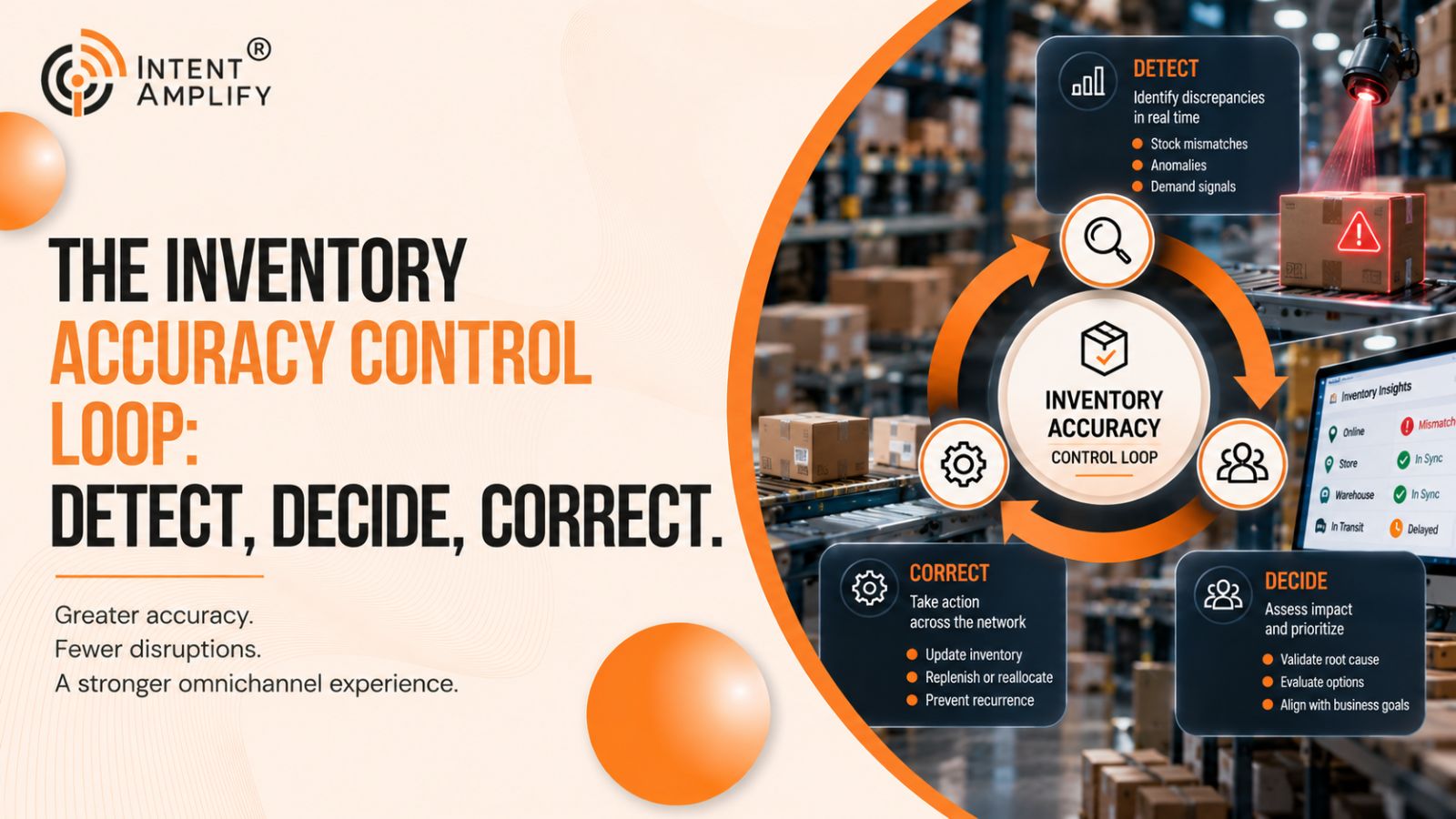
The strongest organizations will not manage tracking, logistics risk management, transportation planning, cargo security, customs compliance, and customer communication as separate activities. They will connect them through one response sequence: detect the event, establish the consequence, compare executable options, authorize action, and verify the outcome.
Technology deployment is not the final measure. Response readiness is.
The Intent Amplify Logistics Resilience Framework
The Intent Amplify Logistics Resilience Framework organizes readiness around five connected disciplines.
Critical-flow mapping identifies the products, suppliers, lanes, facilities, carriers, inventory, customers, and regulatory dependencies that matter most.
Decision-ready context links real-time visibility to order priority, production impact, capacity, security signals, and trade requirements.
Response optionality establishes prequalified routing, carrier, mode, inventory, service-tier, and supplier alternatives.
Trusted execution defines data ownership, escalation thresholds, partner responsibilities, human approval, and evidence requirements.
Outcome learning measures exception-to-decision time, intervention success, arrival accuracy, partner-data quality, and alternative-plan performance.
Read the eBook: The Logistics Resilience Playbook: Building Agile, Visible, and Future-Ready Supply Chains, published by Intent Amplify.
Access the Logistics Resilience Playbook
Use the eBook to operationalize logistics resilience across supply chain planning, operations, procurement, technology, retail fulfillment, partner coordination, cargo security, and trade compliance.
Intent Amplify Executive Readiness Scorecard
Intent Amplify’s research report, Logistics Resilience 2026: Visibility, Risk Management, and the Future of Global Supply Chains, provides an executive scorecard built around demonstrated outcomes rather than purchased technology.
The scorecard evaluates critical-flow coverage, shared-data access, business-impact assessment, alternative-route readiness, partner verification, cargo-security controls, customs preparedness, exception-to-decision time, customer notification, and executive decision ownership.
Read or download the Research Report: Logistics Resilience 2026: Visibility, Risk Management, and the Future of Global Supply Chains, published by Intent Amplify.
Benchmark Logistics Resilience Readiness
A green rating should indicate tested operational proof, not the existence of another dashboard.
Strategic Takeaway for Logistics Leaders
Supply chain visibility is reshaping modern logistics strategy because disruption management now depends on coordinated decision speed.
A carrier event can interrupt production. A customs change can alter routing economics. A fraudulent pickup can become a cargo loss. A late shipment can become a customer-retention issue. These consequences cross functional boundaries, so the information and response model must cross them as well.
The leadership priority is to compress the interval between signal, consequence, decision, and controlled execution.
Seeing sooner matters. Acting with prepared options matters more.
Register for the Webinar
Join the Supply Chain Now webinar From Disruption to Stability: Building Resilient Logistics Solutions in a Rapidly Changing Global Market.
The session will examine practical ways to:
- Strengthen route and service optionality
- Use data to support faster logistics decisions
- Improve carrier and logistics-partner readiness
- Address cargo-theft and freight-security exposure
- Prepare for changing tariff and customs requirements
- Protect customer commitments when markets shift
About Intent Amplify
Intent Amplify helps technology and business brands turn complex market developments into executive-ready research, buyer-focused content, and coordinated go-to-market programs. Its logistics practice translates disruption, network visibility, partner dependencies, freight security, trade requirements, and operational recovery into clear market positioning and decision-useful narratives.
By connecting research, messaging, content strategy, and audience activation, Intent Amplify helps logistics and supply chain providers strengthen campaign relevance, align their capabilities with buyer priorities, and improve readiness across each stage of the demand journey.
For Logistics Technology & Service Providers
If your organization helps logistics and supply chain leaders improve visibility, resilience, freight security, transportation intelligence, or logistics AI, Intent Amplify can help position your solution with enterprise buyers.
Request a Logistics Campaign Briefing
References
- FedEx, Future of Logistics Intelligence Report, February 10, 2026 https://newsroom.fedex.com/fedex-delivers-first-ever-future-of-logistics-intelligence-repotr
- FedEx, The Logistics Data Gap: What’s Needed to Unlock AI’s Value, Publication date not stated on the webpage. https://www.fedex.com/en-us/digital/blog/logistics-data-gap-ai.html
- World Economic Forum and Kearney, Global Value Chains Outlook 2026: Orchestrating Corporate and National Agility, January 19, 2026. https://www.weforum.org/publications/global-value-chains-outlook-2026-orchestrating-corporate-and-national-agility/
- U.S. Department of Transportation, 2026 National Freight Strategic Plan, May 18, 2026. https://www.transportation.gov/freight/NFSP/2026fullplan
- U.S. Department of Transportation, American Supply Chain Sovereignty Initiative to Move Freight Faster and Lower Costs for the American People, June 12, 2026. https://www.transportation.gov/briefing-room/trumps-transportation-secretary-sean-p-duffy-announces-american-supply-chain
- FedEx, Global Challenges in Logistics and Supply Chain Management, Publication date not stated on the webpage. https://www.fedex.com/en-us/digital/blog/global-challenges-supply-chain.html
- Gartner, Gartner Predicts 60% of Supply Chain Disruptions Will Be Resolved Without Human Intervention by 2031, March 18, 2026. https://www.gartner.com/en/newsroom/press-releases/2026-03-18-gartner-predicts-60-percent-of-supply-chain-disruptions-will-be-resolved-without-human-intervention-by-2031