
Executive Summary
Supply chain transformation has reached a point where technology adoption alone is no longer enough. Enterprises have invested in digital supply chain platforms, analytics dashboards, automation, planning systems, and visibility tools, yet many leaders still face the same strategic challenge: how to turn information into faster, better, and more resilient decisions across the end-to-end supply chain.
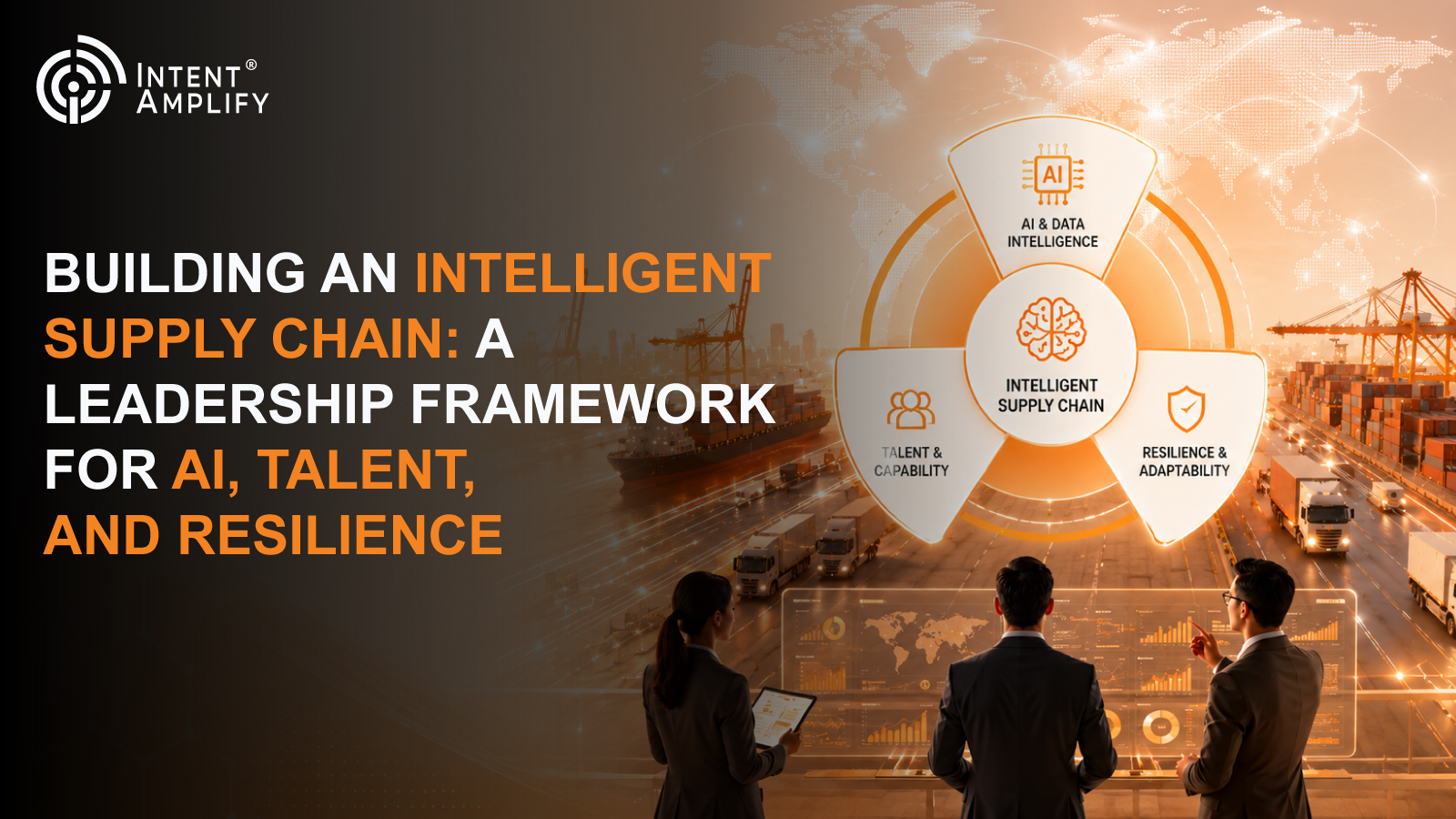
An intelligent supply chain is not simply a more digitized supply chain. It is an operating model where people, data, AI, analytics, process governance, and leadership discipline work together. Supply Chain AI can detect patterns, improve predictive analytics, support scenario planning, and accelerate routine workflows, but talent determines whether those insights become trusted actions. Supply Chain Resilience depends not only on early warning signals but also on teams that can interpret disruption, evaluate options, and coordinate response.
The Future of Supply Chains: Where Talent Meets Technology webinar examines how leading organizations are integrating AI, analytics, workforce capability, and executive leadership into operating models that improve execution quality and enterprise resilience. The discussion focuses on the practical challenge facing supply chain leaders: embedding intelligent systems into planning, coordination, and operational execution without weakening governance, accountability, or human judgment.
Hosted by Supply Chain Now, the webinar explores practical approaches to strengthening workforce capability, improving planning discipline, and aligning AI with enterprise operations to support more consistent execution across increasingly complex supply chain environments.
Reserve Your Seat: The Future of Supply Chains, Where Talent Meets Technology
This whitepaper presents a leadership framework for building an intelligent supply chain around three connected priorities: AI, talent, and resilience. It is designed for executives who need to modernize supply chain strategy while keeping people, governance, and business continuity at the center of transformation.
Why Intelligent Supply Chains Need a Leadership Framework
Many supply chain modernization programs begin with technology selection. Leaders evaluate analytics platforms, planning systems, automation tools, visibility solutions, and AI-powered supply chain software. These investments are necessary, but they do not automatically create transformation. Without a leadership framework, technology can improve reporting while leaving decision-making fragmented.
The future of supply chains will depend on whether organizations can connect digital capability with workforce capability. A planning system may show a demand shift, but people still need to decide how to respond. Predictive analytics may highlight supply risk, but leaders still need to determine whether to build inventory, qualify another supplier, adjust allocation, or communicate with customers. AI may summarize exceptions, although the organization must still define who owns the decision.
This is why an intelligent supply chain strategy must begin with operating model design. Leaders need to clarify which decisions matter most, which workflows require AI support, which skills are needed, how governance should work, and how resilience will be measured. The framework must help teams move from visibility to action and from technology deployment to business value.
Market Signals: AI, Talent and Resilience by the Numbers
The strongest signals for intelligent supply chain transformation come from official enterprise technology research and AI adoption data. Microsoft’s 2026 Work Trend Index surveyed 20,000 AI-using workers across 10 countries and analyzed trillions of anonymized Microsoft 365 productivity signals. A privacy-preserving analysis of more than 100,000 Microsoft 365 Copilot chats found that 49% of conversations supported cognitive work such as analysis, decision-making, problem-solving, and creative thinking.¹
For supply chain leaders, those figures matter because supply chain work increasingly depends on judgment-heavy decisions rather than routine reporting alone. Microsoft also found that 66% of AI users say AI allows them to spend more time on high-value work, while 58% say they are producing work they could not have produced a year earlier. The same research found that 86% of AI users treat AI output as a starting point rather than a final answer, which supports a human-in-the-loop model for AI-powered supply chain decision-making.¹
Organizational readiness remains a defining constraint. Microsoft reports that only 19% of AI users are in the “Frontier” zone, where individual capability and organizational readiness reinforce each other, while only 26% say leadership is clearly and consistently aligned on AI. Microsoft also found that organizational factors such as culture, manager support, and talent practices account for 67% of reported AI impact, compared with 32% for individual mindset and behavior.¹
Production AI is also scaling. AWS states that Amazon Bedrock powers generative AI for more than 100,000 organizations worldwide and supports applications and agents at a production scale. 2
AWS also reports that Bedrock Guardrails can help block up to 88% of harmful content and identify correct model responses with up to 99% accuracy using Automated Reasoning checks.3
Google Cloud’s official 2026 update lists 1,302 real-world generative AI use cases from leading organizations, showing how AI is moving into practical enterprise workflows.4
SAP cites an Oxford Economics survey of 1,600 directors across eight countries, where 31% expect to drive ROI from AI in the next two years.5
These figures show that intelligent supply chains require more than AI investment. They require leadership alignment, workforce readiness, governance, analytics maturity, and a clear connection between technology and operating outcomes.
Pillar One: Build Decision-Centric Supply Chain Transformation
Supply Chain Transformation should begin with the decisions that determine business performance. These may include demand planning, supplier risk response, inventory allocation, logistics prioritization, workforce deployment, production adjustment, and customer service recovery. When transformation starts with decisions, technology selection becomes more practical because leaders can identify where AI, analytics, and automation create the greatest value.
Decision-centric transformation changes the role of data. Instead of treating data as a reporting asset, organizations use it to guide action. Supply Chain Analytics should help leaders understand what is changing, why it matters, and which response options are available. Predictive Analytics should not only identify risk but also support scenario planning and escalation.
Table 1: Decision-Centric Supply Chain Transformation
|
Leadership Question |
Why It Matters |
|
Which supply chain decisions create the most value or risk? |
Helps prioritize transformation investment |
|
Which workflows are slowed by manual reconciliation? |
Identifies where AI and analytics can improve speed |
|
Which decisions require cross-functional approval? |
Clarifies governance and ownership |
|
Which outcomes should be measured? |
Connects transformation to business value |
|
Which skills are needed to act on insights? |
Links technology adoption with workforce transformation |
A decision-centric approach prevents transformation from becoming a collection of isolated digital projects. It creates a clear line between technology, talent, and business performance.
Pillar Two: Make Talent the Multiplier for Supply Chain AI
Supply Chain Talent is the multiplier that determines whether AI creates value. Technology can generate insights, but people decide whether those insights are relevant, trustworthy, and actionable. Planners, procurement teams, logistics leaders, operations managers, and customer-facing supply chain teams bring context that AI systems may not fully capture.
Microsoft’s research shows that manager behavior can materially affect AI value. When managers actively modeled AI use, employees reported a 17-point lift in AI value, a 22-point lift in critical thinking about AI use, and a 30-point lift in trust in agentic AI.¹
When managers created psychological safety around experimentation, employees reported up to 20 points higher AI readiness and value, while becoming 1.4x more likely to be high-frequency users of agentic AI.¹
These findings are highly relevant for supply chain workforce transformation. Leaders cannot assume that teams will adopt AI because tools are available. Employees need role clarity, training, trust, permission to challenge outputs, and confidence that AI will support rather than replace their expertise.
A supply chain workforce transformation strategy should focus on five capabilities: data literacy, AI judgment, scenario thinking, cross-functional collaboration, and change leadership. These capabilities help teams use intelligent systems responsibly and turn insights into action.
Pillar Three: Strengthen Supply Chain Resilience Through Predictive Intelligence
Supply Chain Resilience has become a business continuity mandate. Disruption can emerge from supplier instability, logistics constraints, geopolitical risk, labor shortages, extreme weather, demand shocks, cyber events, or regional operating changes. A resilient supply chain needs the ability to sense early, interpret quickly, and act with discipline.
Predictive intelligence improves resilience by helping teams identify risks before they become critical. AI in supply chain operations can monitor patterns, flag anomalies, prepare scenarios, and support faster responses. However, resilience also depends on leadership judgment because not every risk deserves the same action.
A supply chain risk management strategy should connect predictive analytics with decision rights. If a supplier risk signal appears, who reviews it? If a logistics constraint threatens service, which team owns the response? If inventory needs to be repositioned, how should finance, operations, and commercial leaders be involved?
Table 2: Resilience Capabilities for Intelligent Supply Chains
|
Capability |
Leadership Purpose |
|
End-to-end visibility |
Helps leaders see risk across suppliers, operations, and customers |
|
Predictive analytics |
Identifies potential disruption earlier |
|
Scenario planning |
Compares response options before action |
|
Cross-functional escalation |
Aligns supply chain, finance, commercial, and operations teams |
|
Business continuity governance |
Clarifies ownership during disruption |
Resilience is not only a technology outcome. It is a leadership capability that depends on prepared teams, trusted data, and clear decision rules.
Pillar Four: Connect Digital Supply Chain Investments to Operational Excellence
Digital supply chain investments should improve operational excellence, not simply increase visibility. A control tower that shows exceptions is useful, but the business value increases when teams know what action should follow. A planning platform that generates forecasts is helpful, but its value grows when planners can use those forecasts to improve service, inventory, and cost decisions.
Operational excellence requires execution discipline. Leaders should evaluate digital supply chain initiatives by asking whether they improve speed, accuracy, resilience, productivity, and decision confidence. If a technology adds complexity without improving outcomes, the operating model needs review.
An intelligent supply chain uses technology to remove avoidable friction from work. AI can summarize exceptions, analytics can prioritize risks, automation can reduce repetitive activity, and planning tools can support scenario comparison. The goal is to free human talent for higher-value decisions.
Google Cloud’s catalog of 1,302 real-world generative AI use cases shows how AI is moving across enterprise workflows.4
For supply chain leaders, the lesson is not to copy every use case. The better approach is to identify the workflows where AI can improve operational decisions and then scale with governance.
Pillar Five: Govern AI-Powered Supply Chain Decisions
Governance is essential because AI-powered supply chains rely on decisions that affect customers, cost, suppliers, inventory, and business continuity. Leaders need to define where AI can assist, where it can recommend, and where human approval is required.
AI governance should include data authority, model transparency, escalation rules, decision ownership, and outcome monitoring. If AI recommends changing allocation, increasing inventory, adjusting supplier priority, or rerouting logistics, leaders need to know the logic behind the recommendation and the expected business impact.
AWS’s Bedrock positioning reinforces this point by emphasizing security, privacy, monitoring, logging, and guardrails for generative AI applications and agents.²
These controls matter in supply chain environments because AI systems may interact with supplier data, demand signals, inventory positions, customer commitments, and financial assumptions.
Table 3: Governance Framework for AI-Powered Supply Chains
|
Governance Area |
Executive Question |
|
Data authority |
Which sources are trusted for demand, supply, inventory, and risk signals? |
|
Decision rights |
Which AI-supported actions require human approval? |
|
Explainability |
What reasoning must be visible before action? |
|
Risk escalation |
Which events require leadership review? |
|
Outcome tracking |
How will the organization know whether AI improved performance? |
Governance should not slow transformation. It should make AI adoption safer, more trusted, and easier to scale.
Intelligent Supply Chain Leadership Scorecard
Executives need a practical scorecard to evaluate whether their organization is ready to build an intelligent supply chain. The scorecard should connect technology, talent, resilience, and leadership alignment.
Table 4: Leadership Scorecard
|
Dimension |
Maturity Question |
|
Strategy |
Is supply chain transformation tied to business outcomes? |
|
Talent |
Are teams trained to use and challenge AI-supported insights? |
|
Technology |
Do AI and analytics tools support real decisions? |
|
Data |
Are critical supply chain signals trusted and connected? |
|
Resilience |
Can the organization sense, model, and respond to disruption? |
|
Governance |
Are decision rights and escalation paths clear? |
|
Measurement |
Are outcomes tracked across service, cost, risk, and productivity? |
This scorecard helps leaders avoid treating the intelligent supply chain as a technology program only. It frames transformation as an enterprise operating model.
Implementation Roadmap for Enterprise Leaders
A practical transformation roadmap should begin with leadership alignment. Executives need to agree on the business outcomes that matter most, such as service reliability, risk reduction, productivity, working capital, customer responsiveness, or business continuity.
The next step is to map priority decisions and identify where current processes slow the business down. These may include demand-supply balancing, supplier risk response, inventory positioning, logistics exceptions, workforce deployment, or customer recovery planning.
Once the decision map is clear, leaders can define talent requirements, technology needs, and governance rules. AI and analytics should then be deployed in focused workflows where value can be measured and lessons can be applied before scaling more broadly.
Flowchart: Intelligent Supply Chain Transformation Roadmap
Align leadership around business outcomes.
↓
Identify a high-value supply chain decision.
↓
Map talent, data, technology, and governance gaps
↓
Deploy AI and analytics in focused workflows.
↓
Train teams to interpret, challenge, and act on insights.
↓
Measure resilience, service, productivity, cost, and risk outcomes.
↓
Scale the operating model across functions and regions
This roadmap keeps transformation practical. It helps leaders build capability step by step while connecting every stage to business value.
Supply Chain Now Perspective
Supply Chain Now is positioned for this conversation because its webinar focuses on a critical enterprise shift: the future supply chain will not be built through technology adoption alone. It will be built by aligning talent, AI, analytics, leadership, and operating model design.
For supply chain executives, the webinar provides a timely forum to examine how workforce transformation, intelligent systems, and resilience strategies can work together. It also helps move the conversation beyond the assumption that automation replaces human expertise. In future-ready supply chains, technology expands capability while talent turns intelligence into action.
The value of this discussion lies in its practical balance. AI can help leaders see more, model more, and respond faster, but people remain essential to trust, judgment, and execution.
Explore how enterprises can build intelligent, resilient, and future-ready supply chains by connecting AI, analytics, talent, leadership, and technology into one practical operating model. This Supply Chain Now webinar helps leaders understand how workforce transformation and intelligent systems can improve decision-making in a more complex supply chain environment.
Reserve Your Seat: The Future of Supply Chains, Where Talent Meets Technology
About Intent Amplify
Intent Amplify helps organizations convert market insight into measurable growth through research-led content, demand intelligence, executive engagement, pipeline activation, sponsored assets, webinars, roundtables, vendor intelligence, and GTM consulting. For supply chain technology and transformation teams, Intent Amplify connects audience insight, content strategy, and campaign execution into a practical demand generation engine.
Conclusion
Building an intelligent supply chain requires more than adding AI to existing processes. It requires a leadership framework that connects technology with talent, resilience, governance, and measurable business outcomes. The organizations that succeed will not treat digital supply chain transformation as a series of disconnected tools. They will build an operating model where people and intelligent systems improve decision-making together.
The future of supply chains will belong to enterprises that can combine predictive analytics with practical judgment, automation with accountability, and AI-powered visibility with workforce transformation. When talent, technology, and resilience work together, the supply chain becomes more than a function that responds to disruption. It becomes a strategic capability for growth, continuity, and competitive advantage.
References
- Microsoft (2026) 2026 Work Trend Index: Agents, Human Agency, and the Opportunity for Every Organization. Available at: https://www.microsoft.com/en-us/worklab/work-trend-index/agents-human-agency-and-the-opportunity-for-every-organization
- Amazon Web Services (2026) Amazon Bedrock: Build Generative AI Applications and Agents at Production Scale. Available at: https://aws.amazon.com/bedrock/
- Amazon Web Services (2026) Amazon Bedrock Guardrails. Available at: https://aws.amazon.com/bedrock/guardrails/
- Google Cloud (2026) 1,302 Real-World Gen AI Use Cases from the World’s Leading Organizations. Available at: https://cloud.google.com/transform/101-real-world-generative-ai-use-cases-from-industry-leaders
- SAP (2026) Joule Business AI Solutions. Available at: https://www.sap.com/products/artificial-intelligence.html