
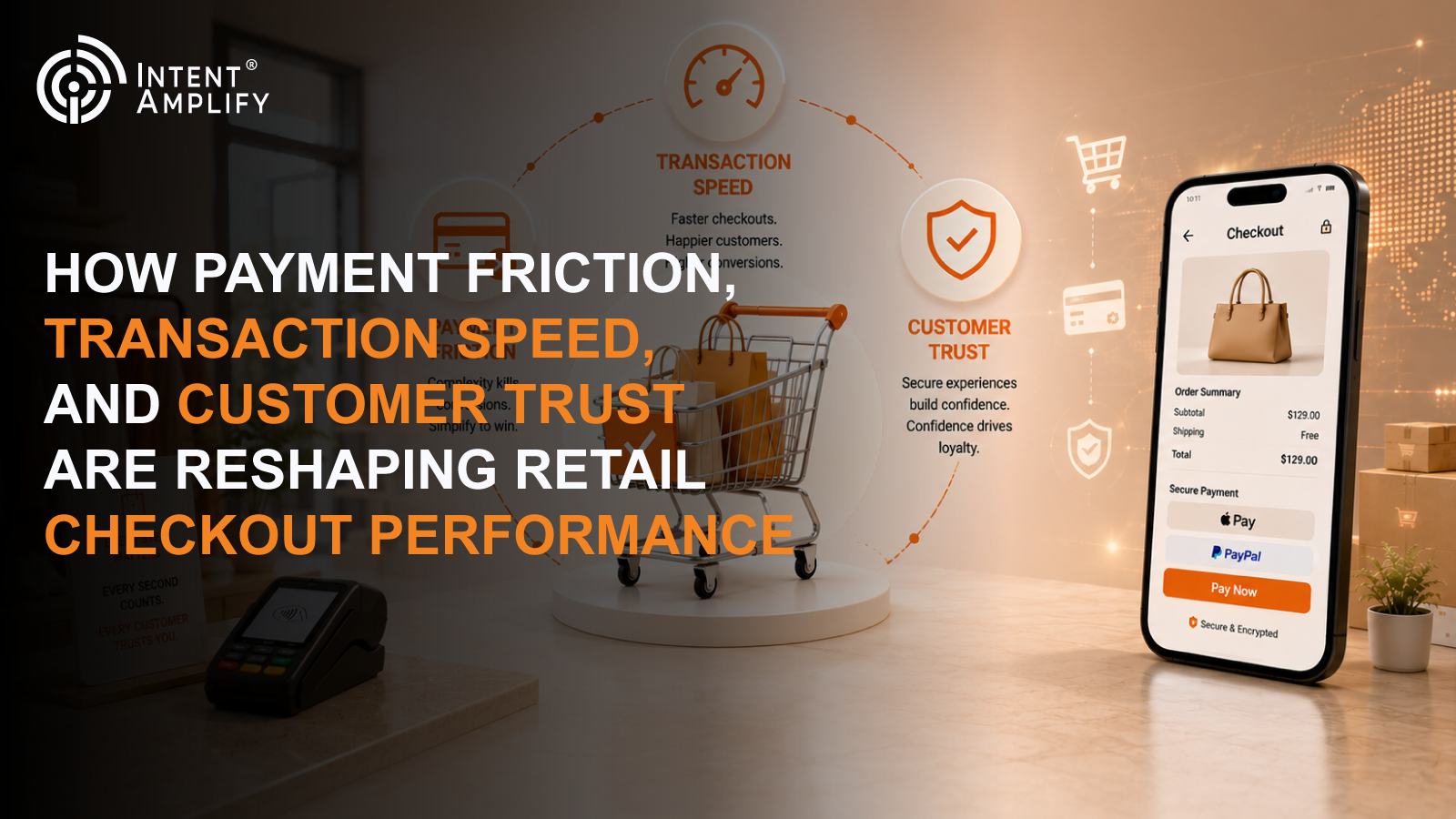
Retail checkout used to be treated like the finish line. A customer found the product. They accepted the price. They reached for a card or phone. The sale was almost done.
Retail buying behavior has changed. Checkout now serves as a critical conversion, trust, and operational performance point across physical and digital commerce. Customer intent, payment execution, and brand confidence converge at this stage of the journey.
For retail leaders, this shift matters because checkout performance is no longer a narrow payment issue. It is a commercial and operational capability. It is also a trust-building function. Payment friction, transaction speed, and customer trust now sit at the center of conversion optimization across physical and digital commerce.
The brands that understand this are not simply improving checkout. They are protecting revenue at the exact moment customers are ready to buy.
The message is clear.
Checkout has evolved beyond a back-office payment function. It now influences revenue capture, customer trust, and operational performance.
The Checkout Performance Gap Is Where Intent Starts Leaking
Retailers spend heavily to attract customers. They invest in engagement, personalization, retargeting, and persuasion. Then the final transaction still becomes the weak link. A shopper who wants to buy should be the easiest person in the funnel to convert. Yet checkout friction can turn that moment into a test of patience, payment compatibility, and trust.
Baymard Institute calculates the average documented online cart abandonment rate at 70.22%. The figure is based on 50 studies. That number is not just an e-commerce trivia fact to terrify marketing teams during quarterly reviews. It shows how much commercial value remains exposed at the edge of conversion. A poor checkout experience can erase the effort invested earlier in the journey.1
Some abandonment is natural. Customers browse. They compare. They save items. They sometimes behave like human beings instead of CRM objects. But a significant share is preventable. Baymard’s research shows 18% of US online shoppers have abandoned an order because the checkout process was too long or complicated. The average US checkout flow also displays 23.48 form elements by default. That is not a checkout flow. That is paperwork with a payment button attached. 1
The performance gap matters especially for Director+ IT and Operations leaders. Checkout breakdowns are rarely isolated UX problems. They often point to deeper issues in payment orchestration, POS reliability, mobile checkout performance, fraud controls, authentication design, network uptime, associate workflows, and data visibility.
In simple terms, retail checkout performance is where enterprise retail infrastructure meets customer impatience. Customer expectations ultimately determine whether the transaction succeeds.
Payment Friction Has Become a Revenue Problem
Payment friction is any moment that makes completion harder than it needs to be. It can appear as forced account creation. It can show up through unclear costs or slow authentication. It can come from limited payment options, failed authorization, confusing form design, weak mobile experience, or a physical checkout line that creates noticeable checkout delays
The problem is not that customers are unwilling to buy. The problem is that retailers sometimes make buying feel like a small administrative punishment.
In physical retail, friction may come from slow terminals, awkward loyalty prompts, self-checkout errors, or staff interventions. In digital retail, it often comes from repetitive fields, missing digital wallets, poor error handling, or a checkout page that acts surprised someone wants to pay.
Baymard estimates that the average large e-commerce site can gain a 35.26% increase in conversion rate through better checkout design. The estimate is based on checkout usability issues that Baymard identifies as solvable. This makes checkout optimization less of a design preference and more of a revenue recovery strategy. The value is already there. Retailers simply need to stop hiding it behind friction. 1
For apparel, specialty retail, grocery, convenience, fuel, QSR, and fast-casual brands, friction takes different shapes. A fashion shopper may abandon a cart because the site demands an account. A grocery customer may lose patience with a slow app payment. A QSR guest may switch locations if the drive-thru or kiosk experience drags. A fuel or convenience customer may expect tap-and-go speed because the entire shopping mission is built around not lingering under fluorescent lights and contemplating civilization.
Transaction Speed Is Now an Operating Metric
Speed in checkout is often misunderstood. It is not only the number of seconds between cart and confirmation. It includes payment processing speed, authorization speed, POS responsiveness, queue movement, mobile checkout performance, error recovery, fraud-review latency, refund handling, and the ability to keep transactions flowing during peak demand.
In stores, slow transaction speed directly affects throughput. Longer queues reduce basket completion. They strain associates. They frustrate customers. They pressure store managers to invent workarounds.
In digital channels, payment latency creates hesitation. A slow payment page gives customers time to reconsider. It gives them time to compare prices. It gives them time to question trust signals or remember they have better things to do than fight a checkout screen.
The Federal Reserve’s 2025 Diary of Consumer Payment Choice found that US consumers made an average of 48 payments per month in 2024. Credit cards accounted for 35% of payments by number. Debit cards accounted for 30%. Cash accounted for 14%. For retailers, this reinforces a practical point. Payment behavior is diverse, frequent, and operationally embedded. Checkout systems must support speed across multiple payment types. They cannot only support the method the retailer wishes everyone to use.2
The same Federal Reserve research found that adults aged 18 to 24 used mobile phones for 45% of all payments. US consumers also made an average of 11 mobile-phone payments per month in 2024. This creates a rising expectation for fast mobile checkout across digital, store, restaurant, and convenience environments. Younger customers are not waiting patiently for legacy checkout logic to catch up. These consumers increasingly expect fast, mobile-native payment experiences. 2
Payment Choice Is Becoming a Conversion Strategy
Payment choice has moved from nice to offer to commercially risky to ignore. Customers increasingly expect to pay with the method that feels fastest, safest, or most familiar in the moment. That might be a card, digital wallet, mobile payment, BNPL option, cash, direct debit, real-time payment, or stored credential.
The 2025 Global eCommerce Payments & Fraud Report from Visa Acceptance Solutions, Verifi, and the Merchant Risk Council found that merchants accept an average of 4.4 payment methods. The report also found that 80% accept cards, 73% accept digital wallets or eWallets, 45% accept mobile commerce payments, 37% accept real-time payments, and 35% accept BNPL. The strategic takeaway is not that retailers should bolt on every payment type like ornaments on a very expensive tree. It is that payment choice that now shapes checkout performance and customer intent capture.3
The same report found that 74% of merchants added at least one new payment acceptance method in the past 12 months. Many did so to improve customer experience and reach new customers or markets. The report also showed that merchants are increasingly adding methods to avoid checkout abandonment. That signals a mature shift. Payment expansion is no longer only about innovation optics. It is about reducing friction where conversion is most vulnerable.3
Worldpay’s 2025 Global Payments Report adds a broader market signal. Digital payment methods grew from 3% of global in-person shopping value in 2014 to 38% in 2024. They also grew from 34% of online value to 66% over the same period. For retailers operating across stores, apps, websites, kiosks, and marketplaces, payment choice is now an omnichannel payments issue. It is not a digital-only concern. 4
The Payment Stack Is Becoming Part of the Retail Experience
Retailers often talk about customer experience as if it ends at product discovery, merchandising, and service. It does not. The payment stack is now part of the retail experience. A modern point of sale system, smart POS terminal, cloud-based POS solution, or mobile POS setup can influence how quickly customers move through checkout and how confidently associates handle exceptions.
This matters in distributed retail environments. A retailer with hundreds or thousands of locations cannot depend on disconnected store systems and hope checkout stays consistent. Hope is not a payment infrastructure strategy. It is what people use when nobody has funded the platform modernization work.
Modern POS systems, Android POS terminals, and unified payment experiences can support faster checkout when they are connected to the broader commerce platform. But speed alone is not enough. Retailers also need visibility into failed payments, queue patterns, wallet adoption, authorization performance, and customer behavior across channels.
That is why checkout performance belongs in the same conversation as unified commerce, payment infrastructure, and retail operations. The more fragmented the system is, the harder it becomes to deliver a frictionless checkout experience.
Customer Trust Is the Invisible Conversion Layer
Trust at checkout is both emotional and technical. Customers need to believe the payment will work. They need to know the total is accurate. They need to see that their method is accepted. They need to feel that their data is protected. They also need confidence that the brand can resolve issues if something goes wrong.
That trust is not built by one lock icon or one reassuring sentence about encryption. Naturally, the internet has tried to make icons do the work of actual reliability.
Checkout.com’s Trust in the Digital Economy 2025 report found that 66% of consumers say payment performance is the key driver of trust at checkout. The same report found that 60% say the rise of AI poses a risk to their data security. This links payment reliability directly to confidence. Customers do not separate payment failure from brand failure. They experience it as one broken moment.4
Security complicates the equation. Retailers need fraud prevention, checkout security, authentication, tokenization, risk scoring, dispute handling, and monitoring. But poorly tuned security tools create false declines, unnecessary step-ups, delayed approvals, and frustrated customers. Strong protection should make the secure checkout feel safer. It should not feel like a checkpoint staffed by suspicious software.
The Visa, MRC, and Verifi report found that over 90% of merchants use at least one tactic to boost authorization rates. Strong Customer Authentication is used by 40%. The report also found that 6 in 10 merchants use tokenization to reinforce payment security, improve authorization rates, and enable more convenient payment experiences. This is where trust becomes operational. Security, speed, and approval performance have to work together. They should not compete for budget like competing operational priorities 3
What Retail Leaders Should Actually Measure
High-performing checkout cannot be managed only through conversion rate or payment approval rate. Those metrics matter. They just do not tell the full story.
Retailers need a broader performance view. They should track cart abandonment, checkout abandonment, authorization success, payment failure reasons, checkout completion time, queue length, mobile payment usage, digital wallet adoption, fraud-review latency, dispute volume, false declines, uptime, and customer satisfaction after checkout.
This is where IT and Operations leaders become central. IT owns much of the infrastructure that determines whether checkout is reliable, integrated, secure, and measurable. Operations owns the store-level reality. That includes queues, labor, associate confidence, exception handling, peak-period readiness, and customer experience.
Security leaders influence fraud controls and trust signals. Strategy and innovation teams help determine whether checkout becomes a competitive advantage or remains a maintenance chore with nicer dashboards.
The opportunity is not to make checkout invisible at all costs. Some trust cues should be visible. Some security steps are necessary. Some payment choices require governance. The goal is to remove unnecessary effort while preserving confidence. That requires orchestration across systems. It does not come from just adding a prettier button.
Retail leaders looking to understand where checkout delays turn into lost revenue can explore deeper findings in the full checkout performance report.
The Retailers That Win Will Capture Intent Faster
Payment friction determines whether customers hesitate. Transaction speed determines whether intent survives. Customer trust determines whether shoppers feel safe enough to complete the purchase. Together, these forces are reshaping retail checkout performance into a strategic capability. They affect revenue, loyalty, operational resilience, and brand credibility.
For retailers across apparel, grocery, convenience, fuel, QSR, fast casual, and retail-adjacent environments, the message is not subtle. Checkout is where demand becomes measurable. It is also where poor execution becomes painfully visible.
The retailers that close the checkout performance gap will not simply reduce abandoned carts or move lines faster. They will recover lost revenue and capture more customer intent across physical and digital commerce before that intent escapes into delay, doubt, or a competitor’s smoother payment flow.
That is the real shift.
Checkout has become a measurable indicator of retail performance. It determines whether customer intent converts into revenue, friction, or abandonment at the point of purchase.
For retailers and technology partners looking to turn checkout performance insights into stronger market engagement, Intent Amplify can help shape campaigns that reach the right decision-makers. Get in touch.
References
-
Baymard Institute (2025) Cart Abandonment Rate Statistics. Available at: https://baymard.com/lists/cart-abandonment-rate
-
Federal Reserve Financial Services (2025) 2025 Findings from the Diary of Consumer Payment Choice. Available at: https://www.frbservices.org/news/research/2025-findings-from-the-diary-of-consumer-payment-choice
-
Visa Acceptance Solutions (2025) Global Fraud Report 2025. Available at: https://www.visaacceptance.com/content/dam/documents/campaign/fraud-report/global-fraud-report-2025.pdf.
-
Worldpay (2025) Global Payments Report 2025. Available at: https://worldpay.com/en/insights/articles/gpr-2025-released
-
Checkout.com (2025) Trust in the Digital Economy Report 2025. Available at: https://www.checkout.com/guides-and-reports/digital-economy-report.