
Executive Summary
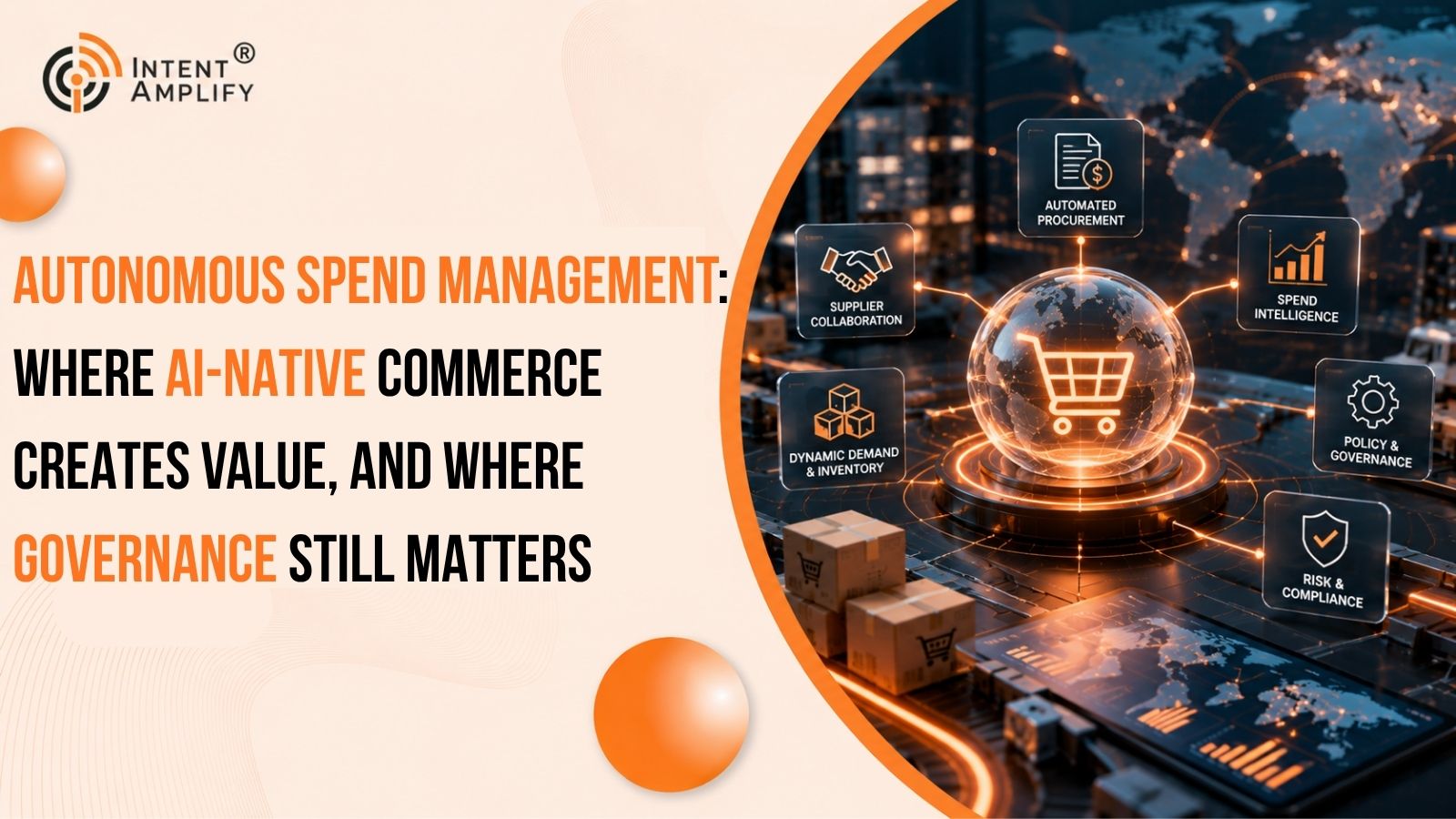
Spend management is moving from a system-of-record problem toward a decision-and-execution problem. The emerging model combines connected spend data, AI-enabled recommendations, workflow automation, supplier collaboration, and human governance so that procurement and finance teams can act faster without giving up control.
That shift matters because autonomous spend management is not simply “more AI in procurement.” It changes how organizations identify demand, source suppliers, manage contracts, approve purchases, monitor risk, and convert spend data into decisions. Recent enterprise technology releases and procurement research point toward increasingly agentic workflows, but they also reinforce a practical constraint: autonomy creates value only when data, decision rights, controls, and accountability are designed into the operating model. [1][2]
For leaders evaluating the next generation of spend management, the core question is therefore not whether AI can automate individual tasks. It is where autonomy should be introduced, which decisions should remain governed by people, and how the organization will measure value beyond activity metrics.
Market Context: Spend Management Is Becoming an AI-Native Operating Layer
Traditional spend management has often been fragmented across procurement, finance, ERP, supplier systems, contracts, sourcing tools, and manual approval processes. That fragmentation makes it difficult to create a consistent view of demand, policy, supplier performance, risk, and realized value.
The current technology direction is toward a more connected operating layer. Gartner’s April 2026 supply-chain software forecast describes a market moving from AI assistants toward simple and advanced agents embedded in operational workflows. Oracle has likewise expanded agentic capabilities across Fusion Applications, reflecting a broader enterprise shift toward AI agents that can operate inside business workflows rather than remain separate analytical tools. [1][3]
This changes the role of the spend platform. Instead of only recording transactions or routing approvals, an AI-native platform can potentially interpret context, recommend actions, coordinate workflows, and surface exceptions. The strategic opportunity is to shorten the distance between insight and action.
The risk is equally clear. If the underlying data is inconsistent, policies are unclear, or accountability is fragmented, automation can accelerate poor decisions just as efficiently as good ones.
Trend Analysis: The Value Equation Is Moving from Automation to Decision Quality
The first wave of procurement automation focused on efficiency: digitize requisitions, automate approvals, reduce manual processing, and improve compliance. The emerging agentic model raises the ambition. Gartner’s April 2026 procurement research emphasizes change management, role redesign, and adoption discipline as organizations introduce AI into sourcing and procurement. [4]
That progression changes how value should be evaluated. Transaction speed still matters, but the larger opportunity is decision quality: identifying better sourcing options, improving contract visibility, reducing preventable exceptions, guiding users toward compliant buying paths, and allowing procurement teams to focus on higher-value judgment.
Gartner’s May 2026 CPO research illustrates another part of this shift: individual AI productivity gains do not automatically translate into team or enterprise outcomes. Procurement leaders need redesigned roles, financial outcome measures, and operating-model changes if AI-enabled work is to create measurable value. [5]
The same logic applies across spend management. AI becomes strategically relevant when it is connected to an operating decision, an accountable owner, and a measurable outcome.
The Governance Layer Around Autonomous Spend
Autonomy does not eliminate governance. It makes governance more important.
An autonomous spend model can involve recommendations or actions across supplier selection, sourcing events, purchase approvals, contract interpretation, payment workflows, risk signals, and policy enforcement. Those activities do not carry equal risk. A low-value recommendation may be appropriate for automated execution, while a supplier change, material contractual decision, or high-value commitment may require explicit human approval.
This is where human-in-the-loop design becomes an operating principle rather than a generic AI safeguard. Organizations need to define which decisions an agent may recommend, which it may execute within thresholds, which require review, and which should remain human-controlled.
BCG’s 2026 analysis of agentic AI in procurement similarly frames scaling as an organizational challenge, not only a technology deployment. Effective adoption requires redesigned processes, roles, governance, and ways of working around the technology. [6]
The implication for spend leaders is direct: autonomy should be governed by decision rights, not by enthusiasm for automation.
Expert Evaluation: AI-Native Spend Management Is an Operating Model, Not a Feature Set
The most important distinction in autonomous spend management is between capability and operating model.
A platform may offer AI assistants, agents, predictive analytics, automated workflows, and supplier intelligence. Those capabilities can be valuable, but they do not by themselves create an autonomous spend function. The operating model determines how data flows across functions, how policies are encoded, how exceptions are handled, who owns outcomes, and when humans intervene.
For procurement leaders, this means connecting AI to sourcing strategy, supplier management, category decisions, contract execution, and adoption. For finance leaders, it means connecting spend intelligence to control, working-capital priorities, forecasting, and measurable economic outcomes. For IT and data leaders, it means ensuring that AI operates on governed, reliable, interoperable data rather than isolated snapshots.
The beginner-friendly principle is simple: start with the business decision, not the AI feature.
If the objective is to reduce avoidable off-contract spend, define the buying behaviors and policy controls that must change. If the objective is to accelerate sourcing, define where cycle time is lost and which steps can be safely automated. If the objective is to improve supplier decisions, define the data and risk signals required before an agent can make a useful recommendation.
Strategic Implications for 2026
Procurement leaders should expect AI to become embedded in more sourcing and buying workflows. The differentiator will increasingly be whether those workflows improve measurable business outcomes rather than merely demonstrate AI functionality.
Finance leaders should treat autonomous spend as a control-and-value question. Faster decisions are useful only when they preserve policy, improve visibility, and support economic outcomes the organization can verify.
IT and data leaders should treat spend data as decision infrastructure. Agentic systems require context, reliable data, clear interfaces, and traceability. Weak data architecture limits autonomy because the organization cannot safely delegate decisions to systems it cannot adequately inform or audit.
Business leaders should also distinguish automation from adoption. A technically capable system can still underperform if users bypass it, suppliers cannot participate effectively, or workflows create friction. The operating model must therefore include change management, incentives, training, and feedback loops.
Explore the Beginner’s Guide
For a practical introduction to spend management and the transition toward AI-native commerce, explore the e-book: Simplified Expense Management: The Definitive Guide for Beginners
Recommendations: A Practical Model for Building Autonomous Spend Readiness
1. Start with a bounded decision domain
Choose a specific spend decision or workflow where the business problem, owner, data, policy, and success measure are clear. Examples can include intake routing, contract review support, supplier discovery, or low-risk purchase guidance. Avoid beginning with an undefined mandate to “automate procurement.”
2. Establish a trusted data foundation
Map the data required for the selected decision, including supplier, contract, transaction, category, policy, and risk data. Identify ownership, quality gaps, refresh requirements, and integration dependencies before expanding autonomy.
3. Define decision rights before agent rights
Document what the system may recommend, what it may execute, the thresholds that require approval, and the conditions that trigger escalation. Governance should be designed around business risk and accountability.
4. Connect AI to measurable outcomes
Measure the outcome the workflow is intended to improve. Depending on the use case, that may include cycle time, compliant spend, contract coverage, exception volume, user adoption, supplier responsiveness, or verified savings. Do not treat agent activity as proof of business value.
5. Design for exceptions, not only the happy path
Spend operations contain incomplete data, policy conflicts, supplier changes, urgent requests, and commercial trade-offs. Define how the system detects uncertainty and routes exceptions to accountable humans.
6. Scale only after governance and value are repeatable
Once a bounded use case demonstrates reliable execution, governed decision-making, and measurable value, extend the model to adjacent workflows. The goal is controlled expansion, not maximum autonomy on day one.
Conclusion: The Advantage Comes from Governed Autonomy
Autonomous spend management is becoming a credible direction for enterprise procurement and finance, but its value will not come from AI alone. The strongest operating models will combine connected spend data, embedded intelligence, workflow automation, supplier participation, clear decision rights, and human judgment where risk is material.
The opportunity is significant because spend management sits at the intersection of cost, supplier performance, operational continuity, compliance, and working capital. AI can make that system more responsive. Governance determines whether it becomes more reliable.
For organizations beginning the journey, the practical path is to identify a valuable decision, establish the required data and controls, introduce bounded autonomy, measure the result, and scale only when the operating model proves it can support the next level of delegation.
Build a Stronger Demand Program Around Autonomous Spend Management
Autonomous spend management is becoming a board-level conversation across procurement, finance, IT, and operations. Technology providers need content that helps buyers distinguish AI capability from operational value and understand the governance, data, and adoption requirements behind successful transformation.
Intent Amplify helps B2B technology companies turn these priorities into campaign-ready demand programs through:
• Thought leadership content: Translate AI-native spend, procurement transformation, and governance issues into executive-facing narratives tied to measurable business priorities.
• Content syndication: Extend high-value content to procurement, finance, IT, operations, and transformation decision-makers researching spend-management modernization.
• Audience development: Build targeted engagement across the accounts, functions, seniority levels, and regions aligned to the campaign ICP.
• Webinar and event activation: Turn autonomous spend and agentic procurement into timely market conversations that attract relevant buyers.
• Full-funnel demand generation: Connect content engagement to measurable buyer interest and sales-ready demand rather than visibility alone.
References
1. Gartner (2026) Forecasts Supply Chain Management Software with Agentic AI Will Grow to $53 Billion in Spend by 2030. 7 April 2026. Available at: https://www.gartner.com/en/newsroom/press-releases/2026-04-07-gartner-forecasts-supply-chain-management-software-with-agentic-ai-will-grow-to-53-billion-in-spend-by-2030
2. SAP (2026) Enabling Autonomous Spend Management with AI and Connected Processes. 14 May 2026. Available at: https://news.sap.com/2026/05/enabling-autonomous-spend-management-ai-connected-processes/
3. Oracle (2026) Oracle Introduces Fusion Agentic Applications. 24 March 2026. Available at: https://www.oracle.com/news/announcement/oracle-introduces-fusion-agentic-applications-2026-03-24/
4. Gartner (2026) 3 Change Management Actions to Improve Procurement AI Adoption. 6 April 2026. Available at: https://www.gartner.com/en/documents/7679461
5. Gartner (2026) Survey Shows Just 36% of Chief Procurement Officers Are Very Confident in Ability to Redesign Function for AI. 19 May 2026. Available at: https://www.gartner.com/en/newsroom/press-releases/2026-05-19-gartner-survey-shows-just-36-perecent-of-chief-procurement-officers-are-very-confident-in-ability-to-redesign-function-for-ai
6. Boston Consulting Group (2026) Scaling Agentic AI in Procurement Is an Organizational Challenge. 21 July 2026. Available at: https://www.bcg.com/publications/2026/scaling-agentic-ai-in-tech-procurement