
Book a Demo
Home Platform Audience Accounts Intent Evidence Activation Solutions Industries Programs Research Pricing About Careers Press Contact Brands Trust Privacy Accessibility Demo ABM Advertising Content Demand Intent Data Sales Blog Infographics Events Product Sheets Videos Webinars White Papers E-books Customer Stories Corporate Presentation Newsletters Expert Insights Expert Analysis Research Reports
Expert Analysis

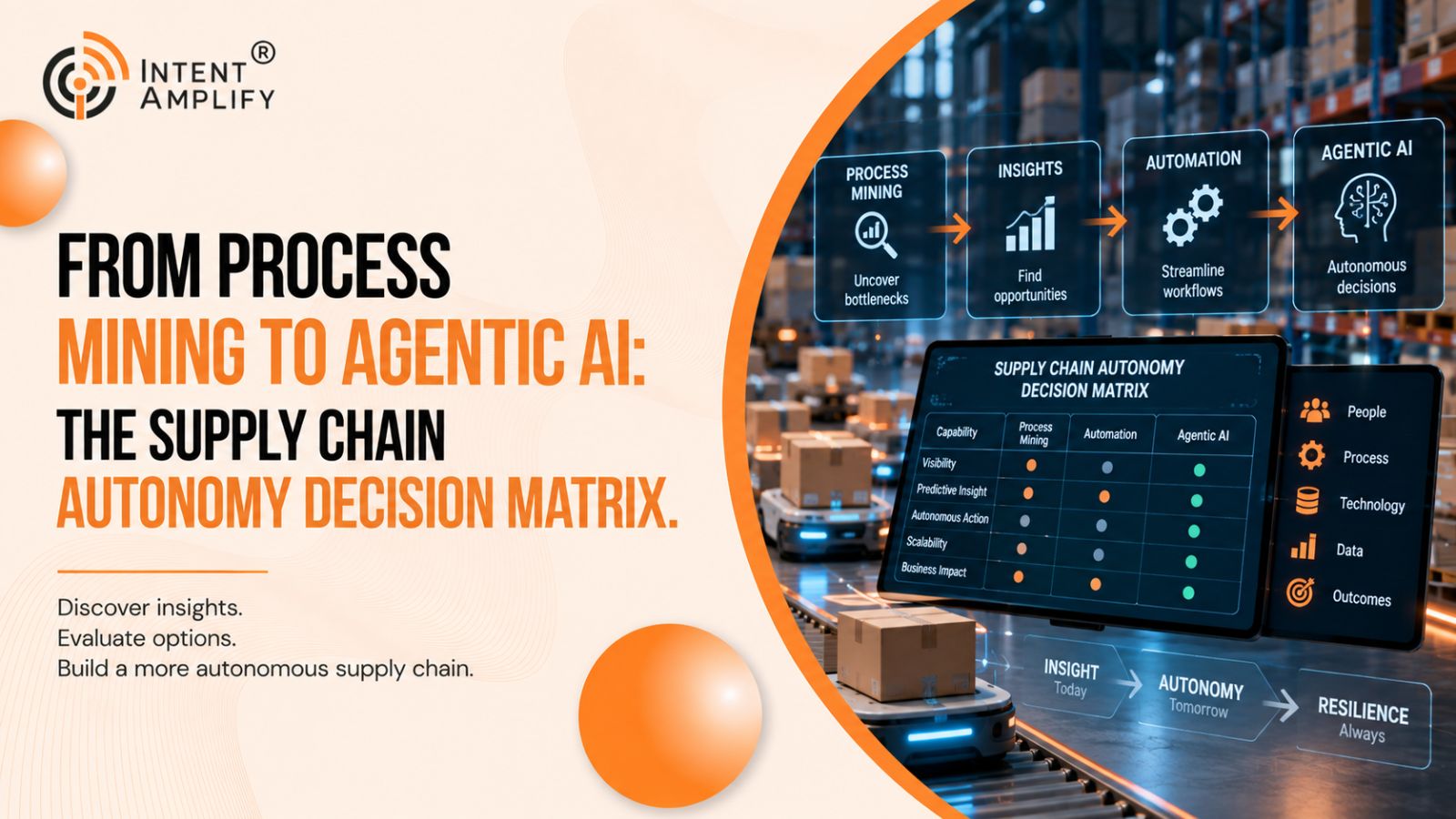
From Process Mining to Agentic AI: The Supply Chain Autonomy Decision Matrix

From Process Mining to Agentic AI: The Supply Chain Autonomy Decision Matrix
September 10, 2026 14 min read

Quick Answer

A practical decision framework for supply chain leaders to determine when process intelligence, automation, AI copilots, or agents fit a workflow based on complexity, impact, context, and authority.

Supply-chain leaders evaluating AI often face a category problem. Process mining, process intelligence, automation, copilots, and AI agents can all improve operations, but they solve different parts of the problem.

The executive decision should not be “Which technology is most advanced?” It should be “Which operating capability does this workflow require?”

PROCESS MINING: UNDERSTAND WHAT ACTUALLY HAPPENED

Process mining uses event data to reveal how processes really flow across systems. It can expose delays, rework, deviations, bottlenecks, and recurring patterns that traditional process documentation may miss.

Its core value is visibility into process behavior.

PROCESS INTELLIGENCE: TURN PROCESS BEHAVIOR INTO OPERATIONAL CONTEXT

Process intelligence extends that understanding by connecting process data with business knowledge, current state, relationships, and decision-relevant context.

The objective is not only to discover a process but to make the process understandable at the moment a decision must be made.

This is especially important for supply chains because a local event can have consequences across inventory, production, procurement, logistics, suppliers, customers, and finance.

AUTOMATION: EXECUTE A KNOWN RESPONSE

Automation is strongest when the desired action is deterministic. A rule detects a condition and triggers a predefined response.

This remains an essential capability. Not every workflow benefits from AI reasoning.

AI COPILOTS: IMPROVE HUMAN UNDERSTANDING

A copilot can summarize, retrieve, explain, draft, or recommend while a person remains the primary decision-maker.

For many supply-chain workflows, this is a strong first step because it improves speed and context without immediately increasing machine authority.

AI AGENTS: PARTICIPATE IN THE WORKFLOW

An agent can monitor, reason across context, coordinate steps, recommend actions, and, where permitted, execute.

The strategic difference is authority. Once an agent can act, the organization must explicitly define what it may do, when it must stop, and who owns the exception.

THE SUPPLY CHAIN AUTONOMY DECISION MATRIX

Use two dimensions to decide the appropriate operating model: decision complexity and action impact.

LOW COMPLEXITY + LOW IMPACT

Best fit: deterministic automation or bounded agent execution.

The response is predictable, information requirements are clear, and the action is reversible or low consequence.

HIGH COMPLEXITY + LOW IMPACT

Best fit: AI copilot or agent recommendation.

The situation requires synthesis or interpretation, but the final action can remain human-approved while the organization builds evidence.

LOW COMPLEXITY + HIGH IMPACT

Best fit: automation with explicit approval or strong control gates.

The decision may be straightforward, but the consequence justifies visible authorization.

HIGH COMPLEXITY + HIGH IMPACT

Best fit: context-rich AI assistance with accountable human decision ownership.

AI can assemble evidence and evaluate options, but autonomy should remain constrained until the organization has strong context, authority, and operating evidence.

CONTEXT IS THE AUTONOMY MULTIPLIER

As context improves, AI can make better recommendations. It can understand how events connect across the process, identify constraints, and evaluate downstream consequences.

But context should not be confused with authority. An agent can understand a situation well and still be prohibited from acting because the decision is financially material, strategically sensitive, or difficult to reverse.

THE AUTHORITY LADDER

  • Observe — monitor and interpret.
  • Recommend — propose an action.
  • Execute — perform an approved action.
  • Escalate — transfer responsibility when conditions exceed the boundary.

A mature operating model can move a workflow up this ladder only when evidence supports the change.

WHEN SUPPLY CHAIN AI SHOULD MOVE FROM COPILOT TO AGENT

A workflow is a stronger candidate for agent execution when:

  • The process is sufficiently understood.
  • Required context is available and trusted.
  • The action boundary is explicit.
  • Exceptions can be detected.
  • Human escalation is designed.
  • The action is sufficiently reversible or controlled.
  • Outcome evidence is observable.
  • Accountability is clear.

If several of these conditions are missing, a recommendation is usually a more defensible role than execution.

WHEN NOT TO ADD AUTONOMY

Do not add autonomy simply because the model is capable of more.

Avoid increasing authority when the process is unstable, data is contradictory, exception ownership is unclear, the action is difficult to reverse, or the organization cannot reconstruct why the decision occurred.

In these situations, the priority should be process improvement, context quality, or governance—not a more autonomous agent.

THE EXECUTIVE PORTFOLIO VIEW

Organizations should evaluate autonomy workflow by workflow rather than assign one maturity label to the enterprise.

One inventory process may support bounded execution. A supplier negotiation may remain human-owned. A logistics exception workflow may use agent recommendations. A routine status process may be fully automated.

This mixed portfolio is not a weakness. It is evidence that authority is being matched to the operating reality.

THE DECISION FRAMEWORK

For each workflow, document:

  • Business objective
  • Decision complexity
  • Action impact
  • Required context
  • Data quality
  • Process stability
  • AI role
  • Human owner
  • Escalation triggers
  • Reversibility
  • Evidence available
  • Expansion criteria

This turns autonomy into a deliberate operating decision.

APPLYING THE MATRIX TO REAL SUPPLY-CHAIN DECISIONS

The decision matrix becomes useful when leaders apply it to specific operating choices rather than broad technology programs. Supply-chain work contains hundreds of decisions with different levels of ambiguity, consequence, reversibility, and cross-functional dependency. Treating all of them as one automation or agentic-AI opportunity obscures the controls that actually matter.

Consider inventory rebalancing. A system may detect excess stock at one location and shortage risk at another. At first glance, moving inventory appears to be a straightforward optimization. In practice, the decision may depend on open customer orders, transport capacity, shelf life, production requirements, transfer costs, regional policies, and whether the inventory is genuinely substitutable. The complexity can therefore move from low to high as the operating context expands. The appropriate AI role should move with it.

A similar pattern appears in supplier management. Monitoring delivery performance can be automated. Summarizing a supplier exception can be handled by a copilot. Recommending an expedite may require an agent to evaluate production exposure, inventory coverage, alternative supply, and logistics options. Changing a strategic supplier, accepting a commercial concession, or committing to a materially different sourcing path can remain human-owned even when AI provides extensive analysis.

The matrix therefore prevents category errors. It helps leaders distinguish a workflow that is technically automatable from a decision that is operationally safe to automate.

DECISION COMPLEXITY: WHAT MAKES A WORKFLOW HARD TO REASON ABOUT

Decision complexity is not simply the number of data fields involved. A decision becomes more complex when its correct interpretation depends on relationships, changing conditions, exceptions, competing objectives, or information distributed across functions.

Several characteristics increase complexity. The first is dependency depth. A local event may affect multiple downstream processes. A delayed component can influence production, customer orders, inventory positioning, transport, and working-capital choices. The second is option ambiguity. Several responses may be technically possible, but the best option changes according to business priorities. The third is exception variability. A workflow that looks stable under normal conditions may become difficult when unusual supplier, customer, regulatory, or operational constraints appear.

Complexity also increases when the decision depends on tacit business knowledge. Teams may know that a supplier relationship is strategically sensitive, that a customer commitment should override a standard allocation rule, or that a nominal substitute creates operational friction not visible in master data. Until that knowledge is represented as usable context or deliberately retained as human judgment, the AI role should remain bounded.

For executives, the practical implication is clear: do not label a decision low-complexity merely because the transaction itself is simple. Evaluate the reasoning required to choose the action.

ACTION IMPACT: WHY CONSEQUENCE MATTERS AS MUCH AS COMPLEXITY

The second axis of the matrix is action impact. Impact should reflect the consequence of being wrong, the difficulty of reversing the action, the number of stakeholders affected, and the materiality of the commitment.

A low-impact action is not necessarily trivial. It is an action whose consequences are sufficiently bounded and recoverable that controlled execution is operationally acceptable. Examples may include routine status changes, internal routing, or reversible workflow updates when the underlying conditions are clear.

High-impact actions require stronger authorization even when the reasoning is simple. A predefined rule may identify when premium freight is allowed, but the financial consequence can still justify approval. A production allocation rule may be deterministic, but changing a customer commitment can carry service and commercial consequences. A supplier action may follow a known policy while still affecting a strategic relationship.

This is why the matrix separates complexity from impact. Complexity determines how much interpretation is required. Impact determines how much authority should be granted. Combining the two gives leaders a more defensible basis for choosing between automation, copilots, recommendations, bounded execution, and human ownership.

REVERSIBILITY AS A PRACTICAL CONTROL

Reversibility deserves explicit attention because it changes the cost of experimentation. A workflow can support more bounded autonomy when an incorrect action can be detected quickly, reversed cleanly, and contained without material downstream effects.

Reversibility should be evaluated operationally, not theoretically. An order field may be technically editable, but a change can become difficult to reverse after a supplier acts on it. A transport instruction may be changeable in a system, but capacity may already have been committed. An inventory allocation may be reversible in software while the physical movement has already begun.

Leaders should therefore ask when the action becomes consequential, what downstream systems or parties receive it, how quickly an error can be detected, and what recovery path exists. These questions help define whether execution authority is appropriate or whether recommendation and approval remain the better operating model.

THE ROLE OF PROCESS INTELLIGENCE IN AUTONOMY DESIGN

Process intelligence strengthens the matrix by showing how a decision actually sits inside the operating process. It can help reveal the sequence of events that produced the current state, the deviations that recur, the handoffs that create delay, and the points where teams repeatedly intervene.

That process view matters because autonomy should be designed around real workflow behavior rather than an idealized process diagram. If a supposedly standard process contains frequent exceptions, informal workarounds, or inconsistent ownership, giving an agent more authority can automate instability rather than improve the operation.

Process intelligence can also help identify where AI assistance is most useful before execution authority is considered. A workflow with significant time spent reconstructing context may benefit from automated monitoring and context assembly. A workflow with repeated decision bottlenecks may benefit from recommendations. A workflow with stable rules and observable outcomes may support bounded execution. The appropriate role emerges from the process evidence.

This makes process intelligence more than a discovery capability. It becomes an input to authority design.

DESIGNING THE EVIDENCE PACKAGE FOR A DECISION

An AI-enabled workflow should produce enough evidence for an authorized person to understand what happened without reconstructing the entire case manually. The evidence package should be proportional to the decision, but it should make the operating logic visible.

For a recommendation, useful evidence can include the triggering event, relevant process history, material data inputs, constraints, options considered, the recommended action, and the reason the recommendation was preferred. For an executed action, the record should additionally show the permission boundary, satisfied conditions, the action performed, and any subsequent outcome or exception.

Evidence serves three purposes. It supports immediate human judgment. It allows later review of whether the workflow behaved as intended. And it creates a basis for deciding whether authority should expand, remain unchanged, or contract.

A workflow that cannot provide reconstructable evidence should not receive greater autonomy simply because its outputs appear plausible.

ESCALATION IS A CAPABILITY, NOT A FAILURE

Autonomy discussions sometimes treat escalation as evidence that the AI is incomplete. In supply-chain operations, escalation is often a sign of a well-designed boundary.

An agent should stop when required context is missing, evidence conflicts, an action exceeds a permission threshold, a material exception appears, or the decision requires judgment that the workflow has deliberately kept human-owned. The quality of the operating model depends on whether those conditions are explicit and whether the handoff preserves context.

A useful escalation package should identify what triggered the workflow, what the agent established, which uncertainty or boundary prevented further action, what options remain available, and which owner is responsible for the next decision. This reduces duplicated analysis and keeps the human intervention inside the same operational thread.

Leaders should measure escalation patterns rather than simply minimize escalation volume. Repeated escalation for the same reason may reveal missing context, an incomplete rule, poor data quality, or an authority boundary that should be reconsidered. Conversely, an unexpected fall in escalations can be a warning if the agent is proceeding where it should stop.

AUTONOMY BY SUPPLY-CHAIN WORKFLOW

The matrix can be applied across common supply-chain domains.

In planning, AI can monitor demand and supply changes, assemble scenario inputs, and recommend responses. Execution authority should depend on the materiality and reversibility of the resulting plan change. Routine parameter updates can differ substantially from decisions that alter production or customer commitments.

In procurement, AI can classify exceptions, summarize supplier performance, identify dependencies, and recommend actions. Routine communications or workflow routing may support bounded execution. Commercial negotiation, supplier substitution, and strategic commitments generally require a clearer human authority boundary.

In logistics, AI can prioritize disruptions by operational consequence and evaluate recovery options using inventory, service, route, and cost context. A low-impact routing or status action may be executable inside explicit conditions, while premium freight or customer-impacting decisions can require approval.

In inventory operations, AI can detect imbalance, evaluate transfer options, and recommend reallocation. Authority should account for downstream demand, physical movement, service consequences, and the point at which the action becomes difficult to reverse.

In fulfillment, AI can help prioritize exceptions and identify which orders require intervention. Decisions that change customer commitments, allocation priorities, or service promises should remain aligned with explicit commercial ownership.

These examples reinforce the portfolio principle: the right autonomy level is specific to the decision, not the function or platform.

FROM SINGLE AGENTS TO MULTI-AGENT OPERATIONS

As organizations explore multiple agents, the decision matrix becomes more important rather than less. A multi-agent workflow can distribute monitoring, analysis, coordination, and execution across specialized components, but distributed capability can also make authority harder to see.

Leaders should identify which agent is responsible for each step, what context is shared, which agent can initiate an action, where approval occurs, and who owns an exception when agents disagree or produce conflicting recommendations. The workflow should preserve a coherent decision trail even when several agents contribute.

The central principle remains unchanged: coordination does not eliminate accountability. An organization should be able to identify the business owner of the decision and reconstruct how the operating system reached the action.

A PRACTICAL AUTONOMY REVIEW CADENCE

Autonomy should be reviewed as the workflow changes. A practical review can examine process stability, data quality, context completeness, recommendation behavior, execution outcomes, overrides, escalations, incidents, and changes in business policy.

The purpose is not to move every workflow toward more autonomy. The purpose is to confirm that the current authority remains appropriate. Evidence may justify expansion, but it may also justify reducing authority when the process changes, data quality deteriorates, or new exceptions appear.

A review should also separate changes in scope from changes in authority. Adding more users, suppliers, geographies, or transactions increases scope. Allowing the agent to execute a new class of action increases authority. These changes create different risks and should be evaluated independently where practical.

THE EXECUTIVE AUTONOMY SCORECARD

A useful executive review can organize evidence around six questions.

Process: Is the workflow stable enough to support the assigned AI role?

Context: Does the system have the information and relationships required to interpret the decision?

Authority: Are permitted and prohibited actions explicit?

Human ownership: Are approval, exception, and escalation responsibilities clear?

Observability: Can reviewers reconstruct recommendations and actions from retained evidence?

Outcomes: Does operating evidence support keeping, expanding, or reducing the current level of autonomy?

The scorecard should not be converted into a universal maturity score without evidence. Its value is in making the decision criteria visible and comparable across workflows.

IMPLEMENTATION SEQUENCE: FROM DISCOVERY TO CONTROLLED EXECUTION

A disciplined sequence begins with process discovery. Identify the decision, map how the workflow actually behaves, and establish the baseline operating problem. Next, define the context required to interpret the decision and identify which information is authoritative.

Then assign the initial AI role. For uncertain or high-impact workflows, observation or recommendation creates evidence without granting premature execution authority. Define escalation triggers and the human owner before the workflow is piloted.

During the pilot, collect evidence on process outcomes, recommendation quality, overrides, escalations, and control behavior. Review whether the agent used the required context and remained inside its boundary. Only then decide whether to increase scope, authority, or neither.

This sequence keeps autonomy tied to operating evidence rather than technology ambition.

CONCLUSION

Process mining helps organizations understand what happened. Process intelligence turns that understanding into decision-grade context. Automation executes known responses. Copilots improve human decisions. AI agents can participate directly in the workflow.

The right destination is not maximum autonomy. It is the right level of autonomy for the decision.

Supply-chain leaders should therefore treat autonomy as a portfolio of explicit authority choices, supported by process context, human accountability, and observable evidence.

Join the September 17 webinar, “Operational AI in the Supply Chain: How Context Empowers Agents and Humans to Operate Side by Side,” to explore how process intelligence and operational context can support the next stage of agentic supply-chain execution.

Register Now

REFERENCES

1. Celonis — Context Model: https://www.celonis.com/platform/context-model 

2. Celonis — Supply Chain Transformation: https://www.celonis.com/solutions/supply-chain-transformation/ 

3. Celonis — Enterprise AI: https://www.celonis.com/solutions/ai 

4. NIST — Artificial Intelligence Risk Management Framework (AI RMF 1.0): https://www.nist.gov/publications/artificial-intelligence-risk-management-framework-ai-rmf-10 

5. NIST — Generative AI Profile (NIST AI 600-1): https://www.nist.gov/publications/artificial-intelligence-risk-management-framework-generative-artificial-intelligence 

Contact
Sales