
Executive Overview
Global ecommerce expansion is moving from a country-launch exercise into an enterprise operating-model challenge. Demand can cross borders quickly, but the ability to transact, fulfill, support, reconcile, and govern that demand remains constrained by local payment behavior, tax and customs rules, product eligibility, delivery expectations, returns, customer service, data quality, and organizational ownership.
RETHINK Retail’s Global Expansion: The New Operating Model for Global Ecommerce campaign frames the shift around four connected priorities: building checkout trust through local relevance, replacing regional duplication with a connected global model, reducing tax/compliance/logistics complexity, and preparing commerce architecture for algorithmic traffic and AI-led discovery. The operating question is no longer simply where to launch next. It is how to make each launch locally credible without rebuilding the enterprise for every market.
This expert analysis argues that scalable global ecommerce requires a governed global core, a controlled market-configuration layer, and explicit decision rights for exceptions. The objective is not uniformity. It is repeatability: common truth and controls where consistency creates leverage, local configuration where relevance or regulation requires variation, and evidence-based governance where the boundary changes economics or risk.
Why the Country-by-Country Model Breaks at Scale
A traditional expansion sequence starts with a target country, storefront, campaign, payment method, shipping option, and local provider set. That model can move quickly when the portfolio is small. As markets accumulate, however, each launch can add new integrations, reporting definitions, tax treatments, customer-service procedures, return flows, data mappings, and manual reconciliation.
The resulting cost is not limited to provider fees or technology. It includes coordination: employees interpreting market-specific rules, finance teams reconciling different transaction states, operations teams investigating exceptions, and technology teams maintaining bespoke interfaces. These costs are often distributed across functions, so the portfolio can become harder to govern even when individual market economics appear acceptable.
A new operating model changes the unit of design. Instead of treating the country website as the scalable unit, leaders treat the reusable operating system as the scalable unit. Each market becomes a controlled configuration of that system rather than a separate version of the company.
Key Figures at a Glance
Current cross-border behavior reinforces why this operating shift matters. DHL’s 2026 E-Commerce Trends Report surveyed 29,000 online shoppers and 5,800 e-commerce businesses across 29 countries. It reports that 70% of shoppers buy internationally, up from 60% in 2025, and 45% buy across borders more than once a month. DHL also reports that more than three in ten orders are sent internationally and that 25% of businesses not currently shipping cross-border are prioritizing cross-border delivery capabilities over the next 12 months.¹
Checkout expectations are equally local. Global Payments’ 2026 report, covering 42 markets and polling 63,000 consumers, reports that digital wallets represented 56% of global ecommerce value in 2025. It describes “glocalization” as a defining payment trend: domestic payment systems are extending across borders while customers continue to expect familiar ways to pay.²
The wider trade environment remains deeply connected. DHL’s 2026 Global Connectedness Report, based on more than nine million data points across trade, capital, information, and people flows, reports that globalization remained at a historically high level in 2025 despite geopolitical and policy uncertainty.³
Together, these figures show the central tension. Cross-border demand is active, but the customer experience and operating obligations remain market-specific. Expansion therefore needs both global coordination and local execution.
The Global Core Should Standardize Enterprise Truth
The global core is the part of the operating model that should become stronger as the business enters more markets. It includes product identity, customer permissions, security, order states, inventory definitions, financial controls, transaction reconciliation, performance measures, and the interfaces that connect commerce to downstream operations.
The purpose of the core is not to eliminate local flexibility. It is to prevent every local decision from creating a different version of enterprise truth. A product should not acquire incompatible identifiers because it is sold in another country. An order should not become impossible to trace because a local provider uses different event language. Finance should not need a bespoke reconciliation process every time a payment method or fulfillment partner changes.
A strong core also improves learning. When order, payment, inventory, return, and service states are comparable, leadership can distinguish a market-specific problem from a recurring system problem. The next launch can inherit the solution rather than rediscover it.
Market Configuration Is Where Local Trust Is Built
Localization should be treated as governed configuration, not uncontrolled customization. Language, currency, price lists, payment methods, tax treatment, permitted assortment, delivery choices, return policies, disclosures, and support routes may legitimately differ by market. These are often the elements customers experience most directly.
The campaign’s emphasis on hyper-local checkout is important because payment choice is not merely a technical integration. It is part of customer trust. Global Payments reports that local payment systems are expanding internationally while digital wallets have become the leading consumer payment method globally.² A globally consistent checkout that ignores local payment expectations can therefore be operationally neat but commercially weak.
The design principle is straightforward: standardize the underlying transaction and control model, then configure the customer-facing methods that create local relevance. Every configuration should have an owner, evidence, test criteria, and a way to reconcile back to shared order and finance controls.
Compliance, Tax, and Customs Must Move Into the Operating Model
Cross-border compliance cannot be treated as a final pre-launch checklist. Seller structure, product eligibility, duties, tax, documentation, customer disclosures, shipping data, returns, and financial reconciliation are connected. A change in one layer can alter several others.
The practical implication is that compliance decisions need to be represented in systems and workflows, not only in policy documents. Product eligibility should control what can be sold. Tax and duty logic should connect to pricing and checkout. Customs data should be available before fulfillment. Returns should account for the financial and regulatory consequences of goods moving back across borders.
A mature operating model therefore makes compliance executable. It identifies the authoritative rule, the system or workflow that enforces it, the owner responsible for keeping it current, and the escalation path when the rule conflicts with a commercial objective. Where appropriate, a Merchant of Record model can be evaluated as an abstraction layer for localized seller, payment, tax, compliance, and logistics obligations; its value depends on economics, control, customer experience, data ownership, and market requirements.
Payments, Fulfillment, and Returns Form One Customer Promise
Customers do not experience payments, logistics, and returns as separate internal functions. They experience one promise: can I buy this product confidently, receive it when expected, and resolve a problem without unnecessary friction?
DHL’s 2026 research reports that 67% of online shoppers have abandoned a cart because of the delivery offering. It also reports that seven in ten shoppers will not shop with a brand if they do not trust the delivery and returns provider, and a similar proportion will abandon a cart when the delivery and returns options they want are unavailable.¹ These are global survey findings, not a forecast for any individual merchant, but they illustrate why checkout and post-purchase operations should be designed together.
The operating model should connect payment authorization, fulfillment status, delivery events, return authorization, refund state, customer communication, and finance reconciliation. When those states are disconnected, exceptions become manual, and customers receive inconsistent answers. When they are connected, teams can diagnose where the promise failed and who owns the next action.
AI-Led Discovery Raises the Standard for Product and Offer Truth
The campaign’s AI-readiness theme changes the expansion discussion again. As discovery shifts toward AI-assisted search, algorithmic interfaces, and global marketplaces, commerce data must be understandable beyond the storefront. Product identity, availability, price, eligibility, delivery promise, policy, and market-specific attributes need authoritative sources and governed updates so demand can arrive at a transaction-ready back end.
AI readiness is therefore not primarily a chatbot decision. It is an information architecture and operating-governance decision. If product and offer data conflict across systems, AI interfaces can amplify inconsistency rather than remove it. If market rules are stored only in manual processes, automated discovery may surface an offer the enterprise cannot reliably fulfill.
The new operating model should treat structured product truth, policy ownership, data quality, and controlled interfaces as prerequisites for AI-led commerce. The same foundations that make cross-border operations governable also make commerce more machine-readable.
Governance Defines What Is Global, Local, and Exceptional
The central governance question is not “centralize or localize?” It is “which layer belongs where, and who governs the boundary?” A useful model separates three categories.
Global standards protect enterprise integrity: product identity, security, core order states, finance controls, customer permissions, data definitions, and minimum performance requirements. Market configurations create justified local relevance: language, currency, payment choice, assortment, tax treatment, delivery, returns, and disclosures. Exceptions are changes that cannot be handled safely through the approved core or configuration layer.
Exceptions deserve explicit scrutiny because they create lifecycle obligations. Leaders should ask what customer, regulatory, resilience, or commercial value the exception creates; which systems and teams it affects; whether it is reusable; how it will be monitored; and whether it can be retired cleanly.
Measure Expansion Through Operating Economics
Market revenue alone does not reveal whether expansion is becoming more scalable. Leaders also need visibility into transaction cost, coordination cost, exception burden, and capability reuse.
A useful operating-adjusted market review begins with contribution economics and adds material market-specific run costs that would disappear if the market or exception did not exist. These may include recurring manual reconciliation, dedicated provider management, unusual support demand, bespoke integration maintenance, special reporting, or return processes that prevent efficient inventory recovery.
The goal is not false precision. It is to make structural differences visible. A market with strong demand may still require operating redesign if complexity grows faster than revenue. Conversely, an investment in a shared capability may appear expensive in one launch but create leverage across several future markets.
What the New Global Ecommerce Operating Model Should Include
The operating model should be practical enough for commerce, operations, finance, technology, compliance, and customer teams to use in the same decision process.
Table 1: Global Ecommerce Operating Model Framework
|
Operating Area |
Executive Control Question |
|
Market Strategy |
Is the market’s role supported by demand, economics, operating feasibility, and a named decision owner? |
|
Commerce Architecture |
Which capabilities belong in the global core, and which should remain controlled local configurations? |
|
Product and Data |
Are product identity, eligibility, attributes, pricing, inventory, and ownership governed by authoritative sources? |
|
Payments and Trust |
Are locally relevant payment methods connected to shared order, fraud, settlement, reconciliation, and refund controls? |
|
Compliance and Tax |
Can product, tax, duties, customs, privacy, and disclosure requirements be executed consistently and evidenced when required? |
|
Fulfillment and Returns |
Can the enterprise trace the customer promise from order through delivery, return, refund, and inventory recovery? |
|
Customer Experience |
Are local language, support, delivery, returns, and redress promises consistent with the operating capabilities the business can actually deliver? |
|
Governance and Analytics |
Are decision rights, exceptions, performance definitions, and market learnings governed and shared across the organization? |
This framework keeps local relevance and enterprise control in the same architecture. It also prevents a common failure mode: launching the visible storefront while the underlying customer-to-cash journey remains fragmented.
Roadmap for Moving From Market Launches to Repeatable Expansion
The transition should begin with evidence rather than platform replacement. First, map the current customer-to-cash journey across live markets and identify where product, payment, tax, fulfillment, returns, service, and finance states diverge. Second, define the minimum global core and the approved configuration layer. Third, identify exceptions that create recurring manual work or unclear ownership.
The next stage is to test the model through a real market decision. Validate demand and contribution economics, configure local checkout and customer promises, test compliance and fulfillment states, and run controlled volume through the complete journey. Measure not only sales but also payment failures, delivery exceptions, return handling, support demand, reconciliation, and the amount of manual coordination required.
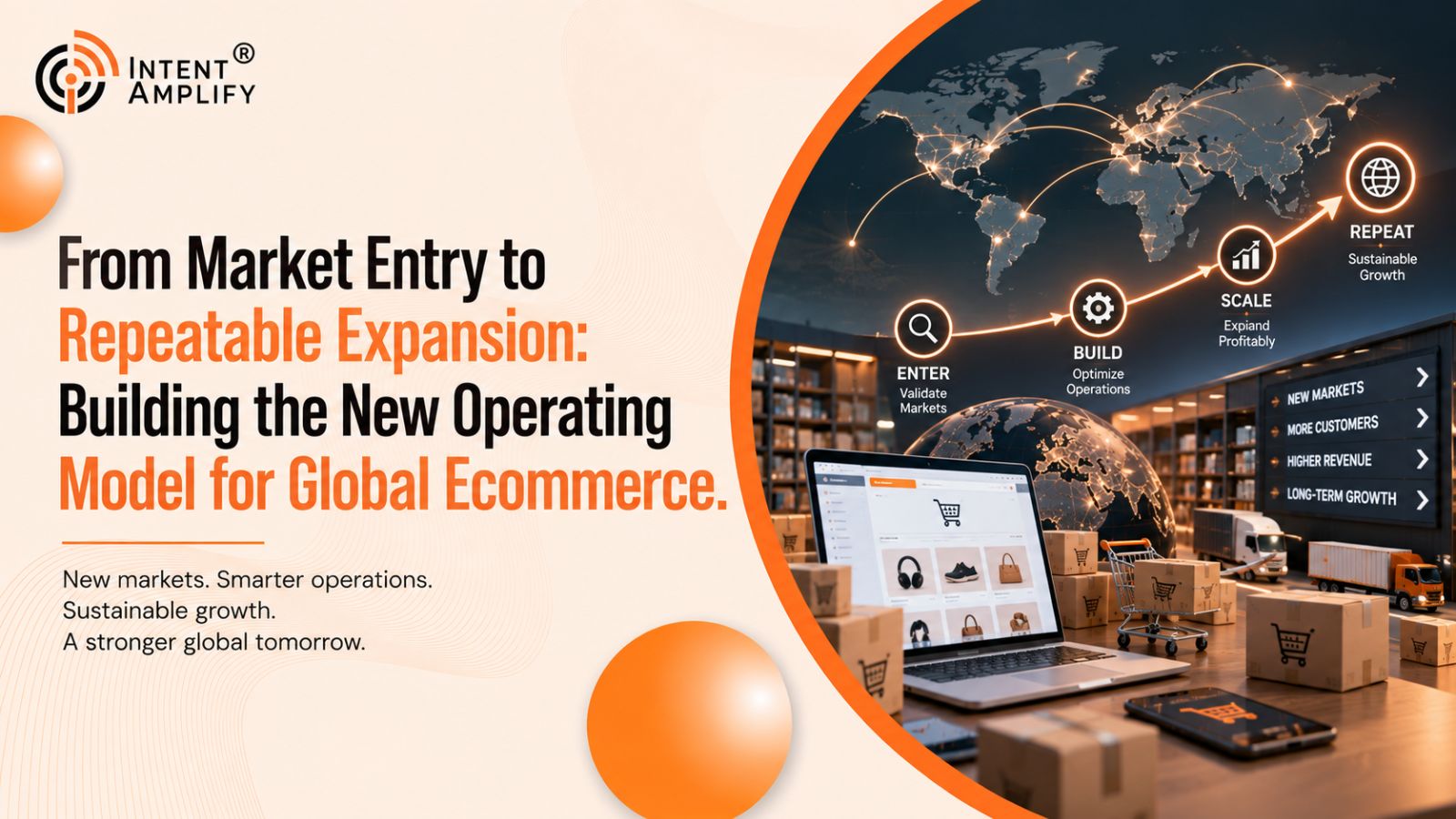
Finally, convert learning into reusable standards. A successful launch should leave behind better configuration, clearer ownership, stronger interfaces, and a smaller unknown set for the next market.
Flowchart: Global Ecommerce Expansion Path
Validate market demand, economics, and strategic role
↓
Define the global core and required local configuration
↓
Test product, payment, compliance, fulfillment, returns, and service end-to-end
↓
Launch controlled volume with named owners and exception thresholds
↓
Measure customer outcomes, operating quality, and coordination burden
↓
Convert learning into reusable global standards before the next expansion wave
This sequence shifts the organization from “launch and fix” toward evidence-led expansion in which every market strengthens the operating system.
What RETHINK Retail Brings to the Conversation
RETHINK Retail’s Global Expansion: The New Operating Model for Global Ecommerce focuses attention on a practical enterprise problem: how to preserve local customer relevance while reducing the duplication and backend complexity created by market-by-market expansion. The campaign connects checkout trust, unified systems, compliance and logistics complexity, and AI discovery within one operating-model discussion.
For ecommerce and retail leaders, that framing matters because the next stage of international growth is not only about acquiring demand. It is about whether the enterprise can support, govern, and learn from that demand across markets. The strongest model is not the one with the fewest local differences. It is the one that makes every difference intentional, observable, and economically justified.
Explore Global Expansion: The New Operating Model for Global Ecommerce
RETHINK Retail’s report examines the shift from market-by-market expansion toward a connected global ecommerce operating model, including hyper-local checkout, one connected global model, backend simplification including Merchant of Record approaches, and architecture prepared for AI search and global-marketplace demand.
Read the full RETHINK Retail report
Next Step for Global Ecommerce Leaders
For ecommerce, digital, operations, payments, logistics, finance, technology, and transformation leaders, the next step is to test whether the operating model can preserve local relevance while reducing regional duplication, compliance burden, and transaction complexity.
Conclusion
Global ecommerce expansion becomes more durable when the enterprise stops treating every country as a separate operating system. Local relevance remains essential, but it should be delivered through a governed model that connects product truth, checkout, payments, compliance, fulfillment, returns, service, finance, and performance measurement.
The leadership challenge is to make common controls stronger as the market portfolio grows while keeping local configuration fast enough to meet customer and regulatory requirements. That is the operating discipline behind repeatable expansion: standardize what protects enterprise truth, configure what creates local trust, and govern the exceptions that materially change economics, accountability, or risk.
The result is not centralization for its own sake. It is a global commerce system that can absorb new markets without multiplying fragmentation at the same rate as growth.
References
1. DHL eCommerce (2026) 2026 E-Commerce Trends Report. Available at: https://www.dhl.com/global-en/microsites/ec/ecommerce-insights/insights/reports/2026-ecommerce-trends-report.html
2. Global Payments (2026) Global Payments Report 2026: Trends Redefining Payments. Available at: https://www.globalpayments.com/en-gb/insights/gpr
3. DHL Group and NYU Stern (2026) DHL Global Connectedness Report 2026. Available at: https://www.dhl.com/global-en/microsites/core/global-connectedness/report.html
4. RETHINK Retail (2026) Global Expansion: The New Operating Model for Global Ecommerce. Available at: https://intenttechpub.com/POC/Rethink/global-expansion-the-new-operating-model-for-global-ecommerce.html
5. World Trade Organization (2026) Agreement on Electronic Commerce. Available at: https://www.wto.org/english/tratop_e/ecom_e/joint_statement_e.htm