
Executive Brief
Spend management is moving beyond transaction processing. Procurement, finance, operations, and business teams increasingly need a connected operating model that can interpret spend signals, guide decisions, coordinate workflows, and preserve governance as AI becomes embedded in enterprise processes.
The shift is not simply from manual work to automation. It is from fragmented workflows toward decision systems in which data, policies, suppliers, users, and AI can work together. SAP describes autonomous spend management as an evolution enabled by AI and connected processes, while BCG argues that AI-first procurement can create competitive advantage when organizations redesign how decisions and work are orchestrated.[1][2]
For beginners, the core idea is straightforward: effective spend management helps an organization understand what it buys, from whom, under which terms, through which process, and with what business consequence. AI-native spend management extends that foundation by helping teams interpret information earlier and act more consistently without removing appropriate human oversight.
This eBook provides a practical introduction to that transition. It explains the operating principles behind autonomous spend, the importance of trusted data, the role of human-in-the-loop agentic AI, the governance requirements leaders should establish, and a phased path for moving from fragmented spend operations toward AI-native commerce.
Why Spend Management Is Being Rebuilt
Traditional spend management has often been organized around separate systems and functions: sourcing, procurement, contracts, invoicing, supplier management, payments, expense controls, and financial planning. Each function may work adequately on its own while the overall decision journey remains fragmented.
That fragmentation becomes more visible as enterprises introduce AI. An AI agent cannot reliably support a purchasing decision if supplier information is inconsistent, contract terms are inaccessible, approval rules are unclear, or spend classifications conflict across systems. Gartner’s 2026 guidance on AI-ready procurement data architecture emphasizes deliberate data-architecture choices so procurement information can support AI use cases reliably rather than adding intelligence on top of fragmented foundations.[3]
The result is a change in leadership focus. The question is no longer only, “How do we automate this procurement task?” It becomes, “How should this decision be made, what evidence should inform it, what policy should constrain it, and where must a person remain accountable?”
Intent Amplify Observation
AI-native spend management begins with decision architecture. Automation can accelerate an existing workflow, but autonomy requires reliable context, explicit boundaries, and clear ownership of the resulting business decision.
Intent Amplify Perspective
Intent Amplify views autonomous spend management as an operating-model evolution rather than a software feature. The strongest programs connect four layers: trusted spend and supplier data, decision logic, AI-enabled execution, and human governance.
This distinction matters because procurement value is rarely created by a single action. A sourcing recommendation may depend on demand, supplier capability, contractual obligations, risk, policy, inventory, cash priorities, and market conditions. If those inputs remain separated, AI may make work faster without making the enterprise decision materially better.
A practical beginner’s model therefore starts with the decision itself. Leaders should identify the business outcome, determine which evidence is required, define what the system may recommend or execute, and establish where human review is mandatory.
The Cost of Fragmented Spend Decisions
Fragmented spend operations create friction in three ways.
First, users face inconsistent buying journeys. They may need to search across catalogs, contracts, suppliers, policies, and approval channels before they can make a compliant purchase.
Second, procurement teams spend time reconciling information rather than interpreting it. Contract data, supplier records, sourcing events, purchase orders, invoices, and financial data can describe the same commercial relationship differently.
Third, governance often arrives late. Policy checks performed after a purchase request is assembled create rework and encourage users to treat procurement as a control gate rather than a decision partner.
IBM’s 2026 analysis of AI-driven integration shows how connected data and workflows can reduce supply-chain exceptions and accelerate decision-making; the broader lesson for spend management is that intelligence creates more value when it is integrated into operational decisions.[4]
Intent Amplify Observation
The objective is not to remove every friction point. Some controls are necessary. The objective is to remove avoidable friction while making required controls easier to understand, apply, and audit.
From Workflow Automation to AI-Native Spend Management
Workflow automation follows predefined steps. AI-native spend management adds interpretation. It can use enterprise context to recommend an action, prioritize an exception, surface a risk, or coordinate work across multiple systems.
A useful maturity path has four stages:
Stage 1 — Tactical AI support: AI primarily advises or assists with operational work while processes may still be fragmented.
Stage 2 — Digital assistants: More unified spend processes enable AI-guided support across sourcing, contracts, intake, analysis, and related work.
Stage 3 — Collaborative partners: AI agents participate more consistently in strategic work and decision support.
Stage 4 — Autonomous operations: Agents can make and execute more decisions with minimal human intervention within mature data, process, governance, and change-management controls.
Gartner’s 2026 guidance on establishing a procurement AI steering committee reinforces the need for cross-functional governance, clear decision rights, and disciplined oversight as AI use expands.[5]
The maturity path is not a race to remove humans. Organizations should advance only where the evidence, process design, controls, and accountability are strong enough to support the next level.
Building a Trusted Spend Data Foundation
AI quality depends on context quality. Spend data must therefore be treated as operating infrastructure.
A trusted foundation should connect supplier identities, categories, contracts, purchase orders, invoices, payment terms, risk signals, policies, business units, and user roles. It should also define which system is authoritative for each critical field.
Common data problems include duplicate suppliers, inconsistent category taxonomies, incomplete contract metadata, disconnected supplier-risk information, and unclear ownership of master data. These issues are not merely technical. They affect what an AI system can infer and which decisions it can safely support.
Leaders should prioritize five data questions:
• Is the information sufficiently complete for the decision?
• Is its source authoritative?
• Is it current enough for the intended use?
• Can the decision logic explain how the information was used?
• Is there an accountable owner when the information is wrong?
Intent Amplify Observation
AI readiness is not achieved by centralizing every dataset. It is achieved when the decision system can access the right evidence, understand its meaning, and operate within defined quality and governance boundaries.
Human-in-the-Loop Agentic AI
Agentic AI introduces a different operating question from traditional automation: what may the system do on behalf of the enterprise?
The answer should vary by decision consequence. Low-risk actions may be suitable for automated execution within clear policy boundaries. Higher-impact decisions may require a recommendation, explanation, and explicit human approval.
A practical human-in-the-loop model can classify activities into four modes:
Observe — AI monitors information and identifies patterns or exceptions.
Recommend — AI proposes an action but a person decides.
Act with approval — AI prepares or coordinates an action that requires human authorization.
Act within policy — AI executes a defined action autonomously inside preapproved limits and escalates exceptions.
Gartner’s 2026 assessment framework for procurement AI adoption reinforces the importance of organizational readiness before scaling more autonomous behavior.[6]
Intent Amplify Observation
Human-in-the-loop is not a temporary limitation to be engineered away. It is an operating-design choice that should reflect financial exposure, regulatory consequence, supplier impact, reversibility, and confidence in the underlying evidence.
Connecting Buyers, Suppliers, Data, and AI
AI-native commerce becomes more valuable when it connects both sides of the commercial relationship. Buyers need relevant supplier options, policy guidance, contractual context, and risk information. Suppliers need clearer requirements, faster resolution of exceptions, and more consistent interaction with enterprise processes.
A connected spend network can support this by bringing together transaction history, supplier information, commercial terms, operational signals, and decision context. The value comes from the quality and relevance of the shared context, not simply the size of the network.
For leaders, the practical design principle is interoperability. Procurement, finance, legal, security, operations, and suppliers should not need to recreate the same context every time a spend decision moves between systems or teams.
Governance, Risk, and Control in Autonomous Spend
Autonomy without governance can accelerate the wrong decision. Governance should therefore be designed into the operating model rather than added after deployment.
At minimum, leaders should define:
• Approved use cases and prohibited actions
• Data sources that may inform each decision
• Financial and contractual authority limits
• Human approval thresholds
• Supplier and user identity requirements
• Logging and audit expectations
• Exception and escalation rules
• Performance and risk review cadence
Governance should also distinguish reversible from irreversible actions. A recommendation can usually be reviewed and changed. A supplier commitment, contract modification, payment instruction, or access change may create consequences that require stronger authorization.
Intent Amplify Observation
The purpose of governance is not to slow AI adoption. It is to make scaled adoption possible by ensuring that teams understand where autonomy is permitted, where oversight is required, and how decisions can be reconstructed after the fact.
Autonomous Spend Readiness Framework
The following framework gives beginners a practical way to assess readiness.
Foundation — Establish trusted spend, supplier, contract, policy, and identity data.
Connect — Link workflows and evidence across procurement, finance, legal, operations, and supplier interactions.
Assist — Use AI to interpret information, surface exceptions, generate recommendations, and improve user guidance.
Govern — Define decision rights, approval thresholds, audit requirements, and escalation paths.
Automate — Allow agents to execute selected activities inside approved policies and limits.
Learn — Measure outcomes, review exceptions, improve decision logic, and expand autonomy only when evidence supports it.
The framework is intentionally sequential. Organizations may operate at different levels across different use cases. Invoice exception handling, sourcing analysis, contract review, supplier onboarding, and purchase guidance do not need to mature at the same pace.
Measuring Business Value Beyond Automation
Traditional automation programs often emphasize time saved or tasks eliminated. Those measures remain useful but are incomplete for autonomous spend.
Leaders should also evaluate:
Decision quality — Are recommendations using the correct commercial, contractual, policy, and supplier context?
Adoption — Are users completing spend decisions through the intended buying journey?
Compliance — Are policies and approval requirements applied consistently?
Exception resolution — Are high-impact exceptions identified and resolved earlier?
Supplier experience — Are suppliers receiving clearer requirements and faster resolution?
Control effectiveness — Can the organization explain, review, and audit AI-supported decisions?
Business value should be tied to verified outcomes rather than assumed AI benefits. Where baseline evidence is unavailable, the correct starting point is measurement design, not an unsupported ROI claim.
Practical Implementation Roadmap
Phase 1: Map the Spend Decision Journey
Identify priority buying, sourcing, contracting, supplier, invoice, and payment decisions. Document the systems, evidence, policies, owners, and approval points involved.
Phase 2: Fix Critical Data Gaps
Prioritize the data problems that directly affect selected use cases. Establish authoritative sources and accountable owners.
Phase 3: Introduce AI Assistance
Start with bounded use cases such as summarization, classification, guided buying, recommendation support, contract interpretation, or exception prioritization.
Phase 4: Define Governance for Agents
Set authority limits, approval rules, prohibited actions, evidence requirements, logging, and escalation paths before enabling autonomous execution.
Phase 5: Pilot Governed Autonomy
Choose reversible or tightly bounded workflows. Compare outcomes against established baselines and review exceptions closely.
Phase 6: Scale Based on Evidence
Expand autonomy only where performance, adoption, control effectiveness, and business outcomes are verified.
What Leaders Should Prioritize Next
1. Start with decisions, not AI features. Identify the spend decisions that create the most friction, risk, or coordination burden.
2. Make data ownership explicit. AI cannot compensate reliably for unclear supplier, contract, category, or policy data.
3. Separate recommendation from authority. Define what AI may suggest, prepare, approve, and execute.
4. Design the human role deliberately. Human review should focus on consequence, ambiguity, and accountability rather than repeating work the system can perform reliably.
5. Measure before scaling. Establish baselines and outcome measures before claiming productivity, savings, compliance, or ROI improvements.
Strategic Takeaway
The path to autonomous spend is not a single technology deployment. It is a controlled progression from fragmented information and workflows toward connected decision architecture, trusted data, AI assistance, governed agency, and evidence-based scaling.
Explore the Beginner’s Guide
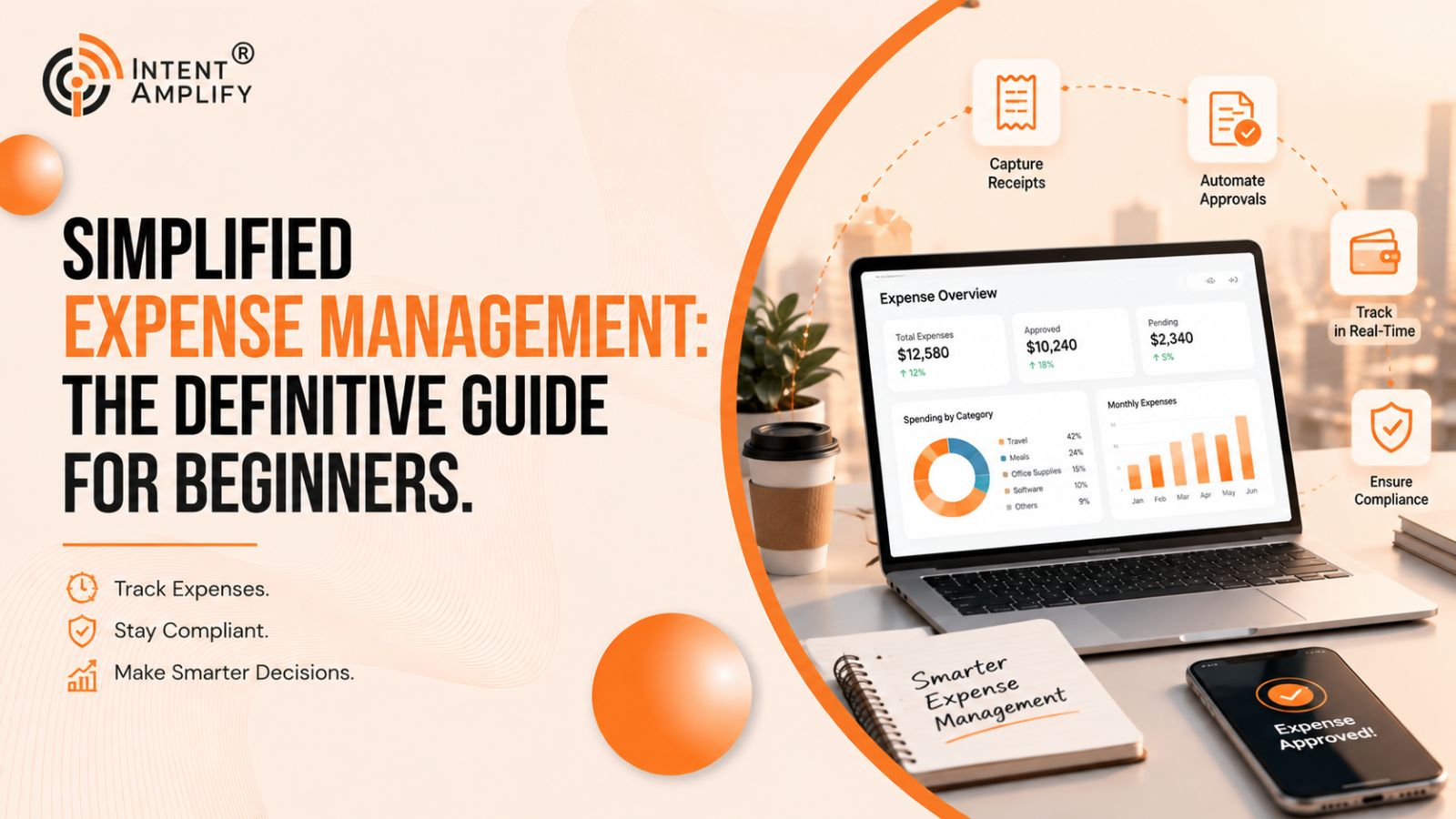
Explore the e-book: “Simplified Expense Management: The Definitive Guide for Beginners.”
Conclusion
Spend management is becoming a decision discipline for the AI-native enterprise. The strongest operating models will connect trusted data, commercial context, policy, suppliers, users, and AI while keeping accountability aligned with business consequence.
For beginners, the priority is not to pursue maximum autonomy immediately. It is to build the conditions that make autonomy useful and governable: reliable evidence, connected workflows, explicit decision rights, human oversight, and outcome measurement.
Organizations that establish those foundations can move from isolated automation toward an operating model in which AI supports better spend decisions and selected agents act safely within defined enterprise boundaries.
References
- SAP (2026) The Future of the Enterprise Is Autonomous. Available at: https://news.sap.com/2026/05/future-enterprise-autonomous/
- Boston Consulting Group (2026) AI-First Procurement: How Autonomous Agents Drive Competitive Advantage. Available at: https://www.bcg.com/publications/2026/ai-in-procurement-drives-competitive-advantage
- Gartner (2026) Make 5 Data Architecture Decisions to Enable AI-Ready Procurement. Available at: https://www.gartner.com/en/documents/8140029
- IBM (2026) How AI-Driven Integration Reduces Supply Chain Exceptions and Accelerates Decision-Making. Available at: https://www.ibm.com/think/insights/ai-driven-integration-reduces-supply-chain-exceptions-accelerates-decision-making
- Gartner (2026) Establish a Procurement AI Steering Committee. Available at: https://www.gartner.com/en/documents/7723557
- Gartner (2026) Assess the Readiness of Your Procurement Organization for AI Adoption. Available at: https://www.gartner.com/en/documents/8313753