
From GenAI Proof of Concept to Production Readiness
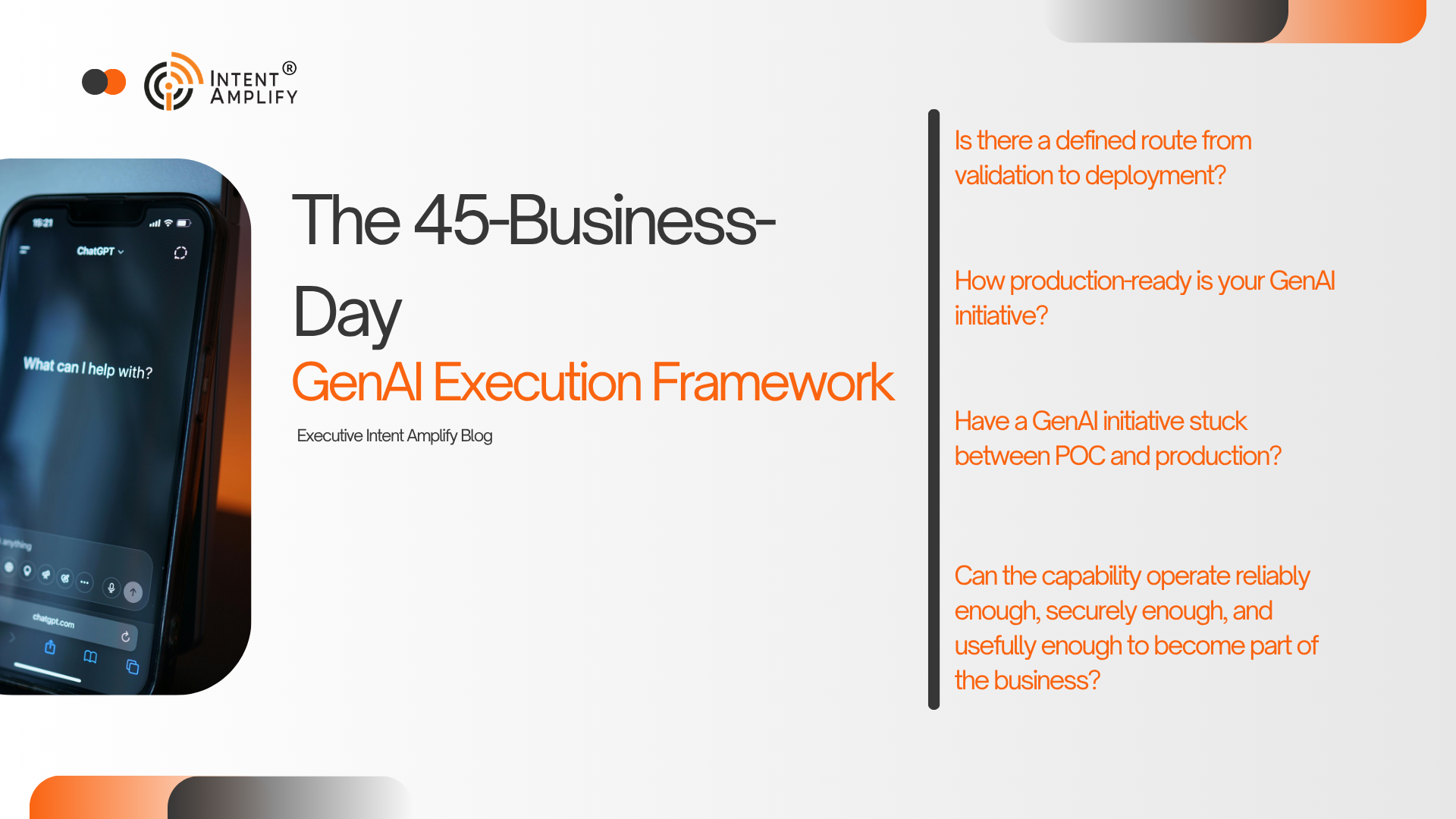
A successful GenAI proof of concept answers one question:
Can the technology work?
Production readiness asks a harder question:
Can this capability operate reliably inside the business, for a defined workflow, under real enterprise conditions, and against explicit success criteria?
That difference is the GenAI Execution Gap.
The GenAI Execution Gap
The gap between proof of concept and production typically spans eight execution dimensions.
Business Value
Is the problem important enough to justify continued investment?
A technically impressive use case is not automatically a production-worthy one. The initiative needs a defined business problem, an intended user or workflow, an accountable owner, and clear criteria for recognizing value.
Data
Is the required enterprise data available, usable, and governed?
Production depends on knowing where the required information lives, who owns it, whether it is current, how it can be accessed, and what the system should never be allowed to access.
Architecture
Can the capability operate inside the intended enterprise environment?
A proof of concept can operate in isolation. Production has to work within real infrastructure, identity, security, cloud, application, and operating constraints.
Integration
Can the capability connect to the systems and workflows where work actually happens?
Production value depends on whether GenAI becomes part of a real business process rather than remaining a disconnected demonstration.
Evaluation
Has the organization defined what acceptable performance means?
A convincing response is not enough. Teams need agreed criteria for quality, reliability, groundedness, failure handling, human review, and business performance.
Governance
Are the required controls, oversight, and risk boundaries clear?
The appropriate governance model depends on the use case, the information being used, the decisions being supported, and the consequences of failure.
Ownership
Who is accountable for the capability after the proof of concept?
Production requires ownership for operations, monitoring, exceptions, changes, adoption, and ongoing performance.
Adoption
Is there a practical route for users and teams to incorporate the capability into their work?
A technically ready system does not create value if the intended users cannot or do not adopt it.
The 45-Business-Day Execution Path
The objective of the 45-business-day framework is not to force every GenAI initiative into production.
It is to create a disciplined execution window that produces enough evidence for a better production decision.
Days 1–5 — DEFINE
Establish the business problem, target workflow, expected value, accountable owner, and success criteria.
Primary question:
Is this use case important enough to justify focused execution?
Days 6–15 — GROUND
Validate the enterprise data, architecture, access, permissions, integration requirements, security considerations, and operating constraints.
Primary question:
Do we understand the enterprise reality this capability must operate within?
Days 16–30 — BUILD
Develop the capability around the intended workflow and the production conditions that matter.
The objective is not feature volume.
The objective is evidence.
Primary question:
Can the use case perform under increasingly realistic enterprise conditions?
Days 31–40 — VALIDATE
Evaluate the capability against agreed business, technical, governance, and operating criteria.
Test where it succeeds.
Identify where it fails.
Document the conditions under which human review, escalation, or additional controls are required.
Primary question:
Does the available evidence support the intended use case?
Days 41–45 — DECIDE
Bring business and technical evidence together.
Determine the appropriate next step.
The Production Decision
ADVANCE
Evidence supports moving the initiative toward production.
REFINE
The use case remains valid, but specific gaps must be resolved before progressing.
RE-SCOPE
The original opportunity is too broad, risky, or poorly aligned, but a narrower or different version may remain viable.
STOP
Available evidence does not justify continued investment.
A disciplined GenAI program does not force every experiment into production.
It produces better decisions faster.
Assess Your GenAI Production Path
If your initiative is caught between proof of concept and production, start by identifying which of the eight execution dimensions remain unresolved.
Ask:
Do we have a clearly defined business outcome?
Is the required enterprise data ready?
Can the capability operate inside the intended technology environment?
Are the necessary integrations understood?
Have we defined acceptable performance?
Are governance requirements clear?
Is production ownership assigned?
Is there a practical path to adoption?
Where the evidence is insufficient, the status should remain UNKNOWN until the required evidence is available.
Download the Infographic