
How B2B teams decide when account evidence is strong enough to act
Account signals can tell a GTM team that something happened. They do not automatically explain what that activity means, who is involved, whether a buying process exists, or whether sales should act.
That gap between observable activity and defensible action is where many B2B revenue teams face the greatest uncertainty.
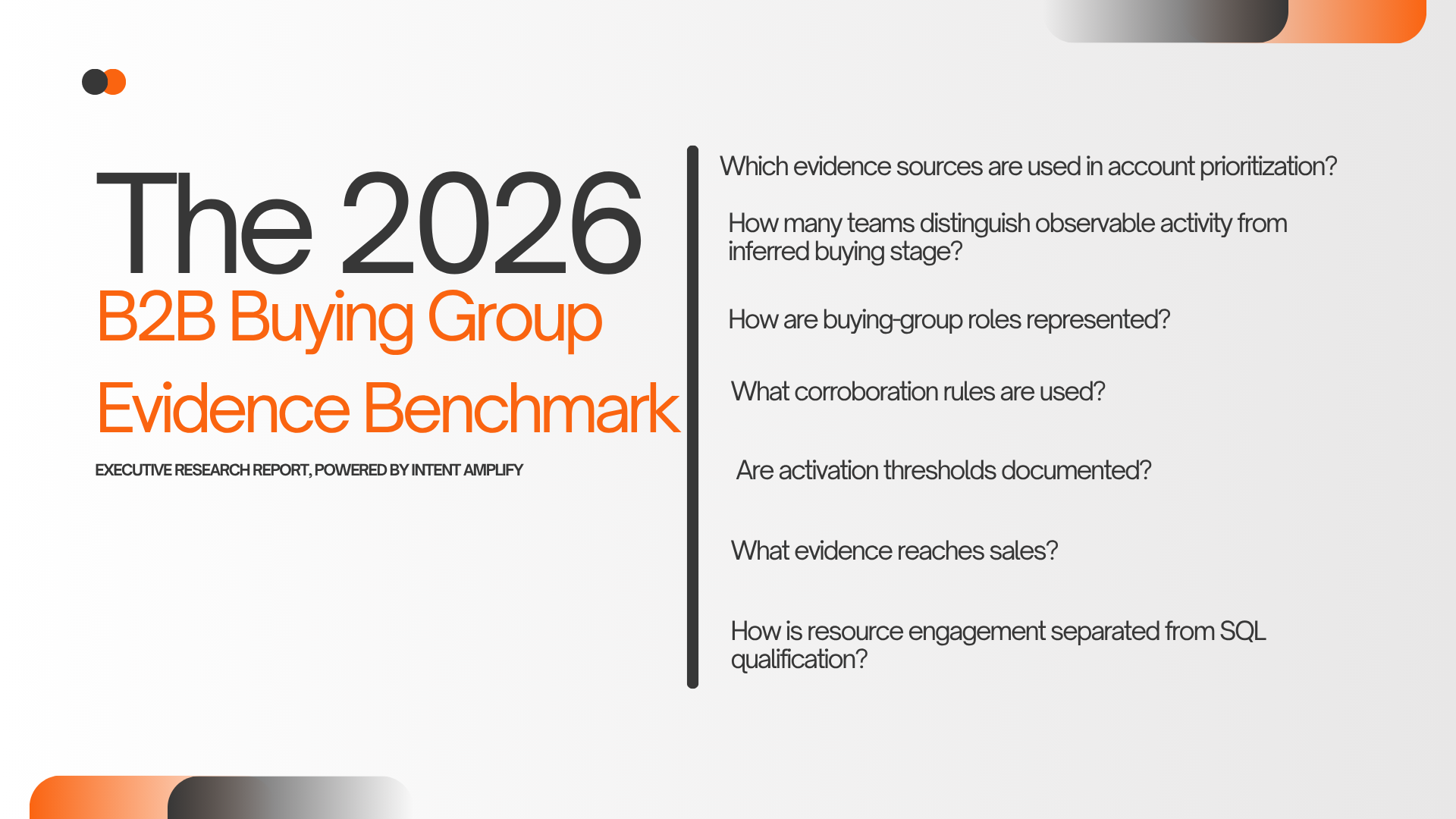
The 2026 B2B Buying Group Evidence Benchmark examines that decision layer: how organizations move from observable account activity to corroborated evidence, buying-group context, governed activation, and auditable sales qualification.
Rather than treating every signal as equivalent, the framework asks whether evidence is sufficiently corroborated, contextualized, and governed to support the next action.
B2B teams have more account signals than ever. The harder problem is determining when those signals become evidence strong enough to support action.
A single content download, page visit, intent spike, or contact interaction can indicate interest. On its own, it does not establish buying intent, buying-group participation, or sales readiness.
The 2026 Buying-Group Intent Benchmark examines how account-level signals can be evaluated as a connected evidence system rather than as isolated activities.
The benchmark focuses on three requirements for decision-grade evidence:
Corroboration — Do multiple independent signals support the same interpretation?
Buying-group representation — Is engagement visible across relevant roles and stakeholders rather than concentrated in one individual?
Governed activation — Are the rules for moving from observed behavior to marketing or sales action explicit, reviewable and measurable?
The operating principle is simple:
Observe → Attribute → Corroborate → Interpret → Activate → Preserve → Feedback
Each stage answers a different operational question:
Observe — What account activity actually occurred?
Attribute — What can be responsibly associated with the activity?
Corroborate — What independent evidence strengthens the interpretation?
Interpret — What does the combined evidence support—and what does it not support?
Activate — What action is justified by the available evidence?
Preserve — What context must accompany the evidence into downstream workflows?
Feedback — What outcome should inform future qualification and activation decisions?
This distinction matters because signal volume is not the same as evidence quality.
A download is not an SQL.
A page view is not an SQL.
An intent spike is not an opportunity.
Each can contribute evidence. Qualification requires additional criteria and an explicit decision boundary.
What the benchmark is designed to answer
Seven questions the benchmark helps GTM teams answer
- Which account-level signals are sufficiently reliable to influence action?
- When do multiple signals become corroborated evidence?
- How should buying-group coverage affect confidence?
- What evidence should trigger marketing activation?
- What additional evidence should be required before sales handoff?
- How should qualification decisions be preserved for audit and learning?
- How should downstream outcomes feed back into future activation decisions?
The objective is not to create another intent score.
It is to establish a more defensible path from observed account behaviour to activation and qualification decisions.
Resource engagement → Account evidence → Activation review → Explicit conversion or qualification review → Accepted sales conversation → SQL
Research Status
The benchmark framework defines the questions, evidence model and qualification boundaries to be evaluated. Findings should only be presented where the underlying research evidence supports them.
Evidence boundary
Where supporting evidence is unavailable, the benchmark does not infer performance, conversion impact, revenue contribution, or sales readiness.
Absence of verified evidence should be treated as an unresolved evidence requirement—not as evidence of poor performance.
Any benchmark finding or qualification conclusion should remain traceable to the evidence used to support it.
From Signals to Decision-Grade Evidence
Organizations can evaluate their current approach through five levels of evidence maturity:
Level 1 — Signal Collection
Individual activities are captured, but evidence remains largely disconnected.
Level 2 — Contextual Evidence
Signals are associated with accounts, topics, roles, or relevant business context.
Level 3 — Corroborated Buying-Group Evidence
Multiple independent stakeholders or evidence sources reinforce an account-level interpretation.
Level 4 — Governed Activation
Defined evidence thresholds determine when—and how—marketing or sales action should occur.
Level 5 — Auditable Qualification & Learning
Qualification decisions, evidence, handoff context, and downstream outcomes are preserved and used to improve future decisions.
The objective is progression from signal collection to evidence-governed revenue action — not simply the accumulation of more intent data.
The progression is deliberate:
Collect signals → establish context → corroborate evidence → govern activation → learn from outcomes.
Ready to operationalize the framework?
Turn account activity into a more defensible evidence and activation system.
Request a Demand Intelligence Audit
Review how your organization currently handles account evidence, stakeholder context, activation thresholds, and sales handoffs.