
Book a Demo
Home Platform Audience Accounts Intent Evidence Activation Solutions Industries Programs Research Pricing About Careers Press Contact Brands Trust Privacy Accessibility Demo ABM Advertising Content Demand Intent Data Sales Blog Infographics Events Product Sheets Videos Webinars White Papers E-books Customer Stories Corporate Presentation Newsletters Expert Insights Expert Analysis Research Reports
Newsletter

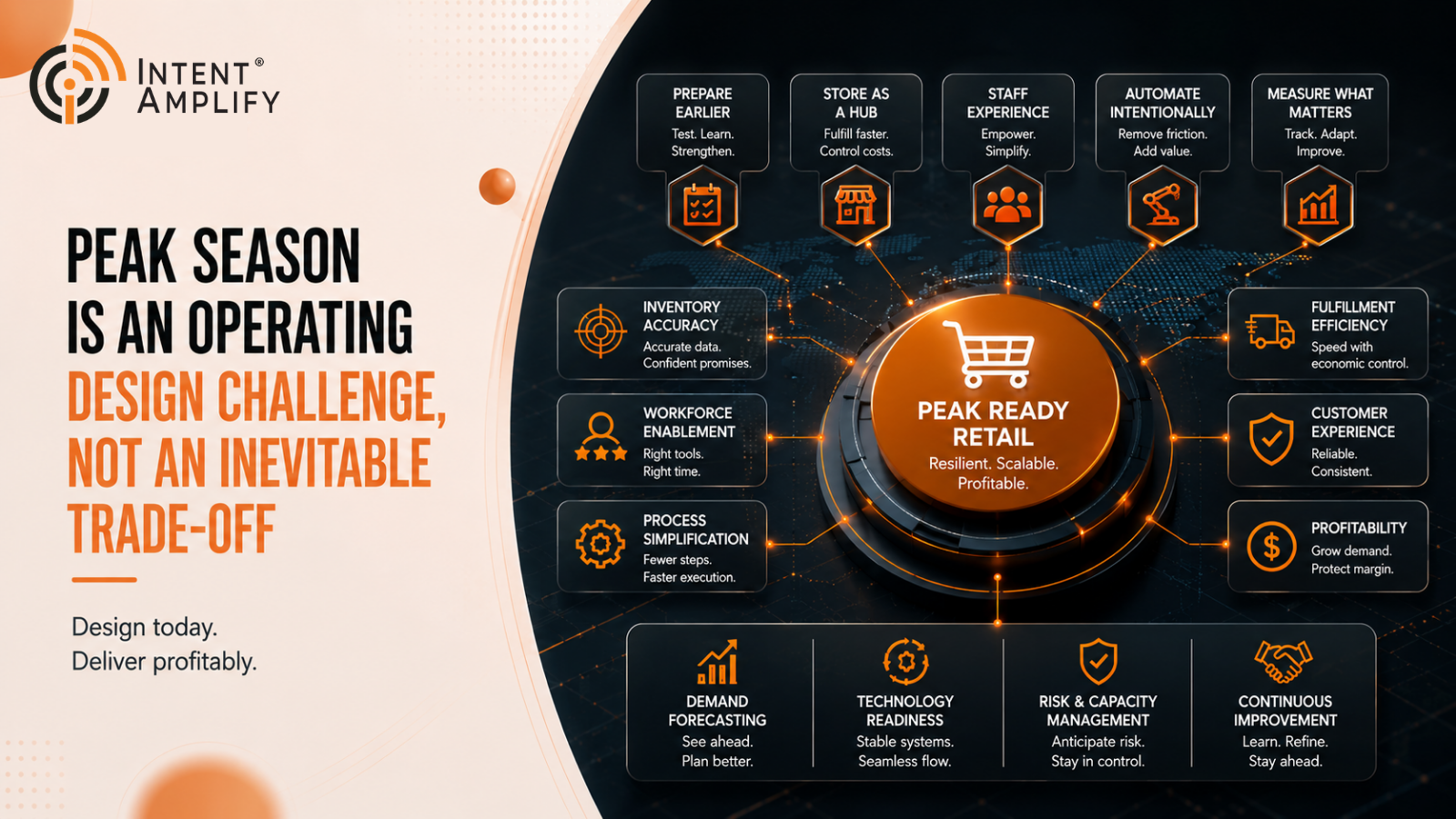
Peak Season Is an Operating Design Challenge, Not an Inevitable Experience Trade-Off

Peak Season Is an Operating Design Challenge, Not an Inevitable Experience Trade-Off
August 31, 2026 7 min read

Quick Answer

Peak season success depends on smart operating design. Retailers can protect customer experience, empower frontline teams, improve fulfillment, and sustain profitable growth through early preparation and intentional automation.

The Strategic Issue

Peak trading is often framed as a capacity problem: more traffic, more orders, more pressure, and therefore some unavoidable decline in service quality or margin. The RETHINK Retail source challenges that assumption. Its central proposition is more consequential: peak-season pressure is a growth problem, and the platform and operating decisions made before Q4 shape whether demand becomes profitable growth or operational drag.

That argument is directionally consistent with the 2026 retail environment. The National Retail Federation forecasts U.S. retail sales growth of 4.4% in 2026 to $5.6 trillion, above the average growth rate of the prior decade excluding the pandemic period (NRF, 2026). Deloitte’s 2026 retail work also describes an environment in which customer expectations, labor pressure, margin discipline, and technology adoption are converging around the store (Deloitte, 2026a). The implication is not that higher demand guarantees stronger results. It is that execution quality becomes more economically significant when demand concentrates.

Observation: Pressure Exposes Operating Design

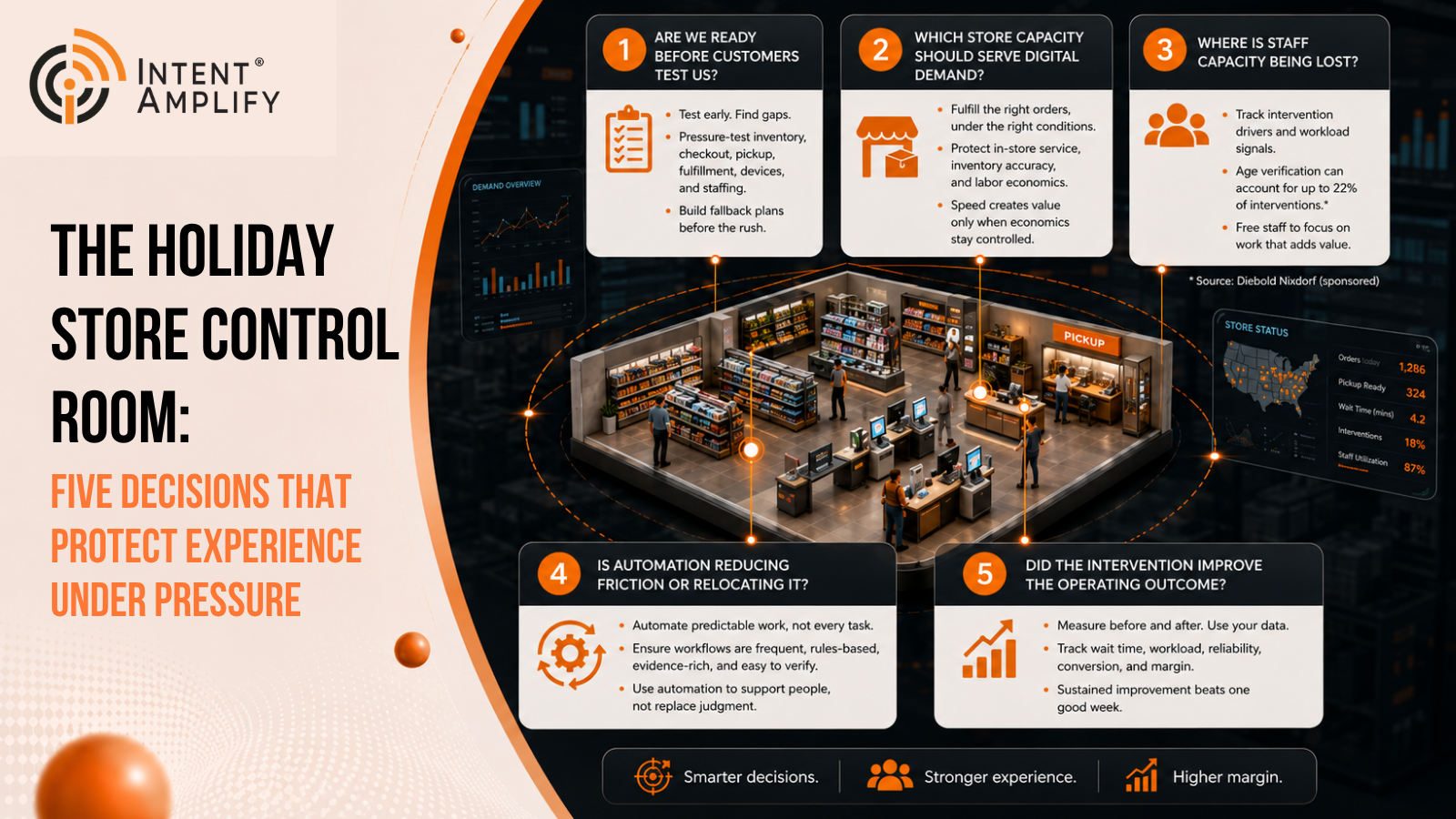
RETHINK Retail organizes the peak-season decision around four levers: prepare earlier, use stores as fulfillment hubs, protect the staff experience, and apply automation selectively. These are not separate initiatives. They describe one operating system.

Preparation determines whether the retailer discovers fragility before customers do. The store-as-hub model determines whether physical assets can serve digital demand without creating uncontrolled labor and inventory costs. Staff experience determines whether frontline teams can convert technology and process into useful action. Intentional automation determines whether software removes friction or simply adds another layer of intervention.

The evidence supports the connected nature of those choices. Deloitte’s connected-store analysis argues that store value increasingly depends on linking customer, associate, and enterprise capabilities rather than treating point solutions as isolated improvements (Deloitte, 2026a). Its workforce research similarly argues that labor modernization should reduce administrative burden and improve day-of execution rather than stop at scheduling efficiency (Deloitte, 2026d). These findings reinforce the RETHINK Retail thesis: the operating model behind the customer interaction matters as much as the visible touchpoint.

Interpretation: Peak Readiness Begins Before Peak

The most important timing point in the RETHINK Retail material is deceptively simple: act in August and early September. This is not an editorial flourish. It changes the type of problem leaders are able to solve.

Before the rush, teams can test. During the rush, teams mostly react. Early stress testing creates room to identify where inventory data diverges from physical reality, where self-checkout interventions repeat, where pickup workflows consume more labor than planned, where technology creates duplicate work, and where employees need unnecessary approvals. Once peak volume arrives, each unresolved design flaw becomes a repeated operational tax.

For retail executives, the decision is therefore not whether to “prepare for the holidays.” It is whether preparation is specific enough to expose failure modes. A generic readiness meeting is weak evidence. A tested customer journey, with known demand assumptions, system dependencies, staff steps, fallback paths, and measured recovery, is far more decision-useful.

Implication: The Store Is Becoming an Economic Hub

The second RETHINK Retail pillar reframes the role of the store. Stores are not only selling locations; they can function as fulfillment nodes that combine inventory proximity with physical customer access. The source highlights strong growth in store-fulfilled delivery. Walmart’s FY26 Q4 earnings presentation independently reported approximately 50% growth in store-fulfilled delivery, with expedited deliveries under three hours representing about 35% of store-fulfilled orders (Walmart, 2026). Because the figure comes from a commercially sponsored source, it should be treated as sponsored evidence rather than a neutral market benchmark. Its analytical value is the mechanism it points toward: fulfillment speed creates advantage only when the economics remain controlled.

Deloitte’s 2026 work on physical-store modernization similarly emphasizes the store’s role in profitability, customer experience, associate enablement, and fulfillment strategy (Deloitte, 2026b). The operational question is therefore not “Can the store fulfill digital orders?” It is “Which orders should the store fulfill, under what capacity conditions, with what inventory confidence, and at what labor cost?”

A store-as-hub strategy can become self-defeating if digital orders cannibalize the labor required for in-store service, if inventory accuracy is too weak to support reliable promises, or if expedited delivery is priced below its true operating cost. Structural advantage appears when fulfillment rules protect both speed and economics.

Implication: Staff Experience Is a Performance Variable

The third RETHINK Retail pillar is especially important because retailers often treat employee friction as a workforce issue rather than a customer experience and margin issue. Yet the customer sees the consequence of the employee workflow.

The source highlights age verification as a major self-checkout intervention point. Diebold Nixdorf states that age verification can account for up to 22% of interventions by a shop employee; the figure should therefore be treated as sponsored-source evidence. The insight is not the percentage alone. It is what the intervention represents: an automated flow still depends on human recovery when policy or product conditions require judgment.

That distinction matters. A retailer can install more self-service capacity and still create longer queues if intervention demand is not designed into staffing, interface, and exception logic. Deloitte’s June 2026 workforce analysis makes a parallel point: labor modernization creates value when work is redesigned, and administrative burden is reduced, not simply when a new system is deployed (Deloitte, 2026d). Frontline capacity should therefore be managed as a mix of scheduled hours, task complexity, interruption frequency, and decision time.

Implication: Automation Should Protect High-Value Human Moments

The fourth pillar, intentional automation, connects the first three. The objective is not maximum automation. It is to automate the work that machines can perform reliably so human judgment is available where it matters most.

Deloitte’s 2026 connected-store research describes a progression from linked systems to intelligent orchestration and closed-loop improvement (Deloitte, 2026a). Its June analysis of AI and frontline work cautions that released capacity does not automatically become value; work must be deliberately redesigned so that freed time is reinvested in higher-value outcomes (Deloitte, 2026e). This is directly relevant to peak trading. Removing a manual status check is useful only if the released time improves service, fulfillment, recovery, selling, or control.

The strongest automation candidates are frequent, rules-based, evidence-rich, and easy to verify. The weakest are ambiguous exceptions where context, customer sensitivity, safety, loss, or policy requires judgment. Retail leaders should measure automation by the quality of the resulting operating decision, not by the percentage of tasks touched by technology.

Executive Decision Framework

1. Preparation discipline: Identify the customer and staff journeys most likely to fail under concentrated demand, then test them before Q4.

2. Store-hub economics: Define which fulfillment promises create advantage without undermining store labor, inventory confidence, or margin.

3. Staff-friction control: Track repeated interventions, searches, approvals, device switching, and exception handling as operating-capacity loss.

4. Automation fit: Automate predictable work; preserve human judgment where the exception is material or context-dependent.

5. Outcome validation: Measure changes in customer delay, staff workload, fulfillment reliability, recovery time, and economic impact before scaling the intervention.

Strategic Takeaway

Peak trading does not automatically create a trade-off between customer experience and profitability. It magnifies the quality of the operating choices already made. The RETHINK Retail thesis is strongest when read this way: Q4 advantage is built before the surge, through disciplined preparation, economically sound use of stores, protection of frontline capacity, and automation that improves rather than displaces judgment.

The evidence does not support a universal promise that these choices will produce a specific financial result for every retailer. It does support a more useful conclusion: retailers can reduce the amount of peak performance left to improvisation by designing the operating system earlier and measuring the outcome more rigorously.

The Holiday Season Playbook: Delivering Exceptional Customer and Staff Experience During Peak Trading

References

  1. RETHINK Retail and Diebold Nixdorf (2026) The Holiday Season Playbook: Delivering Exceptional Customer and Staff Experience During Peak Trading. Available at: https://intentamplify.com/landing-page/report/the-holiday-season-playbook-delivering-exceptional-customer-and-staff-experience-during-peak-trading/

  2. Diebold Nixdorf (2024) Diebold Nixdorf Sets Out to Combat Shrink in Retail with New AI-powered Offering. Available at: https://s27.q4cdn.com/808990265/files/doc_news/Diebold-Nixdorf-Sets-Out-to-Combat-Shrink-in-Retail-with-New-AI-powered-Offering-2024.pdf

  3. Walmart Inc. (2026) FY26 Q4 Earnings Presentation. Available at: https://fortune.com/company-assets/1854/quartr/slides-ad2ae-2026-02-19-12-36-02.pdf

  4. National Retail Federation (2026) NRF Forecasts 4.4% Annual Retail Sales Growth with New Economic Model. Available at: https://nrf.com/media-center/press-releases/nrf-forecasts-4-4-annual-retail-sales-growth-with-new-economic-model

  5. Deloitte (2026a) The Connected Store. Available at: https://www.deloitte.com/us/en/Industries/consumer/articles/connected-store-retail-digital-transformation.html

  6. Deloitte (2026b) Future-proof Your Stores. Available at: https://www.deloitte.com/content/dam/assets-zone3/us/en/docs/industries/consumer/2026/future-proof-your-stores-2026.pdf

  7. Deloitte (2026d) Store Labor Modernization and Workforce Management. Available at: https://www.deloitte.com/us/en/industries/consumer/articles/retail-labor-optimization-workforce-management.html

  8. Deloitte (2026e) AI Is Freeing Up Frontline Retail Capacity. Available at: https://www.deloitte.com/ca/en/Industries/consumer/perspectives/frontline-retail-ai-capacity-value.html

Contact
Sales