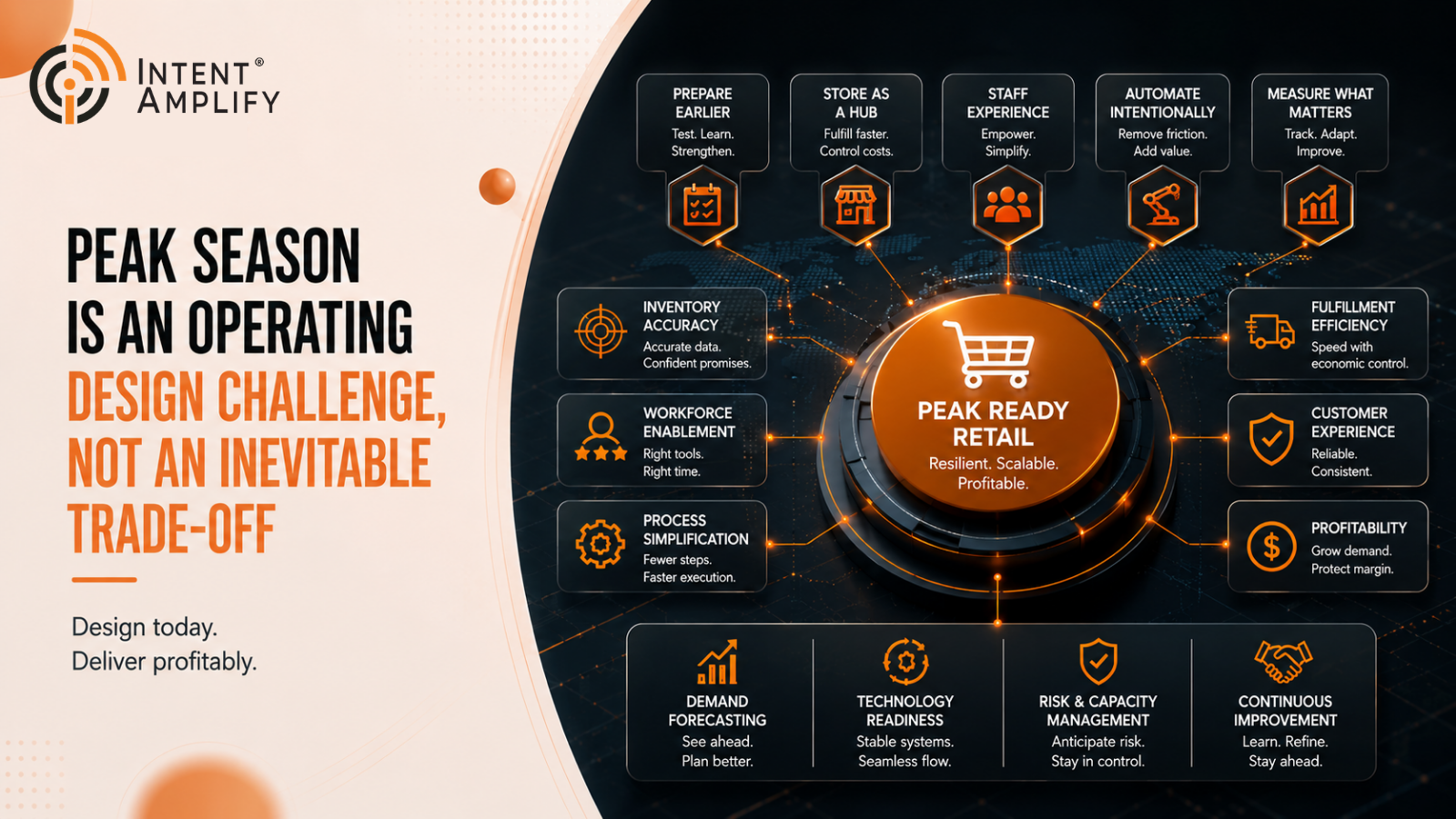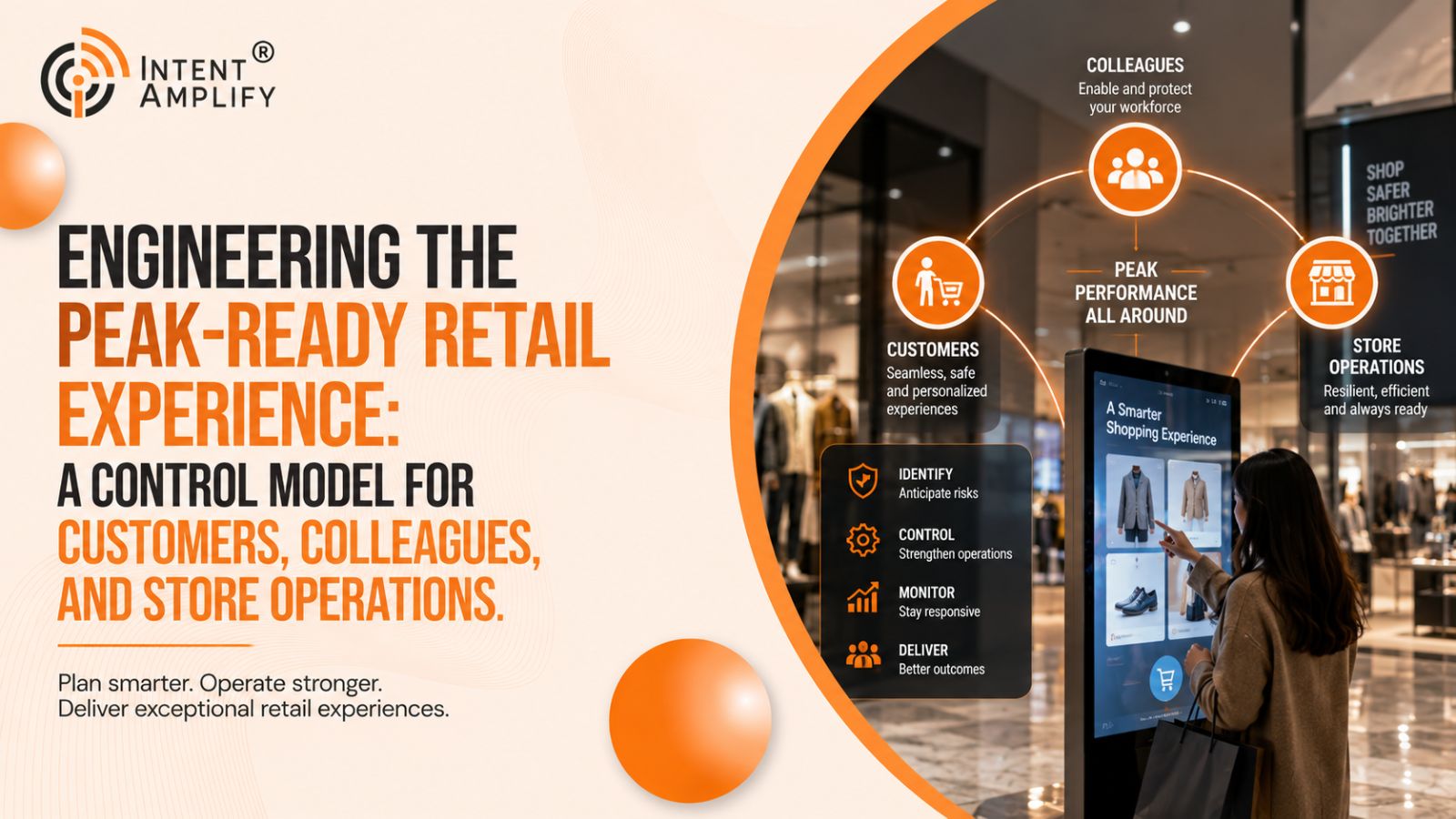

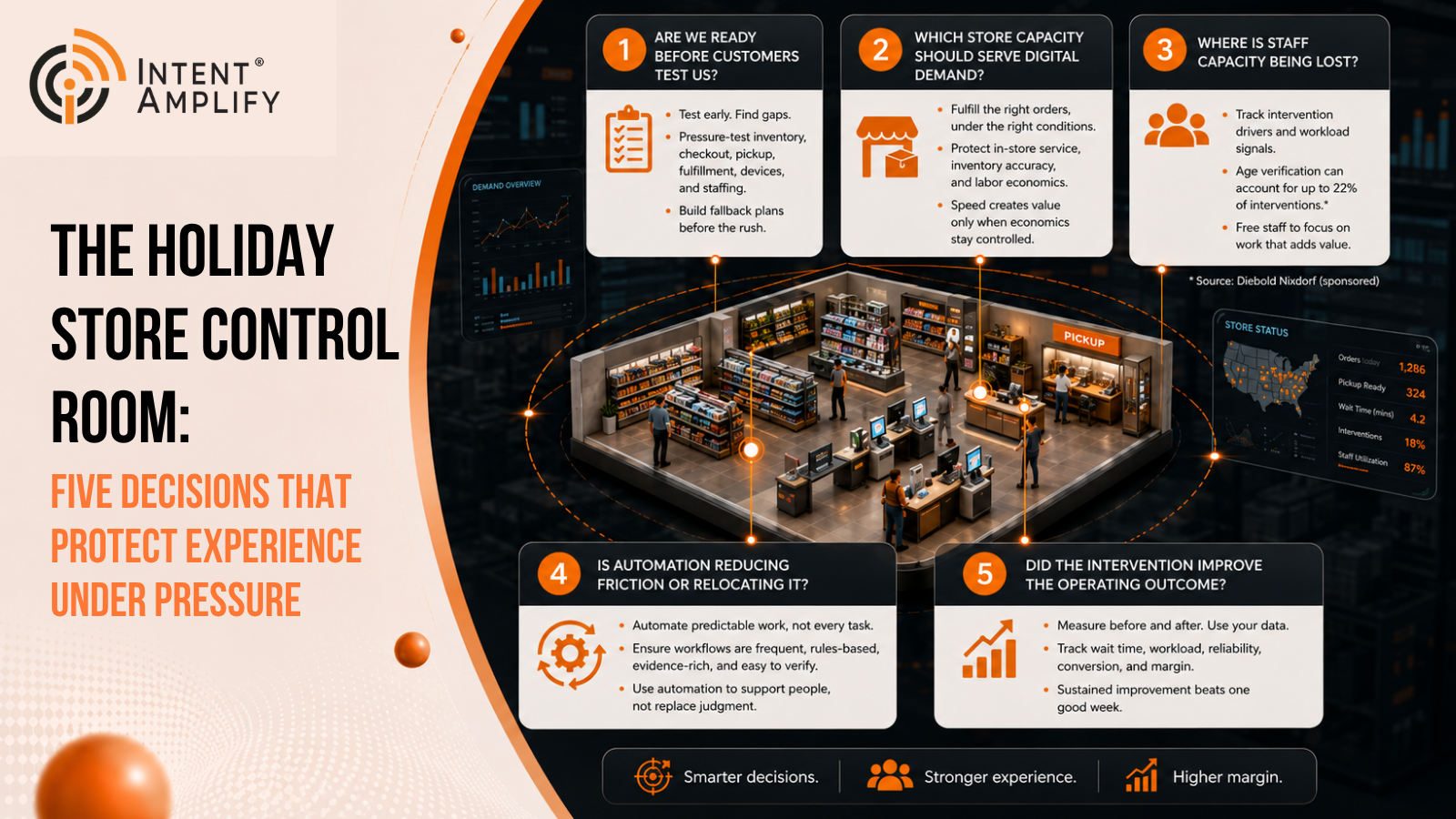
Holiday trading does not fail because leaders lack dashboards. It fails when the operating picture does not translate into timely decisions. RETHINK Retail’s central thesis is that peak pressure should not be accepted as an unavoidable trade-off between customer experience and margin. The more useful question is whether retailers have designed the operating choices that let stores absorb higher demand without degrading service quality, staff effectiveness, or economics.
The 2026 retail backdrop reinforces the importance of that question. NRF forecasts U.S. retail sales growth of 4.4% in 2026 to $5.6 trillion (NRF, 2026). Deloitte’s retail research describes physical stores as increasingly important to customer experience, fulfillment, associate productivity, and margin performance rather than as isolated selling locations (Deloitte, 2026a; Deloitte, 2026b). Higher demand therefore raises the value of decision quality inside the store.
Decision One: Are We Ready Before Customers Test Us?
RETHINK Retail emphasizes preparation in August and early September. The analytical implication is straightforward: early preparation creates a testing window, while late preparation creates a reaction window. Retailers should use that lead time to pressure-test inventory accuracy, checkout interventions, store-fulfilled delivery, pickup workflows, workforce allocation, device fallback, and customer communication.
A strong readiness review is scenario-based. It asks what happens when demand rises faster than expected, when a critical device fails, when a pickup backlog develops, when an item shown as available cannot be found, or when self-checkout interventions rise. The objective is to observe the operating path before live volume makes the weakness expensive.
Decision Two: Which Store Capacity Should Serve Digital Demand?
The stores-as-hubs pillar changes the economics of the store. The source highlights strong growth in store-fulfilled delivery. Walmart’s FY26 Q4 earnings presentation independently reported approximately 50% growth in store-fulfilled delivery, while expedited deliveries under three hours represented about 35% of store-fulfilled orders (Walmart, 2026). Because this figure comes from a sponsored research source, it should be treated as sponsored evidence rather than a neutral market benchmark. The strategic mechanism is more important than the number: fulfillment speed creates advantage only when inventory confidence, labor capacity, delivery economics, and in-store service remain controlled.
Deloitte’s 2026 analysis of store modernization similarly positions stores as fulfillment and service assets whose value depends on orchestration across customer, associate, and enterprise systems (Deloitte, 2026b). The control-room question is therefore not how many orders can be pushed through stores. It is which orders the store should accept, under what conditions, and how the decision changes when capacity tightens.
Decision Three: Where Is Staff Capacity Being Lost?
Staff experience is not separate from customer experience. Every manual search, repeated approval, duplicate status check, poorly routed alert, or avoidable intervention consumes attention that could otherwise support customers or fulfillment.
RETHINK Retail highlights age verification as a major self-checkout intervention point. Diebold Nixdorf states that age verification can account for up to 22% of interventions by a shop employee, so the figure should be treated as sponsored-source evidence rather than a neutral benchmark. The figure is useful because it shows why automation cannot be evaluated by transaction share alone. A self-service flow may still require significant human recovery. Deloitte’s workforce research makes a comparable point: technology creates value when it redesigns work and reduces administrative burden, not simply when another system is introduced (Deloitte, 2026d).
A useful control view should therefore track workload signals alongside traffic. These can include intervention frequency, manager calls, unresolved exceptions, device switching, pickup backlog, and task displacement. The decision question is whether staff attention is being spent on judgment that adds value or coordination that should have been designed out.
Decision Four: Is Automation Reducing Friction or Relocating It?
RETHINK Retail’s fourth pillar is intentional automation. The principle is not to automate every visible task. It is to automate predictable work so human effort remains available for customer-sensitive, policy-sensitive, or exception-heavy moments.
Deloitte’s connected-store research describes a progression toward more orchestrated and intelligent store operations, but its June 2026 analysis of AI and frontline capacity adds an important caveat: released capacity becomes value only when the work is deliberately redesigned (Deloitte, 2026a; Deloitte, 2026e). A faster process that creates more exceptions, extra alerts, or unclear ownership may simply move friction to a different part of the store.
Before scaling automation, leaders should ask whether the workflow is frequent, rules-based, evidence-rich, and easy to verify. If the answer depends heavily on context or material judgment, automation should support the employee rather than replace the decision.
Decision Five: Did the Intervention Improve the Operating Outcome?
The economic case for redesigning peak operations should be evaluated with retailer-specific evidence rather than a universal operating-income benchmark.
The more durable lesson is measurement discipline. Retailers should compare the operating state before and after an intervention. Did waiting decline? Did staff workload move elsewhere? Did fulfillment reliability improve? Did the service response create a new protection or margin issue? Did the exception recur? This read-back is what turns peak activity into learning.
Peak readiness also depends on cross-functional visibility. A store can appear operationally healthy while one customer journey is degrading because queue data, inventory confidence, pickup readiness, and staff availability are monitored separately. Leaders therefore need a shared view of the few conditions that materially change customer or staff experience. That view should connect demand, capacity, exception volume, and recovery status without turning the store into a reporting exercise. The objective is operational coherence: when a signal changes, the relevant owner should understand what it means, what action is permitted, and how the outcome will be checked. This reduces delay between seeing pressure and responding to it.
A second consideration is whether the store can distinguish temporary pressure from structural weakness. Short spikes may justify local task rebalancing, while recurring backlogs, repeated manager interventions, or chronic inventory discrepancies indicate a design issue. Treating both conditions the same can produce overreaction or underreaction. A useful control-room review therefore separates transient variance from repeatable failure patterns. It asks whether the same exception is appearing across shifts, stores, or channels; whether the response is consistent; and whether the intervention resolves the cause or only the symptom. This distinction helps leaders decide when to rebalance work immediately and when to redesign the underlying workflow before peak demand intensifies.
Customer communication is another part of the operating system. When service conditions change, associates need language that is accurate, specific, and consistent with the current operating state. Telling customers that an order is “almost ready” when the store lacks reliable evidence may reduce tension for a moment but creates greater frustration if the promise slips again. Strong peak operations therefore connect customer communication to the same evidence used for internal decisions. If inventory confidence falls, pickup capacity tightens, or a device issue changes the service path, employees should know what expectation can be set safely. Clear communication is not a separate soft skill; it is part of operational control.
Finally, the control room should have a defined cadence for escalation and closure. Peak teams often identify issues quickly but lose time deciding when an issue becomes material enough for intervention. A cadence can reduce that ambiguity: review the condition, confirm the evidence, assign an owner, record the action, and set the next review point. Closure should require evidence that the condition has stabilized. This keeps the view focused on unresolved decisions rather than observations.
Executive Action Point
Build the peak control room around decisions, not reporting volume. For each priority journey, identify the customer promise, the capacity constraint, the authoritative evidence, the decision owner, the intervention, and the outcome measure. Remove any metric that does not change a decision.
Strategic Takeaway
Peak pressure is not inherently destructive. It is diagnostic. It exposes whether preparation, store fulfillment, staff experience, and automation have been designed as one operating system. Retailers that make those choices earlier have more opportunity to protect service quality and economics when demand concentrates.
References
-
RETHINK Retail and Diebold Nixdorf (2026) The Holiday Season Playbook: Delivering Exceptional Customer and Staff Experience During Peak Trading. Available at: https://intentamplify.com/landing-page/report/the-holiday-season-playbook-delivering-exceptional-customer-and-staff-experience-during-peak-trading/
-
Diebold Nixdorf (2024) Diebold Nixdorf Sets Out to Combat Shrink in Retail with New AI-powered Offering. Available at: https://s27.q4cdn.com/808990265/files/doc_news/Diebold-Nixdorf-Sets-Out-to-Combat-Shrink-in-Retail-with-New-AI-powered-Offering-2024.pdf
-
Walmart Inc. (2026) FY26 Q4 Earnings Presentation. Available at: https://fortune.com/company-assets/1854/quartr/slides-ad2ae-2026-02-19-12-36-02.pdf
-
National Retail Federation (2026) NRF Forecasts 4.4% Annual Retail Sales Growth with New Economic Model. Available at: https://nrf.com/media-center/press-releases/nrf-forecasts-4-4-annual-retail-sales-growth-with-new-economic-model
-
Deloitte (2026a) The Connected Store. Available at: https://www.deloitte.com/us/en/Industries/consumer/articles/connected-store-retail-digital-transformation.html
-
Deloitte (2026b) Future-proof Your Stores. Available at: https://www.deloitte.com/content/dam/assets-zone3/us/en/docs/industries/consumer/2026/future-proof-your-stores-2026.pdf
-
Deloitte (2026d) Store Labor Modernization and Workforce Management. Available at: https://www.deloitte.com/us/en/industries/consumer/articles/retail-labor-optimization-workforce-management.html
-
Deloitte (2026e) AI Is Freeing Up Frontline Retail Capacity. Available at: https://www.deloitte.com/ca/en/Industries/consumer/perspectives/frontline-retail-ai-capacity-value.html