
Book a Demo
Home Platform Audience Accounts Intent Evidence Activation Solutions Industries Programs Research Pricing About Careers Press Contact Brands Trust Privacy Accessibility Demo ABM Advertising Content Demand Intent Data Sales Blog Infographics Events Product Sheets Videos Webinars White Papers E-books Customer Stories Corporate Presentation Newsletters Expert Insights Expert Analysis Research Reports
Expert Insight

Peak Retail Resilience Starts With Associate Decision Rights, Not More Alerts

Peak Retail Resilience Starts With Associate Decision Rights, Not More Alerts
September 2, 2026 6 min read

Quick Answer

Peak retail resilience depends on giving store teams clear authority to act. Defined decision rights, trusted evidence, and explicit escalation boundaries help reduce delays, protect manager capacity, and improve customer experience under pressure.

Executive Thesis

Peak retailers can detect more operating conditions than store teams are empowered to resolve. Visibility therefore becomes useful only when the person receiving a signal knows what can be done, what evidence governs the action, and which boundary requires another owner.

RETHINK Retail’s holiday playbook links customer experience, staff experience, store fulfillment, and intentional automation. Read through an operating lens, those pillars share a common dependency: decision rights. Preparation establishes the rules. Store-as-hub models create more cross-channel decisions. Staff experience depends on reducing unnecessary coordination. Automation works best when the next action is already clear.

Observation: Peak Removes the Slack That Hides Ambiguous Authority

During normal trading, informal workarounds can mask weak decision design. A manager is available. A colleague has time to search another system. A customer can tolerate an extra few minutes. Peak conditions remove that slack and repeat the same ambiguity across more interactions.

NRF forecasts U.S. retail sales growth of 4.4% in 2026 to $5.6 trillion (NRF, 2026). The forecast does not predict store-level congestion, but it reinforces the importance of planning for an environment in which demand remains substantial. Under pressure, repeated approval waits become a capacity problem rather than an isolated inconvenience.

Interpretation: Decision Rights Are Part of Customer Experience

Consider an unavailable product. The customer outcome can depend on whether the associate trusts the inventory information, knows the approved alternatives, and can resolve the issue without unnecessary escalation. The policy is internal; the waiting is visible to the customer.

The same mechanism applies to pickup delays, pricing questions, checkout interventions, returns, and service recovery. Appropriate local authority reduces decision latency. Ambiguous authority transfers internal uncertainty into the customer interaction.

This does not imply maximum autonomy. It implies bounded autonomy: routine, low-risk decisions close to the work, with material safety, privacy, loss, financial, or broad customer-impact conditions routed to the appropriate owner.

Implication: Staff Experience Is an Authority Problem as Well as a Tooling Problem

RETHINK Retail highlights age verification as a major self-checkout intervention point. Diebold Nixdorf states that age verification can account for up to 22% of interventions by a shop employee; the percentage should therefore be treated as sponsored-source evidence. The mechanism is nevertheless important: an automated flow can still create concentrated human work when an exception requires authorization or judgment.

Deloitte’s 2026 store-labor research argues that technology creates value when work is redesigned, and administrative burden is reduced (Deloitte, 2026c). That places decision rights directly inside workforce design. A colleague who can see the problem but cannot resolve it remains dependent on another layer of coordination.

A useful staff-experience review therefore asks not only how many tools employees use, but how many routine decisions require another person. Repeated manager intervention is evidence that the workflow may need clearer policy, better information, or delegated authority.

Implication: More Alerts Can Reduce Resilience

Peak environments encourage monitoring. The risk is that every system competes for the same attention. A notification that does not change an action can become operational noise.

Deloitte’s connected-store research emphasizes integration across store capabilities (Deloitte, 2026a). The practical implication is that alerts should connect evidence to ownership. A disciplined alert should identify the condition, priority, owner, expected action, escalation boundary, and closure state. If the recipient cannot act and is not responsible for escalation, the alert may not belong in that person’s peak workflow.

The objective is not fewer signals for their own sake. It is fewer unresolved signals. Instrumentation should reduce uncertainty, not make associates and managers the manual integration layer between tools.

Implication: Stores-as-Hubs Need Explicit Priority Rules

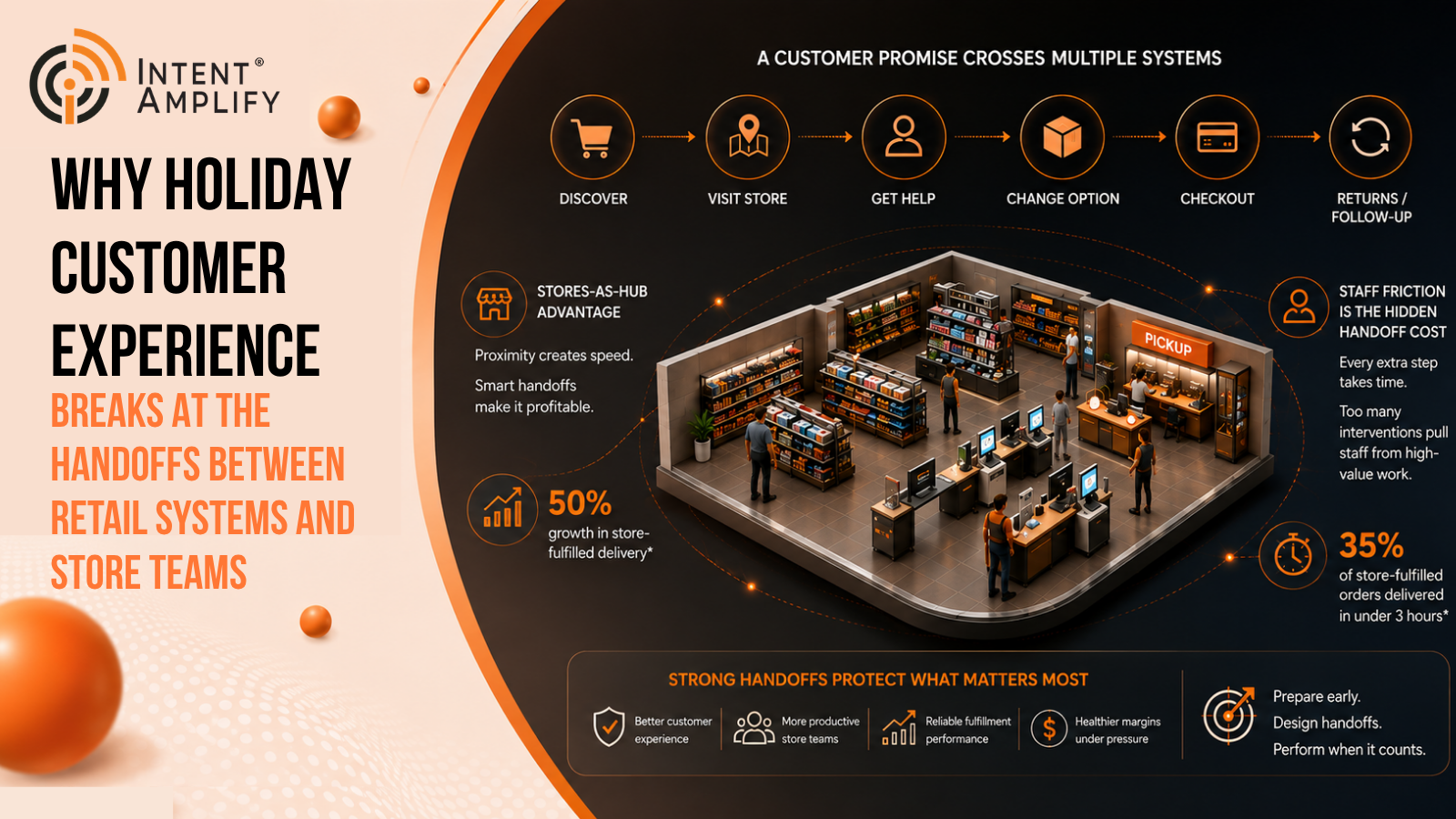
RETHINK Retail identifies store fulfillment as a source of advantage. Walmart’s FY26 Q4 earnings presentation independently reported approximately 50% growth in store-fulfilled delivery, with expedited deliveries under three hours representing about 35% of store-fulfilled orders (Walmart, 2026). The broader mechanism is that using stores for digital fulfillment introduces additional competition for inventory, labor, staging space, and employee attention.

Deloitte’s 2026 store-modernization work positions stores similarly as service and fulfillment assets (Deloitte, 2026b). As stores take on more roles, decision rights become more important. When in-store service and digital fulfillment compete for the same capacity, who can rebalance work? What evidence justifies the change? When should the store stop accepting additional load? Those are authority questions, not merely technology questions.

A Peak Authority Matrix

A practical authority matrix should be organized around recurring workflows rather than job descriptions. For each priority workflow, define:

1. Condition  -  the event or exception that requires a decision.

2. Evidence  -  the authoritative information required.

3. Local owner  -  the lowest appropriate role able to act.

4. Routine action  -  the response that can be executed without additional approval.

5. Boundary  -  the risk, scope, duration, or customer-impact condition that changes ownership.

6. Escalation owner  -  the role responsible beyond that boundary.

7. Read-back  -  the evidence used to determine whether the decision worked.

The matrix should remain short enough to use during pressure. If it becomes a policy encyclopedia, it will not reduce decision latency.

Protect Manager Capacity for Material Decisions

When routine exceptions escalate, managers become bottlenecks. Customers wait for decisions that could have been made closer to the work, while managers lose capacity for the conditions that genuinely require broader judgment.

Pre-authorizing routine recovery protects both layers. Associates gain clarity. Managers gain focus. Governance becomes faster without becoming uncontrolled because the boundaries remain explicit.

Leaders can examine repeated manager interventions during peak simulations. If the same low-risk condition reaches a manager repeatedly, the organization has identified a candidate for clearer authority. If the condition carries material safety, loss, privacy, or financial risk, the boundary should remain constrained.

Read-Back Makes Delegation Safer

Delegation is stronger when actions are observable. For material workflows, compare the initial condition, the decision, the customer outcome, staff impact, and any protection or financial consequence. If the rule repeatedly works within bounds, it can be retained. If it creates a new problem, it can be corrected. If evidence remains insufficient, the authority can stay constrained.

This is more useful than treating approval itself as the control. The control is the combination of evidence, boundary, ownership, and read-back.

Analyst Interpretation

Decision rights are a hidden layer of peak experience architecture. The strongest operating models make the customer promise, employee authority, technology signal, and governance boundary mutually consistent. That alignment allows routine work to move quickly while material exceptions receive the attention they deserve.

The evidence does not support a universal threshold for how much authority should be delegated. That depends on retailer-specific policy, risk appetite, workforce capability, technology, and operating evidence. The defensible principle is narrower: peak resilience improves when recurring decisions have explicit owners and boundaries before demand concentrates.

Access the full Report: The Holiday Season Playbook: Delivering Exceptional Customer and Staff Experience During Peak Trading

References

  1. RETHINK Retail and Diebold Nixdorf (2026) The Holiday Season Playbook: Delivering Exceptional Customer and Staff Experience During Peak Trading. Available at: https://intentamplify.com/landing-page/report/the-holiday-season-playbook-delivering-exceptional-customer-and-staff-experience-during-peak-trading/

  2. Diebold Nixdorf (2024) Diebold Nixdorf Sets Out to Combat Shrink in Retail with New AI-powered Offering. Available at: https://s27.q4cdn.com/808990265/files/doc_news/Diebold-Nixdorf-Sets-Out-to-Combat-Shrink-in-Retail-with-New-AI-powered-Offering-2024.pdf

  3. Walmart Inc. (2026) FY26 Q4 Earnings Presentation. Available at: https://fortune.com/company-assets/1854/quartr/slides-ad2ae-2026-02-19-12-36-02.pdf

  4. National Retail Federation (2026) NRF Forecasts 4.4% Annual Retail Sales Growth with New Economic Model. Available at: https://nrf.com/media-center/press-releases/nrf-forecasts-4-4-annual-retail-sales-growth-with-new-economic-model

  5. Deloitte (2026a) The Connected Store. Available at: https://www.deloitte.com/us/en/Industries/consumer/articles/connected-store-retail-digital-transformation.html

  6. Deloitte (2026b) Future-proof Your Stores. Available at: https://www.deloitte.com/content/dam/assets-zone3/us/en/docs/industries/consumer/2026/future-proof-your-stores-2026.pdf

  7. Deloitte (2026c) Store Labor Modernization and Workforce Management. Available at: https://www.deloitte.com/us/en/industries/consumer/articles/retail-labor-optimization-workforce-management.html


Contact
Sales