
Expert Insight

The Economics of Decision Latency in Agentic Supply Chains

September 30, 2026 6 min read

Quick Answer

Explore how decision latency affects supply-chain economics and how agentic AI can help teams reduce delays across analysis, approvals, and execution while preserving governance and human oversight.

Industry Context: Supply Chains Have a Decision-Latency Problem

Supply-chain technology has spent years improving visibility. Control towers, supplier-risk feeds, planning systems, plant applications, and service platforms can expose disruption earlier than before. Yet earlier detection does not guarantee an earlier decision.

The economic problem begins in the time between a material signal and an approved response. Teams still have to establish whether the signal is credible, reconstruct context across systems, identify dependencies, model alternatives, find the correct decision owner, and translate approval into an executable action.

The DataRobot and Supply Chain Now on-demand webinar, $2.5B in 72 Hours: What Agentic AI Looks Like When It Actually Works, provides a concrete case frame. The session describes a tariff scenario involving $2.5 billion in revenue risk addressed in 72 hours rather than weeks, with human sign-off retained throughout the process.[1]

That example makes decision latency a management issue rather than a purely technical one. The value of agentic AI is not simply that an agent can reason faster. The stronger question is whether the operating model can reduce avoidable waiting without weakening evidence quality, accountability, or control.

Emerging Trend: From Visibility Economics to Decision Economics

The previous phase of supply-chain transformation concentrated on seeing the network more clearly. The next phase is increasingly about shortening the distance between insight and governed action.

Decision latency has multiple components. Detection latency is the time required to recognize a material change. Context latency is the time required to assemble the evidence needed to understand exposure. Analysis latency is the time required to compare feasible responses. Authority latency is the time spent locating or waiting for the appropriate approver. Execution latency is the time between approval and action in the operating system. Verification latency is the time required to confirm that the intended outcome occurred.

These stages matter because each has a different remedy. Better sensing can reduce detection latency. Connected enterprise context can reduce investigation time. Agentic reasoning can accelerate option development. Explicit decision rights can reduce approval ambiguity. System integration can reduce execution delay. Observability can shorten the time needed to confirm what actually happened.

DataRobot's manufacturing positioning reflects this shift by describing AI workflows that identify bottlenecks, shortages, and pricing volatility, model scenarios, rank inventory, sourcing, and production responses, and execute approved actions in enterprise systems.[2]

Expert Perspective: The Cost of Delay Is Not Linear

Not every delayed decision has the same economic consequence.

A supplier cancellation window can close. A tariff can change landed cost. A shortage can force premium freight or production resequencing. A plant constraint can compound into missed output. An aftermarket issue can increase warranty, dispatch, or service expense. In each case, the organization may lose response options as time passes.

This is why the cost of delay should be separated from the cost of making a poor decision. Faster is not automatically better. A rapid decision based on incomplete evidence, unclear authority, or an unverified action can create more value leakage than a slower, defensible response.

The useful objective is governed decision velocity: reduce the time spent on avoidable investigation and coordination while preserving the controls that protect decision quality.

DataRobot's 2026 Unmet AI Needs Survey focuses on the operational challenges organizations encounter after deploying agentic AI, reinforcing the need to manage systems beyond initial experimentation.[3]

Market Implications: Agentic AI Changes the Business Case

Traditional automation business cases often focus on labor hours removed from a process. Agentic supply-chain workflows require a broader economic model.

A credible case should identify the recurring decision, its trigger, the current cycle time, the stages where waiting occurs, the consequence of delay, the permitted actions, the required approvals, and the evidence that proves execution. The baseline should be operational, not simply technical.

This matters because agent activity is not the same as business value. More prompts, recommendations, or automated tasks do not establish economic impact. A workflow creates value when it changes a decision cycle that affects cost, service, inventory, capacity, cash flow, risk, or customer outcomes.

Supply Chain Now's discussion of moving AI from pilots to performance similarly emphasizes the transition from experimentation to operational execution.[4]

Governance Is Part of the Economic Model

Governance is sometimes treated as a cost imposed on automation. In production supply-chain environments, it is part of the value architecture.

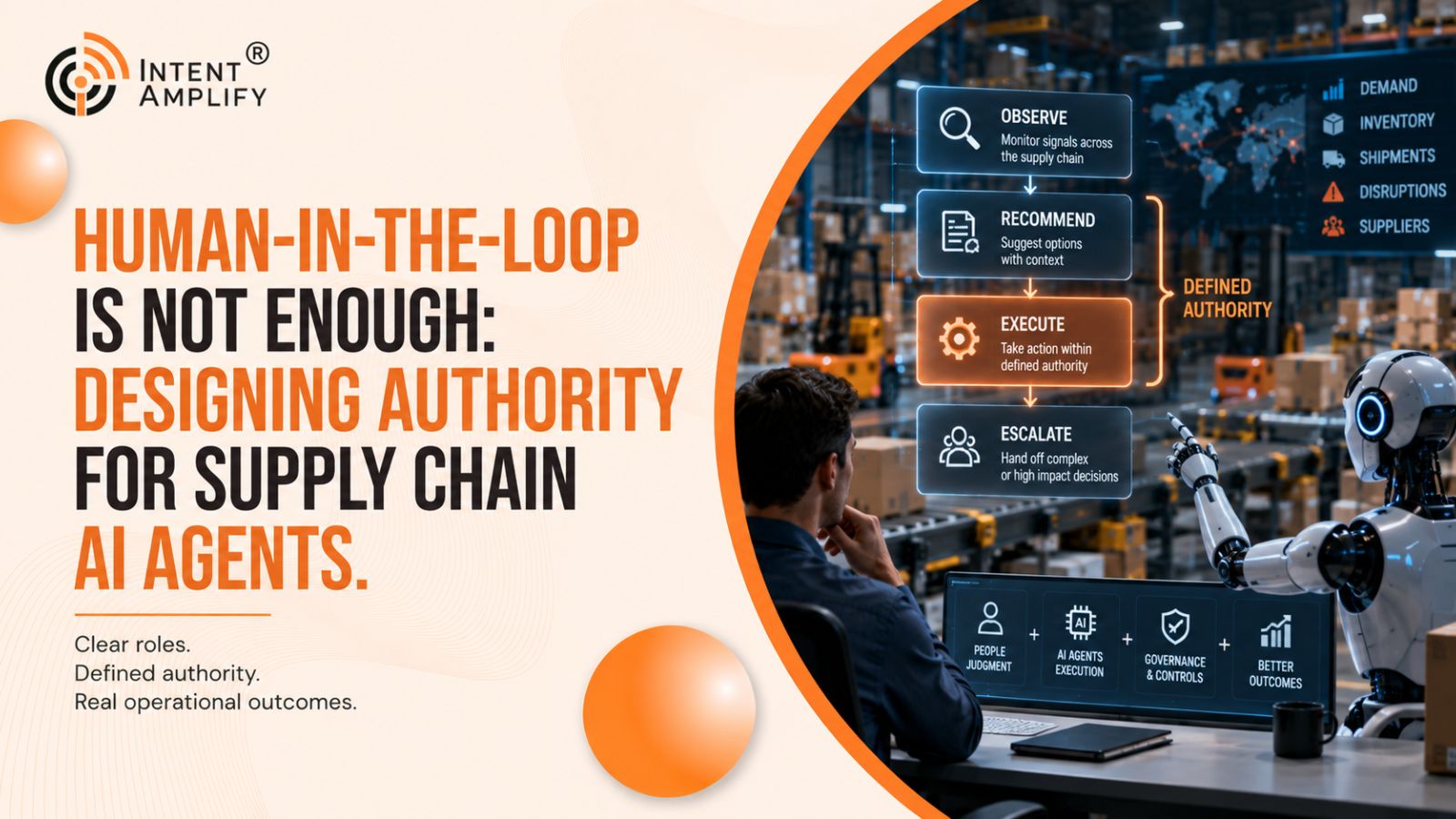
Evidence provenance reduces the risk of acting on stale or conflicting information. Permission boundaries prevent a recommendation engine from becoming an uncontrolled execution layer. Human approval protects decisions whose consequences are material. Audit trails make it possible to reconstruct why an action occurred. Verification confirms that an approved change actually produced the expected operating result.

DataRobot's enterprise agentic AI infrastructure announcements emphasize deployment, monitoring, governance, and operational control as organizations move agents into production.[5] Those capabilities matter economically because a fast workflow that cannot be trusted, explained, or safely stopped can create new forms of operational cost.

Recommendations: Building a Decision-Latency Business Case

Here are the recommendations from Intent Amplify for supply-chain leaders evaluating where agentic AI can create measurable operational value.

1. Map the Decision Before the Technology

Start with one recurring decision where delay has a meaningful consequence. Define the trigger, evidence, owner, feasible actions, approval requirements, execution system, and closure condition.

2. Baseline Every Stage of Latency

Measure detection, context, analysis, authority, execution, and verification separately. A single end-to-end cycle-time number can hide where the real delay occurs.

3. Quantify the Cost of Waiting

Estimate what changes while the decision remains open. Consider option expiry, inventory exposure, production disruption, premium freight, service commitments, warranty expense, or other decision-specific consequences.

4. Preserve Decision Quality

Track rejected recommendations, escalations, reversals, failed actions, stale-data exceptions, and reopened cases alongside cycle time.

5. Expand from Verified Performance

Scale only after the initial workflow demonstrates that it can reduce the targeted latency with reliable evidence, bounded authority, safe exception handling, and verified outcomes.

Conclusion: The Advantage Is Governed Decision Velocity

Agentic AI changes the economics of supply-chain operations by making decision latency visible as a design problem.

The strongest business case does not begin with the number of agents an organization can deploy. It begins with a specific decision whose delay has a measurable consequence. Leaders can then identify where time is lost, connect the required evidence, establish decision rights, automate bounded work, preserve human authority where necessary, and verify the result.

The DataRobot and Supply Chain Now webinar provides a practical example of that model through a tariff-risk scenario addressed in 72 hours rather than weeks.[1]

Build Stronger Demand Around Agentic Supply Chain Decision Intelligence

Intent Amplify helps B2B technology companies turn complex agentic AI and supply-chain transformation themes into credible thought leadership, market education, and demand-generation programs for senior buyers.

Through content strategy, research-led assets, content syndication, and buyer-focused demand generation, Intent Amplify helps technology brands translate advanced supply-chain solutions into clear executive value.

Watch the on-demand webinar: $2.5B in 72 Hours: What Agentic AI Looks Like When It Actually Works.

References

1. DataRobot (2026) $2.5B in 72 Hours: What Agentic AI Looks Like When It Actually Works. Available at:

https://www.datarobot.com/webinars/2-5b-in-72-hours-what-agentic-ai-looks-like-when-it-actually-works/ 

2. DataRobot (2026) AI for Manufacturing. Available at:

https://www.datarobot.com/solutions/manufacturing/ 

3. DataRobot (2026) The Unmet AI Needs Survey 2026. Available at:

https://www.datarobot.com/resources/unmet-ai-needs-survey-2026/ 

4. Supply Chain Now (2026) From AI Pilots to Performance: How Supply Chain Leaders Are Scaling Agentic AI. Available at:

https://supplychainnow.com/ai-pilots-to-performance-how-supply-chain-leaders-scaling-agentic-ai/ 

5. DataRobot (2026) DataRobot Accelerates Adoption of Agentic AI for the Enterprise on the Dell AI Factory with NVIDIA. Available at:

https://www.datarobot.com/newsroom/press/datarobot-accelerates-adoption-of-agentic-ai-for-the-enterprise-on-the-dell-ai-factory-with-nvidia/