
“Human in the loop” sounds reassuring, but it is too vague to govern operational AI.
The phrase does not explain what the AI may do before a person becomes involved, what triggers intervention, who owns the decision, what context transfers, or whether the human is approving, correcting, supervising, or handling an exception.
Supply-chain leaders need an authority model, not a slogan.
THE PROBLEM WITH GENERIC HUMAN OVERSIGHT
An AI agent can participate in very different ways. It can monitor a workflow, summarize a disruption, recommend a recovery action, execute a low-risk update, or coordinate several tasks across systems.
Each role creates a different control requirement.
If every workflow simply says “human in the loop,” teams may believe governance exists while critical questions remain unanswered.
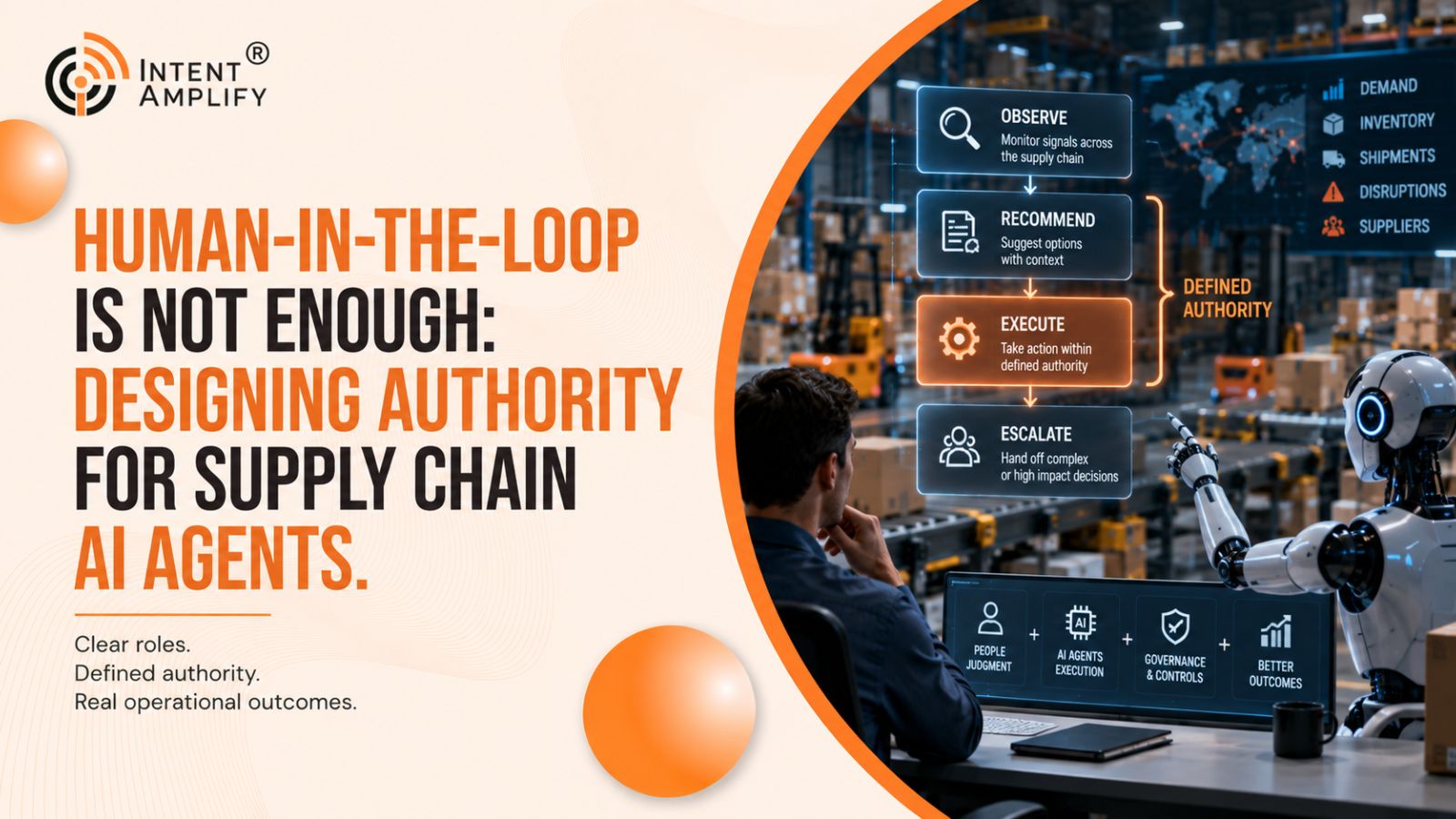
THE FOUR AUTHORITY LEVELS FOR SUPPLY CHAIN AI AGENTS
OBSERVE — The agent monitors, retrieves, summarizes, classifies, or detects. It does not change the workflow.
RECOMMEND — The agent proposes an action. A person reviews and decides.
EXECUTE — The agent performs an approved action when explicit conditions are met.
ESCALATE — The agent stops or transfers responsibility when uncertainty, impact, conflicting evidence, or policy requires human judgment.
This model turns oversight into operating design.
AUTHORITY SHOULD BE DECISION-SPECIFIC
An agent should not receive one enterprise-wide level of autonomy. Authority should be assigned to the specific workflow and action.
A routine, reversible inventory update can support a different level of autonomy from a supplier substitution, production reallocation, premium freight commitment, or customer-impacting decision.
The key factors include impact, reversibility, information certainty, policy, commercial significance, and accountability.
CONTEXT AND AUTHORITY ARE DIFFERENT
Better context can improve the quality of a decision. It does not automatically create permission to execute.
An agent may understand a logistics disruption extremely well and still require human approval because the preferred recovery action crosses a financial threshold.
Keeping context and authority separate prevents capability from silently becoming permission.
DESIGN THE ESCALATION TRIGGER
A useful escalation model identifies the conditions that force human involvement.
Triggers may include missing or conflicting information, material financial impact, strategic supplier consequences, customer service exposure, unusual exceptions, policy thresholds, low confidence, or an action outside the agent’s permission.
The trigger should be testable. “Escalate when needed” is not a control.
DESIGN THE HUMAN ROLE
Human participation can take several forms:
- Approval — the person authorizes a recommended action.
- Exception handling — the person resolves a situation outside the normal workflow.
- Supervisory review — the person evaluates patterns, overrides, and control performance.
- Strategic judgment — the person makes a decision involving negotiation, relationships, or material trade-offs.
These roles should not be collapsed into one generic review step.
PRESERVE CONTEXT IN THE HANDOFF
When the agent escalates, the person should receive the event summary, relevant process history, evidence, constraints, actions already taken, options considered, and reason for escalation.
A handoff that loses context creates delay and duplicated work. A handoff that preserves context turns human judgment into part of the same operating workflow.
MAKE OVERRIDES LEARNING SIGNALS
Human overrides are valuable evidence. Repeated overrides may indicate that the agent lacks context, a rule is incomplete, the process has changed, or the authority boundary is wrong.
The organization should review patterns rather than treating every override as an isolated event.
SUPPLY CHAIN AI AGENT GOVERNANCE CHECKLIST
For each AI-enabled workflow, ask:
- What may the agent observe?
- What may it recommend?
- What may it execute?
- What is explicitly prohibited?
- What conditions force escalation?
- Who owns each escalation type?
- What context must transfer?
- What evidence records the decision?
- What must be true before authority expands?
If these questions cannot be answered, the workflow is not ready for greater autonomy.
WHY AUTHORITY DESIGN MUST BEGIN WITH THE DECISION
Authority becomes practical only when it is attached to a specific decision. Broad statements such as “the agent can handle procurement exceptions” or “AI can manage logistics” are too general to define responsibility. Each domain contains decisions with very different consequences.
A procurement agent might safely classify an exception, retrieve contract information, and prepare a supplier follow-up. The same agent should not automatically receive authority to change a sourcing commitment. A logistics agent might prioritize disruptions and propose recovery options while premium freight remains subject to approval. An inventory agent might execute a reversible status update but escalate a reallocation that affects customer or production commitments.
The unit of governance is therefore the action inside the workflow. Leaders should identify the trigger, the decision to be made, the available options, the material consequences, and the accountable owner. Only then should they decide what role AI receives.
This decision-specific approach also prevents a common scaling problem. When an agent performs well in one bounded task, teams may be tempted to generalize that success to adjacent actions. Performance in observation does not prove readiness for recommendation. Strong recommendations do not prove readiness for execution. Authority should expand only for the action supported by evidence.
THE AUTHORITY CONTRACT
A useful way to operationalize the four authority levels is to create an authority contract for each AI-enabled workflow. The contract is not a legal document; it is an explicit operating definition of what the system may and may not do.
The contract should identify the business objective, workflow trigger, AI role, permitted actions, prohibited actions, decision owner, escalation triggers, evidence requirements, and conditions for changing authority. It should also state what happens when required context is missing or contradictory.
For an observe role, the contract can define which events the agent monitors and what it may surface. For recommend, it can specify which options the agent may propose and which decisions remain subject to approval. For execute, it should define the exact action boundary, relevant thresholds, and conditions that must be satisfied before the action is performed. For escalate, it should identify the receiving owner and the context that must be transferred.
The value of the contract is clarity. Business, operations, IT, data, security, and governance teams can review the same operating boundary rather than relying on different assumptions about what “human oversight” means.
DESIGNING APPROVAL WITHOUT CREATING A BOTTLENECK
Human approval can preserve accountability, but poorly designed approval can recreate the delay that AI was intended to reduce. The answer is not to remove approval indiscriminately. It is to make approval decision-ready.
When an agent requests approval, the reviewer should receive the smallest complete evidence package needed to decide. That can include the triggering event, affected process objects, material constraints, relevant history, available options, the recommended action, expected consequence, and the reason approval is required.
The reviewer should not have to search across several systems to discover what the agent already evaluated. If that reconstruction is necessary, the human remains in the loop, but the workflow has not been meaningfully orchestrated.
Approval design should also account for timing. Some supply-chain exceptions lose value quickly. A delayed approval can convert a manageable disruption into a service or production problem. The workflow should therefore define who owns the approval, what happens when the primary owner is unavailable, and when the situation should be rerouted or escalated further.
The objective is accountable speed: preserve human decision ownership where it matters while transferring enough context to make the intervention efficient.
CONFIDENCE IS NOT AUTHORITY
AI systems may produce confidence indicators, but confidence should not be treated as a substitute for business permission. A high-confidence recommendation can still concern an action the agent is prohibited from executing. A lower-confidence situation may still be safe for a reversible, low-impact action if the operating rules explicitly allow it.
Authority should therefore be determined by the workflow contract, not by model confidence alone. Confidence can be one escalation signal among several, alongside missing data, conflicting evidence, unusual process states, material impact, policy boundaries, or lack of a permitted action.
This distinction matters because confidence describes the system’s assessment of its output or evidence. Authority describes the organization’s decision about responsibility. Mixing the two can allow technical behavior to redefine governance unintentionally.
DESIGNING FOR CONFLICTING EVIDENCE
Supply-chain data is rarely perfectly consistent. An ERP record, supplier message, transport update, planning signal, and warehouse event can describe the same situation differently. An authority model must explain what happens when the evidence needed for action conflicts.
The first requirement is source clarity. Teams should identify which information is authoritative for each material decision input. The second is conflict handling. The agent should know whether to wait for a fresher record, seek corroborating context, recommend with an explicit caveat, or escalate.
The third requirement is visibility. A human reviewer should be able to see that evidence conflicted and understand how the workflow responded. Hiding the disagreement behind a single synthesized answer makes oversight weaker.
This is another reason generic human-in-the-loop language is insufficient. The relevant question is not simply whether a person can intervene. It is whether the workflow knows when conflicting evidence requires intervention and whether the person receives the conflict in a usable form.
THE ROLE OF REVERSIBILITY IN AUTHORITY
Reversibility is one of the strongest practical factors in deciding how much execution authority to grant. A low-impact action that can be detected and reversed quickly creates a different operating risk from an action that becomes difficult to unwind once another system, supplier, carrier, plant, or customer acts on it.
Leaders should evaluate the full operational path. A change may appear reversible in the originating system while becoming consequential downstream. A purchase-order adjustment can trigger supplier activity. A transport decision can commit capacity. An allocation change can affect customer expectations. A production decision can consume scarce material.
For each executable action, ask when it becomes difficult to reverse, how an incorrect action would be detected, who can stop or correct it, and what downstream consequences could persist. These answers help determine whether execution is appropriate or whether recommendation plus approval remains the stronger design.
HUMAN ROLES ACROSS THE AI LIFECYCLE
Human responsibility extends beyond approving individual actions. Different roles become important at different points in the workflow lifecycle.
Operational owners define the business objective, process reality, and acceptable action boundaries. Subject-matter experts identify constraints, exceptions, and judgment that may not be visible in system data. Data and technology teams establish reliable access to the context required by the workflow. Security and governance teams help define permissions and review requirements. Frontline users handle exceptions and provide evidence about where the workflow succeeds or fails.
After deployment, supervisory review becomes important. Leaders should examine overrides, escalations, unusual outcomes, and changes in process behavior. This review determines whether the authority contract remains appropriate.
The result is a broader model of human involvement. People are not merely an approval checkpoint. They design the operating boundary, handle judgment-intensive exceptions, review evidence, and decide when responsibility should change.
OVERRIDES SHOULD HAVE REASONS
An override is most useful when the organization knows why it happened. A simple record that a human rejected an agent recommendation provides limited learning value.
Where appropriate, override reasons can distinguish missing context, incorrect data, unacceptable commercial impact, policy constraints, relationship considerations, changed priorities, novel exceptions, or a recommendation that was otherwise unsuitable. The purpose is not to burden users with excessive documentation. It is to capture enough signal to identify patterns.
If many overrides occur because a key constraint is absent, the priority may be context improvement. If users repeatedly reject an action because the financial boundary is too permissive, the authority contract may need adjustment. If overrides cluster around a particular process variant, the workflow may require different logic or a narrower scope.
Overrides therefore connect frontline human judgment to continuous improvement.
ESCALATION OWNERSHIP MUST BE EXPLICIT
An escalation without an owner is simply a stopped workflow. For every escalation trigger, the operating model should identify who receives responsibility and what response is expected.
Different exceptions can require different owners. A data conflict may route to an operational or data steward. A supplier-commercial issue may require procurement leadership. A production consequence may require planning or operations. A customer-impacting exception may need commercial or service ownership. A policy or permission issue may require governance or security review.
The workflow should avoid sending every exception to one generic queue. Routing should reflect the nature of the decision. Where the correct owner cannot be determined automatically, the agent can surface the uncertainty rather than silently choosing an inappropriate destination.
Clear ownership also makes service expectations possible. Teams can define how urgent exceptions are prioritized and what happens when the expected owner does not respond in time.
AUTHORITY IN MULTI-AGENT WORKFLOWS
Multi-agent systems create an additional authority question: which agent is allowed to initiate, recommend, approve, or execute each step?
One agent may monitor supplier events, another may analyze inventory exposure, and another may coordinate logistics options. Their combined output can be useful, but the organization still needs one coherent business authority model.
Agents should not create circular approvals in which one machine effectively authorizes another without an explicit business rule. Nor should responsibility become unclear because several agents contributed to the recommendation. The workflow should identify which component performed each step, what context was shared, what action was proposed or executed, and who owns the final business decision.
When agents disagree, the operating model should define whether the conflict is resolved through additional evidence, a deterministic priority rule, or human escalation. The important point is that coordination should make authority more visible, not less.
AUTHORITY SHOULD BE REVIEWED, NOT SET ONCE
The appropriate boundary can change as processes, data, suppliers, policies, systems, and business priorities change. An authority model that was appropriate during a pilot can become too restrictive or too permissive later.
A recurring review should examine process stability, data quality, exception patterns, overrides, escalation reasons, execution outcomes, and changes in operating policy. Leaders can then decide whether to preserve, expand, narrow, or temporarily suspend specific permissions.
Expansion should be specific. A workflow may earn authority for one additional action without earning broader autonomy across the process. Similarly, a workflow can increase transaction scope while keeping the same authority level. Separating scope from authority helps teams understand what is actually changing.
A temporary reduction in authority should not automatically be viewed as failure. If operating conditions change materially, moving an agent from execute back to recommend can be a rational control decision until evidence improves.
THE EXECUTIVE AUTHORITY REVIEW
Executives can evaluate an AI-enabled workflow through a concise review structure.
- Decision: Is the exact operational decision and business owner clear?
- Context: Does the workflow have the trusted information required to interpret the situation?
- Permission: Are permitted and prohibited actions explicit?
- Impact: Are consequences and reversibility reflected in the authority level?
- Escalation: Are triggers testable and owners defined?
- Handoff: Does the human receive decision-ready context?
- Evidence: Can the organization reconstruct what the agent recommended or did?
- Learning: Are overrides and exceptions used to improve context, process, or authority?
- Change: Is there an explicit basis for expanding or reducing responsibility?
This review moves the conversation beyond whether a human is nominally present. It tests whether responsibility is deliberately engineered into the workflow.
A PRACTICAL IMPLEMENTATION SEQUENCE
Begin with one bounded decision. Map how the process actually works and identify where people currently assemble context, make judgments, and authorize actions. Define the minimum trusted information required for that decision.
Next, assign the initial AI role. Observation and recommendation are often useful starting points when the workflow is complex, or the consequences are material. Define the authority contract, escalation triggers, human owners, and evidence package before expanding responsibility.
During operation, review recommendations, approvals, overrides, escalations, and outcomes. Determine whether repeated human intervention indicates missing context, a process issue, or an authority boundary that needs adjustment. Expand execution only where the evidence supports the specific action.
This sequence preserves the value of human judgment while making AI participation progressively more operational.
CONCLUSION
Human oversight matters, but “human in the loop” is not enough. Operational AI needs explicit decision authority, defined escalation triggers, accountable owners, context-rich handoffs, and evidence-led expansion.
The objective is not to keep a person attached to every action forever. It is to divide responsibility between people and agents in a deliberate, visible, and adjustable way as evidence improves.
Join the September 17 webinar, “Operational AI in the Supply Chain: How Context Empowers Agents and Humans to Operate Side by Side,” to explore how supply-chain leaders can design clearer authority for human-and-agent operations.
REFERENCES
1. Celonis — Context Model: https://www.celonis.com/platform/context-model
2. Celonis — Enterprise AI: https://www.celonis.com/solutions/ai
3. Celonis — Supply Chain Transformation: https://www.celonis.com/solutions/supply-chain-transformation/
4. NIST — Artificial Intelligence Risk Management Framework (AI RMF 1.0): https://www.nist.gov/publications/artificial-intelligence-risk-management-framework-ai-rmf-10
5. NIST — Generative AI Profile (NIST AI 600-1): https://www.nist.gov/publications/artificial-intelligence-risk-management-framework-generative-artificial-intelligence