
Executive Summary
Retailers have traditionally measured customer experience through traffic, conversion, basket size, loyalty activity, checkout speed, and repeat visits. Those metrics remain useful, but they do not fully capture a shopper’s lived experience inside grocery, convenience, and quick-service restaurant environments.
The more revealing measure is customer effort.
Customer effort is the amount of work a person must do to complete a mission. It shows up when a self-service kiosk stalls, when a mobile order is not ready, when a promotion fails at checkout, when a substitution disappoints, or when an associate must step in because two systems cannot resolve a simple exception.
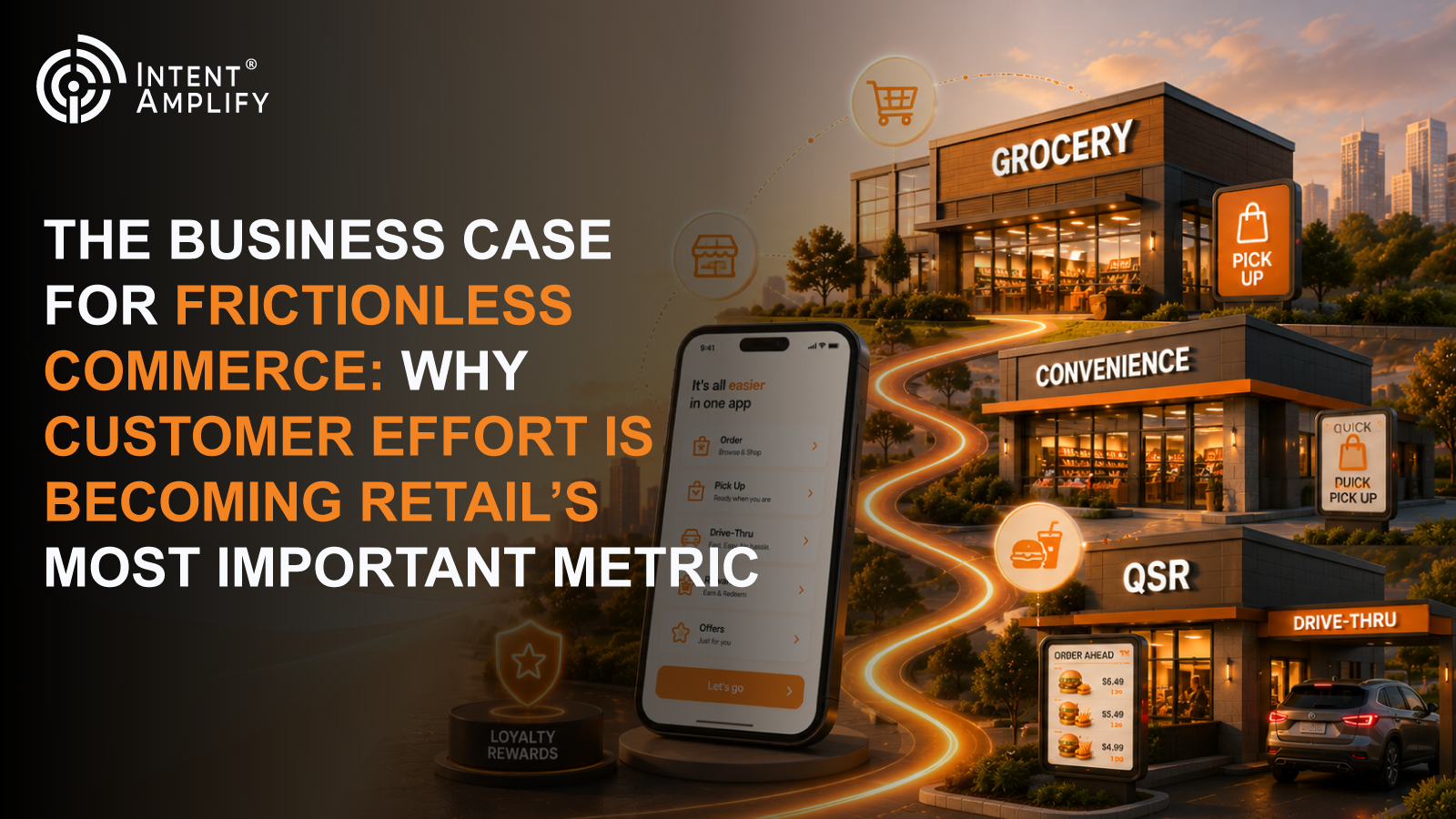
That is why frictionless commerce is becoming a business case, not a design ambition.
The National Retail Federation expects U.S. retail sales to reach $5.42 trillion to $5.48 trillion in 2025, growing between 2.7% and 3.7% despite economic uncertainty.1
In a market that large, even small reductions in checkout friction, order abandonment, store intervention, or fulfillment failure can have meaningful commercial value. RETHINK Retail’s report, The Frictionless Frontier: Why Grocery, Convenience, and QSR Need a Reset, reinforces this point with three practical signals: 84% of consumers prefer self-service kiosks, kiosk deployments can produce 30% higher ticket sizes, and AI age estimation can reduce human intervention by 75%.
The implication is straightforward. Customer effort is no longer soft feedback. It is a measurable operating signal tied to revenue, labor, loyalty, retail throughput, and technology return on investment.
Why Customer Effort Is Moving Up the Retail Agenda
Convenience used to be measured by what retailers added: more checkout lanes, faster payment terminals, better apps, curbside pickup spaces, mobile menus, and self-service kiosks. The next phase is different. Retailers will be judged by what customers no longer have to do.
They should not have to re-enter information. They should not have to ask why a loyalty offer failed. They should not have to wait for an employee to clear a routine age check. They should not have to guess whether an online grocery basket reflects real shelf availability.
That sounds simple. Operationally, it is difficult.
The modern customer journey crosses point-of-sale systems, loyalty platforms, mobile apps, fuel pumps, kitchens, inventory systems, payment rails, age verification software, and loss-prevention tools. If those systems do not share context, friction appears at the customer-facing edge.
Deloitte’s commerce research found that 80% of business-to-consumer leaders believed they were delivering impressive online shopping experiences, while fewer than half of consumers agreed. The same research found that consumers spend 37% more with brands that provide consistent and positive commerce experiences.2
That gap matters because many retailers overestimate the quality of the journey they provide. Customers do not evaluate the enterprise architecture. They evaluate the effort required to complete the task.
Check out Friction Is a Revenue and Labor Problem
Checkout is often treated as the last step in the transaction. In practice, it is where operational weaknesses become visible.
A stalled self-checkout lane can expose poor exception design. A failed coupon can reveal weak POS integration. A long drive-thru payment delay can show that order sequencing and staffing are not aligned. A self-ordering kiosk may increase order volume but create kitchen congestion if store operations are not prepared.
This is why checkout friction should not be viewed only as a queue issue. It is a signal of system fragmentation.
The caution is equally important. Hardware alone does not create frictionless retail. If the kiosk cannot manage exceptions, integrate with loyalty, reflect real availability, or coordinate with production workflows, it becomes another surface where customer effort appears.
The strongest business case is not “more automation.” There are fewer avoidable interruptions.
Grocery: Effort Appears as Doubt
Grocery friction often begins before the shopper reaches checkout. It begins with doubt.
Is the item actually available? Will the substitution make sense? Will the pickup order be complete? Will the digital offer work in-store? Will the retailer waste the customer’s time?
The State of Grocery Retail 2026 from McKinsey highlights how grocery leaders are operating in a market shaped by margin pressure, changing shopper behavior, private-label growth, artificial intelligence, and shifting models of convenience.3
For U.S. grocery leaders, the lesson is practical. Customer experience is not only the visible store environment. It is the reliability of inventory signals, fulfillment logic, pricing consistency, and staff execution.
Predictive analytics retail capabilities can help grocers anticipate demand. Computer vision retail tools can improve shelf awareness. Customer journey mapping can reveal where uncertainty repeatedly appears. Unified commerce can connect digital intent with physical availability.
A shopper may never know which system prevented a poor substitution. They simply experience the grocer as dependable. That dependability is difficult to market but powerful to lose.
Convenience Stores: The Small Trip Has Become Complex
Convenience stores are built around short missions. Coffee before work. Fuel on the way home. A snack, a prepared meal, a beverage, a lottery ticket, or an age-restricted product. The visit may be brief, but the operating model behind it is increasingly complex.
A single site may combine fuel, foodservice, packaged goods, loyalty, mobile payment, age verification, retail shrinkage controls, and QSR-style ordering. That creates the need for platform unification.
When the forecourt, counter, mobile app, loyalty system, food-preparation workflow, and checkout layer do not connect, the customer experiences friction as a delay. When they do connect, the visit feels simple.
RETHINK Retail’s report identifies the “triple-threat site” as a critical theme, where fuel, convenience, and QSR converge and where operational seams begin to break.
This is where AI checkout, checkout automation, self-checkout security, AI loss prevention, and connected POS design become strategic rather than technical. The goal is not to make the site feel more digital. The goal is to make the customer's mission feel lighter.
QSR: Flow Is Becoming the Real Competitive Advantage
QSR operators understand speed. The harder challenge now is flow.
A modern restaurant may receive orders from the counter, drive-thru, mobile app, delivery marketplace, curbside channel, and self-ordering kiosk at the same time. The customer sees one brand. The store team sees competing demand streams landing inside one kitchen.
The National Restaurant Association expects the restaurant industry to reach $1.5 trillion in sales in 2025 and employ 15.9 million people by year-end. The industry is also expected to add more than 200,000 net new jobs during the year.4
That growth increases the stakes for operational efficiency. It also makes it harder for customers to hide.
The National Restaurant Association also reports that nearly 75% of restaurant traffic now happens off-premises, meaning almost three out of four orders are taken to go. It further notes that 57% of adults recently used mobile ordering, including 74% of millennials and 65% of Gen Z adults.5
For QSR leaders, these numbers point to a new operating reality. The restaurant experience increasingly happens outside the dining room. It lives inside the app, the kitchen queue, the pickup shelf, the drive-thru lane, the payment process, and the customer’s expectation that all of it will work as one journey.
Retail digital transformation must therefore focus on production flow, order sequencing, labor planning, and customer flow management. Faster ordering does not help if fulfillment cannot keep pace.
Labor Pressure Makes Customer Effort More Expensive
Customer effort and employee effort are tightly connected. When a process breaks, an associate usually becomes the workaround.
An employee resolves the coupon failure. A cashier clears the self-checkout exception. A crew member explains the delayed mobile order. A manager handles an age-check interruption. A foodservice worker remakes an order that moved through the wrong queue.
This creates hidden labor costs.
The restaurant industry’s expected 15.9 million employment base shows how central people remain to foodservice growth, but rising operational complexity means retailers must use labor more intelligently, not simply add more of it.6
This is why workforce efficiency and labor productivity should be part of every frictionless commerce discussion. Technology should reduce preventable interventions. It should not create new dashboards, alerts, and manual overrides that employees must manage.
RETHINK Retail’s finding that AI age estimation can reduce human intervention by 75% is a useful example. It shows how automation can reduce repetitive compliance burdens while preserving control where human judgment remains necessary.3
The strongest labor automation does not remove humanity from retail. It removes unnecessary interruptions from the people responsible for service.
Trust Is Part of Frictionless Commerce
Frictionless commerce depends on data. That makes trust central to the business case.
Retailers are using more data to personalize offers, manage inventory, detect shrinkage, support AI checkout, improve self-checkout security, and guide customer journeys. Used well, those capabilities reduce effort. Used poorly, they can make shoppers feel watched, misunderstood, or unfairly interrupted.
IBM’s Cost of a Data Breach Report 2025 reported that the global average cost of a data breach reached USD 4.44 million in 2025, while the U.S. average reached USD 10.22 million.6
For retailers managing payment data, loyalty profiles, mobile ordering, delivery information, and identity signals, security is not separate from customer experience. A seamless customer journey must also be a trusted one.
This is the balance leaders must strike. AI loss prevention should reduce retail shrinkage without making honest customers feel suspicious. Personalization should improve relevance without overstepping. Checkout automation should speed the transaction without weakening governance.
Convenience without trust is fragile.
Where RETHINK Retail’s Report Fits
The Frictionless Frontier: Why Grocery, Convenience, and QSR Need a Reset is useful because it treats frictionless commerce as a platform and operating-model issue rather than a surface-level customer experience theme.
The report focuses on where friction hides across checkout, kiosk exceptions, age verification, forecourt-to-store journeys, and disconnected retail systems. For leaders evaluating unified commerce, retail automation software, POS integration, platform unification, AI checkout, and self-service kiosk strategy, that framing is practical.
The benefit is not simply learning that convenience matters. Most executives already know that. The value is in understanding where customer effort is being created by current architecture and where technology decisions can remove that effort before it reaches revenue, labor, loyalty, or margin.
Access the full report here:
The Frictionless Frontier: Why Grocery, Convenience, and QSR Need a Reset
What Leaders Should Do Before Investing
Leaders should begin by mapping effort across high-frequency journeys: grocery pickup, QSR ordering, convenience-store missions, fuel-to-food visits, self-checkout, drive-thru, loyalty redemption, and age-restricted transactions.
Next, they should connect each friction point to the system responsible for it. Checkout friction may require stronger POS integration. Pickup failures may reveal poor inventory visibility. Retail shrinkage may call for better AI loss prevention rather than heavier visible monitoring. Workforce inefficiency may show that employees are compensating for disconnected automation.
Third, operators should prioritize platform unification over isolated tools. More screens will not fix a fragmented journey. The business needs systems that share context, trigger the right workflow, and reduce unnecessary intervention.
Finally, success should be measured through effort removed: fewer checkout exceptions, stronger kiosk completion, faster transaction speed, lower abandonment, higher substitution acceptance, reduced associate intervention, improved workforce efficiency, and cleaner store operations.
About Intent Amplify
Intent Amplify helps B2B revenue teams turn buyer intent into a qualified pipeline through GTM strategy, demand intelligence, pipeline activation, roundtables, research-led content, webinars, panels, vendor intelligence, and strategic consulting.
We help technology, SaaS, cybersecurity, AI, manufacturing, agency, and business services teams move beyond lead volume by identifying high-intent accounts, mapping buying-group signals, and building narrative-led campaigns that engage the right decision-makers at the right stage.
Contact us to learn how Intent Amplify can help your organization convert audience intent into qualified demand and stronger go-to-market outcomes.
Conclusion
Customer effort is becoming one of retail’s most important business metrics because it captures what traditional measures often miss.
A shopper may like the product and still abandon the journey because the process feels too hard. A store may have traffic and still lose value because checkout slows down. A kiosk may look modern and still fail if it cannot handle exceptions. A loyalty program may have members and still underperform if offers do not connect to availability.
That is why frictionless commerce deserves executive attention. It is not a design trend. It is a revenue, labor, trust, and operating-performance issue.
For grocery, convenience, and QSR leaders, the mandate is direct. Reduce the work customers feel and the avoidable effort employees absorb. Build systems that connect intent to outcome. Treat platform decisions as experience decisions. Measure friction before it becomes leakage.
The future will not be won by brands that make shoppers admire technology. It will be won by those who make the work disappear.
References
-
National Retail Federation, NRF Forecasts 2025 Retail Sales to Hit $5.42 Trillion, Despite Economic Uncertainty, April 2, 2025
(https://nrf.com/media-center/press-releases/nrf-forecasts-2025-retail-sales-to-hit-5-42-trillion-despite-economic-uncertainty) -
Deloitte, What Do Consumers Really Think About Commerce Experiences?, April 2024
(https://deloitte.wsj.com/cmo/what-do-consumers-really-think-about-commerce-experiences-b492c8f7) -
McKinsey & Company, The State of Grocery Retail, 2026
(https://www.mckinsey.com/industries/retail/our-insights/state-of-grocery-retail-global) -
National Restaurant Association, Restaurant Industry Poised for Growth in 2025: Industry Expected to Employ 15.9 Million People and Reach $1.5 Trillion in Sales, February 6, 2025
(https://restaurant.org/research-and-media/media/press-releases/restaurant-industry-poised-for-growth-in-2025-industry-expected-to-employ-15-9-million-people-and-r/) -
National Restaurant Association, From Trend to Transformation: Off-Premises Dining Now Essential for Restaurant Consumers, Operators, April 16, 2025
(https://restaurant.org/research-and-media/media/press-releases/from-trend-to-transformation-off-premises-dining-now-essential-for-restaurant-consumers,-operators/) -
IBM, Cost of a Data Breach Report 2025, 2025
(https://www.ibm.com/reports/data-breach)