
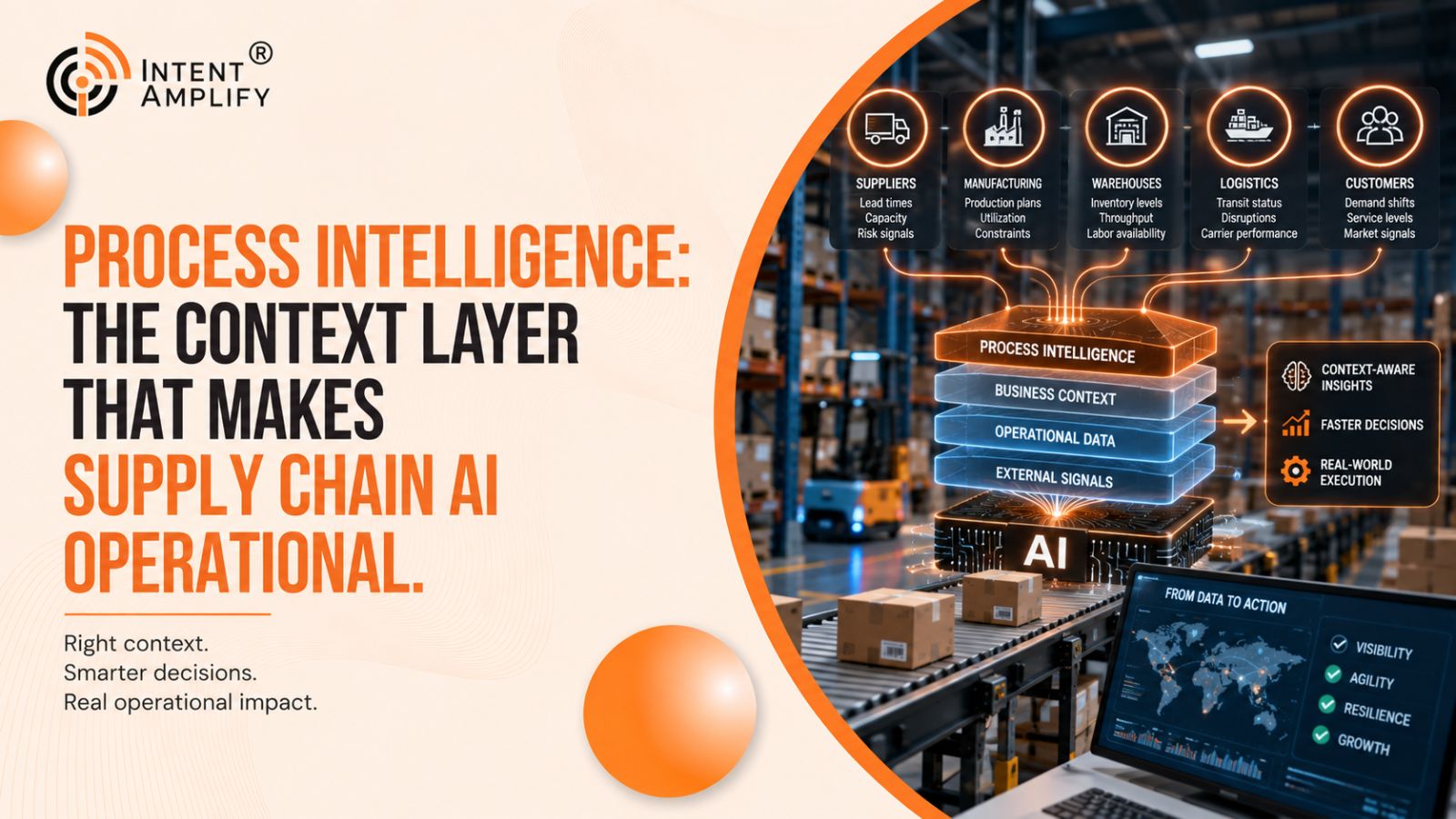
AI can analyze supply-chain data. Operational AI must understand the process that gives the data meaning.
That is where process intelligence becomes strategically important.
Supply-chain information is distributed across ERP, procurement, planning, manufacturing, warehouse, transportation, supplier, and analytics systems. Each system can describe part of the business. The operational decision, however, often depends on the relationships among them.
A shortage is not simply an inventory value. A logistics delay is not simply a timestamp. A supplier exception is not simply a variance. Each event sits inside a process with dependencies, constraints, ownership, and downstream consequences.
HOW PROCESS INTELLIGENCE IMPROVES SUPPLY CHAIN AI
Process intelligence connects events across systems into an understandable view of how work actually flows. It helps reveal sequence, deviation, rework, delay, handoffs, and recurring patterns.
For people, this reduces the time required to reconstruct what happened. For AI agents, it creates context that can support more relevant reasoning.
Instead of asking an agent to respond to an isolated alert, the organization can give it a process-aware situation: what happened, what came before, which objects and teams are affected, what constraints apply, and what actions are available.
WHY THIS MATTERS FOR AGENTIC AI
Agentic AI increases the importance of context because the system is expected to participate in decisions, not merely generate text.
An agent evaluating a supplier delay may need to understand affected purchase orders, production dependencies, alternate supply, inventory coverage, supplier history, qualification rules, customer priorities, and cost implications.
The quality of the decision depends on whether those relationships are visible.
Process intelligence does not eliminate the need for human judgment or governance. It gives both humans and AI a stronger operating foundation.
FROM PROCESS MINING TO OPERATIONAL CONTEXT
Process mining is valuable for discovering how processes actually behave from event data. Operational AI extends the requirement: the discovered process must become usable context inside live decisions.
That means connecting historical patterns with current state, business knowledge, rules, constraints, and action pathways.
The executive opportunity is to move from retrospective process understanding toward decision-time process intelligence.
THE CONTEXT LAYER SHOULD ANSWER FIVE QUESTIONS
1. What operational event is occurring?
2. How did the process arrive at this state?
3. Which dependencies and constraints matter now?
4. What actions are available and permitted?
5. Who owns the decision when the situation exceeds the agent’s authority?
If the context layer cannot answer these questions, autonomy should remain limited.
PROCESS INTELLIGENCE + AUTHORITY
Better context can justify better recommendations, but it should not silently expand agent authority.
Use an explicit model: observe, recommend, execute, escalate.
The process context helps the agent determine what is happening. The authority model determines what the agent is allowed to do about it.
Keeping those concepts separate is essential for controlled operations.
PROCESS INTELLIGENCE + HUMAN ORCHESTRATION
A planner or operations leader should not receive an unexplained recommendation. The workflow should expose the event, relevant process history, material constraints, evidence, options, and reason for escalation.
This makes the AI recommendation inspectable and gives the human enough context to continue the decision efficiently.
Human overrides should also become process-learning signals where appropriate. If the same recommendation is repeatedly rejected, the organization can investigate whether the context, rule, model, or authority boundary is wrong.
THREE HIGH-VALUE APPLICATIONS
EXCEPTION PRIORITIZATION — Use process context to distinguish material exceptions from routine variance.
ROOT-CAUSE ORIENTATION — Connect the current problem to the process path and upstream conditions that produced it.
DECISION SUPPORT — Assemble the operational situation, constraints, and options so people or agents can respond faster.
These applications do not require the organization to begin with full autonomy. They create value by improving understanding first.
THE EXECUTIVE STANDARD
Process intelligence becomes operational when it is embedded in the decision loop: detect, understand, decide, act, observe the outcome, and improve the process.
That loop is the foundation for context-aware AI.
WHAT PROCESS INTELLIGENCE ADDS BEYOND VISIBILITY
Visibility tells teams that an event exists. Process intelligence helps explain why the event matters in the flow of work. That distinction becomes increasingly important as AI participates in operational decisions.
A delayed shipment, for example, can be visible in a transportation system. Process intelligence can connect that event to the purchase order, expected receipt, inventory position, production dependency, customer commitment, and prior actions. The event becomes part of an operating situation rather than an isolated status.
The same applies to a supplier exception. A late confirmation may be routine for one order and material for another. The difference depends on process relationships: whether production is exposed, whether alternate supply exists, whether inventory covers demand, and whether the supplier has unresolved prior exceptions.
For AI, this connected view provides a stronger basis for reasoning. For humans, it reduces the effort required to reconstruct the case. The shared benefit is decision-ready context.
THE SIX ELEMENTS OF A DECISION-TIME CONTEXT LAYER
A useful context layer can be organized around six elements.
Event state identifies what is happening now. Process history explains the sequence of events that produced the state. Object relationships connect the event to orders, materials, suppliers, shipments, customers, assets, or other relevant entities. Constraints define policies, thresholds, qualifications, capacity, commercial conditions, and operational limits. Ownership identifies who is responsible for the decision and exception. Outcome evidence shows what happened after prior recommendations or actions.
These elements do not require one monolithic data environment. The operating requirement is that the workflow can access and interpret the minimum trusted context required for the decision.
Leaders should identify which elements are essential for each use case. If a recommendation repeatedly fails because one relationship is missing, the priority is to improve that context rather than simply increase model capability.
PROCESS INTELLIGENCE AND DECISION-GRADE DATA
Process intelligence depends on data, but the standard is not “more data.” The standard is data that can support the operational interpretation.
Teams should know which sources are authoritative, how current the information needs to be, and what the workflow should do when records conflict. A process view built from stale or contradictory inputs can create a coherent picture that is still operationally wrong.
Decision-grade data therefore combines quality with meaning. The system should understand not only the value but its role in the process. An inventory number can mean different things depending on location, availability status, reservation, timing, or production dependency. A supplier date can have different significance depending on the order, material, and downstream requirement.
Process intelligence creates value when those meanings and relationships become usable inside the decision loop.
FROM ROOT-CAUSE ANALYSIS TO NEXT-BEST ACTION
Process mining is often associated with identifying bottlenecks, deviations, and root causes. Operational AI creates an opportunity to connect that understanding to the next decision.
The transition can follow a sequence. First, detect the event or deviation. Second, reconstruct the relevant process path. Third, identify dependencies and constraints. Fourth, determine the available and permitted actions. Fifth, recommend or execute according to the authority boundary. Sixth, observe the outcome and feed the result into process review.
This sequence links retrospective understanding with operational participation. The organization is not abandoning process analysis. It is making process understanding available at the moment action is required.
The quality of the transition depends on observability. Leaders should be able to see which context influenced the recommendation and what happened after the action.
EXCEPTION MANAGEMENT AS A CORE USE CASE
Exception management is a natural starting point because supply-chain teams often spend substantial effort deciding which deviations deserve attention.
An AI-enabled process-intelligence workflow can monitor events, connect them to downstream consequences, and prioritize exceptions by operational relevance. A late shipment with sufficient inventory coverage may remain low priority. A similar delay affecting a constrained production order can require immediate attention.
The value comes from context-aware prioritization, not simply faster alert generation. The workflow should reduce noise by distinguishing routine variance from decisions that require intervention.
At the initial stage, AI can remain at observe or recommend level. Teams can review whether the prioritization reflects operational reality before considering greater authority.
PROCESS INTELLIGENCE FOR SHORTAGE RESPONSE
Shortage response illustrates how context can change the decision. The initial signal may be an inventory or supply gap. The operational response can depend on affected demand, production sequence, inbound supply, alternate material, supplier commitment, customer priority, transport options, and cost implications.
Process intelligence can assemble how the shortage emerged and which orders or processes are affected. AI can then help evaluate permitted options. A human owner can retain authority over supplier, production, or customer-impacting actions while the system performs continuous monitoring and context assembly.
Over time, specific reversible actions may support bounded execution if the organization has sufficient evidence. The important point is that authority follows context and operating evidence rather than the existence of the AI capability.
PROCESS INTELLIGENCE FOR LOGISTICS RECOVERY
A logistics disruption becomes decision-ready when the workflow connects transport status to the wider operating process. The system may need to understand inventory coverage, production dependency, service commitment, alternative routes, carrier options, and financial thresholds.
AI can use this context to prioritize disruptions and compare recovery options. Some actions can remain recommendations. Others may be executable within predefined conditions. High-impact commitments can escalate to a human owner.
The process-intelligence layer helps ensure that a recovery recommendation reflects downstream consequences rather than optimizing transport in isolation.
PROCESS INTELLIGENCE FOR SUPPLIER EXCEPTIONS
Supplier exceptions often require interpretation across several signals. Delivery performance, order criticality, production dependency, alternative supply, prior exceptions, and commercial considerations can all influence the appropriate response.
Process intelligence can connect these signals to the actual procurement and production workflow. AI can summarize the case, identify material dependencies, and recommend the next step. Strategic supplier decisions and commercial negotiations can remain human-owned.
This model allows AI to reduce information assembly without replacing the relationship judgment that belongs with procurement leaders.
PROCESS INTELLIGENCE AND THE AUTHORITY BOUNDARY
As the context layer improves, leaders may become more comfortable with AI recommendations. That improvement should not automatically expand execution authority.
Authority remains a separate business decision. For each action, define whether the agent may observe, recommend, execute, or escalate. Identify the required conditions, prohibited actions, and human owner. Consider consequences and reversibility, not only model capability.
This separation is particularly important when process intelligence gives the agent a rich view of the operation. Understanding more does not mean the system should be allowed to do more without explicit permission.
A mature workflow can therefore have sophisticated context and deliberately limited authority. That is a valid operating design.
THE HUMAN VIEW: INSPECTABLE RECOMMENDATIONS
Process intelligence can make human oversight more useful by making recommendations inspectable. A planner should be able to see the event, relevant process path, affected objects, constraints, options, and reason for the recommendation.
If the agent escalates, the same context should transfer. The person should know what the system already evaluated and what boundary or uncertainty caused it to stop.
This reduces duplicated investigation. It also creates a better basis for override learning. When a human rejects a recommendation, the organization can compare the decision against the context the agent used and identify what was missing or misinterpreted.
The objective is not merely explainability in abstract terms. It is operational continuity between machine reasoning and human judgment.
OBSERVABILITY CLOSES THE LOOP
Process intelligence should continue after the decision. The organization needs to observe what happened after a recommendation or action.
Outcome evidence can reveal whether the process improved, whether a different exception appeared downstream, whether humans repeatedly overrode the same recommendation, or whether the authority boundary is producing unnecessary escalation.
This evidence supports continuous improvement of the process, context, and AI role. It also prevents the workflow from becoming a black box that produces actions without an operating feedback loop.
A useful review asks whether the process is becoming more effective and whether the current division of responsibility remains appropriate.
HOW TO IMPLEMENT PROCESS INTELLIGENCE FOR SUPPLY CHAIN AI
Start with one decision where fragmented process context creates visible operational friction. Map how the workflow actually runs and identify the information relationships that materially change the decision.
Establish the minimum trusted context and source ownership. Give AI an initial role that matches the evidence - often monitoring, context assembly, prioritization, or recommendation. Define human ownership and escalation before deployment.
Instrument the workflow. Review process outcomes, recommendation behavior, overrides, escalations, and context gaps. Improve the context layer where evidence shows weakness. Expand authority only for specific actions where the process is stable, the context is dependable, and the consequences are controlled.
This path turns process intelligence into an operating capability rather than a reporting layer.
THE PROCESS-INTELLIGENCE EXECUTIVE CHECKLIST
Before increasing the AI role, leaders should be able to answer: Is the real process visible? Is the current state connected to relevant process history? Are material dependencies represented? Are constraints and policies available? Are authoritative sources known? Can the agent identify when information is missing or conflicting? Is the human owner clear? Are permitted and prohibited actions explicit? Can the workflow transfer context during escalation? Are outcomes observable? Is there evidence for the next increase in scope or authority?
If several answers remain unknown, the immediate priority is to strengthen the operating context rather than increase autonomy.
CONCLUSION
The most important AI problem in supply chain is not access to more data. It is the ability to understand how the business is actually operating when a decision must be made.
Process intelligence provides that bridge. It connects fragmented events into operational context, gives humans and agents a shared view of the process, and creates a stronger foundation for controlled action.
Join the September 17 webinar, “Operational AI in the Supply Chain: How Context Empowers Agents and Humans to Operate Side by Side,” to explore how process context can help make AI operational across complex supply-chain workflows.
REFERENCES
1. Celonis — Context Model: https://www.celonis.com/platform/context-model
2. Celonis — Supply Chain Transformation: https://www.celonis.com/solutions/supply-chain-transformation/
3. Celonis — Enterprise AI: https://www.celonis.com/solutions/ai
4. NIST — Artificial Intelligence Risk Management Framework (AI RMF 1.0): https://www.nist.gov/publications/artificial-intelligence-risk-management-framework-ai-rmf-10
5. NIST — Generative AI Profile (NIST AI 600-1): https://www.nist.gov/publications/artificial-intelligence-risk-management-framework-generative-artificial-intelligence