
The Peak-Season Handoff Problem
Retailers don't experience peak pressure within neat functional boundaries. A customer checks availability online, visits a store, asks an associate for help, changes a fulfillment option, joins a checkout queue, and may return through another channel. Behind that apparently simple journey sit inventory systems, store operations, payments, workforce processes, fulfillment rules, customer-service workflows, loss controls, and technology dependencies.
RETHINK Retail’s holiday-season thesis is that this complexity should not be accepted as an unavoidable trade-off between customer experience and margin. Peak pressure is better understood as a growth-design problem. The operating choices made before Q4 determine how effectively stores absorb higher demand without transferring internal complexity to customers or staff.
That framing is consistent with current retail research. NRF forecasts U.S. retail sales growth of 4.4% in 2026 to $5.6 trillion (NRF, 2026). Deloitte’s 2026 connected-store work argues that physical-store value increasingly depends on linking customer, associate, fulfillment, and enterprise capabilities rather than optimizing isolated touchpoints (Deloitte, 2026a). When demand concentrates, weak handoffs repeat faster and become more visible.
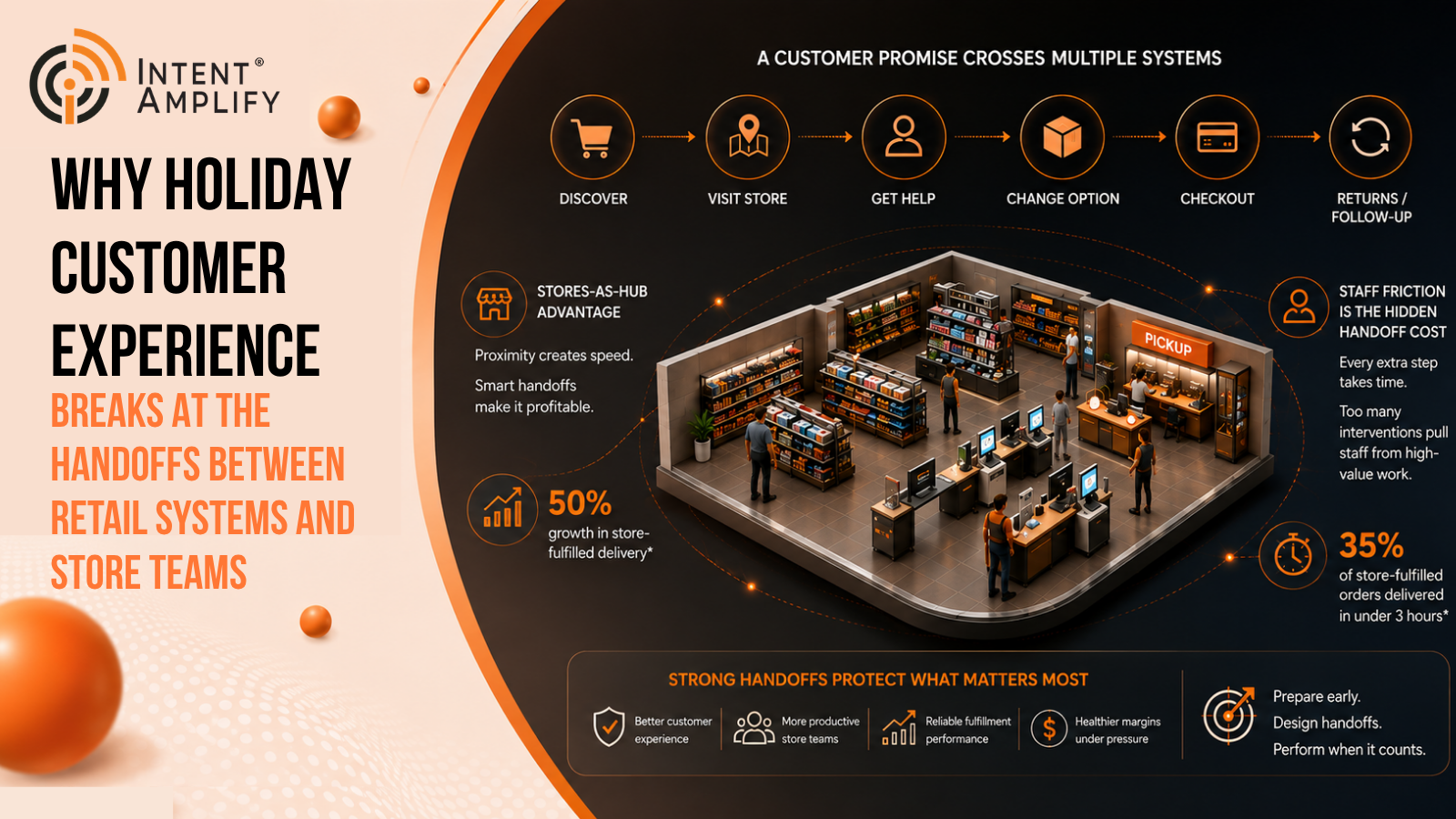
Observation: A Customer Promise Crosses Multiple Operating Systems
The customer sees one promise. The retailer often manages that promise through several systems and teams. Friction appears when the transition between them is ambiguous.
Consider product availability. A digital interface may show an item as available, but the store team needs confidence that the product is physically accessible and saleable. If it cannot be found, the associate needs a clear recovery path: locate an alternative, check another location, offer a substitute, or reset the expectation. Without that path, the customer experiences the gap between data and operating reality.
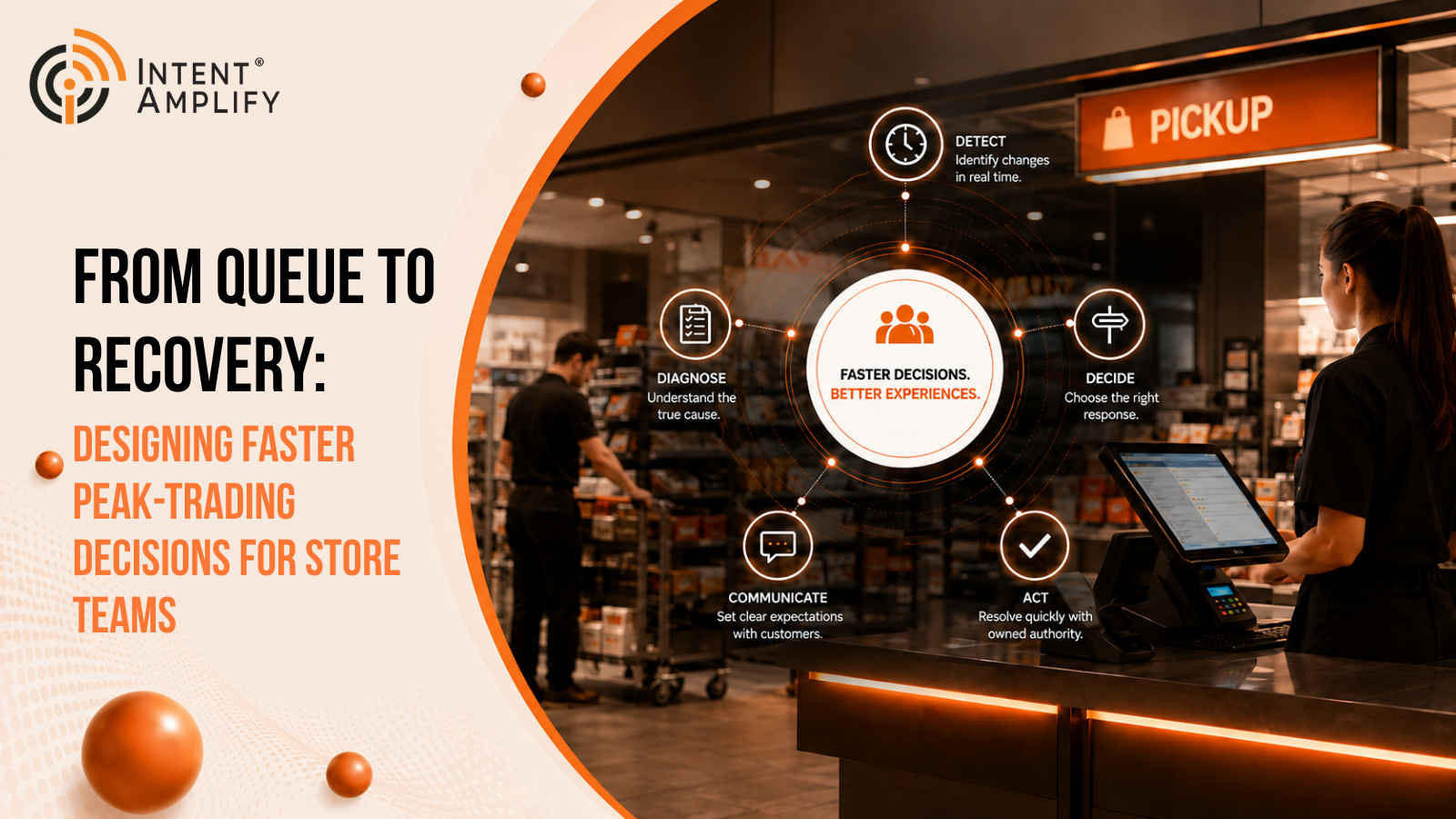
The same pattern appears in pickup. A digital promise depends on accurate inventory, successful picking, staging, customer communication, arrival recognition, and a staffed handoff. Deloitte’s omnichannel research supports consistent execution across the post-purchase journey; the operating implication here is that pickup handoffs need clear ownership, evidence, and recovery paths (Deloitte, 2026c). The operational lesson is that the handoff itself needs design, ownership, and evidence.
Interpretation: Preparation Is the First Handoff Control
RETHINK Retail places unusual emphasis on acting in August and early September. That timing matters because preparation changes the type of evidence available to leaders. Before the surge, teams can test. During the surge, they mostly react.
A useful stress test follows one journey end to end. It asks what the customer expects, which systems support that expectation, what the employee sees, who owns each transition, what happens when the expected condition is false, and how recovery is measured. The objective is not to document every possible exception. It is to expose the recurring points where information, authority, capacity, or ownership can break.
For example, a retailer testing store-fulfilled delivery might simulate a sudden increase in online orders while store traffic is also high. The team can then observe whether inventory confidence holds, whether pick work displaces selling or service, whether staging space is sufficient, and whether the fulfillment promise remains economically sensible. That is stronger preparation than a generic readiness checklist because it connects customer demand to operating consequences.
Implication: Stores-as-Hubs Increase the Value of Handoff Quality
RETHINK Retail identifies stores as fulfillment hubs as a structural advantage. The source highlights strong growth in store-fulfilled delivery. Walmart’s FY26 Q4 earnings presentation independently reported approximately 50% growth in store-fulfilled delivery, while expedited deliveries under three hours represented about 35% of store-fulfilled orders (Walmart, 2026). Because this figure appears in a sponsored research source, it should be treated as sponsored evidence rather than a neutral market benchmark. Its strategic value lies in the mechanism: proximity can create advantage, but only when the handoff between digital demand and store execution remains controlled.
Deloitte’s 2026 work on store modernization similarly describes stores as important fulfillment and service assets rather than purely transactional locations (Deloitte, 2026b). That shift increases the number of operating handoffs inside the store. A store team may serve an in-person shopper, pick an online order, manage returns, support self-checkout, and handle exceptions within the same hour.
The important question is therefore not whether the store can perform more roles. It is whether those roles have explicit priority rules, reliable information, and capacity boundaries. A store-as-hub model that accelerates delivery while creating chronic in-store delay is not automatically an advantage. The economics and the experience have to be evaluated together.
Implication: Staff Friction Is the Hidden Handoff Cost
Customer experience deteriorates when employees become the manual integration layer between systems. Every unnecessary login, repeated search, duplicate update, approval wait, and low-value alert consumes attention.
RETHINK Retail’s staff-experience pillar is therefore operational, not cosmetic. The source highlights age verification as a major self-checkout intervention point. Diebold Nixdorf states that age verification can account for up to 22% of interventions by a shop employee; the percentage should therefore be treated as sponsored-source evidence. The percentage should be interpreted within the disclosed sponsored context, but the underlying mechanism is useful: even a highly automated checkout flow can depend on human recovery when rules or customer circumstances require judgment.
Deloitte’s June 2026 workforce research reaches a related conclusion. Store labor modernization creates value when work is redesigned and administrative burden is reduced, not merely when new scheduling or workforce technology is installed (Deloitte, 2026d). That means leaders should examine where employees lose time because a handoff is poorly designed.
A practical staff-journey review asks: Which information must the colleague find? Which system is authoritative? Which decisions can be made locally? Which exceptions require a manager? Which repeated interventions could be simplified? Which alerts actually change an action? These questions make staff friction observable without turning it into an employee-performance judgment.
Implication: Intentional Automation Should Close Handoffs
RETHINK Retail’s fourth pillar is intentional automation. The aim is not maximum automation. It is to automate predictable, evidence-rich work so people remain available for higher-value interaction and judgment.
Deloitte’s connected-store analysis describes a progression toward more integrated and intelligent store operations (Deloitte, 2026a). Its 2026 work on AI and frontline capacity adds an important qualification: capacity released by technology does not automatically become value; the work must be deliberately redesigned so that time is reinvested in useful outcomes (Deloitte, 2026e).
This is especially important at handoffs. An automated alert that tells an associate an order is at risk is useful only if the employee can take a clear next action. An inventory recommendation is useful only if the evidence is trusted. A self-service flow is useful only if exception handling is fast and staffed appropriately. Technology that creates a second workflow for employees can increase rather than reduce friction.
A Peak Handoff Model
For one priority journey, leaders can map seven elements:
1. Customer promise - what the shopper believes will happen.
2. Authoritative evidence - the information that governs the next action.
3. Store capacity - the labor, device, inventory, and space conditions required.
4. Employee action - what the frontline team can do without unnecessary escalation.
5. Exception boundary - the condition that changes the normal response.
6. Customer communication - the expectation that should be reset when the operating state changes.
7. Read-back - the evidence that shows whether the recovery improved the outcome.
This model is deliberately narrow. It does not require a retailer to redesign the enterprise. It identifies the transitions customers can feel and makes them testable.
Analyst Interpretation
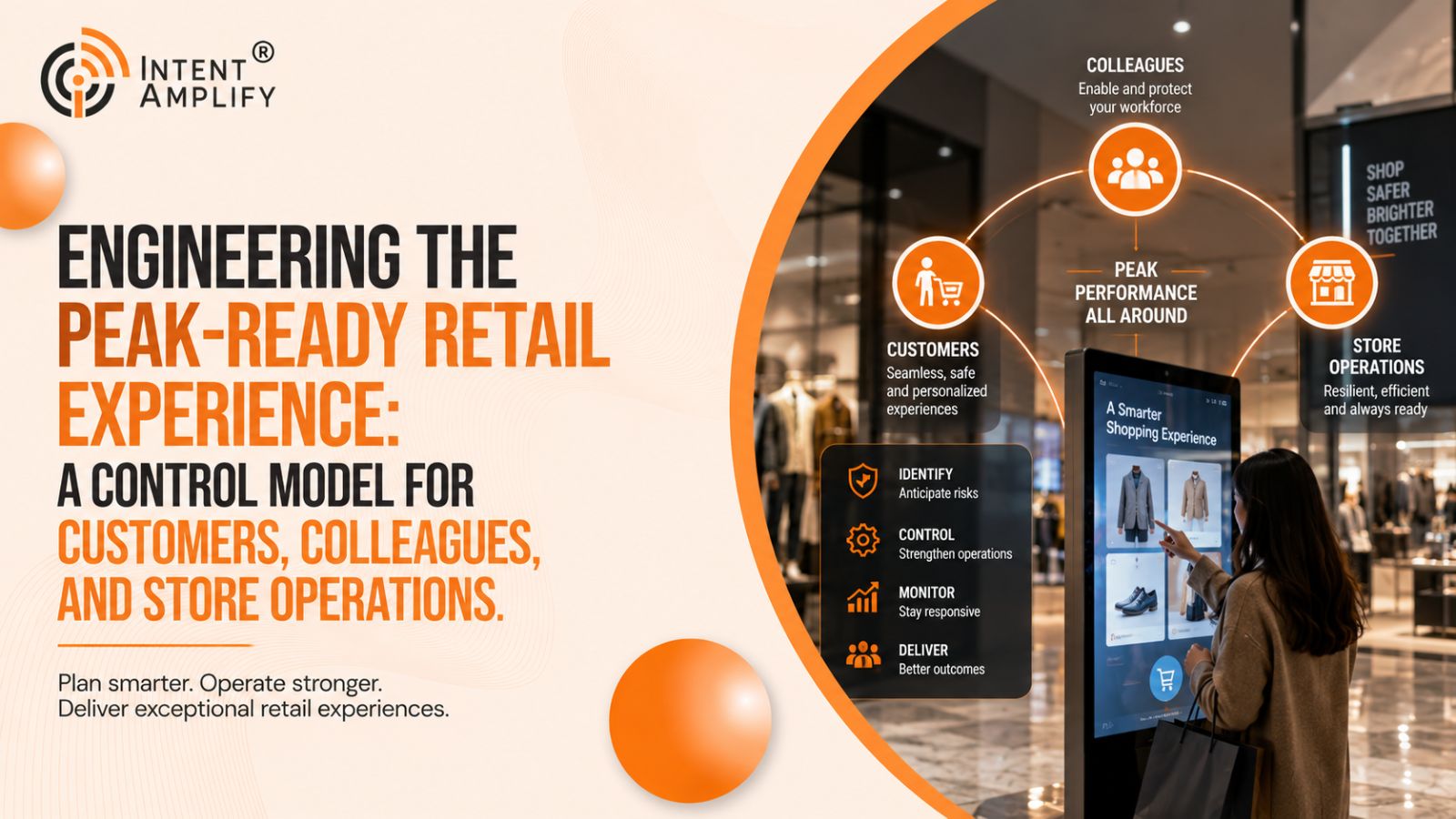
The most important peak-season risk is often not the visible touchpoint but the weak operating handoff behind it. Preparation reduces the chance that those handoffs fail for the first time under live demand. Stores-as-hubs increase the economic importance of reliable cross-channel execution. Staff-experience protection reduces the amount of manual coordination needed to keep the journey moving. Intentional automation can remove predictable handoff work while preserving human judgment for exceptions.
The evidence does not support a universal claim that any single technology or process change guarantees margin or experience improvement. It does support a stronger operating principle: retailers can reduce peak fragility by making critical handoffs explicit, testing them before demand peaks, and measuring the result after intervention.
References
-
RETHINK Retail and Diebold Nixdorf (2026) The Holiday Season Playbook: Delivering Exceptional Customer and Staff Experience During Peak Trading. Available at: https://intentamplify.com/landing-page/report/the-holiday-season-playbook-delivering-exceptional-customer-and-staff-experience-during-peak-trading/
-
Diebold Nixdorf (2024) Diebold Nixdorf Sets Out to Combat Shrink in Retail with New AI-powered Offering. Available at: https://s27.q4cdn.com/808990265/files/doc_news/Diebold-Nixdorf-Sets-Out-to-Combat-Shrink-in-Retail-with-New-AI-powered-Offering-2024.pdf
-
Walmart Inc. (2026) FY26 Q4 Earnings Presentation. Available at: https://fortune.com/company-assets/1854/quartr/slides-ad2ae-2026-02-19-12-36-02.pdf.
-
National Retail Federation (2026) NRF Forecasts 4.4% Annual Retail Sales Growth with New Economic Model. Available at: https://nrf.com/media-center/press-releases/nrf-forecasts-4-4-annual-retail-sales-growth-with-new-economic-model
-
Deloitte (2026a) The Connected Store. Available at: https://www.deloitte.com/us/en/Industries/consumer/articles/connected-store-retail-digital-transformation.html
-
Deloitte (2026b) Future-proof Your Stores. Available at: https://www.deloitte.com/content/dam/assets-zone3/us/en/docs/industries/consumer/2026/future-proof-your-stores-2026.pdf
-
Deloitte (2026c) Omnichannel Post-Purchase Experience. Available at: https://www.deloitte.com/us/en/industries/consumer/articles/omnichannel-post-purchase-strategy.html
-
Deloitte (2026d) Store Labor Modernization and Workforce Management. Available at: https://www.deloitte.com/us/en/industries/consumer/articles/retail-labor-optimization-workforce-management.html
-
Deloitte (2026e) AI Is Freeing Up Frontline Retail Capacity. Available at: https://www.deloitte.com/ca/en/Industries/consumer/perspectives/frontline-retail-ai-capacity-value.html